




Abstract
Background:
High levels of ambient noise are associated with sleep disturbance, the risk of delirium, and exacerbation of cognitive dysfunction. We have reported how to digitize the noise levels of high-flow nasal cannula (HFNC) systems at the AARC meetings and in the article in 2015 to 2017. However, there are still some other HFNC systems, which we have not been yet reported on comparison. Digitizing the noise levels of the Venturi-effect-typed HFNC (HFNC/Venturi) with or without a filter, and a muffler, and the turbine-type HFNC (HFNC/turbine).
Methods:
The noise levels were measured the HFNC systems while alternating the total flow and FIO2. We measured the noise level of the HFNC/Venturi (MaxVenturi; Maxtec) with a filter (Maxtec) and a muffler (Maxtec) while alternating each parameter and settings. The noise level of the HFNC/turbine (AIRVO2, Fisher & Paykel) was measured.
Results:
Without a filter and a muffler on the HFNC/Venturi, the noise level was high when the total flow and FIO2 increased. It became 60.2 dB when FIO2 was 0.4 with the total flow of 30 L/min. It became 74.1 dB when FIO2 was 0.9 with the total flow of 60 L/min. In the HFNC/turbine, the noise level was high when the total flow and FIO2 increased. It became 45.1 dB when FIO2 was 0.4 with the total flow of 30 L/min. It became 69.7dB when FIO2 was 0.9 with the total flow of 60 L/min. In contrast, in the HFNC/Venturi with a filter and a muffler, the noise level increased in proportion to the total flow. However, the noise level remained the same even when FIO2 increased, while the total flow was constant. It became 50.9 dB when FIO2 was 0.4 with the total flow of 30 L/min, 51.2 dB when FIO2 was 0.9 with the total flow of 30 L/min, 57.4 dB when FIO2 was 0.4 with the total flow of 50 L/min, and 57.5 dB when FIO2 was 0.9 with the total flow of 50 L/min. The noise level of the HFNC/Venturi with a filter and a muffler became lower than that of HFNC/turbine when FIO2 was 0.9 in all the flow parameters. Our study was based on keeping noise levels lower than 59 dB for nighttime and 63 dB for daytime in hospital rooms, which are the noise levels reported to prevent sleep.
Conclusions:
The noise level of the HFNC/Venturi with a filter and a muffler significantly decreased in comparison with the HFNC/Venturi without a filter and a muffler, and when with only a filter attached. The noise level of the HFNC/Venturi with a filter and a muffler was significantly different from that of the HFNC/turbine.
Sponsored research: None.
Figure. Comparison of noise levels for the total flow and the oxygen concentration of the MaxVenturiTM (no filters and mufflers, with a filter, with a filter and a muffler) and AIRVO2TM. We recommend the HFNC/Venturi with a filter and a muffler as a choice if we have to use it all day* P< .001 versus the no filter and muffler, and filter, respectively. The significance of measured values was analyzed by Wilcoxon signed-rank test. Mean±standard deviation (n=10).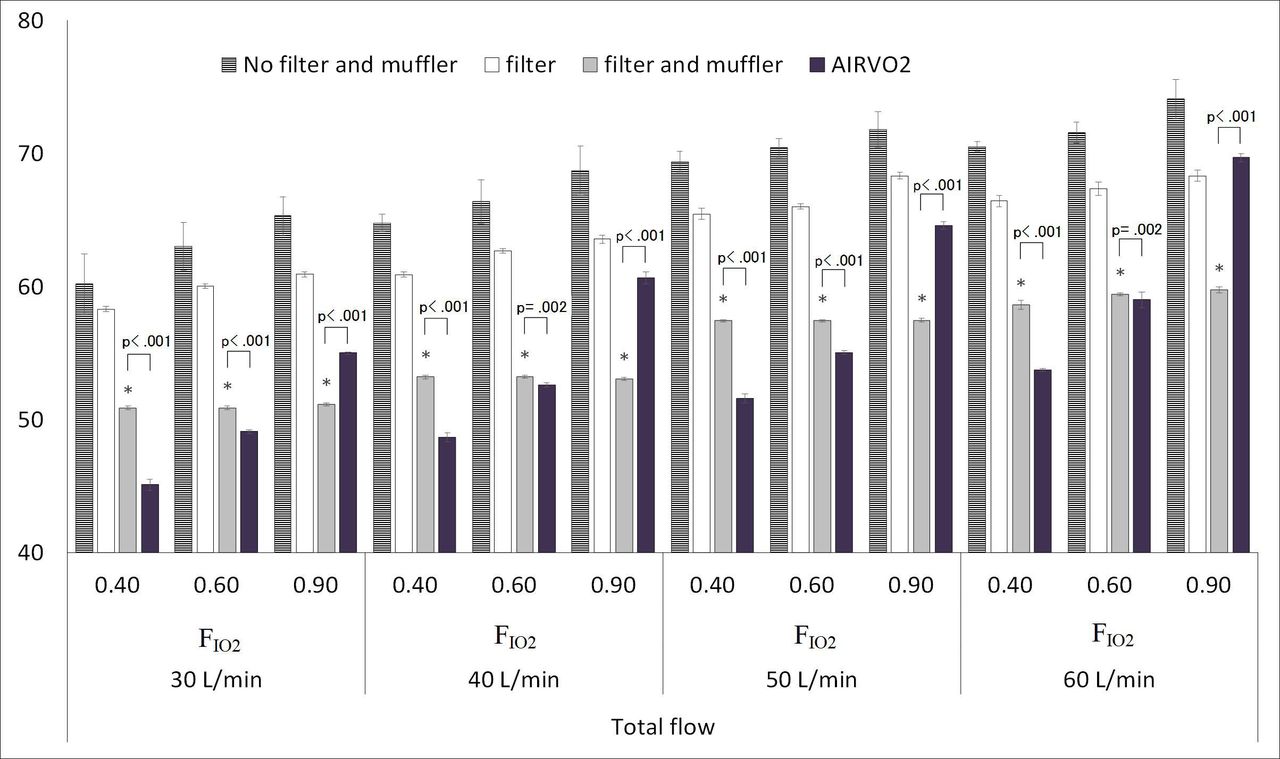
Get full access to this article
View all access options for this article.