




Abstract
Background:
Initial PEEP is difficult to set in ventilated obese patients (body mass index [BMI] ≥30 kg/m2). As obese patients have decreased chest wall compliance, there is potential for not receiving adequate PEEP. Currently, esophageal balloons, an invasive and costly device, can be used to determine optimal PEEP in mechanically ventilated patients. In the absence of these measurements, our clinical practice is to set initial PEEP as BMI/4 in cm H2O. However, to our knowledge, no studies have suggested the use of BMI or any formula for accurately setting initial PEEP at the bedside. Determine the relation between BMI and optimal PEEP and calculated PEEP = BMI/4 as cm H2O. Optimal PEEP is defined as end-expiratory transpulmonary pressure (Ptp exp) = 0 cm H2O. Ptp exP= (PEEP— Pes, where Pes is esophageal pressure at end-expiration).
Methods:
We conducted a retrospective chart review on obese patients ≥18 y of age who were admitted to the ICU and mechanically ventilated for ≥48 h during July 2015-July 2017 in whom Pes was monitored and Ptp exp was calculated. Two linear regression models were used to examine the relationship between BMI and optimal PEEP determined by Ptp exp. A single variable model included BMI/4 and a multivariable model included age. IRB approval was obtained for this review (17-73MR).
Results:
A total of 53 patients met inclusion criteria. Patients were predominantly white non-Hispanic (81.1%), with mean age of 61 y and BMI at initial balloon placement of 43.7 kg/m2. The single variable regression model suggested that optimal PEEP determined by Ptp exp increased 1 cm H2O per 1kg/m2 increase in BMI/4 (β=1.0, P=0.0007, Adj-R2=0.19). The multivariable regression model including age suggested that optimal PEEP increased 1 unit per 0.96kg/m2 increase in BMI/4 (β=0.96, P=0.0008, Adj-R2=0.24).
Conclusions:
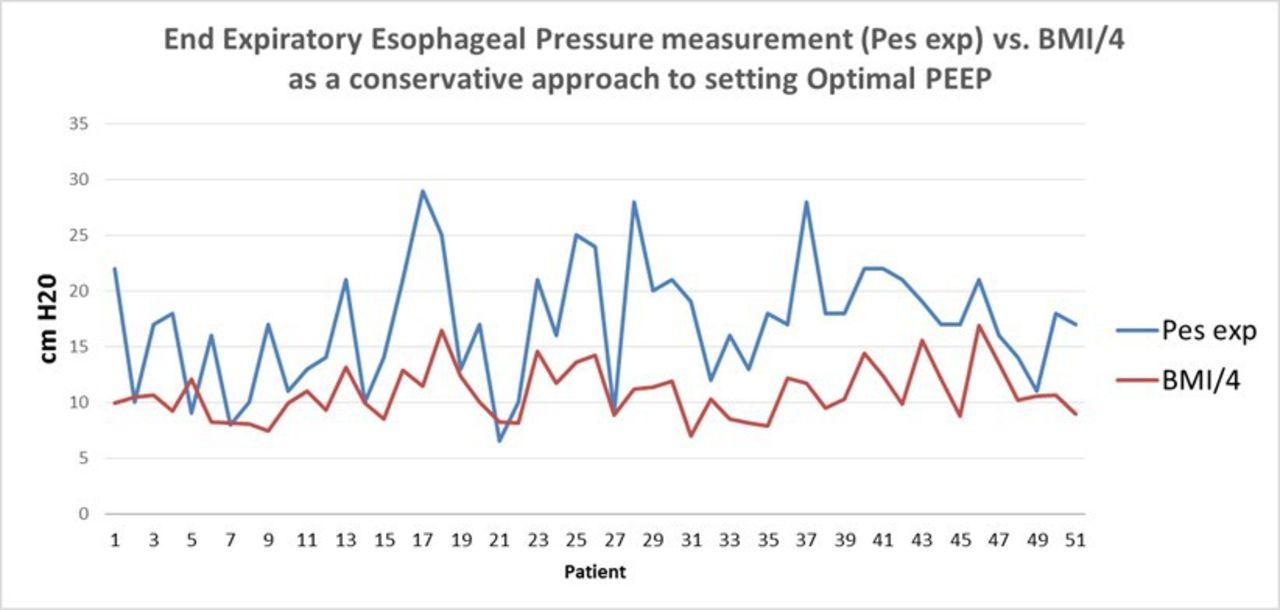
There is a relationship between optimal PEEP determined by Ptp exp and BMI. Furthermore, PEEP, estimated as BMI/4, is consistently less than PEEP determined by Ptp exp and may be used as a conservative guide to set initial PEEP in obese patients without esophageal manometry. However, given low model predictability, further study inclusive of a larger patient population is warranted.
Get full access to this article
View all access options for this article.