






Abstract
Empirical studies assessing alcohol's harm to others very often rely on population survey data. This study addresses some of the problems and challenges in using survey data for this purpose. Such problems include the limited capacity of population surveys in identifying infrequent harm and long-term consequences of drinking. Moreover, the drinker may report the alcohol-related harm or the person being harmed may report the damage. However, irrespective of who reports the harm, causal attribution to drinking is problematic. Challenges for future population surveys to address alcohol's harm to others include the need for improved models and understanding of complex mechanisms to guide empirical studies within the broad range of harm. Study designs other than cross-sectional surveys, such as longitudinal study designs and combinations of population surveys and other data sources, are likely to overcome some of the identified problems in current population surveys of alcohol's harm to others.
Background
While alcohol's harm to the health of the drinker is well described, much less is known about the social harm to drinkers and the negative effects on people other than the drinker (ie, alcohol's harm to others).1,2 Indeed, some particular areas of alcohol's harm to others have been studied quite extensively, including fetal alcohol syndrome and other consequences of prenatal alcohol exposure,3,4 drunk driving and alcohol-related traffic accidents, 5 and alcohol-related violence.6,7 However, the broad range of other health and social harms that people may experience as a consequence of others’ drinking seems to have been less extensively examined, and the total burden to the society because of drinking is still incomplete. In recent years, a renewed and growing interest in measuring the extent and types of alcohol's harm to others (also termed “externalities,” “collateral damage,” or “second-hand effects of alcohol use”) has developed.18–13 While a comprehensive review of the literature on alcohol's harm to others is still warranted, 13 there is an impression that many of the studies in this area are based on cross-sectional population surveys. 13
In this study, the articles that were retrieved from a search in MEDLINE (June 2015, applying the search terms “alcohol” and “harm to others”) serve as examples of literature on alcohol's harm to others. Out of 34 journal articles that solely or in part addressed alcohol's harm to others, two-thirds were published during the past 5 years (since 2010), which may indicate a renewed interest. Moreover, the majority of empirical studies (18 of 25) employed cross-sectional general population survey data to estimate the prevalence of alcohol's harm to others. The remaining articles were reviews, conceptual framework papers, commentaries, or the like,1,2,14–20 or they were empirical studies, employing other research designs and methods or partly addressing issues other than the prevalence of harm.21–27 Notably, this fairly simple literature search does not provide a complete retrieval of relevant publications on alcohol's harm to others, but it may be suggestive of some characteristics of this literature. Thus, it seems likely that cross-sectional survey data from the general population are frequently used to estimate the extent of various types of harm attributable to others’ drinking. While this approach is important, at least as a first step to illustrate that such harm is commonly experienced, this approach also represents a number of challenges and inherent problems. Using the selected cross-sectional survey studies as examples of the epidemiological literature on alcohol's harm to others, this study addresses some of these problems and suggests additional research designs, and methods to further enhance our understanding of the extent and distribution of alcohol's harm to others.
Use of Cross-Sectional Survey Data in Estimating Alcohol's Harm to Others
Whose perspective and what kind of harm?
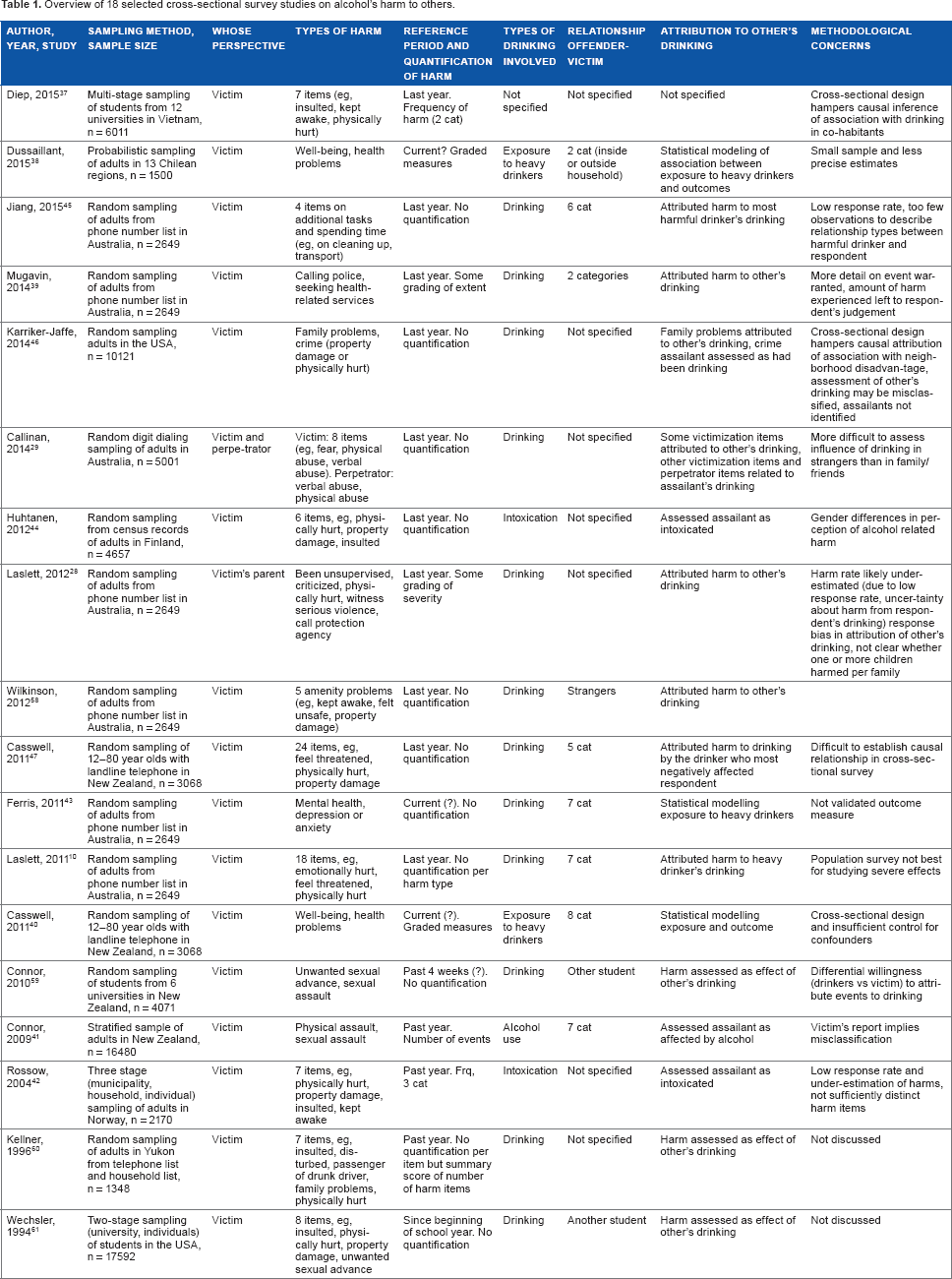
While alcohol's harm to others inherently involves at least two parties (the drinker and the person(s)/company/community being harmed), cross-sectional survey data typically reflect the perspective of only one of these parties, most often the adult victim of others’ actions. Thus, among 18 cross-sectional population surveys identified in the recent MEDLINE search and presented in Table 1, 16 studies investigated harm from others’ drinking as experienced and reported by the victims. One study investigated harm to children as reported by their parent, 28 and in one study, the respondents were asked to report on harm from their own drinking, in addition to the harm they had experienced due to others’ drinking. 29 As noted in later sections, a one-sided perspective on alcohol's harm to others carries a range of potential problems.
Overview of 18 selected cross-sectional survey studies on alcohol's harm to others.
Surveys in this area appear to have been mostly conducted in the general adult population, or they were student samples that illustrated harm to adult persons. Thus, harm to children is often not addressed in these studies, although there are exceptions, for instance, parents reporting harm to their children from others’ drinking 28 and adults reporting retrospectively on both exposure to alcoholic parents and harm during their childhood. 30 Studies of psychosocial adjustment in adult children of alcoholics31,32 also rely on retrospective assessments of exposure to parental heavy drinking; however, these studies often address concurrent problems and possible long-term effects of parents’ drinking behavior. Moreover, a broad range of harm from someone's drinking is not (solely) experienced by individual persons, for instance, harm to work places (eg, lost productivity) or to public properties (eg, vandalism). These types of harm are difficult to capture with this study design, and are therefore easily neglected in such studies.
Another problem with the victim's perspective is that the respondent is asked either to assess whether an assailant who had been drinking committed the harm or to attribute the harm as a consequence of someone's drinking. Both types of assessments are frequently used in surveys (Table 1), and both carry a significant risk of bias. In many cases, victims may not know whether the assailant had been drinking or not. 33 While the respondent may be better informed when the assailant is well known (eg, a household member), judgements about whether the assailant had been drinking may be quite difficult when the assailant is a stranger or less well known. 29 This makes judgements about causal attribution even more difficult and less reliable.
Furthermore, the perpetrator and the victim's perspectives may not deviate only with respect to judgements of drinking and attribution of harm to drinking but also with respect to what is perceived as harmful 1 and the respondent's willingness to report harm. Asking for both perpetrator and victim experiences within the same survey sample, Callinan and Room 29 found that the proportions of those who reported harm from others’ drinking (verbal or physical aggression) were much higher than the proportions of those who reported having committed alcohol-related harm. Thus, it seems that at least some instances of alcohol-related harm are less likely to be perceived and reported as harm by the perpetrator compared to the victim. This may reflect unawareness of consequences of one's own drinking or an unwillingness to report harm (or both), suggesting that by using the perpetrator's perspective, the prevalence of harm is likely to be underestimated.
The types of harm typically examined in cross-sectional population surveys are in the form of events (eg, been assaulted) or conditions (eg, financial troubles). 1 These instances of harm often include “social victimization,” 34 such as having been insulted, disturbed by loud people, involved in a quarrel, lost friendship, experienced family problems, had property vandalized, been assaulted (or pushed or hit), and had financial troubles. These types of harm have been examined in the studies summarized in Table 1, and they have also been reported in previous empirical studies34,35 and reviews.1,16 Surveys of social harm, as reported by the drinker, also often include several of these types of harm (eg, fights, quarrels, family, and friendship problems). 16 They may also include other types of harm (or increasing costs) to a company or to society, such as lost working time or poor work performance and being arrested by (or having been in trouble with) the police. 16
Thus, survey approaches seem to cover harm to others according to all of the main types of relationships (ie, the drinker's relationship with family/household, with workplace, and with friends and strangers). 1 It seems, however, that harm to the workplace is more likely to be covered when applying the perpetrator's perspective. Obviously, surveys tend to address harm that is quite frequently experienced by victims. These instances of harm tend to be less severe and they may, in many cases, be characterized as a nuisance (eg, kept awake at night). Correspondingly, highly severe forms of harm with long-lasting effects on the individual and carrying significant costs to society (eg, severe physical injuries and severe child abuse and neglect) are less frequently experienced and they are rarely covered in surveys. This is not to say that the issue of severity of harm has been neglected in survey studies. Indeed, several literature reviews and empirical studies have noted the large variability in the severity of these instances of harm and, in part, have offered approaches to address this aspect of harm.1,10,16,34,36 Yet, it may also be noted that certain items used to capture harm from others’ drinking also include events that do not necessarily imply harm to any person or belonging other than the drinker. For instance, being a passenger with a driver who had drunk too much 16 will most likely not lead to any harm to the passenger.
Another problem is that several harm measures often used within this survey tradition are rather unspecific and vague with respect to the nature, severity, and extent/amount of harm. Examples of harm measures of this kind include “family problems” and “financial troubles.” As noted by Greenfield et al. 12 , family problems may be of any severity and duration, may affect few or many children, and may or may not engage social agencies. Similarly, financial troubles may also be of any duration and severity, and they may affect few or many people in a household or family. Other examples of vague harm items used in surveys include “child neglect” and “emotional abuse.”
How is harm quantified?
Many survey studies have applied “the last year”/“the past 12 months” as a reference period for reporting harm (Table 1). Within the survey tradition, many types of harm from others’ drinking are damaging events, such as disturbances, property damage, insults, quarrels, and assault (Table 1). In some studies, the frequency (or some other graded measure) of such harmful events is reported,9,37–41 allowing for – but not necessarily leading to – the calculation of an (crude) incidence rate. More common, however, is to report the number of persons (proportion) being harmed in a year (Table 1). As some persons experience the same type of harm several times a year,40,41 the prevalence figures are likely to underestimate the amount of harmful events.
Some types of harm from others’ drinking are not events, but rather are lasting states, for instance, poor mental health, family troubles, or financial problems.9,16,42 Some quantification of these instances of harm at the individual level is seen in studies applying scales for measuring well-being or mental health,9,42 whereas there seems to be no tradition in surveys for applying quantifiable measures of other types of nonevent harm, such as family troubles or financial problems.
How is harm attributed to others’ drinking?
Survey studies employ various approaches to the attribution of harm to another person's drinking. Often the respondent (the drinker or the harmed person) is asked to assess whether the harm was caused by drinking (Table 1). Thus, the drinker is asked whether he/she caused the harm to someone else due to his/her own drinking. Correspondingly, the harmed !person is asked whether another person's drinking caused the experienced harm. The validity of such causal attribution is obviously problematic and more so when victims report harm from strangers. Consequently, the harm estimate is likely biased.
Another survey tradition is to ask whether the assailant had been drinking/was intoxicated/was a heavy drinker (Table 1). In studies applying such alcohol-related harm measures, the author(s) often make the implicit assumption that the reported harm is attributable to drinking. For instance, the authors interpret harm by other persons who were intoxicated as social or negative “consequences from other people's drinking.”41,43 Such causal attribution may inflate estimates of harm caused by others’ drinking.
A third approach taken in survey studies is to ask respondents about the exposure to heavy drinkers and about harm victimization and then perform statistical modeling of these exposure and harm measures (Table 1). With this approach, adequate identification of – and control for – all relevant confounding factors is essential for inferring causality. In reality, however, such control is probably limited to the available covariates, such as sociodemographic characteristics, 38 and may thus be insufficient for drawing causal inferences, 9 and the estimate of harm attributable to others’ drinking is likely biased.
Further Limitations and Gaps
As noted earlier, several characteristics of cross-sectional surveys of alcohol's harm to others imply that many types of harm are not well covered (mainly, the more severe forms of harm) or they are imprecisely assessed and/or the estimates are biased. Further limitations that apply to cross-sectional studies have also been noted by previous authors (Table 1). These include low response rates, which are likely to cause a downward biased estimation of harm,28,41,44 and a lack of time ordering of exposure and outcome measures with a cross-sectional design, thereby hampering the inference of causality.37,45,46
Harm to a person due to another person's drinking is often interactional.1,16 Moreover, persons who drink more frequently and who drink more heavily per occasion compared to others are most at risk, both of causing – at least some types of – harm to others due to their own drinking2,6,47 and of experiencing harm from others’ drinking.10,12,36,41,43 This may suggest that these types of harm often occur in contexts where both the assailant and the victim have been drinking. In line with this, Cherpitel et al. 23 found that in two-thirds of violent injuries, either the assailant or the victim had been drinking, and in 39% of all injury cases, drinking by someone was seen as causal. In almost a third of the violent injuries, both the assailant and the victim had been drinking, and in these cases, causal attribution to someone's drinking occurred more often compared to cases where only one of the assailant or the victim had been drinking. This probably applies to a wider range of harm resulting from the social interaction between two or several intoxicated persons.
As population surveys generally interview one person per household or family (or other relevant social networks in this context), a simultaneous perspective of both the drinker and those harmed by his/her drinking is rarely seen. In 1985, Kaye Fillmore published a study on the extent and characteristics of social harm from others’ drinking, 34 and she concluded that the “results suggest the need for research which more boldly takes the interaction of perpetrator and victim into account in alcohol-related problems.” In recent years, while many studies have addressed the extent and characteristics of the social victimization of drinking, her conclusion still applies, and the need for better understanding of the social interaction that underlies alcohol's harm to others is still significant.
Another limitation to most survey studies of alcohol's harm to others pertains to the assessment of possible long-term effects of drinking and effects of long-term exposure. Indeed, when asking about the exposure to heavy drinkers and the experience of harm, as has been done in several studies,9,10,31,32,36,38 it is possible that long-term effects of exposure to heavy drinkers (eg, in childhood) are captured as part of the outcome measures, but they can hardly be disentangled from short-term effects. Similarly, it is possible that long-term exposure to a heavy drinker (eg, a spouse) has a stronger impact on harm outcomes than does the short-term exposure. However, this may prove difficult to examine with a cross-sectional survey design due to the reversed causality (ie, harm experience may affect length of exposure). Thus, cross-sectional survey studies seem more appropriate for capturing immediate and simple or direct effects, whereas long-term effects, effects of long-term exposure, indirect effects, and interaction effects probably are obtained more adequately by other study designs.
Finally, we may assume that observed correlations between exposure to someone else's drinking and risk of harm are moderated and mediated by various factors. Therefore, the use of theories regarding mechanisms of effect is crucial for identifying important confounding factors and for conducting adequate analyses of causal effects. However, theory-driven analyses of harm attributable to others’ drinking seem to be far between. For instance, in a systematic review of prospective studies, when examining the influence of parental drinking on their children, only a smaller fraction of the included studies had employed theories to guide the analyses and assessment of causality. 48
Challenges for Future Population Surveys Addressing Alcohol's Harm to Others
While the tradition of using surveys to assess social harm from (heavy) drinking and victimization from others’ drinking dates back to several decades,16,34 this research area may still be regarded as being in its infancy or early years, and thus, the potential for improvements seems considerable. The following are a few suggestions of possible directions for further development in this area.
As noted earlier, several harm measures that are often used are vague and imprecise in various respects. Within the cross-sectional survey tradition, the development of more precise measures of several types of harm is therefore important. Better precision is needed in several respects. The content of the term “harm” should be fairly specific. Thus, a broad concept (for instance, “family problems”) may be more precisely covered by specifically asking about the various types of problems and harm that subsume under this category (eg, physical fights, breakup of marriage, and poor economy). Furthermore, some quantification of the harm in question is needed to obtain better precision in the overall account of alcohol's harm to others. For some types of harm, frequency of harmful events (such as fights) may be useful as a quantity indicator, whereas for other types of harm (eg, poor economy), some quantitative indicator is better sought in terms of duration and severity. Development of better precision in harm measurement is likely to include multiple strategies, including qualitative methods 49 and stages of piloting and validation.
Study designs other than the conventional cross-sectional survey design may offer further potential for improving our assessment of the types, magnitude, and nature of alcohol's harm to others. First, survey studies that sample the involvement of both the assailant and the victim can provide relevant data from the perspectives of both the drinker and the harmed person and thereby can obtain more reliable measures on both exposure and harm. For example, samples of pairs of spouses are used in studies of drinking behavior and intimate partner violence, 50 and samples of parent–child dyads or entire households have been used in studies of parental drinking and adverse outcomes in children.51–53 These types of survey samples also allow for graded measurements of exposure and measuring of harm without asking about the attribution to drinking, which facilitates the assessment of risk function and provides another approach to the assessment of causality.
Second, among observational studies, prospective cohort studies offer the best capacity for the assessment of causality. This research design is particularly relevant for studies of long-term effects, the effects of long-term exposure, or effects other than immediate effects, for example, the effects of parental drinking on their offspring. A recent scoping review of prospective cohort studies of parental drinking 54 showed that there is a significantly rich body of literature in this regard; however, few studies addressed adverse outcomes in offspring other than alcohol or other substance use. Thus, there is clearly a need for further prospective cohort studies examining various possible adverse psychosocial consequences for children of parental drinking. When applying prospective cohort studies, there is also clearly a need for theory-driven analyses to enhance the capacity for causal inferences. 48
Relatedly, there is a potential for applying survey data that are linked with various types of register data. Thus, the exposure measure (eg, parents’ or intimate partner's drinking) can be obtained from the survey data, and the outcomes measure (eg, harm to children or spouse) can be obtained from registers. In particular, harm that is not frequently experienced, for instance, severe health-related harm, may be measured more adequately through the use of register data. Moreover, combining survey data on exposure and long-term follow-up data from registers on outcomes may be a valuable approach for the assessment of long-term harmful effects of others’ drinking. It is also likely that the good coverage of national registers reduces the attrition bias that is often expected in longitudinal studies. Britt af Klinteberg et al. 55 study provides one example of using this kind of research design to address the possible effects of paternal drinking on criminal behavior and mortality in the offspring.
Another example of using combined data to study the possible long-term effects of others’ drinking is Peter Nilsson's investigation of alcohol exposure during pregnancy and the harmful consequences for the offspring in adulthood. 56 This study applies a natural experiment of increased availability of alcohol for exposure measures and register data on education and welfare payments as outcome measures, and the combination of data sources and analytic strategies provides a good basis for inferring a causal effect of prenatal alcohol exposure on adverse outcomes in adulthood. Admittedly, this type of study design does not allow for the estimation of risk curves or alcohol-attributable fraction, but, on the other hand, it suggests that alcohol policies may have long-term consequences borne by individuals other than the drinkers.
The importance of demonstrating harmful effects on third persons and to inform policy-making in a health area is well demonstrated with respect to tobacco. The growing evidence of the effects of passive smoking, a form of harm to others, was indeed a key component in changing policies and practices to denormalize the tobacco use. 57 In the same way, we may assume that further assessments of how we can improve survey studies of alcohol's harm to others benefit not only the scientific understanding but also the policy's significance.
Author Contributions
Conceived the concepts: IR. Analyzed the data: IR. Wrote the first draft of the manuscript: IR. Agree with manuscript results and conclusions: IR. Developed the structure and arguments for the paper: IR. Made critical revisions and approved final version: IR. The author reviewed and approved of the final manuscript.
Footnotes
Acknowledgments
The author is grateful for the valuable comments and suggestions by anonymous reviewers on a previous version.