






Abstract
Substance use disorders are prevalent in Nigeria. The number of available specialist health providers is inadequate to fill the treatment gap. Interventions can be provided by nonspecialist health providers and have been found to be beneficial. However, attitudes toward substance misuse and misusers can impede the provision of this service. We aimed to determine attitudes of medical trainees toward substance use by utilizing a modified form of the Substance Abuse Attitude Scale (SAAS). Medical students (n = 200) had positive attitudes toward individuals who misuse psychoactive substances. The medial students, however, preferred treatment to be offered by trained specialists and held restrictive views regarding cannabis and alcohol use. More positive attitudes were expressed by participants who were male or had a lifetime history of psychoactive substance use. The role of personal and family-related psychoactive substance use factors are probably associated with attitudinal responses and would require further exploration.
Introduction
Psychoactive substance use and misuse is common in Nigeria. 1 The majority of individuals who require help in managing their substance use problem do not get access to effective interventions. 2 A common barrier to the availability of effective interventions is the attitude of medical professionals toward individuals who misuse psychoactive substances.3–5
Individuals with substance use problems frequently report being stigmatized. In fact, those with comorbid mental health disorders report a greater degree of discrimination compared with those with mental illness alone. 6
A previous study among medical students in Nigeria showed that a large proportion were intolerant of substance users. 3 Furthermore, attitudes toward individuals with substance use problems have been showed to be more negative as contact with patients increase. 7 A lack of adequate education and skills training has been identified as contributory to poor attitudes toward individuals who misuse psychoactive substance.8,9 Common features from earlier studies show that medical trainees subjectively rate their training as adequate, when the objective evidence was contrary. 10 In a recent study, 11 appropriate training was shown to improve attitudes.
Nigeria ranks as one of the highest worldwide in terms of substance misuse, yet there is a dearth of treatment centers as well as a lack of requisite funding for the few facilities available. 12 While alcohol and nicotine are considered licit substances and may be freely used and traded, cannabis is regarded as illicit under Nigerian law, with the use and sale of the substance regarded as a criminal offence. Medical practitioners in general medical settings can be trained to provide brief and effective intervention strategies for individuals with substance use disorders. Against this backdrop, determining the attitudes of medical trainees toward substance use disorders can help guide the development of appropriate training packages. By way of improving on a previous study conducted in Nigeria, 3 the current study aimed to determine not only the attitudes of medical students undertaking a clinical posting in psychiatry toward substance use and individuals who misuse substances, but we also sought to identify the relationship between the substance use patterns of the participating medical students and their attitudes toward substance misuse.
Methods
Participants and Setting
Fifth-year medical students of the Igbinedion University Okada who had completed their 10-week clerkship in psychiatry at the Federal Neuropsychiatric Hospital, Benin City, were invited to participate in the study. Two hundred medical students participated in the study out of the 210 students that we approached, for a 95.24% participation rate. In Nigeria, the undergraduate medical program spans a 6-year period: 3 years of preclinical training and another 3 years of clinical training. Self administration of a questionnaire incorporating a modified Substance Abuse Attitude Scale 13 was conducted in a class setting.
Students also completed a sociodemographic questionnaire capturing data such as age, gender, and history of psychoactive substance use by the participants as well as by their parents.
Questionnaires
Substance use was rated on a Likert scale of never, rarely (defined as fewer than 1 occasion in 6 months), occasionally (defined as up to 4 occasions per month), and frequently (defined as more than 4 occasions per month).
The Substance Abuse Attitude Scale 13 is a 50-item self-administered questionnaire with each question answered on a 5-point Likert scale format ranging from strongly agree, which was rated as 1; agree (2) or neutral, which was rated 3; to disagree (4) and strongly disagree, which was rated 5. Higher scores on the modified SAAS indicate more positive attitudes toward substance misuse and misusers. The original 50-item SAAS has 5 subscales, viz, permissiveness, treatment interventions, nonstereotypes, treatment optimism, and nonmoralism. These subscales have been shown to have good validity and reliability (scores ranging from 0.63 to 0.77). 13 The factor structure was confirmed by a later study. 14
We pilot tested the SAAS and the sociodemographic questionnaire among 20 students who were excluded from the main study. A review of responses enabled us to modify the phrasing, wording, and length of the questionnaires. For the purpose of this study, a modified 32-item format was used. Certain statements were considered as culture-biased or highly correlated. Under the subscale permissiveness, the statements “cannabis use can be healthy experimentation” and “tobacco smoking should be allowed in high schools” were considered too sensitive in our culture and were removed. The statement “persons convicted for sale of illicit drugs should not be eligible for parole” was also removed because the parole system is not utilized in the jurisdiction where the study was carried out. Under the subscale treatment interventions, the statement “paraprofessional counselors can provide effective treatment for alcohol and other drug misusers” was modified, with the word paraprofessionals deleted, as this term is unfamiliar in our environment. For the subscale nonmoralism, the statement “the laws governing the use of cannabis and heroin should be the same” was removed, as both drugs are considered by the country's laws to be illegal and attract the same punishment for use or trafficking. Also the statement “clergymen should not drink in public” was deleted, because aside from all the respondents in the pilot study endorsing the statement, it was considered too one-directional to elicit a range of opinions from students in this environment because clergymen are expected in this culture to abstain both publicly and in private from the use of alcohol. For the subscale on nonstereotypes, the statement “anybody who is clean shaven with short hair probably does not use illegal drugs” was not included because it was too leading as a statement and a contrasting description is not suggestive of illegal drug use in Nigeria. Also, the statement “people who dress in hippy style clothing probably use psychedelic drugs” was removed because a pilot test showed that participants were unfamiliar with the term “hippy style clothing.” No laws currently exist for legally committing an individual to treatment in Nigeria; thus, we did not include the statement “chronic alcohol dependent people who refuse treatment should be legally committed to long term care.”
The modified 32-item SAAS was found overall to have excellent reliability, with a Cronbach alpha value of 0.76. When the reliability statistics for the subscales according to Chappel's 13 5-factor model were computed, 2 subscales, permissiveness and treatment optimisim had low to moderate reliability (0.4 and 0.32, respectively) compared with the original scale. However, the other subscales, treatment interventions (0.503), nonstereotypes (0.737) and nonmoralism (0.50) showed moderate to strong reliability scores (0.5, 0.74, and 0.5, respectively). It was therefore best to present the modified SAAS as a composite scale.
Ethical Considerations
The Ethical Committee of the Federal Neuropsychiatric Hospital, Benin City, reviewed the study proposal and granted permission to carry out the study. The nature and purpose of the study were explained to all participants. Participants were also informed that participation was entirely voluntary and for those who took part no identifying information was collected. All data were handled confidentially and used only for the purpose of research.
Data Analysis
Data were analyzed using the Statistical Package for Social Sciences (SPSS), version 16 (iBM SPSS Inc., Chicago, IL). Descriptive statistics were used to summarize the data and the summaries were presented in tables. For the purpose of analysis, the responses strongly agree and agree were summarized as agree, while strongly disagree and disagree were summarized as disagree on the SAAS. Participants who reported frequent or occasional substance use were recoded as significant lifetime use present, while responses of rare or never substance use were recoded as significant lifetime use absent. Comparison of categorical and continuous variables were performed using the chi-square test and
Results
Sociodemographic Characteristics
Participants’ ages ranged between 21 and 32 years. Their mean age (SD) was 24.12 (2.45) years. The average (SD) age of male participants was 24.65 (2.58), older than their female colleagues, whose average (SD) age was 23.47 (2.12). This difference was statistically significant (
Patterns of Psychoactive Substance use
Self-reported frequency of use of psychoactive substances in the past year showed that the medical students studied reported frequently using alcohol (7.0%), compared with a lower proportion who reported frequently using nicotine (4.0%) and cannabis (2.5%), respectively (Table 1). A majority of participants reported a family history of alcohol use (66.0%), compared with about a third (31.5%) reporting a family history of nicotine use and just over a tenth (12.0%) reporting a family history of cannabis use. Personal use of alcohol was significantly associated with a family history of alcohol use (
Sociodemographic characteristics and substance use patterns of participants.

Attitudes toward Substance Abuse
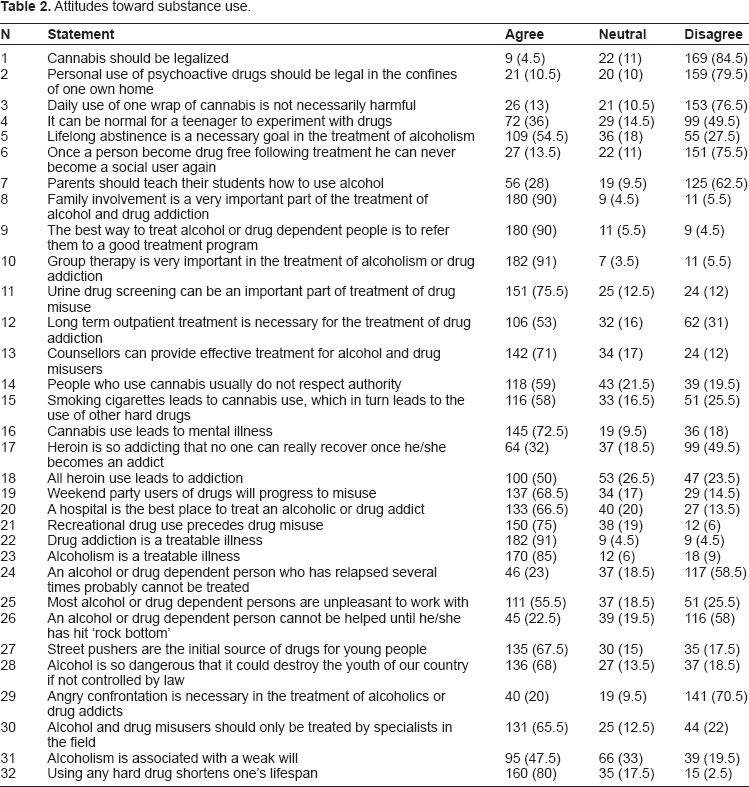
A majority (84.5%) of the students did not want cannabis legalized and most disagreed (79.5%) that use of psychoactive substances was legal in the confines of one's own home. Just over a third (36%) viewed teenage experimentation as normal, while over half (54.5%) endorsed lifelong abstinence as a treatment goal for alcohol treatment. Most (75.5%) would not advise social use of alcohol for an individual who has recently become abstinent and opposed the view (62.5%) that parents should teach their children how to use alcohol.
A high proportion of medical students (67.5%) believed that street pushers were the initial source for drugs for young persons, while most (68%) believed alcohol use to be dangerous requiring control by law. A majority (70.5%) opposed angry confrontation as a treatment modality for alcohol and other drug use problems. Most (65.5%) believed that only specialists should handle substance use problems and that substance use shortens one's lifespan (80%).
A vast majority (91%) believed that drug dependence was a treatable illness; similarly, most (85%) believed alcoholism was treatable. However, over half (58.5%) endorsed the view that individuals who relapse several times cannot be treated.
Nearly all participants (90%) were of the opinion that the family of an individual should be involved in drug treatment. A similar proportion believed that the best way to treat an individual with a substance use disorder is to refer them to a treatment program. Most (91%) also viewed group therapy as beneficial in the treatment of alcohol and drug dependence.
Over half (59%) believed individuals who use cannabis do not respect authority. A similar proportion (58%) believed cigarette use was the gateway to the use of cannabis use. Over two-thirds (72.5%) believed that cannabis use leads to mental illness. See Table 2.
Attitudes toward substance use.
Correlates of Overall Attitude scores
The overall mean score on the modified SAAS for the medical students was 86.18 (12.29). Male medical students had a higher mean attitudinal score compared with their female colleagues (87.17 vs. 85.18). This difference was, however, not statistically significant (
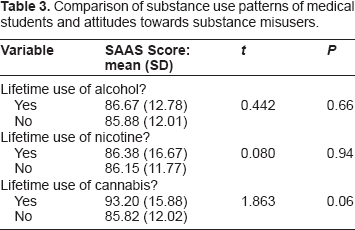
Participants with a significant lifetime history of alcohol use had more positive attitudes compared to those without a history of use (86.67 vs. 85.88). Similarly, students with a significant lifetime history of cannabis use expressed a more positive attitude on average toward substance misusers (93.20 vs. 85.82). Furthermore, a slightly higher mean attitude score was observed among participants with a positive and significant lifetime history of nicotine use (86.38 vs. 86.15). The observed differences across these groups were, however. not statistically significant (See Table 3).
Comparison of substance use patterns of medical students and attitudes towards substance misusers.
Discussion
This study found that the rates of lifetime use for alcohol and nicotine are similar to rates reported from an earlier study of substance use patterns among medical students in Nigeria. 15 Perhaps worthy of note is the sizable proportion of students who admitted to lifetime use of cannabis. Cannabis is commonly grown and processed in Nigeria, and national rates of use are the highest in Africa. It is cheap and readily available. We also observed that substance use among participants was significantly associated with family history of use for the corresponding psychoactive substance. We also observed that participants who use psychoactive substance had on average more positive attitudes toward individuals with substance use disorders compared with participants without a personal history of substance use. The tendency for males to use psychoactive substances more commonly than their female counterparts has also been reported from previous studies among these age groups. 16
Participants were least permissive toward cannabis use and misuse. Though debatable regarding a causal link, cannabis is frequently associated with violent or disruptive behavior and mental illness in Nigeria. 17 This view was probably reflected in the large proportion of students who positively endorsed the statement that cannabis use leads to disregard for authority. Perhaps attitudes toward cannabis are reflective of the association with mental illness and violent conduct in certain individuals who misuse the substance. Another study among medical students showed that they held less stigmatizing attitudes toward individuals who misuse alcohol compared with those misusing cannabis. 18
Concerning treatment interventions or modialities, attitudes were positive and similar to those reported earlier among health professionals in Victoria, Australia. 19 The medical students’ views that a good treatment program is the best place for treatment and that specialists are best equipped to manage individuals with mental disorders could have negative consequences. It could mean that students view their skills as inadequate or are uncomfortable handling the needs of individuals with substance use disorders. A recent national survey of medical students showed that they did not see addiction psychiatry as relevant to their undergraduate psychiatry curriculum. 20
The training years for future physicians holds the best opportunity to correct misconceptions and promote positive attitudes regarding substance use and toward individuals who misuse them. Attitudes have been reported to become more negative as medical professionals transit through medical school and into a residency program. 7 The undergraduate curriculum should emphasize the provision of in-depth knowledge about common substances of abuse, especially within a geographic context, as well as provide training in the screening and primary intervention for individuals who misuse substances. A recent review of health professionals’ attitudes toward substance misuse showed that negative views were pervasive. 21 Raysidi and colleagues 9 note that a possible reason for these negative attitudes include the confinement of addiction education to the psychiatry specialty and recommend that addiction education be integrated into other medical specialties. They also recommended a case-based learning approach to impart knowledge in the didactic years.
We observed that individuals with a positive personal history of substance use exhibited more positive attitudes overall toward individuals who misuse psychoactive substances. In a study among anesthesiologists in Wisconsin and Illinois, it was observed that personal use of addictive substances was associated with more positive attitudes toward individuals who misuse psychoactive substances. 22 In modifying attitudes toward substance misuse, medical trainees who use psychoactive substances could provide needed perspective during teaching sessions and assist colleagues in understanding the dynamics of substance use. On the other hand, trainees with substance use problems are also more likely to underestimate the magnitude of substance use disorders in their patients. Given the foregoing, the effect of personal use of psychoactive substance among trainees should be considered in the design of addiction education in the medical curriculum.
Going forward, medical students from Nigeria are receptive to training when needed in managing substance use disorders. It is, however, not possible to determine from this study if these views are stable over time. Chang and colleagues 23 in their recent study among nurses in southern Taiwan, found that continuing education was able to predict more positive attitudes toward individuals with substance use after controlling for education, work experience, personal experience, and experience working with substance use patients. As a consequence, educational interventions should not be confined to the medical school or residency years, but should be part of continuous professional development for the practicing physician.
Some limitations of this study include the moderate sample size, which did not permit a factor analysis of the modified SAAS, and the moderate to weak reliability of some subscales on the modified SAAS. We also utilized a measure that appears to be dated. It was first developed in 1985, and, over the years, views regarding substance use and its treatment have changed. We, however, made modifications to the SAAS in view of this. We only examined attitudes to three common substances of abuse in this environment: alcohol, nicotine, and cannabis. Other psychostimulants, especially the opioids (prescription and nonprescription), were not assessed. This class represents a group that medical trainees would have high relevance as they become physicians. It is hoped this would be considered in future studies from this environment.
Conclusions
Attitudes toward substance use among medical students was positive overall. Medical students with a lifetime history of psychoactive substance use were more likely to report more positive attitudes. It is recommended that addiction education be incorporated into not just the psychiatry clerkship but other medical clerkships and be continuously provided throughout the physician's practice years in order to reduce the treatment gap between individuals who have substance use disorders and those who receive appropriate intervention.
Author Contributions
Conceived and designed the study: BOJ, JOO. Collected the data: JOO. Analysed the data: BOJ. Wrote the initial draft: BOJ. Made critical revisions and approved final version: BOJ, JOO. All authors reviewed and approved of the final manuscript.
Funding
Author(s) disclose no funding sources.
Competing Interests
Author(s) disclose no potential conflicts of interest.
Disclosures and Ethics
As a requirement of publication the authors have provided signed confirmation of their compliance with ethical and legal obligations including but not limited to compliance with ICMJE authorship and competing interests guidelines, that the article is neither under consideration for publication nor published elsewhere, of their compliance with legal and ethical guidelines concerning human and animal research participants (if applicable), and that permission has been obtained for reproduction of any copyrighted material. This article was subject to blind, independent, expert peer review. The reviewers reported no competing interests.