






Abstract
Objective
The focus of this study was to evaluate the visual status of mine workers who were directly involved in mining and/or are exposed to the mining environment.
Methods
A hospital based cross-sectional study was conducted. Four hundred and six (406) workers were conveniently sampled for the study. Information on their socio-demographic data was also collected. In addition, all participants underwent ophthalmic examination.
Results
The mean age of the workers was 41.1 years. Visual impairment was found in 114 (28.1%) of the study population of which refractive error (56.8%) was the major cause. Presbyopia was also observed in 45.5% of the workers with only 30.3% of them wearing near correction. The prevalence of eye diseases were pterygium/pingueculae (25.8%), conjunctivitis (26.8%), suspected glaucoma (15.3%), and cataract (7.4%).
Conclusions
Visual impairment and eye diseases were found among the miners.
Introduction
Gold mining plays a central role in the socio-economic development of Ghana. It is the single largest foreign exchange earner for the country and accounts for about 40% of the country's total gross foreign exchange earnings and 5.5% of gross domestic product (GDP). 1 However, the boom in the extractive industry in Ghana especially gold mining has had adverse impact on the environment which has also accounted for a set of social problems including disease. 2 Water borne diseases such as schistosomiasis and buruli ulcer prevalent in the Amansie West District of the Ashanti Region, Ghana are believed to have resulted from mining activities in the district. 3 At Obuasi in Ghana, where the biggest gold mine in Ghana is cited, sulphur dioxide produced during roasting and smelting is believed to be a major contributor to respiratory diseases, chronic asthma and bronchitis. 4 Some of the villagers around the mine have also developed chronic eye inflammation due to the chronic exposure. 4
The Wassa West District, with Tarkwa as the capital where the study was conducted may be described as the district with the highest concentration of mines compared to any part of Africa. 5 Occupational related diseases are prevalent in the area.6,7 The environments in which Mine workers operate have an enormous impact on their health, in spite of the various safety measures employed by Mining Companies to protect their employees. Work related disease conditions documented include noise induced hearing loss (NIHL), occupational lung diseases like tuberculosis (TB), silicosis, and obstructive airways diseases; HIV/AIDS, schistosomiasis; onchocerciasis, and malaria. 7 The eye and the visual system is also not spared as exposure to heat, chemicals, dust and poor lighting conditions undermine the integrity of the visual system and predispose the eye to diseases that eventually affect vision. 8
Mining continues to be one of the most dangerous occupations in the world. 9 The fatality rate in mining is six-times higher than other industries. 8 While 33% of reported eye injuries in India are occupationally related 10 (8% of these occur in mining), 11.9% of eye injuries in Finland are occupationally related 11 and significant visual impairment among 21.8% of industrial workers in India 10 have been reported.
AngloGold Ashanti, one of the biggest operating mines in the world recorded 34 fatal accidents with lost time injury frequency rate (LTIFR) of 8.24 per million man hours rising by 7% during the 2007 fiscal year, the company attributing almost 70% of accident occurrence to non-compliance with standards. 12 Goldfields group on the other hand recorded a group fatal accident of 47 for the 2008 fiscal year with LTIFR of 7.57 per million man hours. 13 The role of poor vision and other visual impairments in the occurrence of mine accidents have not been well documented. Compounding this problem is the fact that mine injuries can result in serious visual impairment and blindness leading to economic burden on both employers and employees.14,15 Yet, in Ghana there are no available statistics that show the possible involvement of poor vision in causing accidents at mine sites. This study is therefore an attempt to document visual findings among mine workers at Goldfields Mine, Tarkwa.
Methods
Sampling
A hospital-based cross-sectional study was conducted. Using the expression n = z 2 (1–p)(p)/b2 (where n = minimum sample size, P = anticipated prevalence [assumed to be 50%], b = desired error bound taken as 5% and Z = the standard score at 95%), a minimum sample of 314 was calculated, but using the convenient sampling technique, 406 workers who engaged in active mining were selected to represent the mine workers. Tarkwa mine workforce is categorized into two main divisions namely operations (80%) and services (20%).
Administration of questionnaire
A questionnaire was administered for respondents to indicate their socio demographic data, previous and current work history, workstation, medical history, current use and type of medication, the use of industrial grade protective eye wear and any eye injury sustained.
Clinical examination
All the 406 respondents underwent ophthalmic examination including detailed ocular history, distant and near visual acuity (VA) assessment with Snellen charts, external examination with the penlight, and internal ocular examinations with a direct ophthalmoscope. Pinhole acuity was assessed in eyes with presenting VA less than 6/9. All subjects who read 6/4 in the Snellen letter chart had their VA assessed again with a +1.50 lens. The aim of this was to identify latent hyperopia. Previous eye examination and spectacle prescription were ascertained.
All the workers that needed medical treatment were given prescription notes to the mine hospital for medications. Those who needed immediate referrals and specialist attention were referred through the hospital referral system to the Regional hospital in Takoradi.
Ethical consideration
Institutional approval to carry out the study was obtained from the Department of Optometry, University of Cape Coast. Permission was also sought and obtained from the management of Goldfields Ghana Limited, Tarkwa. A consent form was also signed by a top management officer of the mine on behalf of the mine. Respondents also read informed consent letters attached to the questionnaire before agreeing to take part in the research. Examination procedures were also thoroughly explained. Interventions were instituted for those identified with eye problems while emergency cases were referred.
Data management and analysis
Presenting visual acuity of 6/9 or worse in the better ‘seeing eye’ was considered as visual impairment. The cut off VA (6/9) was used because mining is a visually demanding job16,17 and workers need optimum vision to prevent accidents. Pathologic conditions were entered as abnormal. Data obtained were analyzed using the Statistical Package for Social Sciences (SPSS v 15). Appropriate descriptive and inferential statistics were used to present the results of the study.
Results
Study population
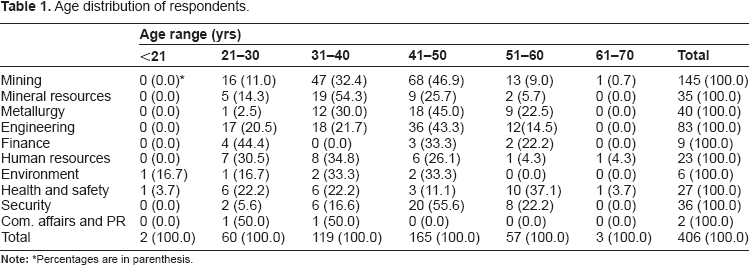
A total of 500 questionnaire and examination forms were purposively distributed to the workers for the study. However, only 406 answered the questionnaire and turned up for the eye examinations representing a response rate of 81.2%. Out of the total number of 406 respondents, 374 (92.1%) were males and 32 (7.9%) females. The respondents were aged between 20–61 years with a mean age of 41.1 (SD = 8.9) years. The majority of respondents were aged between 41–50 (Table 1). The subjects came from intensive mining and processing departments like mining 142 (35.5%), engineering 83 (20.8%), metallurgy 38 (9.5%) and mineral resources 34 (8.5%). Originally, these four departments make 74.3% of the total workforce of the mine. Majority (48.6%) had worked at the mine between 1–5 years. Forty nine (12.1%) had worked between 6–10 years, 41 (10.1%) had worked between 11–15 years, and 38 (9.4%) workers had worked for 21–25 years. Thirteen (3.2%) had worked for over 30 years and only 29 (7.2%) had worked for less than a year at the mine. One person did not state his working experience. While 166 (41.1%) of the respondents either work with or were exposed to chemicals in the mine, 238 (58.9%) were not exposed to any chemical. The use of and exposure to chemicals was significant among the workers of different sections (χ 2 = 92.4, P ≤ 0.01). The study revealed that, 316 (78.8%) workers were comfortable with illumination conditions at their workstations while 85 (21.2%) were not happy with the lighting conditions mainly because of tower lights intensity at night. Overall, 117 (29.%) of 403 confirmed previous eye examination compared to 286 (71%) workers who did not confirm a previous eye examination.
Age distribution of respondents.
Presenting visual acuity (VA)
The distribution of presenting VA for each eye is presented in Figure 1. Using the International Classification of Diseases (ICD) criteria, 18 severe visual impairment (VA ≤ 6/18) was observed in 12 (3%) individuals and moderate impairment (VA ≤ 6/9–9/12) in 102 (25.1%). The results showed that 292 (71.9%) of the workers had normal visual acuity of 6/6 or better. Eleven (2.7%) workers came under category one (VA ≤ 6/18–6/60) of the ICD 18 grades of visual impairment if their vision is left uncorrected. There were, however, five (1.2%) persons who qualified as blind in at least one eye. Notably, one worker had a vision of CF@ 2M in the better eye. Twenty three individual representing 5.7% were wearing glasses and therefore had their VA taken while wearing their spectacles.

Bar charts showing the distribution of entrance visual acuity in the right eye (OD) and left eye (OS).
Near visual acuity was also assessed for the respondents since 225 of the 406 workers representing 55.5% were over 40 years of age. Each eye was assessed separately and then together. Of all those assessed, only 207 (51.0%) could read the N8 or better with both eyes. A considerable number of 185 (45.5%) fell between the N10 and N24 lines with both eyes, and 13 individuals read the N36 to N60 lines. One person could not read with the left eye as he was technically blind in that eye.
Ocular findings
In all, 104 (25.6%) of the workers did not complain about their eyes at the time of the examination. Poor near vision was the highest complain in 93(22.9%) subjects, followed by eye irritation and itching 46 (11.3%). Poor distant vision, poor both near and distant vision, pain in the eyes and lacrimation recorded 6.4%, 6.2%, 5.4% and 3.9% respectively. External ocular abnormalities were found in 134 (33.0%) individuals while 272 (67%) had no abnormality in the external ocular adnexa. Of the 134 who had external ocular abnormalities, 6 (4.5%) were eyelid abnormalities, 112 (83.6%) represented conjunctival abnormalities, 3 (2.2%) were corneal problems, 9 (6.7%) were pupillary defects and other external defects were 4 (3.0%). Overall, internal abnormalities were observed in 93 (23.0%) subjects. This comprised of 21(22.5%) crystalline lens abnormalities, 1 (1.1%) vitreous abnormality, 8 (8.6%) fundus problems, and 62 (66.7%) disc/cup abnormalities. One person could not be examined because he was not present during the internal examination and the right eye of one individual could also not be examined because of the clarity of ocular media. A cup to disc (C/D) ratio of less than 0.5 was seen in the right eyes and left eyes of 334 (82.5%) and 336 (83.0%) workers respectively. Borderline C/D ratio of 0.5 was observed in right and left eyes of 9.1% and 7.9% of individuals respectively. Cup to disc ratio bigger than 0.5 was observed in the right eye 33 (8.0%) and left eye 37 (6.6%) individuals respectively. There was total atrophy seen in two individuals. The relationship between respondents total mining experience and abnormal C/D ratio (C/D ≥ 0.5) was significant (χ 2 = 825, P ≤ 0.01, χ 2 = 810, P ≤ 0.01).
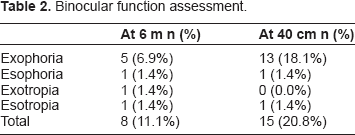
Among 72 individuals who had their binocular function assessed, tropia and phoria was present in 15 (20.8%) at near fixation and 8 (11.1%) at distant fixation. Convergence insufficiency (CI) was a problem in 18 (25.0%) of those examined (Table 2).
Binocular function assessment.
Prevalence of ocular diseases
Of all the 406 workers screened, 62 (8.6%) had no visual impairments and/or any abnormalities detected. The most occurring condition among the miners was presbyopia, found in 185 (45.5%) individuals with only 56 (30.3%) wearing near correction (Table 3). This was followed by refractive errors 109 (26.8%) and chronic conjunctivitis 93 (22.9%). Pterygium and pingueculae together recorded 105 (25.8%). Other were glaucoma suspects 62 (15.3%), cataract 30 (7.4%), acute conjunctivitis 16 (3.9%). Three (0.747%) individuals were strabismic, 13 (3.2%) were photophobic while 8 (2.0%) had the visual field constricted due to their visual impairment. Table 3 shows the distribution of ocular anomalies in the mine workers.
Distribution of ocular abnormalities among the respondents.
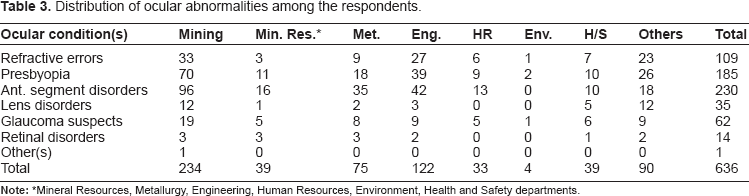
Visual impairment was found in 114 (28.1%) of the respondents. Refractive error was the major cause of impairment accounting for 109 (56.8%). Out of this, only 17 (15.6%) were wearing spectacles for distant correction. Cataract, suspected glaucoma, retinal disorders (Table 3), corneal scar, trauma and post operative cataract, and amblyopia recorded 15.6%, 32.3%, 4.1%, 2.1%, 1.0%, 1.0% and 1.0% respectively. The conditions that caused the impairments were not mutually exclusive.
Discussion
This study falls under the realm of occupational vision which is concerned with the efficient and safe visual functioning of an individual within the work environment. 14 It encompasses more than just the prevention of occupational eye injuries, it also includes vision assessment of workers/patients, taking into account their specific vision requirements and the demand these requirements place on them.
The mine workers voluntarily participated in the study. The convenient sampling method was used because the researchers had limited access to the workers so it afforded them the chance to meet all the workers at one particular location for eye examination. Visual examinations were carried out as in other studies.10,19-92 The results obtained were within the precincts of research in other parts of the world.10,21,22 The results must however be carefully applied since the background and hazards in other mining and industrial settings might differ from what pertains at Goldfields, Tarkwa which operates an open-pit mine. The mean age of workers in the study was 41.1 years. This is higher than that found in related 6 industrial establishments in Saharanpur, India which was 35.3 years, 23 23.0 ± 6.0 years found in miners in Turkey 20 and 33.4 ± 12.0 years found in the study of occupationally injured workers in Tubingen, Germany. 24 The higher mean age found in the miners suggests an aging workforce and may be due to the fact that the main occupation of men in the Wassa West District (Tarkwa) is mining, so mining is a life time job for most of them. 4
The majority (52.5%) of the workers had normal visual acuity. This is comparable to 43.7%s found in study in India. 10 Significant and moderate impairment were 12.3% and 35.0% respectively, compared to 21.8% and 34.5% in India. 10
The prevalence of refractive error was 26.8% in this study (only 15.6% wore spectacles for distant correction). This value is much lower than the 56.7% found in six industrial establishments in India, 23 but almost the same as 26.2% found in selected industrial establishments (cement factory, mining, saw mill and steel works) in Enugu, Nigeria. 19 Presbyopia was observed in 45.5% (30.3% wore near correction) of the population quite higher than 31.4% found in Nigeria. 19 Forty five percent (45.5%) of the workers could not read paper prints at 40 cm (presbyopia), yet none of them had his near prescription incorporated in his eye protective wear as recommended by occupational safety and health administration 14 (OSHA) standards. This had the potential to place the workers at risk of injuring themselves and the fellow workers. Most of the workers reported not wearing their spectacle correction because there was no readily available eye care service at the mine and the miners had little time to spare to seek eye care service elsewhere. The only eye care was at the Government Hospital, Tarkwa, but no refractive services are provided.
The eye diseases detected in this study were common to those found in other industrial establishments in other parts of the world. More prominent were diseases precipitated and/or exacerbated by carcinogenic and irritant substances. Chemicals used in the mine include cyanide, acids, ammonium, nitrate, carbon, and silica. 12 As an open-pit mine, flying dust also posed a threat to the eyes. High illumination and heat were also found as visual hazards in the mine. 12
The prevalence of pterygium and pingueculae together were 25.8%, chronic conjunctivitis 22.9%, acute conjunctivitis 3.9%, cataract 7.4%, glaucoma suspects 15.3%, corneal scar 1.0% and photophobia 3.2%. The prevalence of pterygium in other research are 2.7% in India, 10 68% in silica users in Turkey, 20 27.7% (pterygium and pingueculae) in Nigeria. 19 Chronic conjunctivitis prevalence in sandblaster in Turkey 20 is 70% and 32.6% in industrial workers in India. 23 The prevalence of cataract is 1.06% in India 23 and 12.2% in Enugu, Nigeria. 19 The eye conditions observed were also similar to other finding in Kaduna, 21 Calabar, 22 and Warri 25 all in Nigeria in which the incidence of pingueculae, pterygium, chronic conjunctivitis, cataract corneal opacity and glaucoma were also observed. Retinal abnormities were also observed in this study. Although their causes were not established in this study, a study in Japan 26 has shown that even low concentration of mixed organic solvents might damage the retina and optic nerve.
In Ghana, 4 7 studies in mining areas have mentioned chronic and acute conjunctivitis as being prevalent in mining areas.
There was low eye injury rate recorded. Only 10.0% reported previous eye injuries. Considerably, only 12.5% were wearing eye protection at the time of injury (87.5.0% were not wearing eye protection). Comparatively, 60% occupational eye injuries in the United States 27 occurred while not wearing any eye protection at the time of the injury, 86.0% in Australia, 28 93.2% and 60% in two studies in Germany,24,29 and 75.0% in India. 30 In Enugu, Nigeria, 19 history of industrial eye accidents in industries including mining is 12.5%. The injuries recorded at the mine confirm reports of health facilities in the Tarkwa district admitting and treating mine-related injuries. 7 This calls for a strong advocacy and worker education to record a reduced or zero eye accidents at the mine.
From our study, we can conclude that there appears to be occupationally associated eye diseases and disorders among the mine workers at Goldfields (Gh.) Ltd. Further, the present visual status of some miners cannot safeguard their safety and that of their fellow workers. Refractive error and presbyopia without correction was high among workers. This is not ideal for both close and distant work as mining is a visually demanding job. We therefore recommend that an occupational eye health and safety surveillance system should be instituted to monitor the incidence of eye diseases and injuries. It should also be tasked to undertake eye risk assessment in the mine so as to control preventable occupational eye injuries and diseases.
Author Contributions
Conceived and designed the experiments: SO. Analysed the data: SO, GOO. Wrote the first draft of the manuscript: SO. Contributed to the writing of the manuscript: EKA, SK, SBB. Agree with manuscript results and conclusions: GOO, EKB, SK, SBB. Jointly developed the structure and arguments for the paper: GOO, SO. Made critical revisions and approved final version: GOO, SO. All authors reviewed and approved of the final manuscript.
Funding
No financial support was received for this study.
Competing Interests
Authors report no conflicts of interest
Disclosures and Ethics
As a requirement of publication author(s) have provided to the publisher signed confirmation of compliance with legal and ethical obligations including but not limited to the following: authorship and contributorship, conflicts of interest, privacy and confidentiality and (where applicable) protection of human and animal research subjects. The authors have read and confirmed their agreement with the ICMJE authorship and conflict of interest criteria. The authors have also confirmed that this article is unique and not under consideration or published in any other publication, and that they have permission from rights holders to reproduce any copyrighted material. Any disclosures are made in this section. The external blind peer reviewers report no conflicts of interest.