






Abstract
Pregnancy is a vital time of growth and development during which maternal nutrition significantly influences the future health of both mother and baby. During pregnancy, the fetus experiences a critical period of plasticity. Epigenetics, specifically DNA methylation, plays an important role here. As nutrition is influential for DNA methylation, this review aims to determine if maternal nutrition during pregnancy can modify the offspring's epigenome at birth. Research focuses on micronutrients and methyl donors such as folate and B vitamins. Evidence suggests that maternal nutrition does not largely influence global methylation patterns, particularly in nutrient-replete populations; however, an important impact on gene-specific methylation is observed. A link is shown between maternal nutrition and the methylome of the offspring; however, there remains a paucity of research. With the potential to use DNA methylation patterns at birth to predict health of the child in later life, it is vital that further research be carried out.
Introduction
Pregnancy is a critical period of plasticity whereby fetal development may be significantly influenced by environmental factors, such as maternal nutrients and hormones,1–4 as well as the inherited genetic profile.5,6 There is a strong potential for these factors to exert a long-lasting impact on the offspring's growth and health into adulthood. This concept of
Epigenetics has been found to play a role in fetal programing.6,11 The term “epigenetics” was first coined by Waddington in the 1940s. 12 It refers to the changes to an individual's genetic code that can alter gene expression, without changing the DNA sequence, and are passed from one cell generation to the next. 13 Effectively controlling which genes are expressed can enable the developing fetus to adapt to its environment at birth. One of the key mechanisms in epigenetic modification is DNA methylation. 14 In brief, this involves the addition of a methyl group along the DNA strand where a cytosine base is located beside a guanine base (CpG site). This addition affects the expression of the gene 15 and has been shown to prevent protein coding and decrease the expression levels of the gene.14,16 For an in-depth review of DNA methylation, see the articles by Nakao and Bird.17,18 There is considerable interest in the impact that epigenetic mechanisms in utero may have on fetal programing. It has been shown that during early development, the fetal epigenome is much more susceptible to environmental stimuli.11,19–22
Many factors during pregnancy can impact the child's epigenetic status, including the health of the mother.23–25 A study carried out in the UK identified particular locations and CpG sites within the genome, where methylation patterns of the offspring were altered by mothers’ gestational diabetes status. 23 Maternal weight during pregnancy was also associated with altered methylation patterns in the child's DNA and later infant adiposity. 24 Offspring in both underweight and overweight mothers were also reported to have altered DNA methylation patterns. This later influenced the adiposity levels of the offspring. 24 A further study reported that excessive gestational weight gain was associated with increased DNA methylation levels affecting relevant pathways implicated in developmental programing of the offspring. 25 In addition, it has been shown that the effects of such particular epigenetic stimuli occur individually with each pregnancy.22,26 A study conducted among mothers, who had bariatric gastrointestinal bypass surgery and subsequently improved their weight and cardiovascular profile, demonstrated a change in the methylation status of more than 5,500 genes, particularly those relating to cardiometabolic pathways, in infants born after the surgery compared to those born before the surgery. 26
Particular nutrients are known to impact DNA methylation due to their interaction with the one-carbon metabolism cycle. 16 This cycle results in the formation of methyl groups that are required for the methylation of DNA. Folate feeds into this cycle and has been shown to alter the levels of DNA methylation in women of childbearing age. 27 A decrease in the level of dietary folate has been found to decrease genomic DNA methylation levels. 28 Other nutrients, including vitamins B12, B6, and B2, choline, and betaine, are required to provide the cofactors that are used to make the methyl groups. 29
This review aims to determine if maternal nutrient intakes modify the epigenome of the offspring at birth in both human and animal studies. Studying this specific time point controls for the influence of other factors, such as the environment and diet, after the child is born. Methylation patterns are known to be tissue specific, and as the umbilical cord tissue contains mesenchymal cells and vascular tissue, this may be considered useful when looking for associations with later life anthropometry. 30 For this reason, the human studies included in this review will focus on DNA methylation patterns measured in cord blood, where possible. Due to the limited number of published human studies, animal models are also included.
Methods
For the purpose of this review, the primary search engine used was the online database PubMed (http://www.ncbi.nlm.nih.gov/pubmed). The following keywords were searched: “epigenetics,” “DNA methylation,” “pregnancy,” “nutrition,” “offspring,” and “cord blood.” Relevant free-access abstracts were identified and reviewed to determine appropriate studies. Suitable published articles in the English language were included, and no restrictions were applied to the dates of articles. Both animal and human studies were included as, due to the ethical nature of this area of research, nutrient deficiency studies were primarily available in animal models utilizing DNA methylation patterns from various tissue types. Human studies were restricted to those involving cord bloods for DNA methylation analysis only to try and control for the variation in methylation status found in different human tissues. Manual searches of reference lists were carried out on the selected papers to identify further eligible studies. In total, 17 papers were selected and summarized in Tables 1–3.
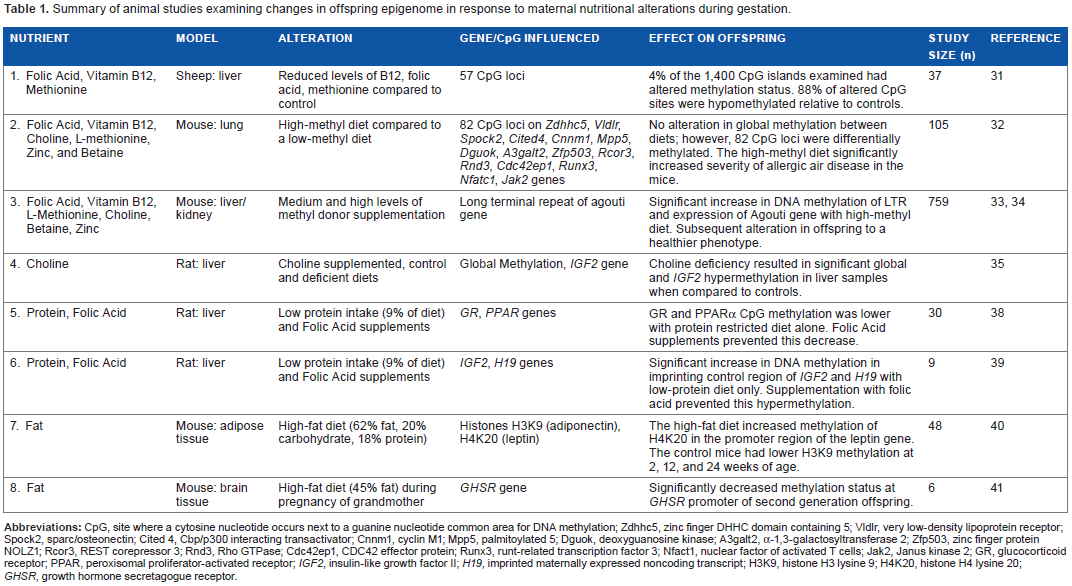
Summary of animal studies examining changes in offspring epigenome in response to maternal nutritional alterations during gestation.
Summary of human intervention studies examining changes in offspring epigenome in response to maternal nutritional alterations during pregnancy.

Summary of human observation studies examining changes in offspring epigenome associated with maternal nutrition pregnancy.

Results
Seventeen papers fit the criteria for inclusion. Table 1 summarizes nine animal studies that are primarily made up of mouse and rat models, examining the effect of maternal nutrient intake on various tissue types. Tables 2 and 3 summarize eight human studies that look at the impact of particular nutrients on the offspring's pattern of DNA methylation in cord blood; both genome-wide methylation and gene-specific methylation were examined.
Discussion
A limited number of studies have been carried out examining the impact of maternal diet in pregnancy on the offspring's epigenetic profile at birth. These studies have primarily focused on nutrients known to interact with the one-carbon metabolism cycle, namely, folate, vitamin B12, B6, choline, and betaine.
Animal Models
Animal studies examining maternal nutritional impact on DNA methylation patterns focused mainly on the combinations of methyl donor nutrients, such as folate, B vitamins, choline, and betaine31–34 (see Table 1). While few studies examined the impact of these nutrients on global methylation, overall evidence shows a relationship between the two. Reduced levels of methyl donors lead to global hypomethylation, as shown in a bovine study in 2007, where 88% of the altered CpG sites had decreased levels of DNA methylation due to experimental methyl donor deficiency. 31 Similarly, in agouti mice, it was shown that diets high in methyl donors resulted in higher DNA methylation levels of the offspring's agouti gene, which altered the phenotype.33,34 In another mouse study, which examined allergic air disease, it was also found that high levels of these methyl donor nutrients increased the levels of DNA methylation in the offspring, which impacted the disease severity. 32
There are few studies examining the individual impact of these methyl donor nutrients. One such study in rats looked at the effect of choline supplements and their deficiencies in relation to controls.
35
Surprisingly, it was found that choline deficiency resulted in an increase in global methylation levels in the offspring when compared to controls. However, this was as a result of hypomethylation of regulatory CpG sites on the
Studies linking global methylation patterns with nutrition primarily focus on micronutrients. Limited studies are carried out on macronutrients, such as protein and fat, and they tend to focus on particular genes or sites. Interestingly, two rat studies looked at the effect of protein restriction on genes relating to cell differentiation and growth.38,39 In both studies, it was found that low protein intake negatively altered the DNA methylation status of these genes. However, when the diet was supplemented with folic acid, no change was observed. These results highlight the potential importance that folic acid may have on methylation status above other dietary components. In mice, maternal dietary fat had a negative impact where a high intake was found to significantly increase the DNA methylation status of the leptin gene, which is associated with the control of energy balance and satiety.
40
In animal models, maternal fat intake has been shown to influence the following generation of offspring through epigenetic mechanisms. For instance, in mouse models, Dunn and Bale found that a high-fat diet resulted in reduced DNA methylation at the growth hormone secretagogue receptor (
Human Studies
See summaries of papers in Tables 2 and 3. In human studies, research to date has found no association between folic acid intake during pregnancy and global methylation or long interspersed nucleotide element-1 (LINE-1) methylation status in the offspring.43–45 LINE-1 sequences are frequently used as a surrogate for global methylation. 43 Fryer et al found that neither folic acid intake nor serum folate levels in the mother were associated with the infant's LINE-1 methylation at birth. 43 Another study also found that dietary folate intake along with other methyl donors had no impact on LINE-1 methylation status of the offspring. 45 However, Fryer et al did report that homocysteine levels in cord plasma were inversely correlated with LINE-1 methylation, 43 indicating that an offspring's methylation status is susceptible to modulation via folate-associated intermediates. Another study by the same research group showed that plasma homocysteine, LINE-1 methylation, and birth weight were associated with CpG methylation patterns in cord blood, providing further evidence that folate-associated intermediates in the mother's diet can influence not only pregnancy outcomes but also the offspring's global methylation status. 46
Other important nutrients involved in the one-carbon metabolism cycle are vitamins B12, B2, B6, choline, and betaine. Maternal serum vitamin B12 was shown to be inversely correlated with offspring's global methylation status at birth.
47
Another study found that early pregnancy intakes of methyl donors, including vitamins B12, B2, and B6, did not impact infants’ global methylation status. However, they did find that intake of choline and betaine in early pregnancy was inversely associated with global cord blood methylation among male infants only.
45
Azzi et al noted that folic acid supplementation and the use of a combination of micronutrients before or during pregnancy had no impact on methylation status of the
With respect to specific genes, folate intake during pregnancy has been shown to have an impact on the infant (see Table 2). One study conducted in the US reported that women who took folic acid supplements during pregnancy gave birth to infants with lower methylation levels at DNA sequences that regulate insulin-like growth factor II (
Another important point to note in this area of research is the gender of the offspring. Many studies have reported gender differences in relation to DNA methylation patterns.45,49,52,53 Boeke et al found that cord blood methylation levels are usually higher for males than females. 45 For future studies, it is advisable that gender-specific analysis be conducted and considered when interpreting results. Understanding the role of gender and how males versus females respond to environmental perturbations particularly at this basic epigenetic level could help physicians and patients to anticipate disease susceptibility. There is emerging evidence that particular patterns of DNA methylation in cord blood are associated with children's body size and composition in later years. 54 Furthermore, DNA methylation patterns at birth may predict the risk of developing particular diseases later in life, such as metabolic disorders. Given the growing childhood obesity epidemic and associated metabolic diseases, advancing our understanding of factors that influence DNA methylation during pregnancy and early life, and how to correctly interpret these patterns, may offer crucial insight into effective measures for future obesity prevention.
Conclusion
Current epigenetic studies suggest an association between maternal nutrient intake during pregnancy and the epigenetic patterns of the offspring at birth. Folate and other methyl donor nutrients appear to primarily affect the offspring's pattern of DNA methylation; however, macronutrient composition of the maternal diet can also exert an influence. In human beings, the impact of nutrients is more clearly seen when examining gene-specific methylation levels rather than overall global methylation levels. It is important that the characteristics of the study cohort, particularly current folate status and offspring gender, should be considered when interpreting results, as these have been shown to influence the impact of particular nutrients. While these results can be used to explain fetal programing in pregnancy, there remains a paucity of research in this area, particularly in human studies. The first years of life are a critical period of development, and advancements in this area of research could influence advice and guidelines regarding maternal nutrition during pregnancy and lactation. With the potential to use DNA methylation patterns at birth to predict health and growth of the child in later life, further epigenetic research is urgently required.
Author Contributions
Conceived and designed the experiments: AAG, ERG, KLL, and FMMA. Analyzed the data: AAG. Wrote the first draft of the manuscript: AAG. Contributed to the writing of the manuscript: AAG and ERG. Agree with manuscript results and conclusions: AAG, ERG, FMMA, KLL, and GA. Jointly developed the structure and arguments for the paper: AAG and ERG. Made critical revisions and approved final version: AAG, ERG, FMMA, KLL, and GA. All authors reviewed and approved of the final manuscript.