






Abstract
Nuclear magnetic resonance (NMR) allows for fast, accurate and noninvasive measurement of fluid flow in restricted and non-restricted media. The results of such measurements may be possible for a very small B0 field and can be enhanced through detailed examination of generating functions that may arise from polynomial solutions of NMR flow equations in terms of Legendre polynomials and Boubaker polynomials. The generating functions of these polynomials can present an array of interesting possibilities that may be useful for understanding the basic physics of extracting relevant NMR flow information from which various hemodynamic problems can be carefully studied. Specifically, these results may be used to develop effective drugs for cardiovascular-related diseases.
Keywords
Introduction
Magnetic resonance imaging (MRI) is an imaging modality based on the principles of NMR and can be used to directly observe the movement of molecules associated with fluid flow. This provides for an excellent opportunity to noninvasively determine molecular velocities within a confined range, for example due to the formation of plaque in blood vessels.1–3
Traditionally, MRI generates exquisite images of the soft tissue anatomy of the human body. The principle of MRI is to record the variations of the nuclear magnetization of biological tissues using different kinds of magnetic fields.1,2,4 A static magnetic field B0 is used to generate a macroscopic nuclear magnetization
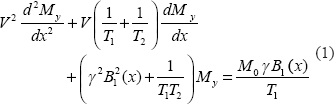
In order to calculate the transverse magnetization component M0 ≠ M
x
, a condition which holds true in general and in particular when there is a small RF limit: γ
2
B1
2
T1T2< < 1. This is typically regarded as a linearity condition in which the frequency response takes on the characteristic Lorentzian form.
4
For this investigation, we assumed that the resonance condition existed at Larmor frequency:
7
Before entering the signal detector coil, fluid particles have magnetization of


Under these conditions and for steady flow, we can write

When the RF B1(x) field is applied, M
y
has the largest possible amplitude when RF B1(x) is maximum and M0 ≍ 0. At this point, when the maximum possible NMR signal amplitude is detected (maximum values of M
y
and B1(x) respectively), Equation (1) becomes:
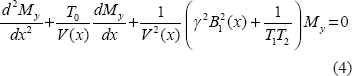

In this study, we conducted a detailed analysis of generating functions that may arise from polynomial solutions of Equation (4) in terms of Legendre polynomials and Boubaker polynomials.9–12 The generating functions of these polynomials can enhance the present understanding of the basic physics required to extract relevant NMR flow information from which various hemodynamic problems can be studied.
Quantitative fluid flow imaging based on the solution of Bloch NMR flow equations in terms of Legendre polynomials and Boubaker polynomials is very important because significant applications of MRI techniques are based on the Bloch NMR equations. Applying appropriate mathematical techniques to solve Bloch NMR flow equations and extract relevant NMR flow parameters to accurately monitor the fluid state is very important for MRI studies.
Mathematical Model
Equation (4) was obtained under conditions of when the RF B1(x) field is applied and M
y
has a maximum value, M0 = 0. Equation (4) can be written in the form:

The fluid velocity V is dependent on the spatial variable x. We may therefore write that:



Specifically, in this model, we consider a fluid particle confined to a limited range as shown in Figure 1.
Illustration of the changes occurring in an ischemic cardiovascular accident and geometrical consideration in coronary artery with atherosclerosis diseases.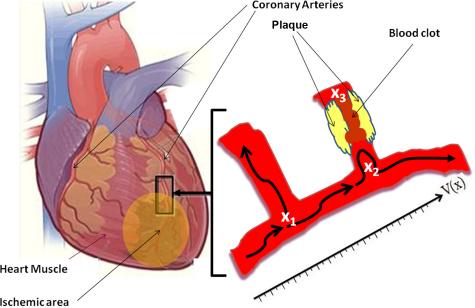
At the point x3, the fluid velocity V(x) becomes virtually zero and the blockage stops the blood supply to the area, leading to ischemia (lack of oxygen) and eventually necrosis.
The fluid velocity is completely quantified within the (anatomical) range except at the points (certain discrete values μ, an NMR number associated with the NMR transverse magnetization and velocities) where μ is odd number because the velocity is infinite at these points (this typically occurs at bifurcations, ie, points x1 and x2).
Since the expression of Equation (7) implies that the fluid velocity is a function of relaxation times, we can assume that V
2
is directly proportional to T
g
such that:

From equations (10), we can write:



If we define

Dividing Equation (14) through by

The solution of Equation (15) is of the form:13–16



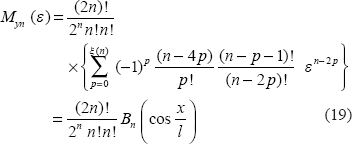
Equation (17) can be factorized by its own first term. Setting m = n - p:
Discussion
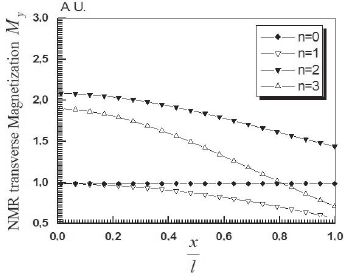
In Figure 3, the curves correspond to the vanishing modes of the expression obtained for the transverse magnetization in Equations (17) and (19). This feature agrees with the results obtained by Kobayashi et al, 16 Chapman et al, 17 and Donnat et al. 18
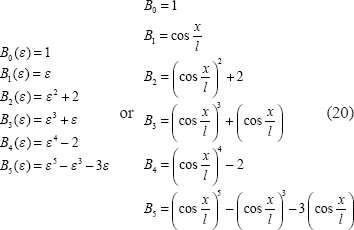
The case n = 0 (Fig. 3) initially corresponds to the reduced equation:


It is interesting to note that whether the blood flow is laminar or turbulent, a magnetic resonance signal is always available. Specifically, at bifurcations and points just after the build-up of fatty deposits (sections d and e in Fig. 2) the transverse magnetization M
y
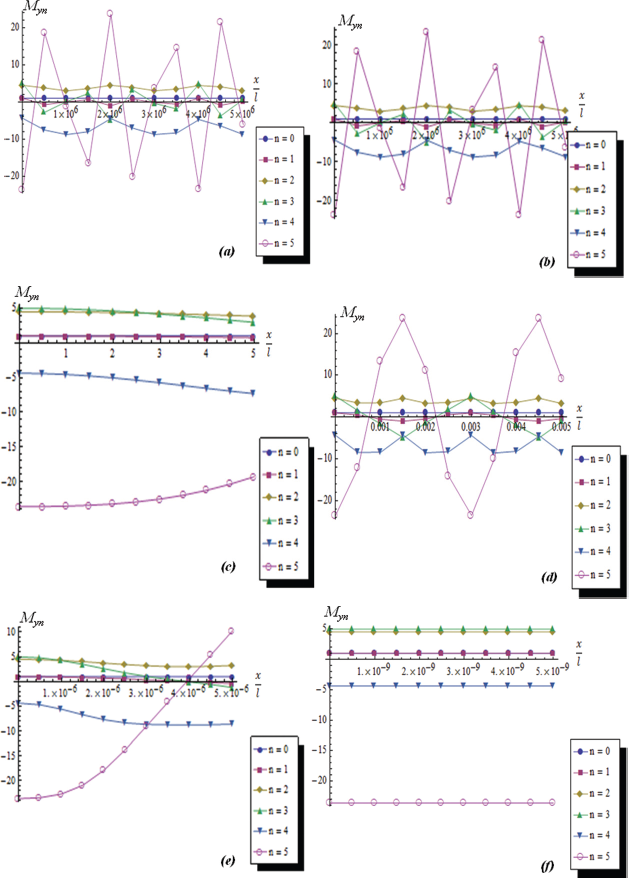
is a constant. This indicates that resonant waves can be reconstructed to image the points within the blood vessels where flow is turbulent. Figures 3 and 4 suggest that except at points where there is no contribution from velocity, transverse magnetization must be continuous. That is, M
y
cannot jump from one value to another. We therefore set the boundary condition for the fluid particle:
Effect of constriction on the velocity profile in a blood vessel: (ab) Laminar flow velocity V, (bc) High velocity V1, (de) Turbulent, and (eg) Laminar flow. The diameter of the blood vessel is h.
21
Reprinted with permission of the Collegium Basilea. The n-indexed solutions. Plots of transverse magnetization as a function of 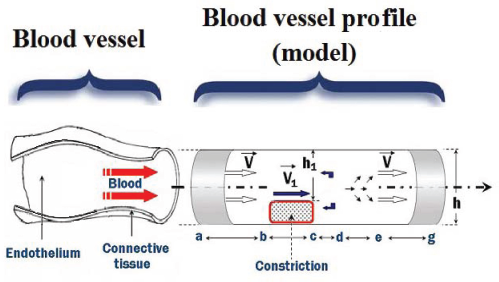

Equation (7) shows that an acceptable solution of Equation (6) according to the assumptions made above can only be obtained if the fluid particle has certain discrete values μ, an NMR number associated with the NMR transverse magnetization and velocities. It is very important to note that this parameter is very related to the nature of flow observed within the vessels.
Figures 3 and 4, show the effect of the values of n on both Boubaker polynomial B
n
and the NMR transverse magnetization M
y
. They show the behavior of the NMR signal at several points within the vessel being observed. Notably, Figure 4 demonstrates the importance of the ratio
Studying the Legendre and Boubaker solutions to the Bloch NMR flow equation for the behavior of NMR signals in flowing media is invaluable because it can allow effective monitoring of geometrical and morphological situations in the arteries as well as the possible effect of drugs on cardiovascular related diseases in any tissue. Based on earlier studies,22–24 l(x) may be defined in the Cartesian cylindrical and spherical coordinates as shown in Figure 2, where l(x) = h - h1. When n = 0 and the vessel is not completely blocked, the flow is extremely complex. Values for n > 0 indicate that the size of h1 is drastically reducing and the velocity V(x) is becoming more laminar (steady) in oxygenated blood and cerebrospinal fluid (CSF) as shown in Figure 5. The value of n can be used to indicate the efficacy of any drug useful for reducing plaque size, as shown in Figure 5.
The plots of the fluid velocity for molecules of (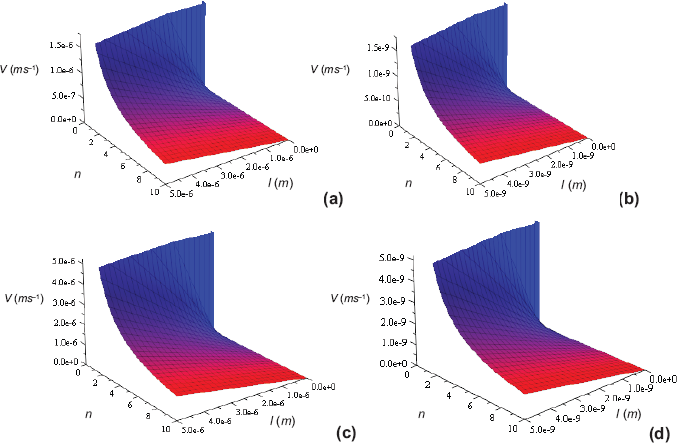
Similarly, Equation (10) can be significantly valuable for estimating blood flow of blood vessels with very small cross section area A = l 2 (x), where the value of n may be defined as 0 < n < 5.
Figure 6 shows the distribution plots for the fluid velocity and the corresponding density plots for different ranges of l. These figures show that the study affords us the opportunity of simultaneously adding velocity mapping to MRI of blood flow within the vessels. The points with white open areas are points at which complex or turbulent flow occurs. These points typically coincide with presence of bifurcations and fatty deposits. Additionally, as l becomes microscopic and lower, the model becomes more realistic. The points with sharp peaks or the red regions on the density image correspond to highest values of fluid velocity and can be used to determine and also image the presence of fatty deposits.
The velocity distribution across l and x, according to Equation (7) and the corresponding density image for l ranging from 0 to (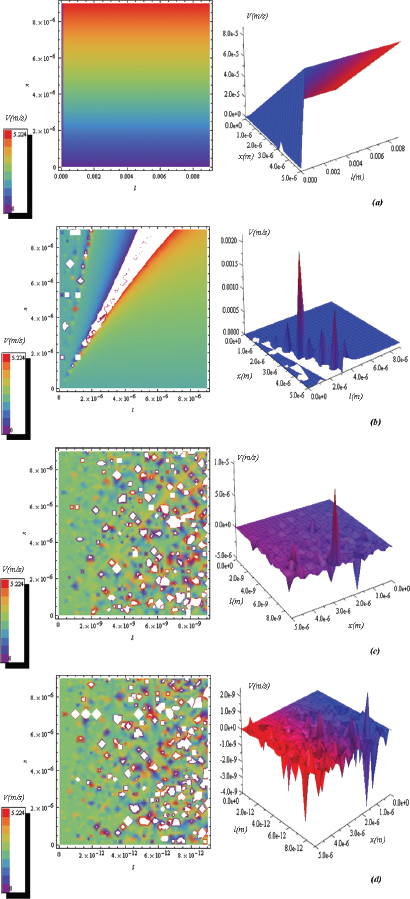
It may be significant to note that the rotational diffusion coefficient D
rot
can be defined from Equation (7) as,19,20 considering that l is a fixed length:

Given that the translational diffusion coefficient is:

For the value n = 1, M
y
(ε) = P1(ε) = B1(ε) and the correlation time becomes

The physical implication for when n = 0 can be interpreted as the constant magnetization where the correlation time is observed to be infinitely small.
Finally, the rotational diffusion coefficient as given in Equation (23) may be written as:19,20


Conclusions
We have derived the MRI signal in terms of Legendre and Boubaker polynomials. By solving the Bloch NMR flow equations under some assumptions, we obtained elementary spatial profiles of the transverse magnetization response. The primary advantage of this approach is the potential to exploit spatial-evolution of magnetic response in the presence of a preset rotating field for monitoring the effect of a drug on cardiovascular-related diseases and to estimate blood flow rate in very small blood vessels.
Interestingly, quantification of the velocity is not a direct prediction of Equation (7), but it is a consequence of the conditions imposed on the transverse magnetization.
In physical situations in which a fluid particle is confined in space, for example, at x = βl, M
y
must be a well-defined functions of position, M
y
cannot be infinite any where except at the point M
y
must be continuous, and not jump abruptly from one value to another. When n = 0, and x = μπl/2 (μ = odd integer), the transverse magnetization is a constant and the velocity is indeterminate. The NMR transverse magnetization is directly proportional to Boubaker polynomials. M
y
has the same value as the Boubaker polynomials when n = 1.
Detailed study of these NMR flow parameters and properties of the transverse magnetization as described in this study can allow for careful optimization and 3D computer graphics of fluid flow magnetic resonance imaging. A simple illustration of this is given in Figure 6. The mathematical analysis presented in this study is based on the assumption made in Equation (7). This was done with the goal of exploring the spatial evolution of the MRI signal in the presence of a preset rotating field.
The biological, physical, biomedical, and geophysical applications of equations (17), (19), (23), (25), and (27) when n > 1 can be used for all NMR/MRI procedures and further application of this study will be presented in separate studies. For an example of the physical properties of a drug designed to reduce the size of h1 of the fatty deposit in Figure 2 may be revealed by equations (24–27).
Notably, the parameter l in Equation (7) is a length used to scale x. This parameter may be used for slice selection in spatial encoding in a typical MRI experiment so that l can be defined such that:

Author Contributions
DOM, AOB, AOA and BK participated equally in the work giving rise to this manuscript. All authors reviewed and approved of the final manuscript.
Competing Interests
Authors disclose no potential conflicts of interest.
Footnotes
Acknowledgement
The authors acknowledge the support of Federal University of Technology Minna through the STEP–-B research scheme. The meticulous review of this article is highly appreciated.
As a requirement of publication the authors have provided signed confirmation of their compliance with ethical and legal obligations including but not limited to compliance with ICMJE authorship and competing interests guidelines, that the article is neither under consideration for publication nor published elsewhere, of their compliance with legal and ethical guidelines concerning human and animal research participants (if applicable), and that permission has been obtained for reproduction of any copyrighted material. This article was subject to blind, independent, expert peer review. The reviewers reported no competing interests.