






Abstract
Effect of pollution on diversity of attached and free-living bacteria in two contrasting stations, namely, Suez Canal and outlet of West Lagoon to Lake Timsah was investigated.
Introduction
Microbiota composition varies as a function of water class, and depends mainly on salt and organic compound concentration, turbidity, temperature, and contamination sources. 1 Thus bacteria found in the seawater can be different from those of freshwater in rivers and lakes.
Large amounts of organic wastes are expected to decrease bacteria diversity.2,3 Also this may select specific microbial populations to dominate in the environment. 4
Classically, in aquatic environments, bacterioplanktons are separated into two main groups: bacteria attached to aggregates and free-living bacteria. 5 Bacteria typically occur on aggregates in concentrations that are orders of magnitude higher than in the ambient water.6,7 Seepage of dissolved organic matter from degrading aggregates can affect microbial processes even outside the aggregates. 8 Accordingly, particle attached bacteria can differ from free-living bacteria 9 although similar community composition was found in coastal marine environments. 10 A possible explanation to this difference depends on the different source of the particle. 10 Even some authors concluded that the diversity of microorganisms in aquatic environments may affect the spatial patterns of larger organisms. 11
Few publications dealt with the effect of pollution on the composition of microbial communities. Studies on the diversity of bacterioplankton in Victoria Harbour, Hong Kong, and its adjacent coastal and estuarial environments
2
revealed that a unique bacterial community was developed in the harbour and it differs from that of the adjacent coastal environment. They concluded that there was a possible relationship between composition of bacterial communities in the harbour and anthropogenic pollution in the harbour. Large proportion of
Lake Timsah represents an important touristic and economical resource. The Lake is receiving higher loads of polluted municipal, industrial and agricultural drainage. It is well known that this affects the ecological status of the Lake. 12 Since microorganisms are important components in the structure and function of water systems, the present paper reports work done to identify groups making up bacterial communities present in Lake Timsah.
To this end, the microbial community composition in Lake Timsah was investigated, including the highly anthropogenically nutrient polluted West lagoon and the nutrient poor Suez Canal. The West Lagoon has been regarded as a highly polluted water body receiving increasingly large volumes of raw sewage, agricultural runoff as well as industrial wastewater. 12 Suez Canal represents relatively clean water regenerated from Suez Canal's strong currents. In the present study, we analyzed the diversity of particle-attached and free-living bacteria and discussed their relationship with dynamic environmental conditions in Lake Timsah and Suez Canal.
Materials and Methods
Sampling sites and sampling
Two sampling sites in Lake Timsah were chosen according to their pollution status and reflecting contrast environments; outlet of highly polluted West Lagoon and Suez Canal (Fig. 1). Suez Canal is characterized by relatively clean water while West Lagoon station is receiving high load of municipal wastewater as well as agriculture drainage (Table 2). Samples were collected on a biweekly basis during September–December 2010 from subsurface (0.5 m), middle (3 m) and bottom (7 m) of the West Lagoon station and only subsurface samples from Suez Canal. Lagoon water (2 litres) was collected in two carefully acid-rinsed glass bottles (rinsed with the sample itself before use) and was kept in an ice box until it was brought to the laboratory, where it was processed within 3 h. Where duplicates or triplicates were taken the value presented is the mean of the subsamples taken from a given bottle. Water samples were filtered first through a 1.0 μm pore size filter and subsequently a 0.22 μm pore size filter (47 mm diameter) to collect particle attached and free-living bacteria, respectively.
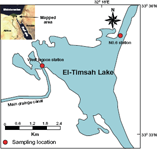
Map showing two sampling station.
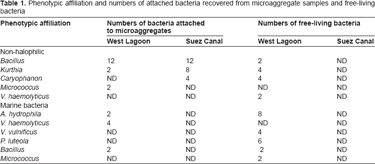
Phenotypic affiliation and numbers of attached bacteria recovered from microaggregate samples and free-living bacteria
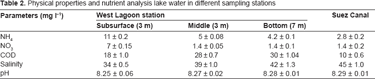
Physical properties and nutrient analysis lake water in different sampling stations
Samples Processing
Membranes were immersed into 50 ml saline solution and suspensions were shacked to release cells from the membrane surfaces. Two physiological groups of heterotrophic bacteria were studied using the following isolation media 1) For non-halophilic bacteria: nutrient agar medium. 2) For marine bacteria two media were used i) Sea water complete medium consisting of 5 g Difco Bacto-Peptone, 0.5 g Difco Yeast Extract and 3 ml glycerol in 1 litre of 75% (v/v) seawater; 13 and ii) Marine Agar medium containing NaCI, 2.34; MgSO, 7H20, 0.61; MgCl, ·6H2O, 0.39; KCI, 0.06; CaCl2 · 2H20, 0.01; NaBr, 0.007; NaHCO, 0.002; yeast extract (Difco), 1; proteose-peptone no. 3 (Difco), 0.5; glucose, 0.1; agar (technical) (Oxoid), 1.5; pH adjusted to 7.2 with 1 M-NaOH (compositions given as %, w/v). 14 The samples were plated on the three different media either directly or after dilution in sterile saline water. Plates were incubated in sealed plastic bags at 28 °C for 4 to 7 d. Colonies were isolated randomly from the plates and successively subcultured in the same isolation medium to ensure purity.
Phenotypic Characterization
A total of 82 strains were analyzed to determine their Gram reactions by staining and also by non-staining KOH method, 15 catalase formation, oxidase formation and motility. Gram positive spore formers and asporogenous Gram positive were identified based on systems and characters from The Prokaryotes-volume 4. 16 Gram negative rods were characterized phenotypically by using the Api 20NE (bio-Mérieux, Marcy L'Etoile, France). Each strip includes microtubules represent 20 phenotypic characteristics (8 represent conventional tests, such as protein hydrolysis, including: reduction of nitrates to nitrites, reduction of nitrates to nitrogen, indole production (Tryptophane), fermentation (Glucose), Arginine Dihydrolase, Urease, hydrolysis (β-glucosidase) (Esculin), hydrolysis (protease) (Gelatin), β-galactosidase (Para- Nitrophenyl-βDGala ctopyranosidase) and 12 are assimilation tests, with substrates such as (Glucose), (Arabinose), (Mannose), (Mannitol), (N-Acetyl- Glucosamine, (Maltose), (potassium Gluconate), (Capric acid), (Adipic acid), (Malate), trisodium citrate and Phenylacetic acid.
The Api 20 NE strips were inoculated with bacterial cultures that had been grown for 24 hours. The strips were inoculated according to the manufacturer's instructions and were incubated for 24 and 48 h at 28 °C.
Environmental Factors
In the field pH and salinity were determined. Water samples were analyzed for Ammonium (NH+4), Nitrate (NO–) and chemical Oxygen Demand (COD) according to Standard Methods. 17
Statistical Analysis
Single factor analysis of variance (ANOVA) and correlation analysis were used to analyze results. Also, the Canonical Correspondense Analysis (CCA) ordination program was applied using CANOCO Fortran program.18,19
Results
Main phenotypic groups
A total of 82 bacterial colonies were tested for Gram reaction by KOH method 15 and by compound Gram staining method. Each of the 82 pure isolates was tested for protein and other compounds hydrolysis tests (8 tests) as well as carbohydrate assimilation tests (12 tests). Primary identification tests were also carried out such as catalase, cytochrome oxidase and motility.
Gram positive spore forming rods
30 strains were included in this phenotypic group. They were Gram positive, spore forming, motile and catalase was positive. Indole was not produced. Nitrate was reduced and only four strains were not able to reduce it. Acid was not produced from glucose. All strains were able to hydrolyse gelatin. Oxidase was variable. Trisodium citrate was assimilated except in four strains. Esculin ferric citrate was hydrolysed by β-glucosidase. Carbon substrate assimilation was variable between strains. The strains could be assigned to the genus
Gram positive nonspore forming rods
This phenomenon contains 22 strains. All were nonspore forming rods, Gram positive, strictly aerobic and catalase positive. Ten strains with cytochrome oxidase negative. Gelatin not hydrolysed except in two strains, indole was not produced, glucose was assimilated, urease was negative and Nitrate was not reduced except in one strain. These strains could be placed in the genus
Gram positive cocci
Only four strains were isolated which were Gram-positive asprogenous cocci, non-motile, and catalase positive. All strains were oxidase negative. Most were aerobic. Indole was not produced; Esculin ferric citrate test was negative. Strains were not able to reduce nitrate. Numerous organic compounds were not used for growth except mannose. These strains may be placed in the genus
Gram negative rods
Totally 26 strains were included in this phenotypic group. The strains were identified using the Api 20 NE strips. Six strains were identified as
Physiological groups
Non-halophilic bacteria
54 strains were harvested from the nutrient agar medium included in this group isolated from both stations. The group included 26 spore forming Gram positive rods, 22 asporogenous Gram positive rods, two Gram positive cocci and four strains of Gram negative rods (Table 1).
Marine bacteria
28 strains were isolated from the marine agar medium and the sea water complete medium. The group included six spore forming Gram positive rods, two Gram positive cocci and 20 strains of Gram negative rods (Table 1).
Bacteria distribution on the two sampling stations
In general, 34 isolates were cultivated from the West lagoon and Suez canal samples respectively. The frequency of the Gram positive bacteria presence was higher in the water column of the West Lagoon station (53.8%) and only two Gram negative strains were encountered from that station. The percentage of the genus
Attached vs. free-living bacteria
Bacterial richness in this study defined according to the numbers of bacterial genera as shown in Figure 2. For subsurface, middle (3 m) and bottom (7 m) in the case of West lagoon station and subsurface samples in the case of Suez Canal, attached/free-living bacterial populations, samples of the subsurface layer showed higher taxonomic diversity (ie, the number of taxa and their relative amounts in a sample) than the middle and bottom layers (Fig. 2). Also, seven genera were isolated from the subsurface layer in the clean water of Suez Canal, and four genera were isolated from the subsurface layer of the West lagoon station. The phenotypic types recovered in the free-living fraction were not significantly different than attached types. Attached bacteria in this study belonged to the genera
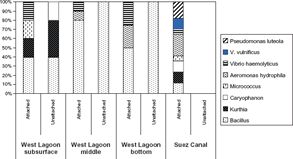
Bacteria species richness in different samples and water depths from the two sampling sites; West Lagoon and Suez canal.
Environmental characterization
Average concentrations of the environmental factors were tabulated in Table 2. The West lagoon station is receiving high organic loads. Average ammonium concentrations was 11.0 mg/l in subsurface water, 5 mg/l in middle layer and 4.2 mg/l in bottom layer. In Suez Canal water ammonium average a concentration was 2.8 mg/l. Nitrate average concentrations were 7 mg/l in subsurface water layer, 1.4 mg/l in middle layer and 1.4 mg/l in the bottom layer. Lower average concentrations of nitrate were recorded in Suez Canal and was 1.4 mg/l. COD average concentrations were also higher in the West Lagoon station compared with the Suez Canal waters. COD average concentrations was 18 mg/l in subsurface water, 28 mg/l in middle layer and 30 mg/l in bottom layer. In Suez Canal a water COD average concentration were lower and was 10 mg/l.
Richness of
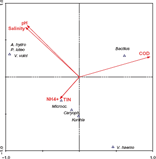
Biplot of Canonical Correspondence Analsis (CCA) showing the relationships between the bacterial species and correlated water variables. These species are abbreviated to the first four letters of the genus and the first three letters of the species name.
Discussion
In this study, the microbial diversity and community structure within the water column in Lake Timsah were estimated. The microbial ecology of the lake is of specific interest because it is believed that the Lake is spatially separated into two distinct microbial communities because of the pollution status. This lake is also an anomalous environment in that it receives high load of organic pollutants from the south while water in the northern part of the Lake is renewed through strong water currents of the Suez Canal.
Polluted West Lagoon station vs. unpolluted clear water of Suez Canal
Water samples were collected from two stations in Lake Timsah; the first is adjacent to the West Lagoon and from three water depths, namely, subsurface (0.5 m), middle (3 m) and bottom (7 m). The second is Suez Canal which is characterized by relatively clean water (Table 2). The West Lagoon station has mixed water from Lake Timsah and the West Lagoon, which discharges high organic load into the Lake (Fig. 1). Subsurface water in the West lagoon station has an average salinity of 34 ±, the 3 m layer possesses an average salinity of 39 ± and the 7 m layer has showed an average salinity of 45±. Increased salinity of Lake Timsah water was recorded in previous studies, with surface salinities of 20%–40± and over 40± in deeper water. 20 Subsurface water samples collected from Suez Canal characterized by a water salinity of 45±. West Lagoon station was characterized by higher concentrations of COD (18 mg/l in the subsurface to 30 mg/l in the bottom layer) compared to lower concentrations in Suez Canal (10 mg/l) (Table 2). COD indicates the concentrations of organic matter. 21 The discharge of municipal wastewater form the West Lagoon into Lake Timsah may cause extensive tidal fluctuation. The nutrient loading (Table 2) discharged to the West Lagoon mix with the saline water of the Lake may cause fluctuations in the nutrients at this station. Lead concentration was measured 22 at the West Lagoon to be 0.64 μg l-1, whereas recent measurements (Bahgat 2010, accepted for publication in the African Journal of Aquatic Sciences) showed an average lead concentration of 12.8 μg l-1. This increase in concentration (about 20 fold) reflects the effect of continuous discharge of wastes to the lake.
Bacterial diversity in surface water usually is highly responsive to perturbation, shifting with tidal cycling,
23
salinity fluctuations
24
and dissolved organic matter concentrations.
25
All these may be reflected in the higher diversity of the subsurface layers in both two stations compared with the middle (3 m) and bottom (7 m) layers which were characterized by the dominance of
Seven genera were isolated from the subsurface layer in the clean water of Suez Canal and four genera form the subsurface layer of the West Lagoon station. In contrary,
The percentage of the Gram positive bacteria was higher in the West Lagoon station (53.8%) and the
It was originally estimated that 95% of the bacteria in the sea are Gram negative. Subsequently, low numbers of Gram positive bacteria have been reported from a variety of marine samples.
26
The richness of nutrients which may originate from a high anthropogenic organic load may play a role in formatting the bacterial communities in the ecosystem. Usually higher numbers of Gram positive bacteria are related to adequate nutrient availability.
16
For example, it was found that the Gram positive bacterial community in the Wadden Sea is surprisingly diverse and consists mainly of indigenous species which appear to be well adapted to the environmental conditions of this coastal ecosystem.
27
However, there is an uncertainty to the origin and activities of Gram positive bacteria in the sea. This uncertainty emerges from the fact that Gram positive bacteria are abundant in soils and can be introduced into near shore aquatic masses. Gram positive bacteria can represent a large percentage of the colony forming bacteria obtained from near shore.
26
Similar conclusions were reported in the study of
28
their findings indicate that a unique bacterial community has developed in the Victoria Harbor area, Hong Kong, and there was a possible relationship between bacterioplankton populations and anthropogenetic pollution in the harbor. Accordingly, the increase in the Gram positive percentage at the West lagoon station can be attributed to the high organic load from municipal and agriculture drainage. In contrary, lower Gram positive percentage was recorded in Suez Canal as it is characterized by a relatively better water quality in terms of its lower organic load (Table 2). Also, more diverse bacterial types were recorded at Suez Canal water, namely,
Particle attached vs. free-living bacteria
Both attached and free-living bacteria recovered in the study fell within the
Effect of environmental factors
The application of multivariate techniques (CCA) revealed and confirmed that the principal environmental factor controls the dominance of the genus
Comment on methodology (cultured versus uncultured)
There is a classical discrepancy between culture-and Polymerase Chain Reaction (PCR)-based methods to describe microbial biodiversity. On one hand, PCR-based studies are subjected to their own inherent errors, biases and artifacts. 32 On the other hand, the microbial cultivation techniques may underestimate some bacterial cells living in water and are not cultivated on standard marine agar media. 33 However, there are numbers of studies in which it is shown that cultured strains of marine bacteria can represent significant fractions of the bacterial biomass in sea water.34,35 Also, studies showed some agreements among the two approaches 36 suggesting that the effectiveness of the identification techniques varies among genera and species. Accordingly, depending on the technique used to collect biomass and/or detect the presence of one group or another, very different conclusions could be reached. For example, if total biomass is collected and hybridized to a probe for the attached (cultured) representatives, 34 a good proportion of the hybridization signal could be detected by this fraction, although numerically they represent a very minor component of the community.
Lake Timsah has mixed water from Suez Canal and the wastewater discharges. A unique bacterial community has developed in the Lake area and there is a possible relation between bacteria populations and anthropogenic pollution. This is not surprising as the Lake is still subjected to direct disposal of sewage discharges.
The current investigation clearly defined the effect of pollution on the diversity of bacterial communities in Lake Timsah. The West Lagoon station, receiving polluted water, showed dominance of Gram positive bacteria, especially the genus
Footnotes
Acknowledgment
The author wishes to thank Dr. Hoda Abd- Elhamid, Botany Department, Suez Canal University for assistance in application of the Canonical Correspondense Analysis (CCA) ordination using CANOCO Fortran program.
This manuscript has been read and approved by the author. This paper is unique and is not under consideration by any other publication and has not been published elsewhere. The author and peer reviewers of this paper report no conflicts of interest. The author confirms that they have permission to reproduce any copyrighted material.