






Abstract
Autism is a neurodevelopmental disorder of social behavior, which is more common in males than in females. The causes of autism are unknown; there is evidence for a substantial genetic component, but it is likely that a combination of genetic, environmental and epigenetic factors contribute to its complex pathogenesis. Rodent models that mimic the behavioral deficits of autism can be useful tools for dissecting both the etiology and molecular mechanisms. This review discusses animal models of autism generated by prenatal or neonatal environmental challenges, including virus infection and exposure to valproic acid (VPA) or stress. Studies of viral infection models suggest that interleukin-6 can influence fetal development and programming. Prenatal exposure to the histone deacetylase inhibitor VPA has been linked to autism in children, and male VPA-exposed rats exhibit a spectrum of autistic-like behaviors. The experience of prenatal stress produces male-specific behavioral abnormalities in rats. These effects may be mediated by epigenetic modifications such as DNA methylation and histone acetylation resulting in alterations to the transcriptome.
Introduction
Autism is a neurodevelopmental disorder in the category of pervasive developmental disorders, and is characterized by severe and sustained impairment in social interaction, deviance in communication, and patterns of behavior and interest that are restricted or stereotyped. The prevalence is approximately 1.6% in the general population, and there is a 4:1 male:female ratio.1, 2 Although twin studies have provided evidence for a strong genetic component for autism, 3 the underlying genetic determinants are still largely unknown. Additionally, the prevalence of autism appears to be increasing rapidly.4, 5 This explosive increase cannot be explained simply by widening diagnostic categories and increasing professional and public awareness. A complex interaction of genetic and environmental factors, such as chemicals, viral infections, and stresses, is suspected.6–9 Recently, epigenetic factors have been implicated in the pathogenesis of autism. 10 Epigenetic mechanisms typically involve DNA methylation, histone acetylation, and non-coding RNAs, including microRNAs. Increasing evidence shows that numerous types of chromatin modification, referred to as chromatin remodeling, are widespread in the brain and undergo dynamic regulation in the developing nervous system. 11
This review describes animal models produced by prenatal or neonatal environmental challenges, including exposure to valproic acid (VPA), inflammatory agents or stresses. Finally, based on the common features of these models, we discuss the potential mechanisms of environmental factor-mediated pathogenesis, especially epigenetic aspects. These models are useful tools towards a better understanding of the complex etiology of autism.
Relevant Behaviors in Animal Models of Autism
Certain criteria have been proposed to improve the validity of animal models with regard to the mental disorders that they are intended to model. Robbins and Sahakian identified three criteria: behavioral similarity (face validity), shared etiology involving similarity of underlying neurobiological mechanisms (construct and etiological validity), and pharmacological similarity (predictive validity). 12 Face validity refers to the phenomenological similarity between the behavior exhibited by the animal model and specific symptoms of the human condition. Table 1 shows the correspondence between the three primary behavioral impairments observed in autism and their relevant behavioral measures in mice and rats. 13 The etiology of autism is unknown, and there is no clear and consistent neuroanatomical abnormality. 14 Therefore, in this review, we describe only the models with face validity.
Clinical Aspects of Autistic Disorder and Relevant Behaviors in Animal Models (Based on Tordjman et al 2007).

Viral Infections
Maternal bacterial and viral infections during pregnancy represent a risk factor in several neurodevelopmental disorders.7, 15–18 Additionally, many findings point to immune dysregulation in autism. Higher titers of autoantibodies to brain proteins/antigens have been reported in autistic subjects.19–21 Similarly, evidence for elevated levels of various pro-inflammatory cytokines, such as interleukin (IL)-6, tumor necrosis factor (TNF)-α and IL-1β has been found in the brain,22, 23 and blood24, 25 of autistic individuals.
Many viruses or immunostimulants, including influenza virus, cytomegalovirus, polyinosinic: polycytidylic acid [poly(I:C)], and bacterial lipopolysaccharide have been used to established animal models of psychiatric and neurodevelopmental disorders such as schizophrenia and autism. Shi et al reported that maternal injection of influenza virus causes deficits in social interaction, prepulse inhibition (PPI), and exploratory behavior in the adult offspring. 26 These behavioral changes in the adult offspring suggest that brain development was altered by perturbation of the fetal environment; however, the virus has not been detected in the brains of neonatal mice born to infected mothers. 26 Smith et al have shown that maternal injection of poly(I:C), which evokes an antiviral-like immune response, causes behavioral deficits in the adult offspring. 27 This indicates that the maternal immune response is sufficient to cause changes in the behavior of the adult offspring. Additionally, Smith et al demonstrated that IL-6 was elevated in poly(I:C) model mice, and co-administration of an anti-IL-6 antibody, but not an anti-TNF-α antibody, prevents the social interaction and PPI deficits caused by poly(I:C) in adult offspring. 27 Similarly, maternal injection of poly(I:C) into IL-6 knockout mice does not effect all of the expected behavioral changes.
Although Borna disease virus (BDV) has not been implicated in the pathogenesis of autism, neonatal BDV infection profoundly affected social behaviors and stereotypic behaviors in adult rats.28, 29 In these rats, glial activation is prominent throughout the brain and persists for several weeks in concert with increased levels of proinflammatory cytokine mRNAs including IL-6 mRNA.
These findings suggest that IL-6 as a key intermediary should aid in the molecular dissection of the pathways whereby maternal immune activation alters brain development. IL-6 induces Janus tyrosine kinase-2/signal transducer and activator of transcription-3 (JAK2/STAT3) phosphorylation, and induction of neuronal JAK2/STAT3 phosphorylation following IL-6 challenge led to significant deficits in social interaction behaviors in mice.
30
Another potential mechanism is related to the inhibitory effect of IL-6 on DNA methylation. It has been reported that IL-6 exerts many epigenetic changes in cells
Valproic Acid Exposure from Medication
Of the environmental agents linked to autism, VPA has been studied the most extensively. Current indications for VPA include: epilepsy,34, 35 mania,36, 37 and migraine prophylaxis.
38
VPA is a recognized teratogen. Exposure
Rodier et al developed an animal model of autism by exposing rats to VPA
Recently, epigenetic factors have been implicated in the pathogenesis of autism. It has been reported that VPA inhibits histone deacetylase (HDAC).
55
HDAC reduces the acetylation of histones, inducing chromatin changes that affect the interaction of transcription factors and RNA polymerase with DNA, thereby modulating gene transcription. Inhibition of HDAC has been estimated to cause approximately 2% of transcriptionally inactive genes to become available for transcription
VPA also has anti-folate activity. Reduced embryonic folic acid may disrupt gene expression, increase embryonic oxidative stress and induce changes in protein synthesis.62, 63 Additionally, a polymorphism in the methylenetetrahydrofolate (
Stress
Numerous studies have demonstrated that stress may be an important factor in autism. The experience of stress during gestation is associated with an increased incidence of autism.8, 9 Additionally, it has been shown that stress exacerbates autistic behaviors and that these effects may be due to abnormal regulation of the hypothalamic-pituitary axis (HPA) and stress hormones.69, 70
Prenatal stress produces male-specific decreased social interaction in rats.
71
Additionally, impaired spatial learning and reversal learning have been reported in male offspring exposed to stress.72, 73 On the other hand, prenatally stressed females exhibited increased social interaction and spatial learning.71, 73, 74 These findings too are intriguing in light of the disproportionate male: female ratio in autism. Mueller and Bale have suggested that one of the mechanisms underlying male vulnerability may involve sex-specific placental responsivity; stress early in pregnancy significantly increased expression of peroxisome proliferator-activated receptor α (
Conclusions
Thus far, a single gene responsible for autism has not been identified, and it seems unlikely that any single gene could fully explain the pathogenesis of this complex disorder. Genes transcription is highly regulated and responsive to environmental factors.
Thus, animal models generated by exposure to environmental factors are important tools for understanding the pathogenic mechanisms of autism. This review describes animal models produced by prenatal environmental challenges, including exposure to inflammatory agents, VPA and stress. Studies of viral infection models suggest that further investigation of IL-6 should aid in the molecular dissection of the pathways whereby maternal immune activation alters brain development. Intriguingly, IL-6 can influence fetal development and programming through epigenetics (Fig. 1). VPA and stress can also alter fetal development and programming in the same way (Fig. 1). Using this evidence, autistic phenotypes produced by environmental factors possibly result from changes in gene expression, mediated by epigenetic changes including DNA methylation and histone acetylation (Fig. 1). Despite the strongly skewed male:female ratio in autism, no evidence for X-linked loci or a simple sex-limited multifactorial threshold model has been found in twin and family studies. 1 However, gender-specific abnormalities have been demonstrated in VPA rats and stressed rats. These models will be useful in the further understanding of the complex etiology of autism.
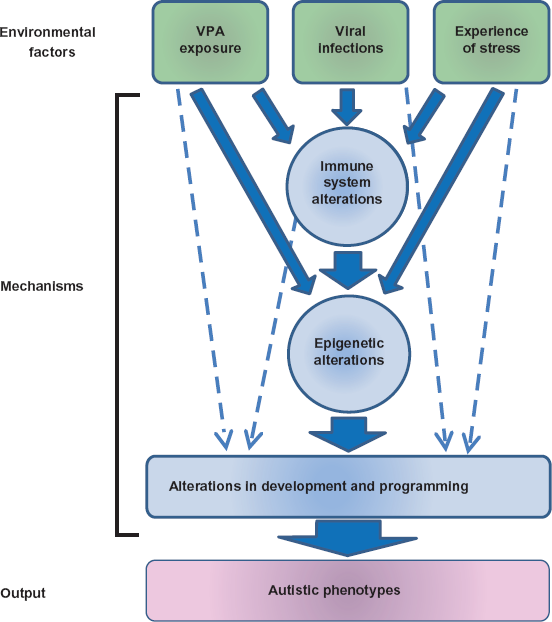
Possible Pathogenic Mechanisms of Autism by Environmental Factors.
Abbreviations
VPA, valproic acid; IL, interleukin; TNF, tumor necrosis factor; poly(I:C), polyinosinic: polycytidylic acid; PPI, prepulse inhibition; BDV, Borna disease virus; JAK2/STAT3, Janus tyrosine kinase 2/signal transducer and activator of transcription 3; DNMT1, DNA (cytosine-5-)-methyltransferase 1; IFN, interferon; HDAC, histone deacetylase; HPA, hypothalamic-pituitary axis; PPARα, peroxisome proliferator-activated receptor α; IGFBP1, insulin-like growth factor binding protein 1; CRF, corticotropin-releasing factor; GR, glucocorticoid receptor; NGFI-A, nerve growth factor-inducible protein A.
Disclosure
This manuscript has been read and approved by all authors. This paper is unique and is not under consideration by any other publication and has not been published elsewhere. The authors and peer reviewers of this paper report no conflicts of interest. The authors confirm that they have permission to reproduce any copyrighted material.