






Abstract
This study investigated the effectiveness of Chinese therapeutic food on female reproductive hormones in a double–blind, placebo–controlled clinical trial. Chinese kiwi fruit extract (Hong En No. 1) was provided for Australian peri-menopausal women for one month. Chinese medical assessment and urinary 2-hydroxyestrone (2-OHE) and 16alpha-hydroxyestrone (16alpha-OHE) tests were conducted. Twenty-six urinary samples (pre and post-trial) which met the requirement of testing were analysed, the ratio 2-OHE:16alpha-OHE of pre-trial (1.18 ± 0.34) and post-trial (0.97 ± 0.29) in the control group (n = 6) decreased but showed no significant change, this ratio of pre-trial (1.44 ± 0.16) and post-trial (1.65 ± 0.21) in the treatment group (n = 7) indicated an improvement (P = 0.066), which results in beneficial hormone regulation. The Chinese medicine assessment indicated that the patterns of disharmony mainly include Liver Qi stagnation and Liver-Kidney Yin deficiency patterns. No significant change observed in the control group, significant score reduction of the patterns of disharmony was achieved at post-trial in the treatment group, which indicates an improvement of general health condition.
Keywords
Background
Hormonal fluctuations are known to affect the quality of life at different stages in the human lifespan. In middle-aged peri-menopausal women, hormonal fluctuations are specifically known to impact both mental and physical health. Sometimes the health outcomes eventuate in severe diseases for many women, eg, breast cancer, coronary heart disease and osteoporosis.
Treatments for hormonally-related diseases are available from both Western and Chinese perspectives. While there is a great deal of commonly shared ground between Western and Chinese medicine, the main difference between them is that diagnosis in Chinese medicine relies on patterns of disharmony or dysfunction of the organ systems and then aims to match the pattern of disharmony to observable pathophysiological change rather than explaining causes based solely in terms of pathophysiological malfunction.
This study investigated the Chinese medicine patterns presented in this peri-menopausal group and the effectiveness of the selected Chinese food–-Chinese kiwi fruit extract on the regulation of the biomarker 2-hydroxyestrone:16α-hydroxyestrone. The outcomes were compared with a similar study conducted previously.
Chinese Medicine Patterns of Disharmony
In Chinese medicine, female hormonal related diseases are related to the Liver meridian. In menstrual disorders, Liver meridian and Kidney meridian functions are important factors. 1 During the fourteenth century, Dr Dan-Xi Zhu summarised that a woman, who was worried and depressed, would suffer from an accumulation of stagnation. The stagnation would be the cause of Spleen Qi deficiency, the Liver Qi rebels horizontally and the stagnation finally turns into nodules. 1 The selected Chinese food extract, can nourish yin and clear heat which may resolve the symptoms mentioned above (which prevent an unwanted change in hormonal levels) and improve the quality of women's lives.2,3
Comparisons between modern diagnostic methods (eg, bio-marker tests) and Chinese medicine diagnostic methods indicate that Liver Qi stagnation and Liver-Kidney Yin deficiency may be the two main patterns of pre-clinical changes in the breast. 4
Female Reproductive Hormones
Female reproductive hormones have an important role in hormonally related breast cancer growth. 5 Endocrine therapy has been developed based on the hormone and cancer relationship, for example the oestrogen receptor blocker, tamoxifen, has been widely used. 6 Breast cancer oestrogen receptor (ER) status is useful in predicting benefits from endocrine therapy. 7
In spite of the benefit of oestrogen receptor blockers for breast cancer treatment, modern research has investigated oestrogen specific pathways, which are involved in oestrogen metabolism and play a role in the aetiology of breast cancer. 8 A large population based case control study has been used to assess the association of the urinary oestrogen metabolites 2-hydroxyestrone (2-OHE) and 16α-hydroxyestrone (16α-OHE) and their ratio in breast cancer. 9 The mean of 2-OHE:16α-OHE ratio is reported at 1.6:1 in 42 postmenopausal patients and in the breast cancer patient is reported at 0.71:1. 10 Studies indicate 2-OHE is a weak acting oestrogen, non-genotoxic and has an antiestrogen effect.11,12 In Lewis’ research, 13 16α-OHE has been found as a potent oestrogen which is capable of accelerating cell cycle kinetics and stimulating the expression of cell cycle regulatory proteins. Lewis also stated that 16α-OHE is a potent stimulator of DNA synthesis in ER-positive breast cancer cells. 13
In view of the above, a high level of 16α-OHE will stimulate the ER-positive breast cancer growth and a high ratio of 2-OHE:16α-OHE may be of benefit to reduce breast cancer incidence. The ratio of 2-OHE:16α-OHE has also been used as a biomarker for breast cancer in clinical trials.14,15
Chinese Kiwi Fruit Extract
Chinese herbal formulae and food therapy have long been used to effectively regulate endocrinal disorders in Chinese clinical practice.1,2 One Chinese food therapy of interest is the Chinese food extract–-Chinese kiwi fruit drink, Kiwi fruit (Actinidia chinensis) is rich in vitamin C, vitamin E, vitamin K, folate, antithetic acid, niacin, lutein, zeaxanthin, arytenoids, falconoid, calcium, iron, manganese, selenium, zinc, copper, potassium and magnesium, fibre and amino acids.16, 17 The selected extract contains polysaccharides, multiple kinds of organic acids, isoflavones and adequate amounts of trace elements, all of which have been previously used to increase the bio-marker 2-OHE:16α-OHE.2, 18 This extract is used to improve the quality of life of women suffering from endocrine disorders. 19 Research indicates that Kiwi fruit itself may be a potential therapeutic product for preventing cancer.20–22
The Chinese kiwi fruit extract contains isoflavones which are categorised as phytoestrogens. Their functions are different to oestrogen 22 and the isoflavones will not cause side effects like those commonly attributed to hormone replacement therapy. A cohort study found that the therapy, which combined oestrogen with progestin, was associated with an increased risk of breast cancer, stroke, venous thromboembolic disease and heart disease. 23 Isoflavone can increase the ratio of 2-OHE:16α-OHE and reduce the risk of breast cancer. 12
The Chinese kiwi fruit extract was investigated in a series of laboratory, animal and human studies and found to have anti-mutagenic, anti-carcinogenic, antioxidant, anti-atherogenic and anti-toxicity effects, as well as assisting in DNA repair and stimulating the immune system. 24
Methods
Fourteen middle aged women responded to newspaper advertisements and were recruited as participants of this study at Victoria University according to the following criteria: female, Melbourne resident; aged from 40 to 55 (not experiencing amenorrhoea over two years). Criteria for applicant exclusion:
Pregnant or breast feeding
Positive mammogram or ultrasound diagnosis of breast cancer
Undertaking hormone therapy or taking any form of contraceptive pills
Taking tamoxifen or undergoing chemotherapy after surgical treatment of breast cancer
Suffering from liver and/or kidney disease
Being post-menopausal or experiencing amenorrhoea over two years
Food allergy or history of intolerance to kiwi fruit
Suffering from a major chronic disorder which required of taking medications
The selected Chinese therapeutic food is a wild resourced Chinese kiwi fruit extract (Hong En No. 1, also known as Hong En Health Drink) in powder form, provided by Professor Houen Xu of Peking University. This extract meets the requirement of providing therapeutic efficient 3-OH isoflavones, extracted by ethanol-water extraction method.
In this double-blind, placebo-controlled clinical trial, the participants were randomly assigned into treatment (taking the Chinese kiwi fruit extract) and control group (taking placebo) using numbered order as they became available. The group assignments were kept blind from the participants and data collectors.
Participants in treatment group took 10 g powder each time, twice a day, mixed with 100 ml warm water. 24 The selected dosage was recommended by a number of Chinese medicine practitioners and laboratory experiments.3, 19 The powder was administered one hour before meals (breakfast and dinner), over a one month period.
Chinese medicine assessment involved standard Chinese medicine diagnostic procedures 25 which include questioning of symptoms, checking of pulse and observing the tongue of the participants by two registered Chinese medicine practitioners. The symptoms and signs in relation to Liver Qi Stagnation including: anger, stress, abdominal bloating, excessive dreams, irregular menstruation, bitter taste in mouth and wiry pulse; The symptoms and signs in relation to Liver-Kidney Yin deficiency including: lower back pain, weak knee, hot flushes, tinnitus, night sweating, scanty menstruation, dry throat, red tongue, less tongue coating, thin and rapid pulse. The collected symptoms and signs were matched to patterns of disharmony, using the 0–10 scale (agreeable by the practitioners). The scores represent the levels of disharmony from 0 to a maximum of 10. Scores between 1–5 are recognised as minor patterns of disharmony, while those between 6–10 are severe patterns of disharmony.
2-OHE:16α-OHE urine test used the ESTRAMET Urinary Estrogen Metabolite Kit (from IMMUNA CARE Corporation), which is a competitive, solid-phase enzyme immunoassays. 18 The collected urine samples at the pre and post-trial were analysed. Procedures follow the requirement of the Urinary Estrogen Metabolite Kit. Urinary oestrogen is ordinarily measured normalized according to urinary creatinine concentration in units of nanograms, which is the ratio of oestrogen to per mg creatinine. The correlation of ESTRAMET 2-OHE and 16α-OHE versus these metabolites by Gas Chromatography-Mass Spectroscopy (GCMS) method were greater than 0.94. 26 Data were analysed using t-test by SPSS 18.
The study was approved by the relative committee and the ethics approval was gained from the Human Research Ethics Committee of Victoria University, Australia. All participants received an explanation document and a consent form for completion.
Results and Discussion
Thirteen participants completed all the tests, one withdrew due to other health condition. Twenty-six urinary samples (pre and post-trial) which met the requirement of testing were analysed, the ratio 2-OHE:16α-OHE of pre-trial (1.18 ± 0.34) and post-trial (0.97 ± 0.29) in the control group (n = 6) decreased but showed no significant change, this ratio of pre-trial (1.44 ± 0.16) and post-trial (1.65 ± 0.21) in the treatment group (n = 7) indicated an improvement (P = 0.066), which results in beneficial hormone regulation (See Table 1). The Chinese medicine assessment indicated that the patterns of disharmony mainly include Liver Qi stagnation and Liver–Kidney Yin deficiency patterns. Significant score reduction of the patterns of disharmony was achieved at post-trial in the treatment group, no significant change observed in the control group (See Table 2).
The effects of Chinese kiwi fruit extract on urinary 2OHE:16α-OHE of peri-menopausal women. *

Participants take Chinese kiwi fruit extract (Hong En No. 1) 10 g x 2/days x 4weeks;
P = 0.066, t = 2.244.
Levels of Liver Qi stagnation and Liver-Kidney Yin deficiency at pre and post-trial.
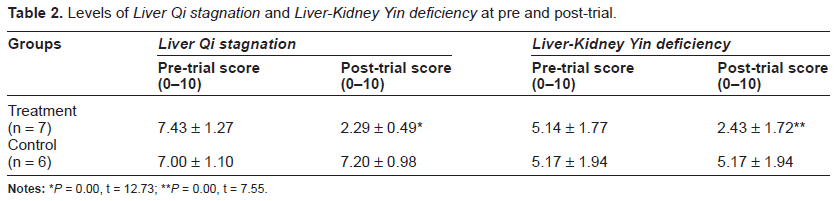
P = 0.00, t = 12.73;
P = 0.00, t = 7.55.
Chinese medicine assessment indicated that the participants felt correspondingly weaker and their health conditions also had adverse trends in their middle age. They commonly had mood swings which relates to Liver Qi stagnation. 1 Peri-menopausal symptoms also affected their daily life. Data collected from these participants at this stage of testing indicated that the adverse symptoms and relative signs changed after the treatment resulting in the levels of disharmony being reduced.
The results of this study have further approved a similar conclusion to a previous pilot study, with six Chinese menopausal women, who were administered 100 ml Hong En No. 1 drink for two days. Their urine sample ratio of 2-OHE:16α-OHE was elevated by the intake of this drink. 24 After a two day period of usage, 16α-OHE had reduced significantly that benefit women's health.
In a previous clinical trial, 3 thirty-nine participants, who were diagnosed with cancer and had just completed chemotherapy, were given this drink (equal to 20 g of Hong En No. 1) daily over a seven day period. The results indicated the rate of binucleate lymphocyte cells with micronuclei in these participants had significantly decreased. This may indicate the recovery of chromosome change. 3
According to Bradlow 18 the urine 2-OHE:16α-OHE ratio is stable over the menstrual cycle of women who have not taken oral contraceptives. The results gained from these studies demonstrate a reliable outcome which using 2-OHE:16α-OHE as a biomarker to evaluate the effectiveness of the selected Chinese therapeutic food on reproductive hormone. These results indicated that Chinese kiwi fruit extract can benefit the reproductive hormones for middle aged women, therefore reduce the risk of hormone fluctuation related diseases.
After the completion of the trial, it was shown that the changes of patterns of disharmony indicated in the Chinese medicine assessment are relevant to the change of biomedical markers, which may be useful in western-medical assessment of hormones fluctuation and pre-clinical breast diseases. If Chinese medicine diagnostic methods indicate that Liver Qi stagnation and Liver-Kidney Yin deficiency are the main patterns of middle aged women hormone fluctuation or pre-clinical breast diseases, it is reasonable to argue that the treatment principle should be based on regulating Qi and nourishing Yin. This study has provided a repeatable evidence of using the Chinese kiwi fruit extract for the regulation of hormonal disorder and Chinese medicine patterns of disharmony.
Conclusions
In this study, the patterns of disharmony for a group of middle aged Australian women presented reflect the Chinese medicine theory that Liver Qi stagnation and Liver-Kidney Yin deficiency are the main patterns for this group. The bio markers used in this study are both reliable and sensitive in order to investigate the hormone imbalance. The selection of the Chinese therapeutic food–-Chinese kiwi fruit extract could benefit those concerned with peri-menopausal symptoms or diseases associated with hormone disorders and treat the patterns of disharmony.
Disclosures
This manuscript has been read and approved by all authors. This paper is unique and not under consideration by any other publication and has not been published elsewhere. The authors and peer reviewers report no conflicts of interest. The authors confirm that they have permission to reproduce any copyrighted material.
Footnotes
Acknowledgements
We would to thank Associate Professor Jack Antonas of Victoria University who has assisted in proposing the study. We would also like to thank the participants for their involvement in this research.