






Abstract
There are few reported studies on Saudi population for human leukocyte antigens (HLA) genes. We investigated allele lineages (two-digit) and haplotype frequencies of HLA-A, -B, -C, -DRB1, and -DQB1 loci in 499 healthy unrelated individuals, selected from potential bone marrow transplant (BMT) families’ donors at King Fahad Medical City (KFMC), Saudi Arabia (SA). Genotyping was performed by Sequence Specific Oligonucleotide Probe (SSOP) utilizing a Luminex-based method. Allele lineages and haplotype frequencies were evaluated along with principal component analysis (PCA) to compare findings with previously reported data on Arab related populations. A total of 18 allele lineages for HLA-A, 28 for -B, 14 for -C, 13 for -DRB1, and 5 for -DQB1 were detected. High values for linkage disequilibrium indicators were found for B:C (D’ = 0.86599) and DRB1:DQB1 (D’ = 0.89468) loci. Additionally, PCA results confirmed previous findings on this population, but also indicated some genetic distances from other Arab related populations. The present study helps in further investigations of this population in anthropological analysis and HLA-associated disease studies.
Keywords
Introduction
Major histocompatibility complex (MHC) molecules in humans, also known as human leukocyte antigens (HLA), are encoded by several genes on the short arm of chromosome 6 in region 6p21.3.1. HLA genes are highly polymorphic and have a significant impact on the outcome of organ transplant (SOT), hematopoietic stem cell transplantation (HSCT), and pharmacogenetics.1–6 In HSCT, serious complications such as graft rejection and graft-versus-host disease could be minimized by matching HLA alleles of donor and recipient prior to transplant. 7 In the case of pharmacogenomics, several drugs such as abacavir and carbamazepine may cause diverse reactions, as these drugs appear to react with the antigen-binding groove of certain HLA alleles causing T-cell mediated hypersensitivity. 8 Analysis of alleles and/or haplotypes of the HLA molecules also provides useful means to study the genetic diversity among different populations and within individuals of the same ethnic group.9–11
Most of the population in Saudi Arabia (SA) are of Arab origin who have lived in this region for thousands of years. 12 The central areas of SA such as Riyadh and Al Gaseem have more population stability than other parts. 13 The rate of consanguineous marriage is relatively higher among the Saudis, and for the central area of Riyadh province, it is estimated to be around 62.8%.13,14 SA is part of the Arabian Peninsula, which also includes other countries such as Oman and the United Arab Emirates. During the Islamic state era (between the 7th and 8th centuries AD), the Muslim Arabs spread their language and culture to North Africa and the middle of Asia.13,15
Frequency and geographical distribution of HLA genes/ alleles have been well studied over the last two decades; however, few studies were performed among the Saudi population.16–18 In this study, we investigated HLA-A, -B, -C, -DRB1, and -DQB1 allele lineages and haplotype frequencies among healthy and unrelated families of bone marrow donors from Riyadh province. To our knowledge, the sample size of individuals recruited in this study is relatively larger than the previous HLA studies in Saudi population. Our aim was to determine allele and haplotype frequencies in the Saudi population and compare the outcome with other Arab related populations and also to provide a frequency pool reference to assist researchers in anthropological analysis and HLA-associated disease studies.
Materials and Methods
Samples
Ethylenediaminetetraacetic acid (EDTA) blood samples were collected from 499 healthy unrelated individuals randomly selected from donor-related Bone Marrow Transplant (BMT) patients list (one donor from each family) whose parent and grandparent were living in the Riyadh Province of SA. There were 275 males with an average age of 33.3 years and 224 females with an average age of 29.5 years at the time of sample collection. According to King Fahad Medical City (KFMC) hospital records, the selection of study subjects precluded having any two individuals or their mothers/ fathers descending from the same parents. Thus, first or second cousins are not included in the study. The study was approved by the institutional review board of KFMC, and informed consent from study participants was obtained.
Allele lineage typing
Genomic DNA was extracted using a MagNa pure compact instrument (Roche Diagnostics GmbH, Mannheim, Germany). HLA-A, -B, -C, -DRB1, and -DQB1 genotyping was performed by Sequence Specific Oligonucleotide Probe (SSOP) utilizing a Luminex-based method using the Lab Type kit (One Lambda, San Diego, USA), procedure details are available at http://www.onelambda.com. The genotyping procedure at KFMC is continuously monitored for quality assurance by the University of California Los Angeles (UCLA) and by the College of American Pathologists (CAP).
Statistical analysis
Allele lineages for HLA-A, -B, -C, -DRB1, and -DQB1 loci were calculated by a direct counting method, the exact testing method was used to evaluate Hardy–Weinberg equilibrium (HWE), and also the Ewens–Watterson (EW) homozygosity neutrality test, linkage disequilibrium (LD) tests among different loci as well as haplotype frequencies were all evaluated using the PyPop software. 19 Principal component analysis (PCA) was conducted using the SAS software 20 to determine and portray the genetic differences and similarities between our study sample and other available data on Arab related populations.
Results and Discussion
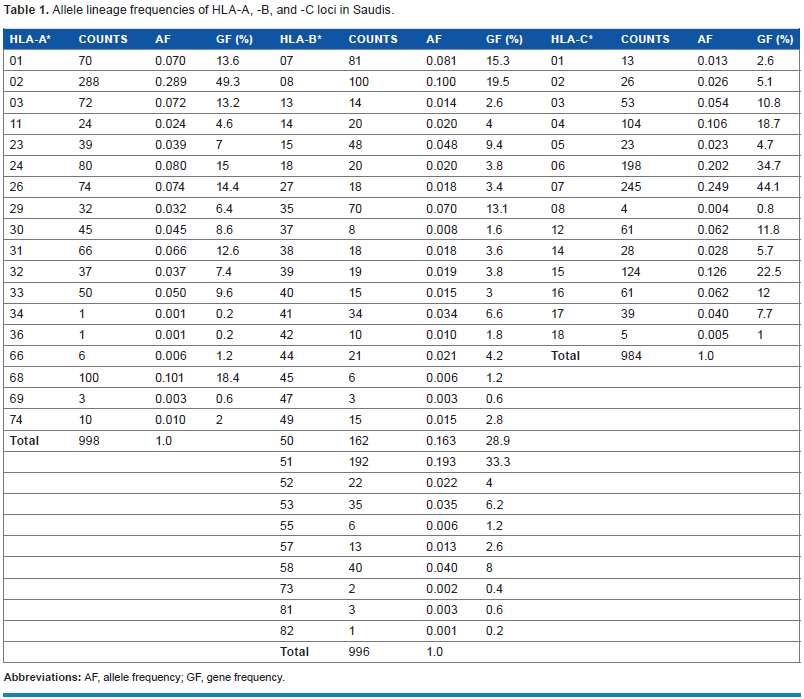
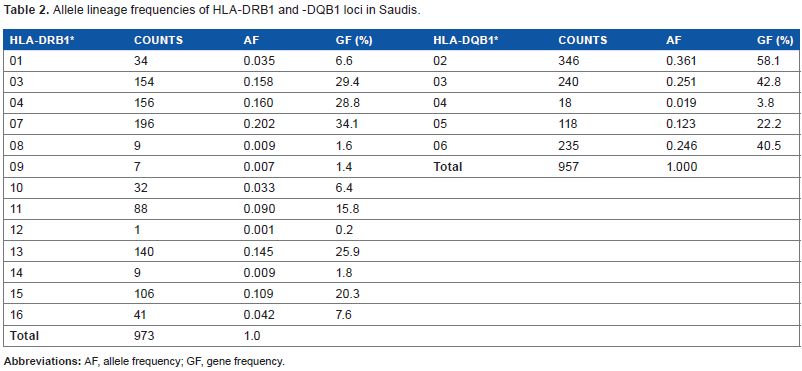
The frequencies for HLA-A, -B, -C, -DRB1, and -DQB1 allele lineages are shown in Tables 1 and 2. All previously described allele lineages for the HLA-A locus were observed in this study, except A*25, A*43, and A*80. The highest frequency was observed for A*02 (28.9%), followed by A*68 (10.1%), A*24 (8%), and A*26 (7.4%). Similar frequencies of A*02 have been reported in other SA studies (Riyadh city) (30.4%) and Guraiat and Hail areas (27.9%) and also in other related Arabs populations such as United Arab Emirates (25.2%).16,18,21,22 The allele lineage A*43 has been mainly reported in populations of African descent, 23 which may explain its absence in our Saudi population. For HLA-B locus, 28 allele lineages were identified in this study with B*51, B*50, and B*08 representing more than 45% of the alleles frequency. The B*51 allele lineage, which has been associated with Behçet's disease, 24 demonstrated the highest frequency among Saudis (19.3%). In contrast, B*46, B*48, B*54, B*56, B*59, B*67, B*78, and B*83 allele lineages were not observed in our study population. There is nothing remarkable about finding previously reported results. The highest observed frequencies for HLA-C were C*07 (24.9%), C*06 (20.2%), and C*15 (12.6%); whereas for HLA-DQB1 were DQB1*02 (36.1%), DQB1*03 (25.1%), and DQB1*06 (24.6%). Lastly, DRB1*07, DRB1*04, DRB1*03, and DRB1*13 were the most predominant allele lineages for the HLA-DRB1 locus with 20.2%, 16%, 15.8%, and 14.5% frequencies, respectively. It is worth noting that our study is in agreement with previously reported Saudi studies in terms of allele lineage frequencies for HLA-A, -B, and -DRB1.16,21 However, little variation from our study was indicated in Guraiat and Hail area reports that may explain the possible differences from one area to another within one country.
Allele lineage frequencies of HLA-A, -B, and -C loci in Saudis.
Allele lineage frequencies of HLA-DRB1 and -DQB1 loci in Saudis.
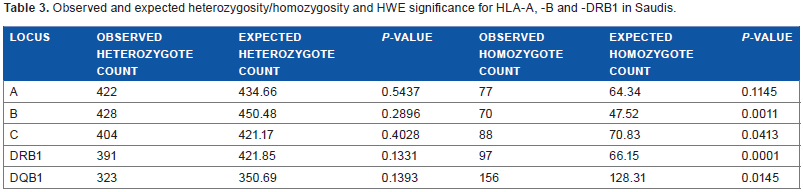
As displayed in Table 3, the HWE deviation was not observed for the heterozygote component of the HLA-A, -B, -C, -DRB1, and -DQB1 loci data. However, that was not the case for the homozygote component of these genetic markers except for HLA-A locus; the high frequency of A*02 (28.9%) allele suggests that this population may have been positively selected. 4 Excess homozygosity was observed in this dataset and Hajeer et al 18 dataset. This deviation from HWE can be attributed to the high rate of consanguinity among the Saudi population and particularly in Riyadh province or to Wahlund effect that is caused by subpopulation structure. 14
Observed and expected heterozygosity/homozygosity and HWE significance for HLA-A, -B and -DRB1 in Saudis.
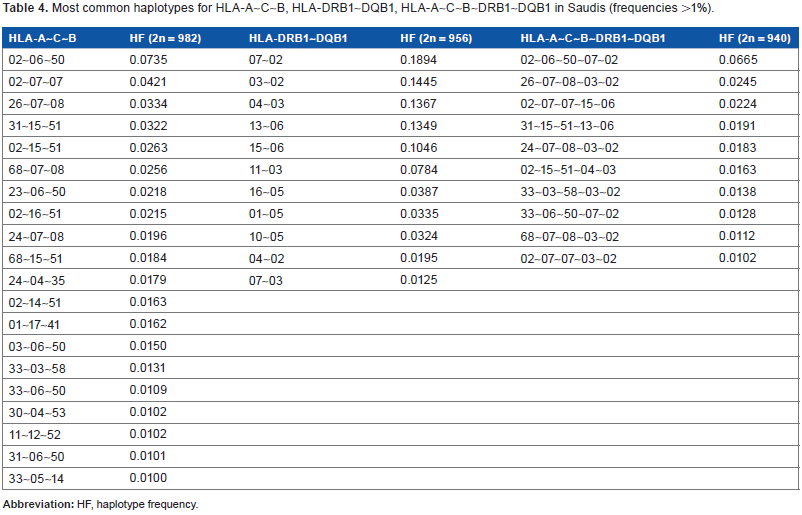
Estimation of multiple-locus haplotypes by the maximum likelihood method revealed 20 common (>1%) haplotype groups for HLA-A~C~B loci combinations (Table 4). The most common haplotypes were A*02~C*06~B*50 (7.3%), A*02~C*07~B*07 (4.2%), and A*26~C*07~B*08 (3.3%). The A*02~C*06~B*50 haplotype has been mainly found in two North African populations, Morocco and Tunisia,9,25 probably because of their Arabic descent. For HLA-DRB1 and -DQB1 haplotypes, 11 common haplotypes were found (Table 4). The most predominant haplotypes were DRB1*07~DQB1*02 (18.9%), DRB1*03~DQB1*02 (14.4%), and DRB1*04~DQB1*03 (13.6%). Finally, the analysis of HLA-A: C:B: DRB1:DQB1 loci revealed 424 haplotypes with 10 haplotypes having frequencies >1%. The highest observed frequencies among these allele lineages were for combinations A*02~C*06~B*50~DRB1*07~DQB1*02 (6.7%), A*26~C*07 ~B*08~DRB1*03~DQB1*02 (2.4%), and A*02~C*07~B*07~ DRB1*15~DQB1*06 (2.2%). The most common haplotype in our study (A*02~C*06~B*50~DRB1*07~DQB1*02) was also reported as one of the highest in the Tunisian population with a frequency of 3%. 25
Most common haplotypes for HLA-A~C~B, HLA-DRB1~DQB1, HLA-A~C~B~DRB1~DQB1 in Saudis (frequencies >1%).
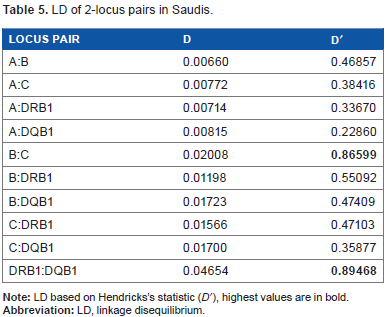
The LD values for A-B, A-C, A-DRB1, A-DQB1, B-C, B-DRB1, B-DQB1, C-DRB1, C-DQB1, and DRB1-DQB1 pairs were calculated (Table 5), the highest D’ values were observed between B-C (0.86599) and DRB1-DQB1 (0.89468) loci pairs.
LD of 2-locus pairs in Saudis.
PCA analyses (Fig. 1) were performed to portray the genetic distances of the HLA-A, -B, and -DRB1 allelic distributions between our study population and other Arab related origin, available at http://www.allelefrequencies.net. 21 Except for the study in Guraiat and Hail areas of HLA-DRB1 locus, other Saudi reports were very close in genetic distance to our study population. Similarities with our data were also indicated for United Arab Emirates, and Oman in HLA-A locus, and for Moroccan, Tunisians, and Algerians for HLA-DRB1. Interestingly, our previous data demonstrated close affinities between the Saudis and Omani, Tunisian, Palestinian (Gaza), and Moroccan populations in killer immunoglobulin-like receptors study. 15 The noted variable degree of genetic distances between our study and other Arab populations (Fig. 1) may be attributed to admixture with populations from other ethnic origins.
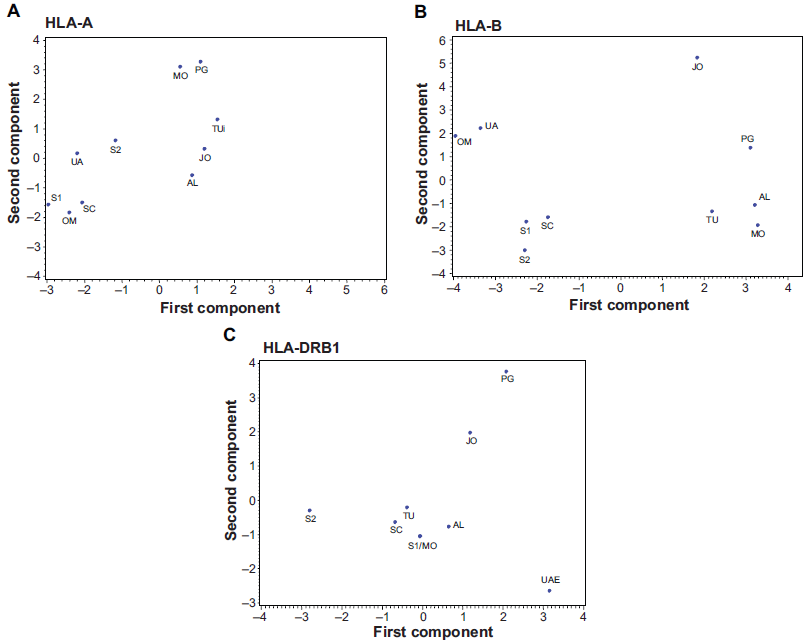
PCA of (A) HLA-A, (B) -B, and (C) -DRB1 allele frequencies data of 10 Arab related populations. Saudis Riyadh 16 (S1), Saudis Guraiat and Hail 21 (S2), Saudi current study (SC), Jordanians 21 (JO), Omanis 21 (OM), Moroccans 9 (MO), Palestine 21 (PG), Tunisians 25 (TU), Algerians 21 (AL), and United Arab Emirates 22 (UA). First component represents 68.5% of the total genetic variation and second component represents 17.5%.
Although one of the potential limitations of our results is that the analyses were performed using a two-digit resolution typing level, this study provides basic data for anthropological analysis, HLA-associated disease studies, and organ transplantation (eg renal transplantation). Larger sample size studies using higher resolution typing methods are also recommended.
Author Contributions
AO and GE conceived and designed the experiments. AO, HA, and NE performed the experiments. FG and MM analyzed the data. AO and HA contributed reagents/materials/ analysis tools. AO, FG, and MM wrote the paper. DM, GE, and NB supervised the study. All authors reviewed and approved of the final manuscript.
Footnotes
Acknowledgments
Our thanks and appreciation is extended to the BMT donors who participated in this study. We also thank Dr Abdulwahid Aldehaimi and members of the immunology and serology laboratory at KFMC for their help and support.