






Abstract
Mass care feeding for disaster evacuees is an important component of public health preparedness. If universities that offer a training course for registered dietitians could provide food assistance to the evacuated people in their campus, it could contribute to maintain their health. Many universities are expected to become a base of support activities for people affected by disaster. This study aimed to reveal disaster preparedness in a university that offers a training course for registered dietitians, from the aspect of provision of mass care feeding. As Japan has 124 universities that offer such training courses, this case study could serve as a useful reference for them and contribute to the improvement of health of the affected people. A group interview was conducted in University A in 2012. The participants included two faculty members in the course, a vice president, a staff member, and a faculty member in charge of disaster preparedness and response. Stockpiled foods were limited to dry bread and pre-processed rice. No alternative heat sources were stored. It was concluded that to provide nutrients other than carbohydrate, hot meals should be served for the evacuees. Additionally, it would be difficult to provide meal service when the essential utilities such as gas and electricity are disrupted.
Introduction
Japan has experienced large earthquakes many times. At 14:46 on March 11, 2011, the Great East Japan Earthquake, with a magnitude of 9.0, struck off the Sanriku coast of the Pacific Ocean. The earthquake generated a large-scale tsunami, and more than 15,000 people were killed, 8,500 were injured, and the number of evacuees amounted to approximately 470,000. 1
The earthquake also affected the Tokyo metropolitan area, located 300 km from the epicenter of the earthquake. In the metropolitan area, many people commute by public transportation. Because this service stopped as a result of the earthquake, 5.15 million commuters spent hours walking home or had to spend the night in schools, workplaces, and other public facilities. 2
In Japan, local governments have stockpiled foodstuffs such as dry bread and drinking water for residents, and city employees take a lead role in support activity for the affected people. However, public stockpiles are not sufficient for all residents, because of constraints on budget and storage space. 3 In a large-scale disaster, local governments cannot support all the shelters in their jurisdiction. 4 There are some situations where the administrative function failed and support activities by city employees did not have adequate reach, because municipal office was damaged or many employees were affected as well. 5
Many universities are assigned as local evacuation sites in Japan because they have large school yards and gymnastic halls that are suitable for evacuation. In addition, they are expected to serve as a base for support activities, including food assistance, for neighboring residents and stranded people (people who are unable to return home due to the disruption of public transportation).
In the evacuation centers operated by local governments, the residents are provided with stockpiled foods, such as dry bread and bottled water, for the first few days. After that, foods delivered as relief supplies and meals cooked by the Self-Defense Forces or volunteer groups are served. For example, the meals for one day in a shelter two weeks after the Great East Japan Earthquake consisted of a rice ball, ham, and soy milk for breakfast; a rice ball and herring with kelp for lunch; and a rice ball, a boiled egg, pickles, and curry for supper. 4 When people come to universities for safety, water, food, adequate plumbing, and a blanket should be provided for them. In addition, if they are required to stay for a few days due to the unrecovered transportation, cooked food like a rice ball and miso soup should be provided, even if support from the local government cannot be gained. Cooked hot meals like soup can improve appetite among disaster affected people under unusual stress, and they can include vegetables, which cannot be provided by stockpiled or instant foods. 6
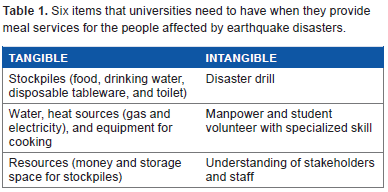
In universities that offer training courses for registered dietitians, there are cooking rooms in which students practice, where meals can be cooked in large quantities. The students learn menu planning, cooking techniques, hygiene management, and food service administration. The teachers, being specialists of food hygiene and nutritional management, can coordinate meal services for the evacuees. If the facilities and manpower in such universities can be used for food assistance in natural disasters, it may greatly contribute to evacuees’ health. In fact, a public health center requested that a registered dietitian training institution provide meal services for affected people in the past earthquake. 7 However, various preparations are needed to make such services viable (Table 1).
Six items that universities need to have when they provide meal services for the people affected by earthquake disasters.
Japan has 124 universities that offer a training course for registered dietitians throughout the nation. If disaster preparedness at these sites is advanced, they can contribute to improved care and health of the affected people. This case study aimed to reveal disaster preparedness in a university offering a training course for registered dietitians and to discuss how such a university should prepare to carry out mass care feeding as a support activity for people affected by a disaster.
Methods
Study period and method
In November 2012, the second author, acting as an interviewer and following a script, held a group interview for two hours. Participants were interviewed about the six items in Table 1.
Participants
There were a total of five participants consisting of two faculty members (B, C) and three persons in charge of disaster preparedness and response (D–F) in University A, which offers a training course for registered dietitians.
University A, which is a national women's university located in the metropolitan Tokyo area, is home to about 4,000 students, faculty, and staff. Approximately 160 students, from freshman to senior year, are enrolled in the training course for registered dietitians.
Professor B was the chairman of the training course. When the university provides food assistance after a natural disaster, contribution of persons associated with the training course would be indispensable in both technical and personnel terms, and the course supervisor's view would be important. Associate Professor C was in charge of the food service management subject area. The teacher in charge of this subject area must play a core role in planning and management of meal services for the evacuees.
Person D was the vice president in charge of emergency management and disaster prevention. Person E, a faculty member in another department, was the leader of the working group in the campus disaster prevention committee, and had once engaged in preparing the risk management manual of University A. Person F was the chief of the disaster prevention subsection, and was involved in practical aspects such as stockpile management and institutional disaster prevention measures.
Ethical considerations
The participants were asked to read the request form for participation in the study before the interview began. We obtained the participants’ consent to participate in the study by receiving their signed consent forms. This study was approved by the institutional review board of University A (approval number: 24–25). As this article contains the detailed information of University A, we obtained a written approval for publication from the head of general affairs of University A.
Analysis
The content of the interview was recorded and transcribed. After reading the transcript, the following points were extracted: (1) insufficient areas in preparedness for emergency food assistance, (2) barriers and difficulties in promoting the preparedness, and (3) what they have to do from this time. Two authors performed the extracting task independently. The areas extracted by both these authors were included in this study. The words within quotation marks (“ ”) were briefly rewritten on the basis of the participant's real speech.
Results
Stockpiles (food, drinking water, disposable tableware, and toilet)
Stockpiles in University A at the time of the interview are shown in Table 2. It followed the local disaster-preparedness plan of the Tokyo Special Ward, in which University A is located. It requires inhabitants and business establishments to store food and drinking water sufficient for 3 days. Although the number of meals needed for 1,000 people for 3 days is 9,000, 30,000 meals of stockpiled foods were actually stored. There was a large quantity overall, but poor variety of foods. As for drinking water, Ordinance for Comprehensively Promoting Measures for Stranded Persons, which was enacted by the Tokyo Metropolitan Government in 2012, says that 3 L of water a day for each person should be stored. University A was considering increasing the storage quantity in the future to meet this standard.
Stockpiles in University A as of November 2012, a year and a half after the Great East Japan Earthquake.

There are about 4,000 people (students and faculty) in University A, but not all of them come to the campus every day. The number of people attending school at one time was estimated to be about 30% of the total, then 3 days worth of stockpiles for 1,000 people are planned to be stored.
No disposable tableware was stored at the time of the interview as dry bread can be eaten with hands and a disposable spoon is attached in the bag of pre-processed rice.
When a major earthquake occurs, water and sewage systems stop. Simple emergency toilets that are used by covering a normal toilet bowl with vinyl were stockpiled, in case water to flush the toilets cannot be used. The vinyl must be removed after every use, putting coagulant in it. They had not determined the disposal location of the final excreta, where they can throw away the collected plastic bags. As garbage collection by municipalities stopped after previous large-scale earthquakes, Person E said they would dig garbage pits. Although it is a women's university, menstrual materials were not stockpiled.
Water, heat sources (gas and electricity), and equipment for cooking
In regards to the interviewer's idea that water for cooking should also be stored, Person F in charge of disaster prevention answered that the university had no space for it. However, University A has several water tanks outside. As it was unknown whether water in them was drinkable or not, Person F suggested that water in tanks would be used as daily life water, and bottled water would be used for drinking and cooking.
The university had a private power generator that uses gasoline as fuel. However, there was no place to store sufficient gasoline for long-term electricity generation; therefore, it could not be used.
In the school cafeteria and the cooking room for mass feeding practice, city gas and electricity were the heat sources. Although propane gas can be used even when city gas and electricity stop, the cooking equipment in both the school cafeteria and the cooking room did not support propane gas. If they want to use propane gas as an alternative heat source during a disaster, the entire cooking equipment should be replaced for its use.
The school cafeteria in University A was run by the university co-op. As the university owns the facility, people in the registered dietitian training course who have abilities for mass cooking were allowed to use the facilities, foods, and cooking utensils in it.
No portable gas stoves or gas bombs were stored in the school cafeteria. In the cooking room used for the class of food service management, however, there was one portable gas stove to demonstrate cooking without the conventional gas stove.
Resources (money and storage space for stockpiles)
If the university provides the evacuees with hot meals, disposable tableware and more variety of foods should be stocked. According to the vice president, Person D, the university could bear the costs of those items, but the storage space was limited. There were many requests for stockpile items other than the foods to be bought in and stored in the warehouses.
Disaster drill
In University A, disaster drills in which the students, staff, and faculty members massed on the field to confirm the escape routes were conducted twice a year. The vice president was considering changing the contents of the drill into more specific ones in the future, for example, eating emergency foods where they evacuated or practicing mass cooking. Disaster drills practicing emergency toilet use had never been conducted before, and the person in charge of providing vinyl and coagulant to the users after the occurrence of a disaster had not been determined.
Manpower and student volunteer with specialized skill
In the Great East Japan Earthquake on March 11, 2011, the university staff had a hard time carrying large quantities of stored supplies, especially 1.5 L bottles of water, from the storage warehouse to the lecture hall where the people had evacuated. Although they are located in the same campus and the supplies were stored sufficiently for all the evacuees, they could not provide the quantity needed due to the lack of carrier and manpower.
In University A, it is the role of homeroom teachers to confirm the safety of their students using e-mail or cell phone when an earthquake occurs. It is difficult for the faculty members who have extra tasks in emergencies to devote themselves to providing meal services for the evacuees. There was a suggestion that a system should be established by constructing a volunteer project with the faculty members from various sections in the university who could get together to take action in a time of disaster. In another suggestion, the staff who are able to grasp and coordinate all the aspects of various support activities within the campus were also necessary.
To provide meal services for the evacuees, there are tasks that are not described in the current university's disaster-prevention manual, such as listing the names of the evacuees to know the number of meals to be served. The vice president stated, “The existing disaster-preparedness plan does not mention the case of prolonged evacuation and detailed matters other than the evacuation route and stockpiles. We would like to ask the students belonging to the training course for registered dietitians who can work voluntarily to cooperate with us.”
Understanding of stakeholders and staff
The understanding of stakeholders and staff is necessary to use the facility and manpower of the university for mass care feeding during disaster. Person E, who was the leader of the working group in the campus disaster prevention committee, stated that “I totally agree with providing hot meals if lifeline works. When providing it, I would ask for the full cooperation of faculty and students in the training course for registered dietitians.” The vice president had a similar idea. Professor B, the chairman of the training course for registered dietitians, also showed a positive attitude. She said, “Whether we can actually do it or not is another matter. I think we should do what we can, as university's mission and social contribution.”
Discussion
Stockpiles (food, drinking water, disposable tableware, and toilet)
A questionnaire survey that was conducted in public universities all over Japan between March and May in 2011, just after the Great East Japan Earthquake, showed that of the universities assigned as local evacuation sites, 32% stored drinking water and 26% stored emergency food. 8 It indicates that even in the assigned local evacuation sites, a limited percentage of the universities stored water and food.
University A had stockpiled food and water, while the variety of foods was limited to dry bread and pre-processed rice. This is not just the case for University A, but for many prefectures and municipalities. 9 The foods provide carbohydrates, a main energy source in Japanese population, and they are cheap and have long shelf life compared to animal foods and vegetable products. In every earthquake, however, protein and vitamin deficiencies became a serious health problem among the evacuees. 10 Nutritional values of the stockpiled foods should be considered as the next step.
The number of toilets University A stored was equal to the total number of meals it stocked. Considering the characteristics of the women's university, however, it is estimated that the number of times one goes to the toilet exceeds three times a day. In addition to this, the evacuees may experience diarrhea due to stress and anxiety, and may also experience irregular bowel movements caused by eating unfamiliar, emergency foods. Therefore, the total number of stored toilets seemed to be not sufficient.
Water, heat sources (gas and electricity), and cooking equipment
According to the Sphere Project, basic water needs for cooking and hygiene practices are between 3–6 and 2–6 L/day, respectively. 11 When water for dishwashing is limited, using disposable dishes covered with plastic wraps enables us to use the same dishes repeatedly by only replacing the wraps. 12 Water for cooking can be reduced by using pre-cut vegetables or ready-to-use ingredients, if available. 13 Pre-cut vegetables and ready-to-use ingredients could also reduce the burden among the cooking personnel.
University A did not store any alternative heat sources for disaster situations. If hot water is available, hot meals such as instant noodles and powdered soup can be served. In the Great East Japan Earthquake, the affected people were delighted with hot meals because it was during the cold season. 14 It is better to store outdoor cooking stoves, gas bombs, and thermos bottles to allow the evacuees to have a hot meal or drink as early as possible after the earthquake occurs. However, it is difficult to determine the quantity of these items to be stored.
In addition, it is important to ensure an accessible supply of fuel. In Japanese households, water is boiled and rice cakes are baked on the top of an oil stove. The oil stoves usually serve not only as space heaters but also as heat sources for simple cooking. However, long-term storage of liquid fuel is difficult in relation to fire laws which is why University A did not store fuel for a power generator.
In every earthquake, electricity had been recovered fastest among the essential utilities such as tap water and city gas. Cooking devices such as electrical pots, electrical hot plates, and rice cookers should be stored as alternative cooking equipment.
Resources (money and storage space for stockpiles)
The reasons given as to why public universities in Japan did not store supplies included “never been discussed,” “no storage space,” and “cannot afford.” 8 In the universities located in the metropolitan Tokyo area where land prices are particularly high, the variety and quantity of stored supplies are often limited due to storage constraint. In University A, water and ready-to-eat food have higher priority than disposable tableware and heat sources when purchasing supplies.
Disaster drill
The disaster-preparedness plan of University A only mentioned the evacuation route immediately after an earthquake, and food and water stockpiles for 3 days. However, this is not limited to University A. 15
A series of simulations regarding the use of the emergency toilets including the collection system of used plastic bags has not been performed yet in University A. It is also important to ensure that women feel and are safe when using the toilet at all times, day and night, with appropriate lighting. A provision of menstrual hygiene material and its appropriate disposal should be included in the plan related to the emergency toilets. As key players, such as Persons D, E, and F, in emergency preparedness in University A are all men, women should be consulted when planning.
The experience in the Great East Japan Earthquake revealed that stockpiles could not be used unless the measures to transport them were available. It is important to simulate transportation and distribution of stored supplies when preparing the manual, and to distribute real stockpiled items in disaster drills to know the heaviness and easiness to transport the items.
It is also important to actually eat the emergency food in the place they will be consumed to become familiar with the preparation and taste, to confirm if it is easy to swallow and digest, and to check how much water is required and desired to drink with it. 16
Manpower and student volunteer with specialized skill
In a time of disaster, various tasks occur such as operation of an evacuation center, answering phone calls, patrolling, and accepting volunteer groups and supplies. The teachers may also have emergency duties, such as confirming the safety of students. Therefore, it is difficult for the teachers to be devoted to supporting activities, such as meal services for the evacuees. It is important to organize the staff immediately after a disaster to cope with the enormous duties, while relieving their anxieties, feelings of being burdened, and fatigue as much as possible. 15 Cross-training to allow several staff and faculty members to take on various roles and making the duty manuals available to everyone are useful for filling a vacant post in a case where the staff member is injured or finds it difficult to come to the university.
One important person in a time of disaster is the coordinator who understands all the aspects of various support activities in the campus. Collection of information is necessary to avoid overlapping of labor (eg similar support activities performed at several places) and to utilize limited stored supplies effectively.
In the Great East Japan Earthquake, students of Ishinomaki Senshu University, which was used as an evacuation center, actively involved in the volunteer activities: serving meals for evacuees, bed-making, providing information, and cleaning the toilets. 17 If a university is opened as an evacuation center, the students who know the campus well can become powerful assets. It is important for the students to move actively by themselves rather than waiting for support from the university. In establishing a disaster prevention system in the university, a cooperation system between the faculty members and students should be built, raising students’ awareness of disasters through drills or the training of meal services for the disaster evacuees.
Understanding of stakeholders and staff
The universities likely to be assigned as local evacuation centers are expected to distribute stockpiled foods, water, and blankets to the evacuees, but it is not necessarily required for them to provide cooked food. If a university intends to conduct mass care feeding voluntarily as a service to the society, it is necessary to obtain understanding of the university's president and person in charge of emergency management and disaster prevention, other than the chairman of the training course for registered dietitians and faculty member(s) with an ability for mass cooking. In University A, the key persons who were the participants in this group interview showed positive attitudes.
Limitations
This study is the first one that elicited in-depth information about disaster preparedness in a university with registered dietitian training course. This was a case study in one university that offers a training course for registered dietitians in Japan; hence, these findings do not necessarily have empirical generalizability to all that sort of universities.
It is said that arbitrariness and subjectivity of researchers are likely to be reflected in the interpretations of the research results in qualitative studies like an interview, but such a problem did not occur as this study aimed to reveal mainly the practical aspects of disaster preparedness in University A. By including not only the faculty members but also the administrative staff, we could reveal a picture of disaster preparedness for food assistance during disaster in University A.
In this interview, person D who was the vice president in charge of emergency management and disaster prevention said that this group interview was a good opportunity for him to review disaster preparedness in University A from the viewpoint of food assistance. This case study could be a useful reference for other universities to have similar approaches, being mutually beneficial for both participants and researchers, and contributes to the improvement of health of the affected people in the future.
Conclusions
The findings from this study concluded that only 1.5 L of drinking water per person was available, and a large quantity but poor variety of foods were stockpiled; no heat sources were available when city gas and electricity would stop in University A; incorporation of practical training of mass care feeding into the current syllabus of food service management is difficult because a larger variety of food and disposable tableware for the class is required and it takes longer hours than lecture; in universities located in the areas where land prices are particularly high, the variety and quantity of stored supplies are often limited due to storage constraint; it is important to simulate transportation and distribution of stored supplies when preparing the disaster prevention manual, and to distribute real stockpiled items in disaster drills to know the heaviness and easiness to transport the items; if a university is opened as an evacuation center, students can become powerful assets and the interviewees expressed their expectation for student volunteers; and In University A, stakeholders showed positive attitudes toward conducting mass care feeding as a service to the society.
Author Contributions
NS and YF conceived and designed the experiments. SI and NS analyzed the data. SI wrote the first draft of the manuscript. SI and NS contributed to the writing of the manuscript. SI and NS agreed with the manuscript results and conclusions. SI, NS, and YF jointly developed the structure and arguments for the paper. NS made critical revisions and approved the final version. All authors reviewed and approved the final manuscript.
Disclosures and Ethics
As a requirement of publication the authors have provided signed confirmation of their compliance with ethical and legal obligations including but not limited to compliance with ICMJE authorship and competing interests guidelines, that the article is neither under consideration for publication nor published elsewhere, of their compliance with legal and ethical guidelines concerning human and animal research participants (if applicable), and that permission has been obtained for reproduction of any copyrighted material. This article was subject to blind, independent, expert peer review. The reviewers reported no competing interests.
Footnotes
Acknowledgment
We would like to thank all the people who took part in this study.