






Abstract
There is no evidence from literature to show the use of ultrasound follicle tracking to monitor ovulation in women on Ricinus communis contraception. In the present study 20 women desiring contraception, gave an informed consent to be scanned from day 9 to day 16 of one of their menstrual cycle to track for follicles. After taking one seed of Ricinus communis, the women were again scanned for the same duration. The result obtained showed normal follicular development before the administration of Ricinus communis and the abolition of follicular development in all the 20 volunteers after taking one seed of Ricinus communis (Figs. 1a and 1b). This result showed that one seed of Ricinus communis taken orally is capable of preventing ovulation in humans and hence its anticonceptive effect may be due in part to the prevention of ovulation.
Keywords
Introduction
It is exciting to know that one small seed (from a plant called Ricinus communis popularly called Castor bean) weighing about 0.14 g can prevent pregnancy for about a year with little or no side effects when taken orally. Toxicity studies in rats have demonstrated a high safety margin, with an LD50 of 63.2 + 16.0 g/ kg compared with a contraceptive dose of 20 mg/kg. This is further supported by the observation that RICOM-1013-J had virtually no effect on the renal status in rats and in women volunteers at the contraceptive doses used. 1
When 2.3-2.5 g of RICOM-1013-J was administered to 50 women volunteers, the result of blood assays showed that the intergrity of the liver was not affected as determined by the values of alkaline phosphatase, transaminases, total protein, albumin and bilirubin in these volunteers which were within normal range. Similarly renal function was not significantly impaired in these women when values obtained after administration of RICOM-1013-J (urea, sodium, potassium, chloride, bicarbonate and glucose) were compared with control. In addition, the serum lipid profile was not significantly affected. 2 In a similar study 3 administered orally three seeds of Ricinus communis and found that the seed demonstrated high efficacy in protecting against pregnancy for a period of 12 months with high compliance. The high acceptability of this seed as a means of contraception is in part due to the minimal side effects and the ease of administration. 1
Based on the size of the seed and initial experiment 4 suggested that lectins in Ricinus communis var minor. known to bind at low concentration for a long period of time may be the agent responsible for the contraceptive action of this seed.
Also 4 found that Methanolic extract of the ether-soluble fraction of Ricinus communis seed possess antiovulatory activity and also distorts the estrous cycle of adult cyclic rats.
Since follicular tracking can be used to track a womans natural cycle using transabdominal or transvaginal ultrasonic approach, the aim of the present study therefore, is to use Ultrasound follicle tracking on those who have ingested the seed to determine if the seed inhibits follicular development and ovulation in humans.
Materials and Subjects
Ricinus communis seeds, ultrasound machine, 20 women Volunteers on Ricinus communis contraception.
Method
20 literate married women between the age of 25 and 40 that attended the family planning clinic in Magnus hospital volunteered to take Ricinus communis contraceptive seed after an exhaustive discussion on the drugs efficacy and the absence of the side effects associated with the hormonal contraceptives. Ethical clearance was also obtained from the Jos University Teaching Hospital ethical committee before conducting the study.
Pretest questions were asked to collect information about the volunteers. Information included gynaecological history (parity, last menstrual period, and duration of menses, length of the cycle, regularity of the cycle, presence or absence of dysmenorrhoea, presence or absence of vaginal discharge. Vaginal examination was conducted on each of the volunteers using a Sims speculum and High Vaginal Swab (HVS) and Endocervical Swab (ECS) were taken for microscopy, culture and sensitivity (MCS).
The subjects were followed up for three cycles during which no other contraceptives were taken. During the three cycles before the administration of the Ricinus communis, follicle tracking was also conducted on the subjects using abdominal ultrasound which also helped to rule out pregnancies in addition to the pregnancy test that was conducted. The women were scanned daily for 7 days from day 9 of their third menstrual cycle to ensure that each woman was producing follicles and therefore, ovulating normally. Each patient that was scanned was given a full big bottle of swan water to drink for some minutes before scanning to be sure they had a full bladder. The subjects were similarly scanned on the third, sixth and ninth cycles after taking Ricinus communis seed.
Results
All the patients selected
In all the 20 subjects, follicles were identified in the control study but no follicles were found when subjects took Ricinus communis. The scanning results are as displayed in Figures 1a and 1b below. The scanning results displayed in Figure 1a was taken from the first subject on day 12 of her third menstrual cycle. The scanning result showed one dominant follicle. The result in Figure 1b was taken from the same patient on day 14 of her third menstrual cycle after taking Ricinus communis when no follicles were identified on the serial scan from day 9 to day 15. This subject had a 28 days cycle when she had her first scan and a 29 day cycle when she was scanned the second time on Ricinus communis.
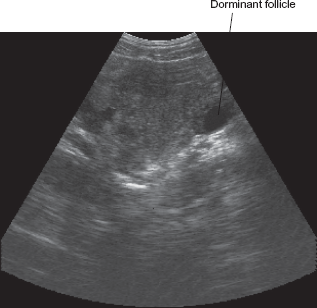
Ultrasound follicle tracking before administration of Ricinus communis, showing a matured follicle.

Ultrasound follicle tracking after administration of Ricinus communis, showing no follicles.
Discussion
When 20 volunteers were scanned daily from day 9 of the menstrual cycle before the administration of Ricinus communis, all the subjects were seen to show evidence of normal follicular development. None of these subjects showed evidence of follicular development after administration of Ricinus communis.
The administration of one seed of Ricinus communis inhibits follicular development and possibly ovulation in 20 of the volunteers that were scanned. It is possible that Ricinus communis inhibit follicular development by competitively binding to estrogen receptors either on the hypothalamus or pituitary; therefore, inhibiting the positive feedback that is required for LH surge that is necessary for folliculogenesis and consequently ovulation to take place. It is also possible that Ricinus communis acts directly on the ovaries by blocking the FSH and LH receptors. The present study failed short of explaining the exact mechanism of inhibition of ovulation by Ricinus communis. Receptor studies and hormonal assays would be essential to expound the mode of inhibition of ovulation.
Conclusion
Ricinus communis prevents conception partly by inhibiting follicular development and hence ovulation in human subjects.
Acknowledgements
We are grateful to the management of Magnus Hospital for giving us the permission to use their patients.
Publish with Libertas Academica and every scientist working in your field can read your article
“I would like to say that this is the most author-friendly editing process I have experienced in over 150 publications. Thank you most sincerely.”
“The communication between your staff and me has been terrific. Whenever progress is made with the manuscript, I receive notice. Quite honestly, I've never had such complete communication with a journal.”
“LA is different, and hopefully represents a kind of scientific publication machinery that removes the hurdles from free flow of scientific thought.”
Available to your entire community free of charge
Fairly and quickly peer reviewed
Yours! You retain copyright
Footnotes
This manuscript has been read and approved by all authors. This paper is unique and is not under consideration by any other publication and has not been published elsewhere. The authors and peer reviewers of this paper report no conflicts of interest. The authors confirm that they have permission to reproduce any copyrighted material.