






Abstract
Aim
To assess plasma zinc and copper concentration in individuals with Asperger's Syndrome, Pervasive Developmental Disorder-Not Otherwise Specified (PDD-NOS) and autistic disorder, and to analyze the efficacy of zinc therapy on the normalization of zinc and copper levels and symptom severity in these disorders.
Subjects and methods
Plasma from 79 autistic individuals, 52 individuals with PDD-NOS, 21 individuals with Asperger's Syndrome (all meeting DSM-IV diagnostic criteria), and 18 age and gender similar neurotypical controls, were tested for plasma zinc and copper using inductively-coupled plasma-mass spectrometry.
Results
Autistic and PDD-NOS individuals had significantly elevated plasma levels of copper. None of the groups (autism, Asperger's or PDD-NOS) had significantly lower plasma zinc concentrations. Post zinc and B-6 therapy, individuals with autism and PDD-NOS had significantly lower levels of copper, but individuals with Asperger's did not have significantly lower copper. Individuals with autism, PDD-NOS and Asperger's all had significantly higher zinc levels. Severity of symptoms decreased in autistic individuals following zinc and B-6 therapy with respect to awareness, receptive language, focus and attention, hyperactivity, tip toeing, eye contact, sound sensitivity, tactile sensitivity and seizures. None of the measured symptoms worsened after therapy. None of the symptoms in the Asperger's patients improved after therapy.
Discussion
These results suggest an association between copper and zinc plasma levels and individuals with autism, PDD-NOS and Asperger's Syndrome. The data also indicates that copper levels normalize (decrease to levels of controls) in individuals with autism and PDD-NOS, but not in individuals with Asperger's. These same Asperger's patients do not improve with respect to symptoms after therapy, whereas many symptoms improved in the autism group. This may indicate an association between copper levels and symptom severity.
Introduction
The pervasive developmental disorders, or autism spectrum disorders (ASD), range from a severe form, called autistic disorder, to a milder form, Asperger syndrome. If a child has symptoms of either of these disorders, but does not meet the specific criteria for either, the diagnosis is called pervasive developmental disorder not otherwise specified (PDD-NOS). Other rare, very severe disorders that are included in the autism spectrum disorders are Rett syndrome and childhood disintegrative disorder. 1
ASD is a complex, behaviorally defined neurodevelopmental group of disorders characterized by social deficits, language impairments, and repetitive behaviors. There has been a dramatic increase in the diagnosis of ASDs over the past decade. 2
The etiology of this complex disease is highly heritable, but likely involves environmental factors. 3 Twin studies demonstrate concordance rates of 82%–92% in monozygotic twins and 1%–10% concordance rate in dizygotic twins. 1 Sibling recurrence risk (6%–8%) is 35 times the population prevalence.1,4
Genetic analysis suggests that as many as 15 genes might be involved in autism spectrum disorders, including variants on chromosomes 2q, 7q, 15q, and 17q.5–8
Children with ASD frequently have accompanying gastrointestinal, immunological, or nonspecific neurological symptoms.9–15
Zinc has a unique and extensive role in biological processes. Since the discovery of this element as an essential nutrient for living organisms,16–18 many diverse biochemical roles for it have been identified. These include roles in enzyme function, 19 nucleic acid metabolism,20,21 cell signaling 22 and apoptosis. 23 Zinc is essential for physiological processes including growth and development, 24 lipid metabolism, 25 brain and immune function.24,26
Dietary factors that reduce the availability of zinc are the most common cause of zinc deficiency. However, inherited defects can also result in reduced zinc. Both nutritional and inherited zinc deficiency produce similar symptoms, such as dermatitis, diarrhea, alopecia and loss of appetite. 27 With more prolonged deficiency causing growth impairment and neuropsychological changes such as emotional instability, irritability and depression.28–31
Deficiency of zinc in man has now been recognized to occur not only as a result of nutritional factors, but also in various disease states, including malabsorption syndromes, acrodermatitis enteropathica, Crohn's disease, alcoholism and cirrhosis of the liver.59,60
Low intracellular zinc has been found to be associated with DNA damage, oxidative stress, antioxidant defenses, and DNA repair,32,33 and zinc may serve as an important anti-oxidant. 34
Copper (Cu), a trace metal, is also an essential element for living cells. It plays an important role in redox reactions because of its easy conversion from Cu+ to Cu++. Copper is transported mainly by ceruloplasmin, a copper-binding antioxidant protein that is synthesized in several tissues, including brain.35,36
Copper levels are low in Menke's kinky hair syndrome, 37 malnutrition 38 and Malabsorption. 39 Elevated copper levels are associated with infections, 40 inflammation, 41 trauma, 42 Wilson's disease, 43 excessive dietary intake 44 systemic lupus erythematosus, 45 as well as autism. 46
Because of the potential association between Zn and Cu levels and ASD, we tested patients with autism, Asperger's and PDD-NOS for plasma concentration of these elements and then compared the concentrations with severity of disease symptoms.
Materials and Methods
Subjects
Experimental and Control
Plasma from 79 autistic individuals 68 make; mean age 11.7 ± 5.62), 52 individuals with PDD-NOS (47 male; mean age 9.9 ± 7.6), 21 individuals with Asperger's Syndrome (19 male; mean age 14.87 ± 7.87) (all meeting DSM-IV diagnostic criteria), and 18 age and gender similar neurotypical controls, was obtained from patients presenting at the Health Research Institute/Pfeiffer Treatment Center. Most of these individuals meet the DSM-IV criteria and were diagnosed using The Autism Diagnostic Interview-Revised–-ADI-R before presenting for treatment at the Pfeiffer Treatment Center, Warrenville, Il.*
The Pfeiffer Treatment Center is a comprehensive treatment and research center, specializing in the care of with neurological disorders, including depression.
Patient consent was obtained from all patients involved in this study and this study was approved by the IRB of the Health Research Institute/Pfeiffer Treatment Center.
Severity of Disease
An autism questionnaire was used to evaluate symptoms. The questionnaire (Pfeiffer Questionnaire) asked parents or caregivers to assess the severity of the following symptoms: Awareness, Expressive Language, Receptive Language, (Conversational) Pragmatic Language, Focus, Attention, Hyperactivity, Impulsivity, Perseveration, Fine Motor Skills, Gross Motor Skills, Hypotonia (low muscle tone), Tip Toeing, Rocking/Pacing, Stimming, Obsessions/Fixations, Eye Contact, Sound Sensitivity, Light Sensitivity, Tactile Sensitivity, Pica/ eats dirt, metal, Tics and Seizures. The symptoms were rated on a scale of 0–5 (5 being the highest severity) for each of these behaviors.
Zn and Anti-Oxidant Therapy
Individuals in this study who presented to the Pfeiffer Treatment Center with depression (or anxiety) were tested for Zn, Cu and anti-oxidant levels. Based on deficiencies, they were then prescribed the appropriate dose of anti-oxidants. Pre-therapy patients represent those who were tested when they first presented and were not previously taking any Zn or anti- oxidants. Post-Therapy patients received anti-oxidant therapy (Vitamin C, E, B-6 as well as Magnesium, and Manganese if warranted), and Zn supplementation (as Zn picolinate), daily, for a minimum of 8 weeks.
Serum/Plasma
All experimental and control plasmas were treated in an identical fashion–-refrigerated (4 C) immediately after collection and cell/serum separation, then used within 4 hours for inductively-coupled plasma-mass spectrometry.
Copper and Zinc Serum Concentration
Copper and zinc plasma concentration was performed by LabCorp, Inc. (Naperville, IL 60563) using inductively-coupled plasma-mass spectrometry, as previously described. 62
Statistics
Inferential statistics were derived from t-test with 95% confidence intervals.
Results
Plasma from 79 autistic individuals, 52 individuals with PDD-NOS, 21 individuals with Asperger's Syndrome (all meeting DSM-IV diagnostic criteria), and 18 age and gender similar neurotypical controls, were tested for plasma zinc and copper using inductively-coupled plasma-mass spectrometry.
Autistic and PDD-NOS individuals had significantly elevated plasma levels of copper (P = 0.0133; P = 0.04556, respectively) None of the groups (autism, Asperger's or PDD-NOS) had significantly lower plasma zinc concentration (Table 1).
Plasma Cu (mg/dL), Zn (mg/dL) and Cu/Zn in neurotypical controls and Autistic, Asperger's and PDD-NOS Individuals.

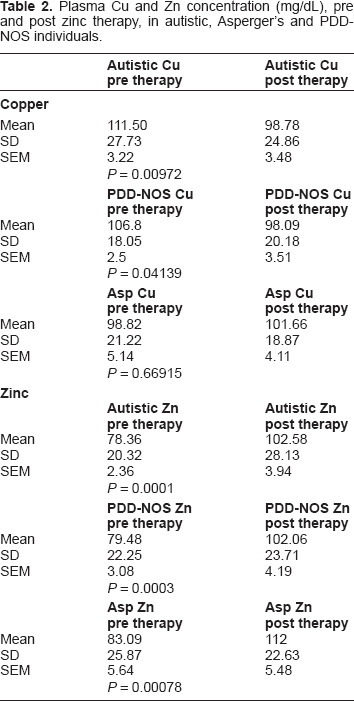
Post zinc and B-6 therapy, individuals with autism and PDD-NOS had significantly lower levels of copper (P = 0.00972; P = 0.04139, respectively), but individuals with Asperger's did not have significantly lower copper (P = 0.66915). Individuals with autism, PDD-NOS and Asperger's all had significantly higher zinc levels (Table 2).
Plasma Cu and Zn concentration (mg/dL), pre and post zinc therapy, in autistic, Asperger's and PDD-NOS individuals.
Severity of symptoms decreased in autistic individuals following zinc and B-6 therapy with respect to awareness (P = 0.039), receptive language (P = 0.014), focus and attention (P = 0.011), Hyperactivity (P = 0.002), Tip Toeing (P = 0.002), Eye Contact (P = 0.085), Sound Sensitivity (P = 0.098), Tactile Sensitivity (P = 0.012) and seizures (P = 0.057). None of the measured symptoms worsened after therapy. None of the symptoms in the Asperger's patients improved after therapy (Fig. 1).
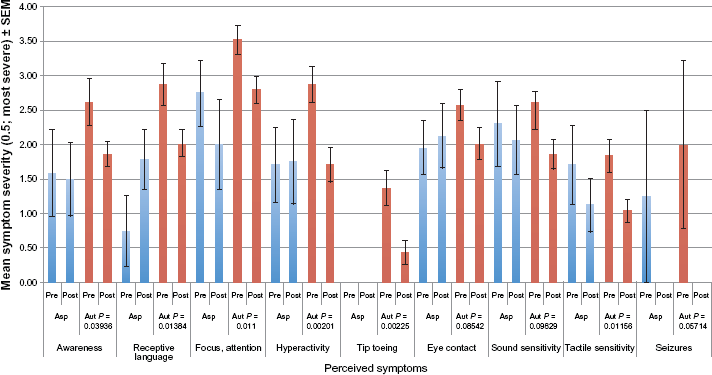
Perceived symptom severity in individuals with autism and Asperger's Syndrome pre and post zinc and B-6 therapy.
Discussion
There is much support for the role of GABA in the etiology of autism. Alterations in levels of GABA and GABA receptors in autistic patients indicate that the GABAergic system, which is responsible for synaptic inhibition in the adult brain, may be involved in autism.47–49
Zinc has been found to be associated with GABA and glutamate regulation, particularly through anxiolytic activity, modulating GABAergic inhibition and seizure susceptibility.50–52 Zinc deficiency has also been found to be associated with GABAergic impairment. 53
Copper, on the other hand, has been found to be a potent inhibitor of GABA-evoked responses, particularly in Purkinje cells. Copper toxicity, notably in Wilson's disease, could result, to some extent, from chronic GABAA receptor blockade. 54 Data strongly suggest that Cu and Zn might interact with each other with GABAA receptor complex and participate in modulation of synaptic transmission. 55
Dopamine-β-hydroxylase (DBH) is a neurotransmitter, synthesizing enzyme, which catalyzes the formation of norepinephrine from dopamine. Copper is a co-factor required for this enzyme's activity.57,58 Increased norepinephrine levels have been found in autistic individuals, 56 which, at least in part, could be explained by excess copper.
Our study shows that autistic individuals have lower levels of zinc and significantly higher levels of copper when compared to neurotypical controls. We suggest that the low zinc and high copper may modulate GABA, ultimately causing a lowering of transmitter concentration. High copper may also be associated with high norepinephrine found in autistic children, and low GABA and high epinephrine may, in turn, manifest as excitability and hyperactivity associated autistic symptoms. To evaluate this relationship, future studies will assess more patients with autism and evaluate GABA and norepinephrine levels, as they are associated with Cu and Zn levels.
Zinc induces the intestinal synthesis of a copper-binding protein's such as metallothionein. Metallothionein traps copper within intestinal cells and prevents its systemic absorption. 61 Our data suggest an association between copper and zinc plasma levels and individuals with autism, PDD-NOS and Asperger's Syndrome. We report that copper levels normalize (decrease to levels of controls) in individuals with autism and PDD-NOS, but not in individuals with Asperger's. These same Asperger's patients do not improve with respect to symptoms after therapy, whereas severity of symptoms (awareness, receptive language, focus and attention, hyperactivity, tip toeing, eye contact, sound sensitivity, tactile sensitivity and seizures) decreased in autistic individuals following zinc and B-6 therapy.
We do not know why copper doesn't normalize after zinc therapy in Asperger's patients but suggest that since symptom severity of these patients remains high, high copper levels are most likely associated with symptom severity.
Disclosures
Author(s) have provided signed confirmations to the publisher of their compliance with all applicable legal and ethical obligations in respect to declaration of conflicts of interest, funding, authorship and contributorship, and compliance with ethical requirements in respect to treatment of human and animal test subjects. If this article contains identifiable human subject(s) author(s) were required to supply signed patient consent prior to publication. Author(s) have confirmed that the published article is unique and not under consideration nor published by any other publication and that they have consent to reproduce any copyrighted material. The peer reviewers declared no conflicts of interest.
Footnotes
Acknowledgement
This study was supported by a grant from the Autism Research Institute