






Abstract
Nowadays, an electronic health information management system (EHIMS) is crucial for patient care in hospitals. This paper explores the aspects and elements that contribute to the success of EHIMS in Nigerian teaching hospitals. The study adopted a survey research design. The population of study comprised 442 health information management personnel in five teaching hospitals that had implemented EHIMS in Nigeria. A self-developed questionnaire was used as an instrument for data collection. The findings revealed that there is a positive, close relationship between all the identified factors and EHIMS's success: technical factors (
Keywords
Introduction
The healthcare delivery system of a nation hinges, amongst other things, on how well its hospitals are able to deliver qualitative and affordable healthcare to its citizens. Thus, the role of hospitals in the healthcare delivery system of a nation cannot be overemphasized. The Nigerian healthcare delivery system includes a wide range of providers in both the public and private sectors, such as public facilities managed by federal, state, and local government. There are also private-for-profit providers, nongovernmental organizations (NGOs), community-based and faith-based organizations, and religious and traditional care givers. This paper focuses on teaching hospitals as tertiary-level care providers in Nigeria.
The Nigerian healthcare delivery system operates a referral system, thus making teaching hospitals the primary health institutions providing tertiary level of healthcare. In medical practice, tertiary-level healthcare specializes in consultative care, usually on referral from primary or secondary medical care personnel by specialists working in a center that has personnel and facilities for special investigations and treatment. They are also vital sites of education and research that bear considerable and varied expertise to clinical care. 1 The functions expected of a teaching hospital will be difficult to attain without a well-organized, effective, and efficient health information management system in place.
The amount and quality of information available to healthcare professionals in patient care impact the outcome and continuity of patient care. Furthermore, medical information needed for clinical decision making continues to increase, especially in developing countries. However, the organization and accessibility of medical information have remained poor, usually resulting in inappropriate decisions and medical errors. 2 Electronic health information management systems are therefore seen as crucial for increasing accessibility and management of medical information. 3
Healthcare organizations around the world are recognizing the importance of investing in information technology as an efficient means to deliver high-quality care through rapid information retrieval and efficient data management. Studies have shown that, with the advent of information technology, traditional paper-based health information system can be replaced with flexible electronic means, which could lead to cost reduction and effectiveness in terms of timely delivery of healthcare services.4–7
The application of information and communication technology (ICT) in the management of health information in healthcare organizations in hospitals has been tagged with diverse names – electronic health record (EHR), electronic medical record (EMR), computer-based patient record (CBPR), hospital information system (HIS), and electronic health information management system (EHIMS). This paper adopts the term EHIMS in a more comprehensive sense through which the management of health information can be viewed in a teaching hospital.
EHIMS can be defined as a massive and integrated system that supports the comprehensive information requirement of hospitals including patient, clinical, ancillary, and even financial management. It could be seen as only one instance of a holistic health information system, which has been designed to store, manipulate, and retrieve clinical and administrative information. 8 The ideal EHIMS is generally considered as one that captures data from any number of computer systems in the healthcare organization and is used at the point of care to support clinical decision making. This is both demonstrated and supported by the International Organization for Standardization's (ISO's) definition of EHR as “a repository of patient data in a digital form, stored and exchanged securely, and accessible by multiple authorized users. It contains retrospective, concurrent, and prospective information, and its primary purpose is to support continued, efficient, and quality integrated health”. 9
Research has shown that the use of EHIMS will bring about increased digitization, which makes the management of comprehensive medical records (from patient information to diagnostic care and prescription data) an effortlessly straightforward process. EHIMS will also enable healthcare providers to get multiple views on diagnostic care and treatment, as well as assess both preventive measures for various illnesses and the outcome of clinical trials and research. It also has significant potential to improve patient safety, patient satisfaction, and organizational efficiency, thereby improving health outcomes for patients.10–13
In addition, there are clinical and financial opportunities associated with using EHIMS. 14 Clinical opportunities include continuous access to patient records, 24 hours a day; practitioner reminders and alerts; ongoing education for healthcare professionals; easy access for practitioner and patients; improved decision support through electronic links to bodies of scientific knowledge and other external sources; timely and effective care, and easy and smooth follow-up of patient care. Financial opportunities of the EHIMS include reduction in the cost of healthcare, time savings in documentation; prevention of misfiling or loss of patient records, better utilization of resources, and reduction of frequent services such as laboratory tests. EHIMS also plays a vital role in planning, initiating, organizing, and controlling operations of the subsystems of a hospital, thus providing a synergistic organization in the process. Furthermore, it improves patient care by accessing data and making recommendations for care, and enables a hospital to move from a retrospective review to a concurrent one of the appropriateness of care. Furthermore, studies have revealed an objective correlation between the degree of adoption of technologies in healthcare and the reduction of complications and mortality in hospitals.15,16
Given the aforementioned advantages of the implementation of the EHIMS, the introduction of such ICT-based initiatives to transform existing paper-based health information management systems in most public health institutions in developing countries has usually been a difficult process of change, often fraught with several context-sensitive challenges and problems such as lack of adequate resources (poor financial resources and uneven infrastructural development),17,18 inadequate skills and knowledge at a local level to handle new systems and technologies, 19 fragmented and uncoordinated organizational structure and heterogeneity of stakeholders, 20 and political and bureaucratic constraints.18,21,22 Studies have also reported attempts, by governments and donors, concerning the design, development, and implementation of EHIMS in different developing countries.23–25 However, many of these efforts have proven to be unsustainable because of political, socioeconomic, and technological factors. 26
Given the high failure rate of EHIMS, successful implementation is imperative in order to actualize its benefits. In the context of this study, an effective EHIMS is one that serves its intended purposes after implementation. The success of the system is achieved through user satisfaction with the system, which is a result of prolonged use, consequently producing the desired benefits. The success of EHIMS or its efficiency can be measured along several themes of quality dimension (system quality, information quality, and service quality) as well as usage.27–30 The understanding of the factors responsible for the success of the EHIMS is therefore critical to improved healthcare as a whole.
While it is important that this system is implemented as part of a holistic health information system, there are still certain issues challenging its continuous use and overall success. It is crucial that this system is successfully implemented and continuously used over time if it is to bring about any of its intended benefits to healthcare. Several factors ranging from technical ones that have to do with putting the appropriate infrastructures in place, social factors relating to the understanding of human interaction with the system, organizational factors pertaining to organizational structures and work processes through to financial factors relating to the cost of developing and operating the system, political factors that deal with legislative issues, and the government's bureaucratic procedures have all been suggested in the literature as contributing to the success of EHIMS.
Therefore, the objective of this study is to explore some factors that might contribute to the success of EHIMS in Nigerian teaching hospitals. We believe that an exploration of these factors will help in developing and proposing a framework to understand the design, development, and implementation of a successful EHIMS in the Nigerian Public Health Sector, taking into consideration the complexities of the health environment. It is also worth mentioning that this study will be surveying the perceptions of EHIMS end users, who are presented in this study as health information management personnel. The rationale behind this is that the use of EHIMS is not in a steady state yet compared to other supposed users such as physicians and nurses. Health information management personnel are professionals who have undergone specialized training in the management of patient data. However, for the purpose of this study, data entry personnel, despite not having been trained in health information management, are also considered as users. This study also concentrates on the university teaching hospitals in Nigeria that have had experience in implementing an EHIMS.
The following null research hypotheses were formulated to guide the study:
There is no significant relationship between technical factors and EHIMS's success in Nigerian teaching hospitals. There is no significant relationship between social factors and EHIMS's success in Nigerian teaching hospitals. There is no significant relationship between organizational factors and EHIMS's success in Nigerian teaching hospitals. There is no significant relationship between financial factors and EHIMS's success in Nigerian teaching hospitals. There is no significant relationship between political factors and EHIMS's success in Nigerian teaching hospitals.
Methods
A survey research design was employed to explore some of the correlates of EHIMS's success in Nigerian teaching hospitals. We sought to elicit responses from health information management personnel who are the primary users of the system. The study population comprised 442 health information management (HIM) personnel in both federal and state university teaching hospitals that have implemented EHIMS in Nigeria.
The teaching hospitals and the respective HIM personnel included the University College Hospital (UCH), Ibadan (102 HIM personnel); the University of Abuja Teaching Hospital (UATH), Abuja (100 HIM personnel); the University of Ilorin Teaching Hospital (UITH), Ilorin (98 HIM personnel); Obafemi Awolowo University Teaching Hospital (OAUTH), Ile-Ife (32 HIM personnel), and Lagos State University Teaching Hospital (LASUTH), and Ikeja, Lagos (110 HIM personnel). This gave a total of 442 HIM personnel.
We used a total enumeration technique to survey the responses of the HIM personnel. This technique, also referred to as total population sampling, is considered appropriate for this study based on the fact that the population size is relatively small and shares the same characteristics.
The empirical data, which were used in the study, were collected by the researcher at teaching hospitals where there is an existing EHIMS. This was achieved through the use of an instrument tagged “Electronic Health Information Management System Success Factors” (EHIMSSF) questionnaire (see Appendix). To ensure the validity of the instrument used for data collection, the process was subjected to a rigorous peer review conducted by experts in the field of health information systems. The comments and suggestions offered by the experts led to the modification of items in the instrument, thereby ensuring its face and content validity. The questionnaire was also subjected to a reliability test, using the Cronbach's alpha reliability technique. In line with the research hypotheses, a section-by-section reliability test yielded the following results: technical factors: 0.82, social factors: 0.66, organizational factors: 0.77, financial factors: 0.68, political factors: 0.84, and EHIMS's success: 0.76.
Four-hundred forty-two copies of the questionnaire were thereafter administered to the HIM personnel in the studied teaching hospitals by the researchers. A total of 421 copies of the questionnaire (representing a 95% response rate) were retrieved and found to be eligible for analysis. This was then analyzed using a simple correlation analysis, which was conducted using the Statistical Package for Social Science (SPSS version 15).
Results
This segment of the paper presents the results of the statistical analyses carried out in line with the formulated hypotheses.
Hypothesis 1
There is no significant relationship between technical factors and EHIMS's success in Nigerian teaching hospitals.
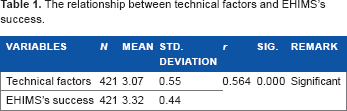
Table 1 reveals a significant positive relationship between technical factors and the success of the EHIMS in Nigerian teaching hospitals (
The relationship between technical factors and EHIMS's success.
Hypothesis 2
There is no significant relationship between social factors and EHIMS's success in Nigerian teaching hospitals.
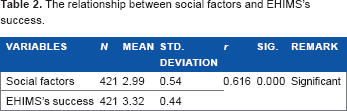
Table 2 indicates a significant positive relationship between social factors and the success of the EHIMS in Nigerian teaching hospitals (
The relationship between social factors and EHIMS's success.
Hypothesis 3
There is no significant relationship between organizational factors and EHIMS's success in Nigerian teaching hospitals.
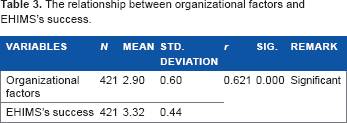
The results of the analysis in Table 3 provide adequate evidence to reject the null hypothesis. It therefore triggers the fact that there is a significant positive relationship between organizational factors and the success of the EHIMS in Nigerian teaching hospitals (
The relationship between organizational factors and EHIMS's success.
Hypothesis 4
There is no significant relationship between financial factors and EHIMS's success in Nigerian teaching hospitals.
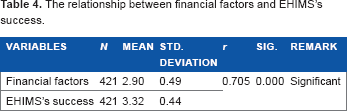
The results in Table 4 demonstrate a significantly positive relationship between financial factors and the success of the EHIMS in Nigerian teaching hospitals (
The relationship between financial factors and EHIMS's success.
Hypothesis 5
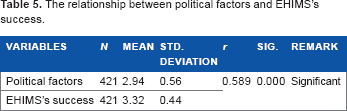
There is no significant relationship between political factors and EHIMS's success in Nigerian teaching hospitals.
The results in Table 5 indicate a rejection of the null hypothesis. Therefore, there is a significant positive relationship between political factors and the success of the EHIMS in Nigerian teaching hospitals (
The relationship between political factors and EHIMS's success.
Discussion
This study reveals that a significant positive relationship exists between technical factors and EHIMS's success in Nigerian teaching hospitals. Technical factors in this study include hardware and software compatibility, appropriately designed software serving its intended functions, an infrastructure supporting implementation of the system, an easy-to-use software requiring little or no training, adequate hardware components, adequate technical support from the system's provider, supportive communication network infrastructure, evaluation of software before implementation, and enough expertise for EHIMS operation. This implies that improving the technical state of the electronic health information system in Nigerian teaching hospitals is closely associated with its success. The findings from this study is in line with those of Hussein et al, who in the context of the Malaysian electronic government environment also identified technical factors such as information system (IS) facilities, that is, the availability of infrastructure; IS integration, that is, the degree to which different components of the system are integrated in terms of functionality; IS competency, that is, employees’ competency to use the system; and the IS structure, that is, the extent to which the system, for instance, supports the communication network, as critical factors to be considered for the success of information systems. 31 This is also in line with the findings of Grover, who found IS infrastructure as one of the top predictors of IS success among several factors investigated. 32 Similarly, a study by Zhu et al found that physical information technology infrastructure contributed to e-business adoption in European firms. 33 It should be noted that e-health, e-government, e-learning, e-payment, e-commerce, etc. are all information systems that require technical factors for their successful implementation. Hence, the relationship of technical factors with the EHIMS's success in this study is not coincidental.
A significant positive relationship between social factors and successful electronic health information management systems in Nigerian teaching hospitals was also revealed in this study. Social factors in this study centered around user awareness of the benefits of using the system, user commitment to the success of the system, user willingness to share information about the system among themselves, adequate training of users, user involvement in design and implementation of the system, and adequacy of the personnel to operate the system. The implication here is that continuous investment in the user of the electronic health information management system could extensively enhance its success. This corroborates the findings of Berg et al, who concluded that the user involvement in the whole design process of an electronic health information system was inevitable. 34 This is no coincidence, as previous studies (eg, Ash et al) have affirmed that people are the most important elements of healthcare delivery systems. 35 Likewise, Ismail et al, in a qualitative study of the Implementation of hospital information system in Malaysian tertiary hospitals, found that quality human resources, a good support system, a user-friendly system, and adequate training of end user determine the successful implementation of EHIMS. 36
Furthermore, this study has also revealed that there is a significant positive relationship between organizational factors and EHIMS's success in Nigerian teaching hospitals. Such organizational factors include top management commitment to the success of the system, support from the different departments involved in the systems’ operation, management's prompt attendance to systems’ maintenance, well-defined system processes, consensus usually reached by various departmental heads on systems’ operation, top management leadership style, user motivation by the management, planning and coordination for systems’ success, and minimal disruption of normal work flow. This result implies that factors such as leadership style and an organization's commitment to the success of the electronic health information system will undeniably contribute to its success. This finding is corroborated by the findings of Lorenzi et al, where it was confirmed that organizational factors can be the decisive element in the success of an intervention. 37 Additionally, the degree to which all stakeholders cooperate and are involved as well as the stability of management structures is fundamental to the successful introduction of innovations.38,39 Similarly, Tsiknakis and Kouroubali in a study of the organizational factors affecting successful adoption of innovative e-health services found that the two most influential factors for the success of ICT implementations were training and organizational support. 40 Ang et al also confirmed that organizational factors such as organizational structure, organizational size, managerial IT knowledge, top management support, financial resources, goal alignment, and the budgeting method all influence IT usage. 41 Biehl also highlights top management support, well-understood work processes, the use of a cross-functional team, and maintaining cross-functional cooperation and communication as important organizational factors to be considered for the implementation of efficient information systems. 42
It is also evident in this study that a significant positive relationship exists between financial factors and EHIMS's success in Nigerian teaching hospitals. Financial factors include availability of funds for systems’ maintenance, eager expectation on returns on investment, cost–benefit analysis, and sufficient budget for continued operations. The result here implies that implementing EHIMS involves a huge capital investment and that continuous financial investment in operating and maintaining the system will consequently aid its success. Cost and lack of awareness of return on investment are usually the biggest impediments to successful implementation and adoption of EHIMS.43,44 This finding confirms that of Postema et al, who in a study of home telecare application found the stability of financing of technology in the home care domain to be a specific influencer with even more complexity than hospital care. 39 Similarly, findings by Yoon et al revealed that, of the factors that impede or facilitate the adoption of EHRs in Korea, financial aspects were reported to be the most important facilitator of the EHR adoption as well as a barrier. 45 This result is, however, contrary to the findings of Raymond, who opined that greater financial investment in computer hardware and software had no direct effect on the success of the system. 46 Likewise, Guy and Marie-Claude opine that demonstrating the financial viability of an electronic health information system project is a necessary but not sufficient condition for success. 47 It is pertinent to mention that the environment for the implementation of a technology application might go a long way in determining whether finance would contribute to its success or not. In a resource-constrained setting like Nigeria where finances are usually hard to come by, its availability or nonavailability will definitely associate with success, as funding is required for running the systems and their maintenance.
This study also brought to light a significant positive relationship between political factors and EHIMS's success in Nigerian teaching hospitals. The political factors studied, such as a change in the government, eagerness to invest on the part of the government, government policy, tools for quality assurance, and a flexible government bureaucracy, will influence the successful implementation of EHIMS. The implication here is that the more the political factors are taken care of, the more will be the success of EHIMS in Nigerian teaching hospitals. Similar to Lin and Silva's position, the adoption of an information system is more a social and political process, which involves various tactics. 48 There is no denying of the fact that the healthcare sector is an intrinsically political one, usually plagued by scarcity of resources and involving a number of actors (top management, government, politicians, practitioners, systems’ vendors, donors) with different agendas. It is therefore essential, according to Braa et al, that the actors in the health information systems fully engage in politics to acquire sustainability. 6 In line with the findings of this study, Ayeni opines that the role of government is also very important in technology adoption and cannot be ignored. 49 Government policies about tax and tariff subsidies, rules and regulations, restrictions, and incentives and support to a particular technology play an important role in its acceptance and rejection.
Conclusion
This study explored factors contributing to the success of EHIMS in Nigerian teaching hospitals. The healthcare sector is information-intensive, and as such there is a need to invest in an effective and efficient EHIMS. This work provided a new perspective on health information systems research and provided a foundation for further research in the field. It theoretically explained the factors that are essential for the success of EHIMS in Nigerian teaching hospitals, thus providing empirical evidence. The results of this study can also serve as a framework for other hospitals on the verge of implementing an EHIMS to follow. This would help them to understand the factors to be considered in implementing a successful system, thereby helping them to prevent wastage of human and financial resources. Again, most studies in the field have been focused on the development and implementation of EHIMS without exploring the factors necessary for success and sustainability. An understanding of what works at the tertiary level of healthcare in the country can be scaled down to other levels of healthcare in the country.
Clinical Relevance Statement
The results of this study are an indicator of the factors to be considered in ensuring that EHIMSs in Nigeria go beyond the implementation stage to bring the expected benefits. While a number of studies have focused on the technological factors, this study has been able to show that there are a number of other factors to be considered in ensuring the success of EHIMS.
Author Contributions
Conceived and designed the experiments: AI, SO. Analyzed the data: AI. Wrote the first draft of the manuscript: AI. Contributed to the writing of the manuscript: AI, SO. Agree with manuscript results and conclusions: AI, SO. Jointly developed the structure and arguments for the paper: AI, SO. Made critical revisions and approved final version: AI. Both authors reviewed and approved of the final manuscript.
Footnotes
Appendix
(SA = Strongly agree, A = Agree, D = Disagree, SD = Strongly disagree)
(SA = Strongly agree, A = Agree, D = Disagree, SD = Strongly disagree)
(SA = Strongly agree, A = Agree, D = Disagree, SD = Strongly disagree)
(SA = Strongly agree, A = Agree, D = Disagree, SD = Strongly disagree)
(SA = Strongly agree, A = Agree, D = Disagree, SD = Strongly disagree)
(SA = Strongly agree, A = Agree, D = Disagree, SD = Strongly disagree)