






Abstract
For the subcutaneous administration of a chemical agent (salubrinal), we constructed a mathematical model of molecule transportation and subsequently evaluated the kinetics of diffusion, convection, and molecular turnover. Salubrinal is a potential therapeutic agent that can reduce cellular damage and death. The understanding of its temporal profiles in local tissue as well as in a whole body is important to develop a proper strategy for its administration. Here, the diffusion and convection kinetics was formulated using partial and ordinary differential equations in one- and three-dimensional (semi-spherical) coordinates. Several key parameters including an injection velocity, a diffusion coefficient, thickness of subcutaneous tissue, and a permeability factor at the tissue-blood boundary were estimated from experimental data in rats. With reference to analytical solutions in a simplified model without convection, numerical solutions revealed that the diffusion coefficient and thickness of subcutaneous tissue determined the timing of the peak concentration in the plasma, and its magnitude was dictated by the permeability factor. Furthermore, the initial velocity, induced by needle injection, elevated an immediate transport of salubrinal at
Introduction
One of the common forms of drug delivery is subcutaneous administration, in which a therapeutic agent is locally injected into a tissue under a skin. An injected agent diffuses into the subcutaneous tissue near the injection site, and it usually circulates throughout a whole body in a bloodstream. To determine appropriate dosages and frequencies of administration as well as evaluate efficacy of local and systemic therapeutic outcomes, it is important to understand pharmacokinetics by analyzing a mass transportation mechanism and a quantitative profile of concentrations in local tissue and blood (plasma). Using data obtained from animal experiments (rats) with subcutaneous and intravenous injections of salubrinal, we built a mathematical model and characterized the temporal profiles of salubrinal concentrations in the plasma.
Salubrinal is a potential therapeutic agent that can reduce cellular stress such as oxidation and stress to the endoplasmic reticulum, and it has been shown to protect cells from apoptosis and assista metabolic process.1,2 However, the expected outcomes may depend on its concentration profiles in the plasma as seen in the case of parathyroid hormone (PTH). PTH is often administered as a form of subcutaneous injection for treatments of patients with osteoporosis and related bone diseases. 3 Interestingly, both animal experimentation and clinical data show that a transient increase of PTH yields an anabolic response and stimulates bone formation, while its sustained elevation contrarily induces a catabolic response leading to bone loss.4,5 Although salubrinal is a synthetic chemical agent and its mechanism of action is largely different from that of PTH,6,7 it is imperative to quantitatively characterize its delivery efficiency as well as temporal concentrations in the plasma prior to any clinical trials.
Models for pharmacokinetics, simulating the concentration profiles of chemical agents and biomolecules, have been studied in various areas.8–10 However, most of these models utilize a compartmental description considering only interactions expressed in ordinary differential equations (ODEs). These ODEs serve to predict the general trends of agents injected subcutaneously, but they do not account for time-dependent spatial distributions. Partial differential equations (PDEs) are utilized in some formulations, for instance, in evaluating the effects of administration of insulin. 11 Few models, however, can be analytically solved using a well-characterized set of parameters and thus it is difficult to validate their predicted mechanisms and behaviors.
In this study we combined PDEs and ODEs to account for diffusion, convection, and molecular turnover in the one- and three-dimensional coordinates, and employed analytical solutions in the simplified model without convection to validate numerical solutions of the general model. The model consisted of two modules: a module for diffusion and convection kinetics from the local tissue at the injection site to blood vessels; and the other module for turnover kinetics (degradation of salubrinal) in the bloodstream. In the first module, PDEs were derived to model diffusion and convection of salubrinal. In the second module, these PDEs in the first module were linked to ODEs that included a transfer of salubrinal at the tissue-blood boundary as well as its degradation during blood circulation.
Using experimental data obtained in rats, the parameters in the model such as the injection velocity, the diffusion coefficient, thickness of the subcutaneous tissue, and the permeability factor (effective boundary area ratio of subcutaneous tissue to blood circulation) were estimated. Note that the permeability factor (between 0 and 1) represents the degree of salubrinal to be transmitted at the boundary of subcutaneous tissue to blood vessels. The specific solutions without convection were derived analytically, while the general solutions were obtained numerically by simultaneously solving PDEs and ODEs. Using numerical simulations, we evaluated sensitivities of key parameters and obtained the model-based prediction of the salubrinal profile in the plasma.
Materials and Methods
Experimental determination of the salubrinal concentration in the rat plasma
Experimental data for building the model were collected using Sprague-Dawley female rats (~8 weeks; ~300 g body weight). All procedures performed in this study were approved by the Animal Care and Use Committee. A dosage of 0.5 mg/kg (salubrinal weight/body weight) was administered via intravenous or subcutaneous injection. Data from intravenous injection were used to predict the degradation rate of salubrinal in the plasma. Blood samples were collected at various time points at 1–22 h after salubrinal injection. The concentrations of salubrinal in the plasma were determined from three animals at each time point by mass spectrometry at Wolfe Laboratories Inc. (MA).
Diffusion and molecular turnover in the one-dimensional model
In the one-dimensional coordinate, the concentration of salubrinal in the subcutaneous tissue in the vicinity of the injection site was derived:

In which

where

In which
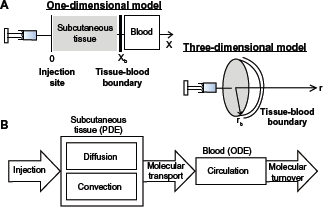
Schematic illustration of the described model.
Diffusion and molecular turnover in the three-dimensional model
In the three-dimensional coordinate (semi-spherical domain; Fig. 1), the salubrinal concentration in the subcutaneous tissue (

In which r = radial coordinate. The concentrations in the subcutaneous tissue and the plasma (

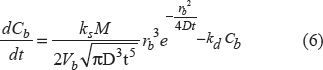
where
Convection induced by the needle injection of salubrinal
To evaluate the effects of the initial velocity induced by needle injection, a term for convection was included in the subcutaneous tissue. In the one-dimensional coordinate, the PDE becomes:

where the injection velocity was modeled as ν = ν0
Estimation of the key parameters
Table 1 lists the representative values for the key parameters employed in this study. The values for the amount of injection, and the blood volume were chosen independently from the mass spectrometry data. The degradation rate,
Representative parameter values employed in this study.

The value for the one-dimensional model;
The value for the three-dimensional model.
The permeability factor (
Numerical simulations
The schematic diagram illustrating the computational procedure is depicted (Fig. 1). The described models were numerically evaluated using MATLAB (version 7.8.0). The PDEs without a term of convection were analytically obtained. The PDEs including convection were solved numerically using a discrete difference method implemented by the
Results
Effects of diffusion and molecular turnover in the plasma
We first examined the pharmacokinetics model for diffusion and molecular turnover without including the convection term. In the one-dimensional model, the selected parameters were

Comparison of one- and three-dimensional models without convection.
Sensitivity analysis of the parameters
Using both one-and three-dimensional models, a sensitivity analysis was conducted to evaluate dependence of the temporal profile of salubrinal concentrations in the plasma on the diffusion coefficient and tissue thickness (Fig. 3). In the figure, the predictions with three different values for each of the parameters are illustrated. First, increasing the diffusion coefficient enhanced the transport of salubrinal into the blood stream, generating a higher and quicker peak value in the plasma. Second, thickening the subcutaneous tissue decreased the entry of salubrinal to the plasma, causing a slower transient response with a lower and longer peak (Fig. 3B). These features were observed both in the one- and three-dimensional models.

Parameter sensitivities.
Effects of convection and injection velocity
In addition to diffusion and molecular turnover, we examined the effects of convection by introducing the initial velocity at the time of salubrinal injection into the subcutaneous tissue. In consistent with the experimental procedure, we modeled the initial velocity as an exponential function with a time constant of 3 min that corresponded to a typical duration of injection. The predicted response with the initial velocity of 2 × 10⁻²m/s is depicted (Fig. 4). Compared to the model without convection, the time required to reach the peak concentration value was shortened and this prediction became closer to the experimental data. The effects of convection were further analyzed by varying the initial velocity (Fig. 5). The result showed that the larger injection velocity was, the quicker rise of the peak salubrinal concentration was generated with the higher peak value in the plasma.

Comparison of the salubrinal concentration profiles in the plasma using the models with and without convection. The solid and dotted curves are the models with and without convection, respectively.

Dependence on the initial velocity. Three values, chosen for the initial velocity, were 1, 3, and 5 cm/s.
Evaluation of experimental data
Using the described model, the concentration profile, obtained by experimentation, was fitted by the numerical solutions for the one-and three-dimensional model (Fig. 6). In this figure, the experimental data points are shown by the dots. The parameters were selected to offer a minimum square-sum error at 6 given data points. The convection term reduced the modeling error at
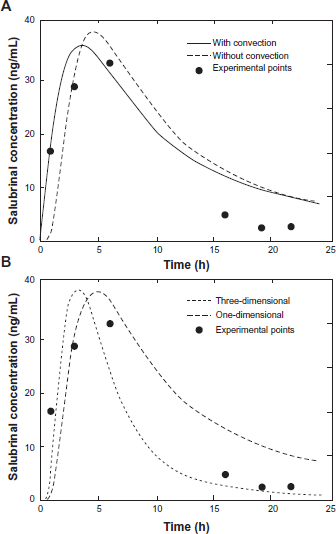
Comparison of the model-predicted concentration profiles to the experimental data. The initial velocity and tissue thickness were set to 2 cm/sec and 5.2 mm, respectively. The permeability factor was chosen to be 0.057 (one-dimensional) and 0.0095 (three-dimensional).
Discussion
We conducted analytical and numerical simulations to evaluate experimental data for the salubrinal concentrations in the plasma in response to subcutaneous administration. The model combined the PDE-derived diffusion and convection process to the ODE-based turnover of salubrinal in the bloodstream using one- and three-dimensional (semi-spherical) coordinates. With reference to analytical solutions of the simplified model without convection, the modelbased analysis herein allowed us to estimate the key parameters in pharmacokinetics and predicted the temporal profiles as well as the delivery efficiency in local tissues and a whole body.
The diffusion-based model without convection in the PDE module was able to characterize the processes of diffusion, transportation at the tissue-blood boundary, and molecular turnover during blood circulation. In both the one- and three-dimensional models, there was a quick increase to the peak concentration followed by an exponential decay of the salubrinal concentrations in the plasma within a day. Using the same set of parameter values, the three-dimensional model exhibiteda slightly faster transient response. Namely, applying the same diffusion coefficient and tissue thickness to the models, the three-dimensional version ascended more quickly to the peak and descended both earlier and more steeply than the one-dimensional version. This model-based result captured the principal differences in these two models, since the three-dimensional coordinate provided the spatial domain with two more degrees of freedom. The permeability factor for the three-dimensional model was close to the predicted value of one fifth of that for the one-dimensional model. The results also indicated that 0.5%–2.5% of the total amount of salubrinal was transported to the blood stream and the rest was absorbed in local tissue and interstitial fluid.
As expected from a biophysical viewpoint, the diffusion coefficient and the tissue thickness affected the temporal profile of the salubrinal concentration in the opposite way. An increase in the diffusion coefficient accelerated the diffusive transportation and elevated the peak of the salubrinal concentration, whereas an increase in the tissue thickness decreased both diffusive efficiency and the peak value. A larger diffusion coefficient implies that molecular agent scan diffuse more quickly, while a larger tissue thickness indicates that there is a greater distance through which salubrinal has to travel to reach the tissue-blood boundary. We assumed that the diffusion coefficient was constant, but it may differ depending on specific tissue locations and diffusive directions. Furthermore, we used 3 mm as tissue thickness for experimental data collected from rats but this thickness may need to be modified when clinical data are employed.
The convection term improved the model at the initial time point. In the absence of convection, we observed a slower rise of the salubrinal concentration than the experimental data points, particularly at
Salubrinal was originally identified as a selective inhibitor of a phosphatase specific to eukaryotic initiation factor 2 alpha (eIF2α), whose phosphory-lation level is regulated by various cellular stresses including oxidation, nutrient deprivation, radiation, and the stress to the endoplasmic reticulum.16–18Administration of salubrinal was reported to reduce cellular stress and cellular death. 1 and chemical analogues to salubrinal were also examined to enhance efficacy to protect cells from apoptosis. 19 We previously applied control theories to derive an administration sequence of salubrinal for treatment of metabolic diseases. 20 The described models in this paper should contribute to development of dosages, frequencies and durations of administration of salubrinal and other chemical agents.
Conclusion
We described the novel mathematical model for estimating the plasma concentration of salubrinal in rats in response to subcutaneous injection. The molecular transportation by diffusion and convection was formulated using PDEs, while the molecular turnover in blood circulation was described by ODEs. The analytical solutions without convection were employed to validate the numerical procedure, and the experimental data were used to select the key parameters such as the diffusion coefficient, thickness of the subcutaneous tissue, the permeability factor, and the injection velocity. The results supported the notion that subcutaneous administration of salubrinal could induce both local and global circulations.
Disclosure
This manuscript has been read and approved by all authors. This paper is unique and is not under consideration by any other publication and has not been published elsewhere. The authors and peer reviewers of this paper report no conflicts of interest. The authors confirm that they have permission to reproduce any copyrighted material.
Footnotes
Acknowledgement
The study was in part supported by funds from the Indiana Clinical and Translational Sciences Institute (to HY) and DOE DE-FG02-09ER16093 (to GW).