






Abstract
Biological enrichment analysis using gene ontology (GO) provides a global overview of the functional role of genes or proteins identified from large-scale genomic or proteomic experiments. Phenomic enrichment analysis of gene lists can provide an important layer of information as well as cellular components, molecular functions, and biological processes associated with gene lists. Plant phenomic enrichment analysis will be useful for performing new experiments to better understand plant systems and for the interpretation of gene or proteins identified from high-throughput experiments. Plant ontology (PO) is a compendium of terms to define the diverse phenotypic characteristics of plant species, including plant anatomy, morphology, and development stages. Adoption of this highly useful ontology is limited, when compared to GO, because of the lack of user-friendly tools that enable the use of PO for statistical enrichment analysis. To address this challenge, we introduce Plant Ontology Enrichment Analysis Server (POEAS) in the public domain. POEAS uses a simple list of genes as input data and performs enrichment analysis using Ontologizer 2.0 to provide results in two levels, enrichment results and visualization utilities, to generate ontological graphs that are of publication quality. POEAS also offers interactive options to identify user-defined background population sets, various multiple-testing correction methods, different enrichment calculation methods, and resampling tests to improve statistical significance. The availability of such a tool to perform phenomic enrichment analyses using plant genes as a complementary resource will permit the adoption of PO-based phenomic analysis as part of analytical workflows. POEAS can be accessed using the URL http://caps.ncbs.res.in/poeas.
Introduction
Phenomics is a recently evolved term to collectively define the measurement of the phenotypic characteristics of biological entities, including the physical and biochemical traits of an organism.1,2 A phenome is a catalog of all phenotypes that is compiled from an experiment or from the collective phenomic knowledge of an organism. Plant phenomics 3 7 refers to the systematic study of plant phenotypes. Ontologies, such as plant ontology (PO), play an important role functioning as translational resources between experimental and in silico phenotyping. Ontologies can be used to capture and map out an existing library of phenotypes to a list of new entities (for example, genes, proteins, and metabolites). Biomedical ontologies have improved the unified interpretation of a group of genes (gene lists), proteins, RNA, or metabolites identified from high-throughput genomics, proteomics, transcriptomics, or metabolomics studies. Gene ontology (GO) and the association of GO terms with gene products and statistical enrichment analyses have contributed to the interpretation of gene or protein lists for more than one decade. Ontologies are currently developed to address highly specific domains or subdomains in the biomedical knowledge universe. To illustrate the growth, currently a total of 329 ontologies are available from BioPortal – an ontology repository of the National Centre for Biomedical Ontology (NCBO). 8 Along with the unanimous growth ofbroad spectrum ontology and widely used ontologies, such as GO,9,10 various other biomedical ontologies are under active development.11,12 While these resources are available as reference tools, a large subset of biomedical ontologies does not have direct association data to connect different biological entities. Apart from the primary goal of the unification of concepts, definitions, and knowledge in biomedical science, a prominent application of biomedical ontologies is enrichment analysis. 13 15 Biological enrichment analysis is a collective term used to define a broad area of knowledge-based statistical approaches. It is designed to identify statistically significant terms associated with the list of biological molecules identified from an experiment when compared to the background distribution (annotations of genes in the genome or genes in experimental platforms). Enrichment analysis can be implemented with an ontology or an annotation repository, such as Pfam domains and Swiss-Prot annotations, to understand the functional trend of biological phenomena.6,16,17 Ontology-based phenomic mappings were used in human phenotypes,18,19 cellular phenotypes, 20 fission yeast, 21 disease annotations, 22 and plants. 23 Plant phenomics have been employed to study several aspects of plants, including the phenomic impact of stress-responsive genes.6,24
Plant Phenomic Enrichment Analyses Using PO
Plant phenomics is the collective measurement of phenomes that includes the physical and biochemical traits of an organism, and the phenome of an organism can be effectively described using ontologies. PO is a compendium of terms to define the diverse phenotypic characteristics of plant species into two categories (plant anatomy, and morphology and development stages). PO definitions and related annotations are available for several model plant genomes and are integrated into several key plant genome databases, such as The Arabidopsis Information Resource (TAIR), NASC/NASCArrays, 25 Gramene/GrameneMart, 26 Sol Genomics Network (SGN), 27 and MaizeGDB. 28 Additional terms, annotations and genomes, are being added to PO because of the collective effort from experimental biologists, computational biologists, and biocurators. 29 However, tools that are designed specifically to utilize the growing plant phenomic knowledgebase are required to leverage their application in large-scale plant phenomic studies. Currently, generic metaanalyses tools, such as DAVID 30 or PANTHER, 31 do not provide enrichment analyses using PO. A tool reported by Xin et al. 29 provides enrichment analysis using PO terms, but the tool does not offer an option to select enrichment methods, multiple-testing correction methods, or visualization in diacyclic graph formats. Recently, while performing a large-scale comparative analysis of stress-responsive genes (n = 3091) in Arabidopsis thaliana, 6 we realized this challenge and adapted a widely used GO term enrichment analysis tool (Ontologizer 2.0) to perform phenomic enrichment analyses using genes from STIFB2. 17 In this manuscript, we describe a web-based version of the utility called Plant Ontology Enrichment Analysis Server (POEAS), which has been developed and provided in the public domain for phenomic analyses.
Materials and Methods
POEAS is currently available for A. thaliana; additional genomes will be added as part of future updates. The latest version of PO files (.obo and .assoc) and TAIR annotations are fetched periodically from PO and TAIR FTP servers, respectively. Currently, POEAS accepts lists of gene names, locus names, or TAIR identifiers (IDs) as input data. The POEAS web interface (Fig. 1) is developed using Javascript, HTML, and CSS. Enrichment analysis was implemented using Ontologizer 2.0, a biomedical ontology enrichment analysis tool that has multiple options available to select the enrichment method and statistical approach. The following types of multiple-testing correction methods are available in the current version of POEAS: Bonferroni, Bonferroni-Holm, Benjamini-Hochberg, Benjamini-Yekutieli, Westfall and Young step-down, and Westfall and Young single-step. Options are also provided to run enrichment analyses without multiple-testing corrections to test potential enrichment in small gene lists. Six enrichment calculation methods are available in the current version of POEAS: Model-Based Gene-Set Enrichment Analyses (MGSA), 32 Parent-Child-Intersection, Parent-Child-Union, 33 Term-For-Term, 13 Topology-Elim, and Toplogy-Weighted.33,34 In the backend, the server uses a scheduler script to retrieve updated PO annotations and associations. POEAS also offers interactive options to identify user-defined background population sets, various multiple-testing correction methods, different enrichment calculation methods, and resampling tests to improve statistical significance (Fig. 1).
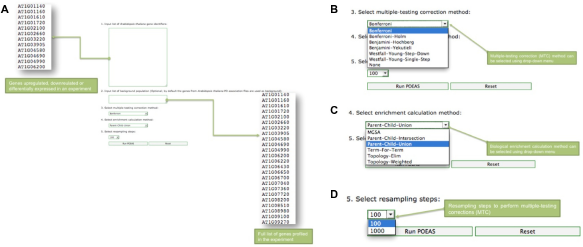
Web interface of POEAS. (
Web Server Construction, the Application Features, and Performance of POEAS
POEAS provides a web-platform for performing enrichment analyses of PO terms using genes from A. thaliana. The user can submit a list of differentially expressed gene IDs from expression profiling (RNASeq or microarray experiments). Depending on the availability, a list of background genes tested in the experiment can also be provided. Further, the user can select multiple-testing correction methods, enrichment calculation methods, and resampling steps to perform the enrichment analyses (Fig. 1). The successful POEAS run provides tables with enriched PO terms associated with the gene list; visualization of the enriched terms in a PO tree diagram can also be accessed. Files are also provided to download enrichment results, annotation tables, and PO diagrams in SVG format. The downloadable files can be used to filter associated PO terms and genes associated with each PO term based on user requirements (Fig. 2).

Features of POEAS. (
A Use-Case for POEAS: Phenomic Features of Stress-Responsive Genes Upregulated by Abscisic Acid (ABA)
POEAS can be used for the phenomic inference of genes from different types of experiments. To illustrate the application of POEAS, we discuss a use-case here. We identified 700 A. thaliana genes that were responsive to ABA stress, which were obtained from the Stress Responsive Transcription Factor Database, version 2 (STIFDB2). These were targeted by one or more stress-responsive transcription factors.6,17,35 This list of 700 TAIR locus IDs was used as input, and the multiple-testing correction method was set to “Bonferroni,” the enrichment calculation method was set to “Term-For-Term,” and the resampling steps were set to “1000.” The output from this analysis provided extensive information on plant phenotypic characteristics represented by these genes. Phenomic analytics revealed that a subset of genes influences plant phenotypes in multiple levels of plant structure development stages (temporal) and plant anatomy. A total of 65 enriched plant anatomy terms (Table 1) and 20 temporal terms (Table 2) were enriched (P = 0.05; Bonferroni corrected). The most significant terms associated with genes that respond to ABA stress treatments are ones like “cotyledon”, “pollen”, “microgametophyte” and “pollen sac”. ABA is a key regulatory plant hormone that acts as a mediator between various physiological processes, including seed dormancy, plant growth, and secondary stress response for various abiotic stressors, such as drought, cold, light, and temperature. Increased levels of ABA were used to replicate environmental stress in the laboratory setting. 36 38 Biological and functional term enrichment analyses of the 700 genes responsive to ABA treatment provided insights into the key biological processes and molecular functions mediated by the genes.6,16,17 Such analyses did not provide insights into plant-specific anatomical or developmental regions where the ABA-responsive genes were localized. PO-based enrichment analyses provided information on sets of genes that are enriched to different anatomical or developmental regions. This information would further help plant or crop biologists in designing experiments that can target a specific anatomical or developmental region and further analyze its role in stress response, tolerance, and adaptation.39,40
PO (anatomy/plant anatomical entity) terms associated with ABA responsive genes in A. thaliana identified using POEAS.
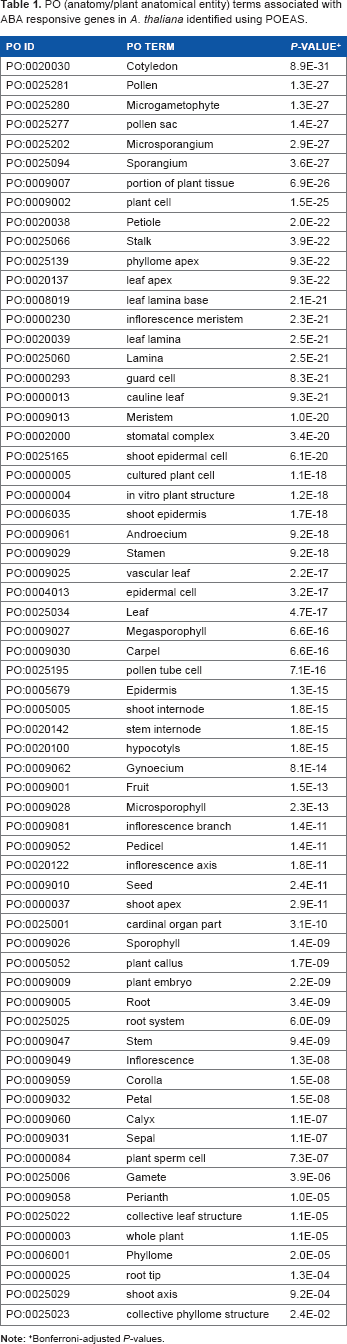
Bonferroni-adjusted P-values.
PO (temporal/plant structure development stage) terms associated with ABA responsive genes in A. thaliana identified using POEAS.

Bonferroni-adjusted P-values.
The server can also be used for phenomic interpretation of Arabidopsis gene lists from a wide array of experimental methods, including gene expression analysis using microarrays, transcriptomic profiling using next-generation sequencing technologies, and differential abundance analysis using proteomic profiling technologies.
Discussion
There are a large number of high-throughput resources that offer information on genes in plant genomics. However, there is currently no standard tool to integrate PO with GO data to conveniently analyze a large number of genes that are of interest. We report the development and availability of POEAS – a web server – for the automatic connections between PO and GO for gene products of A. thaliana. We will soon update this server for other plant genomes as well. Starting from a list of genes, TAIR codes, or locus of genes, it is possible to arrive at the connections after enrichment analysis, and they are suitable for publication-quality visualization outputs. It is possible for the user to include additional layers of information, such as a background dataset; select statistical tests, such as Bonferroni correction; and resample to improve plant phenomic enrichment analyses.

Visualization of PO terms associated with genes responsive to ABA using POEAS. (
Conclusion
We have designed a public web server called POEAS for automated phenomic enrichment analyses of the genes of A. thaliana. As phenomic analyses are gaining interest in the plant community, the availability of POEAS would enable the use of phenomic enrichment as a routine analytical step in automated and custom annotation workflows.
Author Contributions
Conceived and designed the experiments: RS, KS. Analysed the data: MBNN, KS. Contributed to the writing of the manuscript: KS, MBNN, OKM. Agree with manuscript results and conclusions: KS, MBNN, OKM, RS. Jointly developed the structure and arguements for the paper: KS, MBNN, OKM. Made critical revisions and approved final version: RS. All authors reviewed and approved of the final manuscript.
Footnotes
Acknowledgments
The authors of this paper would like to acknowledge the authors of Ontologizer 2.0 and PO for their useful discussions. The authors thank the National Centre for Biological Sciences, Tata Institute of Fundamental Research, and the University of Agricultural Sciences (Bangalore) for infrastructural support.