






Abstract
Merkel cell carcinoma (MCC) is a rare, aggressive skin tumor that mainly occurs in the elderly with a generally poor prognosis. Like all skin cancers, its incidence is rising. Despite the poor prognosis, a few reports of spontaneous regression have been published. We describe the case of a 89-year-old male patient who presented two MCC lesions of the scalp. Following biopsy the lesions underwent complete regression with no clinical evidence of residual tumor up to 24 months. The current knowledge of MCC and the other cases of spontaneous regression described in the literature are reviewed.
Introduction
Merkel cell carcinoma (MCC) is a rare and aggressive skin tumor characterized by frequent local relapses, progression of disease, poor quality of life and short survival.
1
MCC was first described by Toker in 1972 as a trabecular carcinoma of the skin,
2
and later as
Treatment of MCC is particularly complex: it involves some expertise from the Clinician, and includes both surgical and pharmacological treatments, often combined, in particular in advanced disease.4,5 The spontaneous regression of MCC has been described in a few cases reported in literature. This paper reports a case personally observed by the author, giving final remarks on the possible explanations of this process.
Case Report
Male patient 89-years-old, treated with antiaggregating, diuretics and anti-hypertensive, without any autoimmune disease or other immunocompromized status. From a bit of time, the patient has observed the growth of two distinct lesions of the scalp, on the left temporal site and on the vertex, each of them with a size greater than 4 cm (Figure 1). Approximately two months later the patient undergoes to biopsy of both lesions, and histology shows a Merkel cell carcinoma in both lesions with positive immunohistochemistry for chromogranin A, synaptofisin, CK20, CD117 (spots), neurofilaments (spots), and negative for S100 and TTF1; proliferative index (ki67, MIB1 clone) is equal to 60-70% (Figure 2). Investigations regarding a potential poly-omavirus status was missed. Later, 18 F-FDGPET-CT showed uptake on both lesions, and on the left site of the neck, this last considered as metastatic site but without cyto-histological confirmation. Approximately one month after the biopsy, the two tumoral skin sites spontaneously began to shrink in size, thing that excluded a wider excision. Despite the almost complete remission of the skin lesions, the patient started a palliative radiotherapy on primitive lesions of the scalp and on the left neck with a total dose of 40 Gy in 20 sessions for a period of 30 days. After radiotherapy the patient did not other controls. After 24 months from the biopsy the disease is totally regressed (Figure 3).
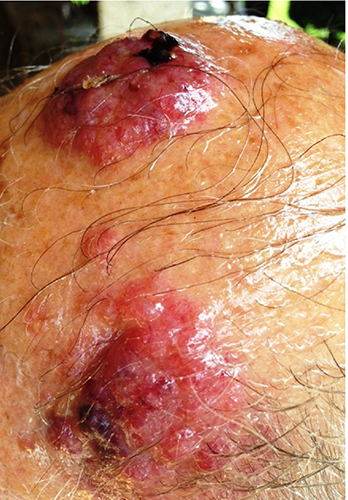
The two lesions before biopsy.
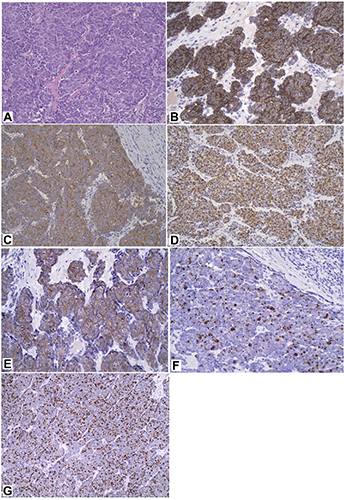
Histological and immunohistochemical pictures of Merkel cell carcinoma. A) Hematoxylin and Eosin staining; B) chromogranin A; C) synaptofisin; D) CK20; E) CD117; F) neurofilaments; G) Ki67-MIB1

Vertex lesion after 24 months
Discussion
MCC is a highly aggressive skin tumor which rapidly metastasizes with disappointing survival rates close to 50% of cases after 3-year. 6 The incidence of MCC is about 2/1.000.000 in Caucasians and 0.1/1.000.000 in black Americans. The average age of onset is the late 60s, with less than 5% occurring in people under the 50 years of age and the highest incidence over the 85-years-old age group. 7 About 50% of MCCs occurs on the head and neck, 40% on the extremities, and the remaining on the trunk. Sex incidence appears to be equal. 7
Spontaneous regression of MCC is exceedingly rare, and highlights the potentially capricious nature of MCC. As far as we know, a little but not inconsistent number of previous cases has been reported in Literature, so as to speculate that this kind of feature might be not so rare (Table 1).8–29 In fact, considering the prevalence of MCC in over 600 cases reported in literature, 30 the estimated prevalence of spontaneous regression appears to be greater than expected (1.7-3% of cases). 21 In most cases regression of MCC was preceded by a biopsy of the lesion, as in the present case: it was also suggested a potential stimulation of the immune system. 31 It has been reported that dense clusters of lymphocytes are found within tumor nests; 10 some reports found that CD4+ and CD8+ cells has heavily infiltrated around the tumor nests, via immunophenotypic analysis of the infiltrated lymphocytes.10,12,16,31 These findings suggest the role of T-cell mediated immune response in the development of tumor regression resulting in apoptosis and cellular necrosis: 19 it was also reported that intratumoral CD3+ (and CD8+) cell infiltration is associated with improved overall survival in a Finnish MCC cohort. 32 Regarding the role of T-cell mediated immune response in tumor regression, of a certain interest could be the potential role of diet with the aim to enhance the antiproliferative response via an immune-mediated mechanism. Dietary supplements as vitamin C, turmeric, probiotics, cod liver oil, organic vegetables, and mushroom, in particular Trametes versicolor, can elicit Natural Killer activity increasing numbers of CD8+ T-cells and CD19+ B-cells. 33 It should be noted that, in the reported case, regression of MCC begins approximately one month after the biopsy, and certainly before radiation treatment. Therefore, we can support that the regression of the lesions is mediated by an immune response stimulated by biopsy.
Complete spontaneous regression in Merkel cell carcinoma described in literature.

F, Female; M, Male; ND, Not Done; w, week; m, month; y, year. Adapted from Vesley
The biggest number of cases of complete spontaneous regression of MCC have been described in the head and neck, mostly with a lesion of size equal or less than 2 cm. 7 It was found a significant difference in the incidence of regressing MCC between males and females, with a prevalence for females with 77% of cases. 19 Regression, once initiated, was lasting between 1 and 5 months: 7 in the present case, regression lasts from 24 months.
A little series of partial spontaneous regression of MCC is reported by Vesely
Conclusions
Spontaneous complete regression is a significant event in MCC. A small number of cases of regression has been described in literature, to which we have added a further case. Many of these events began shortly after biopsy, and in some cases lymphocytic infiltration was described. This fact suggests that MCC can be responsive to immunological reactions. In fact, MCC is highly linked with T lymphocyte immune suppression in epidemiologic studies, and CD8+ T cell infiltration into MCC tumors has been shown to be strongly predictive of improved survival. Some Authors have observed, however, that biopsy does not commonly determine the induction of CD8 + lymphocyte infiltration into the tumor, and this fact causes a different survival. 34 Further research about mechanism of spontaneous regression, the role of immune response and also of dietary supplements, could contribute to improve the knowledge about biology of MCC in order to offer a better expectation of prognosis.
Footnotes
Acknowledgments
I am grateful to Marco Ungari, MD, pathologist at the Hospital in Cremona, for his valuable contribution.