






Abstract
Approximately, twenty years ago, the Rare Cancer Network (RCN) was formed in Lausanne, Switzerland, to support the study of rare malignancies. The RCN has grown over the years and now includes 130 investigators from twenty-four nations on six continents. The network held its first international symposium in Nice, France, on March 21-22, 2014. The proceedings of that meeting are presented in two companion papers. This manuscript reviews the history of the growth of the RCN and contains the abstracts of fourteen oral presentations made at the meeting of prior RCN studies. From 1993 to 2014, 74 RCN studies have been initiated, of which 54 were completed, 10 are in progress or under analysis, and 9 were stopped due to poor accrual. Forty-four peer reviewed publications have been written on behalf of the RCN.
Introduction
Approximately twenty years ago, the Rare Cancer Network, (RCN) was formed by Professors Rene-Olivier Mirimanoff and Mahmut Ozsahin (ROM and MO) in Lausanne, Switzerland. The RCN has grown substantially over the years and includes investigators from twenty-four nations on six continents. The network held its first international symposium in Nice, France, on March 21-22, 2014. The proceedings of that meeting are presented in two companion papers. The first, this manuscript, reviews the history of the RCN and selected works published to date. The second manuscript will review ongoing investigations and the future vision of the RCN membership for rare cancer research.
History and the Rare Cancer Network
The original idea to create the Rare Cancer Network in the 1990's stems from the observation that case reports and small series of patients with a rare type of tumor were not very contributory to medical knowledge or even provided contradictory conclusions. For example, Morgan
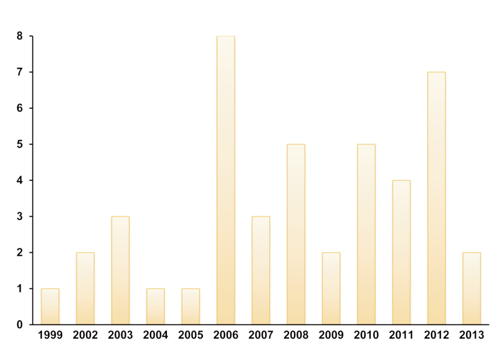
Publication frequency over time for the Rare Cancer Network in peer reviewed, academic journals, 1999-2013.
Overview of frequency of published papers of the Rare Cancer Network by journal.

Overview of studies published by the Rare Cancer Network.

The 5 largest studies of the Rare Cancer Network.
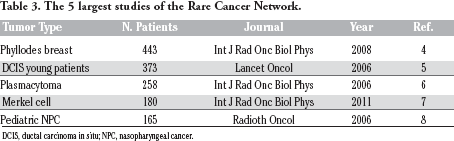
DCIS, ductal carcinoma in situ; NPC, nasopharyngeal cancer.
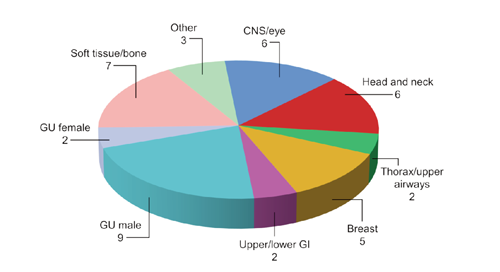
Distribution of sites of malignant diseases studied in Rare Cancer Network by number of studies per site.
In summary, RCN, a
The Rare Cancer Network and Growth of the Internet
Rare cancers are difficult to study due to their infrequency. Clinical trials, even in cooperative groups, are challenging due to the low accrual rates over time. Studies performed using population based data sources, such as the SEER-Medicare database, can provide statistical power, but have not in the past contained sufficient details to draw meaningful conclusions on individual treatment modalities and prognostic factors. 10
The Rare Cancer Network came into being at the time the internet was evolving from a specialist tool used in research into a modus for everyday communication. In the early 1990's, medical research took place in silos based on location, nationality, specialty, and language to a degree much greater than the current day. Rare tumor research was largely confined to the largest medical institutions that could report on single institution clinical experiences. Global communication was slow and expensive. The emergence of email and the World Wide Web provided an ideal platform for collaborations between researchers interested in rare disease. Email provided a cheap and rapid means for the leadership of the Rare Cancer Network to rapidly connect researchers around the globe on an
Summary of past Research Studies Presented at the Symposium
Pediatric Nasopharyngeal Cancer (E. Ozyar)
Pediatric nasopharyngeal cancer (NPC) is mainly seen in Mediterranean countries and constitutes 8-18% of all NPC patients in this region. In contrast to adult NPC, the optimal chemo-radiotherapy sequence and radiotherapy dose has not been established yet in the pediatric population. The RCN pediatric NPC study enrolled 165 cases from 16 centers and majority patients were from Mediterranean region. This study is still the largest series in the literature. 8
Adenosquamous Carcinoma of Head and Neck (U. Schick)
Adenosquamous carcinoma of the head and neck is a rare malignancy with fewer than 100 cases reported in the literature. Classically, adenosquamous carcinoma has been described as having an aggressive behavior and an associated with poor prognosis. However, given the rarity of the disease, neither the prognostic factors nor the optimal management strategy, especially regarding adjuvant treatment are well characterized. Within the RCN, we collected interesting data from an heterogeneous group of patients. We showed that, despite high rates of locoregional and distant recurrence, patients with early stage disease that are managed with combined modality treatment can achieve favorable outcomes. 11
Olfactory Neuroblastoma (B. Pehlivan)
Olfactory neuroblastoma (ONB) or esthesioneuroblastoma is a rare malignant disease of the olfactory neuroepithelium. It constitutes only 3% of all intranasal neoplasms, and can be observed in both children and adults. Its incidence peaks between either 11 and 20 years or 51 and 60 years. In this multicenter retrospective RCN study including 13 European and North American centers, 77 patients were enrolled. Being one of the largest studies in the literature, it concluded that ONB treated with R0 or R1 surgical resection followed by at least 54-Gy postoperative radiotherapy has the best outcome. 12
Mucosal Melanoma of the Aerodigestive Tract (M. Krengli)
Mucosal melanoma of the upper aero-digestive tract is a rare tumor, representing less than 2% of all melanoma cases. The optimal treatment strategy, including the role of radiotherapy, has still to be defined. The RCN study analyzed 74 patients, most of them (57%) in postoperative setting. Local control was improved by postoperative radiotherapy and initial stage and melanosis at diagnosis were favorable prognostic factors. A subsequent literature review confirmed that radiotherapy plays a role in the treatment of mucosal melanoma of the upper aero-digestive tract although the dose and fractionation schemes still require further investigation.13,14
Sarcoma of the Uterus (A. Franzetti)
Primary Uterine Leiomyosarcoma (ULMS) is a rare type of cancer with a definite pathological identity among the five different categories of uterine sarcoma. ULMS remains a tumor with poor prognosis. Uterine sarcomas represent 2-6% of all malignant uterine tumors. Each group of these tumors exhibits a different pattern of spread, prognostic factors and likely, different responses to treatments. Considering the rare incidence of these tumors and their different subgroups is very difficult to collect a sufficiently number of patients. In this multi-center retrospective RCN study 110 patients affected by primary ULMS were collected from 19 member institutions and analyzed. The study was aimed at assessing and establishing prognostic and therapeutic factors in patients with primary ULMS most of them treated with surgery and adjuvant radiotherapy. The poor overall prognosis of this rare and aggressive disease indicates a strong need to evaluate new therapeutic approaches as well as its sequence. The role of radiotherapy needs to be assessed in the light of new high-precision techniques. Publication of this manuscript is pending.
Solitary Plasmocytoma (M. Ozsahin)
Solitary plasmacytoma (SP) is defined as a proliferation of monoclonal plasma cells without evidence of significant bone-marrow plasma-cell infiltration, and constitutes about 5% of cases of plasma-cell myeloma. SP has two separate entities originating from either bone or extramedullary soft tissues. Its treatment consists of definitive radiotherapy (RT) but there are no conclusive data on the optimal radiation dose. This retrospective RCN study being the largest reported in the literature, enrolled 258 patients (206 bone and 52 extramedullary SP) from 19 European and North American centers, and concluded that progression to multiple myeloma is the main problem. Patients with extramedullary SP had the best outcome, especially when treated with moderate-dose RT (≥30 Gy), even for larger tumors. 6
Non-Hodgkins Lymphoma of Bone (L. Cai)
Primary bone lymphoma (PBL) is a rare entity of non-Hodgkin's lymphoma accounting for 5% of primary malignant bone tumors. In our comprehensive review of 136 patients with PBL, we identified 116 patients with single bone lesions and found that adequate radiotherapy and chemotherapy were essential regarding the outcome. The remaining 20 cases were excluded from our analysis because of either late stages (III and IV) or because of multiple bone lesions at the outset. Thus the 8 cases in this report represent a subset with multiple bone lesions. We wished to clarify the profile and outcome of those particular cases of PBL compared to PBL with single bone involvement. These 8 cases of multiple bone involved PBL had comparable characteristics as early stage PBL. We found that PBL with multiple bone involvement is not related with a poor prognosis. Combined chemoradiotherapy does benefit for these patients, especially enough cycles of chemotherapy. 15
Squamous Cell Carcinoma of the Breast (L. Scandolaro)
Breast squamous cell carcinoma (BSCC) is a rare disease, counted within metaplastic breast cancers, whose diagnosis follows strict criteria. The RCN collected 35 patients with tumors of large size (mean 38 mm; range 10-180 mm) and negative hormone receptors. A combination of surgery and radiotherapy is the best therapeutic option. The most favorable chemotherapeutic approach seems to be the combination of cisplatin and 5-Fluorouracil in a neoadjuvant setting. Progression occurs mainly in the first 4 years, particularly with bone and lungs metastases. After this period, further metastatic progression was not observed. To best of our knowledge, this is the second largest experience concerning this disease after the largest report of MD Anderson-Texas. 16
Carcinosarcoma of the Uterus (H.J. Vees)
Uterine carcinosarcomas (UCS) are dedifferentiated carcinomas comprised of carcinomatous and sarcomatous elements. According to the National Comprehensive Cancer Network, they should be considered as carcinomas. There is no consensus concerning the optimal therapeutic management of UCS due to its rarity. A multi-institutional RCN study collected 124 patients in between 1987 and 2007. All patients underwent surgery and the majority received external beam radiotherapy with and without brachytherapy. The results of this investigation have been submitted for publication at this time.
Phyllode Tumor of the Breast (Y. Belkacemi)
Phyllodes tumors (PT) are rare fibroepithelial neoplasms of the breast representing 1% of all breast cancers. The distinction between malignant and non-malignant forms of this tumors has been widely debated. In 1982, the World Health Organization (WHO) proposed a classification, which supports the concept of a continuum between three different histologic types of PT: benign, borderline or intermediate, and malignant. Surgery is the standard of care for first-line treatment of PT. The limited numbers of patients in the reported studies has prevented any consistent conclusion about prognostic factors or the role of RT in the past. The RCN study is one of the largest reports in the literature, with 443 women treated in 17 worldwide centers. Since RCN publication, there has been 8 important published series including one meta-analysis (n=5530) and 2 registry reports from SEER (n=1035) and California (n=752). 4
Primary Pineal Tumors (S. Villa)
Combined modality therapy (surgery, radiotherapy, and chemotherapy) for primary pineal tumors have demonstrated good overall survival in the modern era. Age, dissemination at diagnosis and, probably, histological subtypes influenced survival in our series. The prevalence of chronic toxicity suggests that new strategies in radiotherapy and chemotherapy are advisable. Further studies are needed to really define different diseases of PPTs concerning histological subtypes and individualized therapeutic strategies. 17
Duct Cell Carcinoma of the Prostate (S. Igdem)
Prostatic duct adenocarcinoma (PDA) is a rare variant of prostate cancer representing about 1% of all prostate cancer cases. We collected the clinical data of 31 patients from 6 member institutions of the RCN. Our results suggest that PDA is a cancer with a behavior similar to that of high Gleason grade acinar carcinoma. Good local control can be achieved by either radiation or surgery. Postoperative radiotherapy seems to work as an adjuvant or salvage treatment. 18
Langerhans Cell Histiocytosis (B. Atalar)
Langerhans Cell Histiocytosis (LCH) is an uncommon benign bone tumour typically seen in children. LCH of the bone in adults has been reported in isolated cases. Thirty patients from five RCN centers were analyzed to determine the outcome of different treatment approaches and to determine the role of radiotherapy in adult LCH of bones. The results of this study suggest that recurrence rates were significantly lower in patients who were treated with both surgery and RT. Surgery plays the primary role in the treatment of adult LCH of the bone; radiotherapy should be considered in the adjuvant setting and for palliation. 19
Erdheim-Chester Disease (R. Miller)
Erdheim-Chester disease (ECD) is a rare non-Langerhans histiocytoses. Histiocytic infiltration of bones and other organs secondary to ECD can lead to pain, particularly in long bones of the appendicular skeleton, as well as mass associated symptoms in the brain or orbits. The RCN conducted a small review of symptom palliation that found that low dose RT was associated with excellent short term pain relief, but that symptoms typically recurred at a later date, reflecting the systemic nature of this disease. 20
Rare Cancer Network Studies not Presented at the Symposium
A complete summary of publications of the Rare Cancer Network through the year 2012 containing details on studies not presented at this meeting is available in a prior publication. 21
Conclusions
The Rare Cancer Network has made significant contributions to the understanding of rare cancer behavior and treatment as outlined in the reports above and elsewhere. Beginning as a modest initiative to better understand prognostic factors in testicular cancers, the Rare Cancer Network has now grown to include researchers across the globe.
On-going and planned studies will be discussed in the second manuscript of proceedings from the international symposium. As also noted above, the rise of the Rare Cancer Network was facilitated by technological changes that permitted rapid and cheap communication globally in ways not possible before the emergence of the internet. Further evolutions in technology, most notably the new prominence of
Footnotes
Acknowledgements
Congress report of the First International Symposium of the Rare Cancer Network − Nice (France), March 21-22, 2014.