






Abstract
Background
As the global incidence of end-stage organ failure increases, the gap between organ donors and recipients continues to widen. This study was conducted to determine the association between organ donation awareness and organ donation willingness among students of a Saudi university.
Design and methods
This analytical cross-sectional study was conducted in King Faisal University, Al-Ahsa, Saudi Arabia. Multi-stage stratified random sampling was used to select the required 723 sample size. Estimation of proportion of students who were aware about organ donation and those who were willing to donate their organs was performed using EpiInfo© Version 7. Association between organ donation awareness and willingness was determined using multivariate logistic regression.
Results
Nearly 98% of the participants were aware that organ donation saves lives (95% CI: 96.27%-98.53%); 84.09% were aware that Islam allows organ donation (95% CI: 81.25%- 86.58%); 64.87% were aware that organ donation is successfully done in Saudi Arabia (95% CI: 61.32%-68.26%); 32.64% were aware that the government gives incentives to the family of an organ donor (95% CI: 29.32%-36.14%). Over half (56.71%) of the students (95% CI: 53.07-60.28%) expressed willingness to donate their organs. Positive association was found between awareness on the position of Islam on organ donation (OR=2.7023, p<0.0001) and awareness of that organ donation can be successfully performed in Saudi Arabia (OR=1.9447, p=0.0001).
Conclusions
Awareness that Islam allows organ donation and awareness that organ donation is successfully done in Saudi Arabia increased the students’ willingness to donate.
Introduction
Organ transplantation involves harvesting biological tissues or solid organs, from a living or a deceased person to a living recipient. 1–3 Organ transplantation is often the only treatment option for patients diagnosed with end stage organ failure. Organ transplantation significantly decreases the cost of health care for governments and provides organ failure patients a better quality of life, allowing them to remain productive for many years after the procedure. 4–8 Transplantation is one of the most successful medical advances in the past 60 years.9,10 Post-transplantation survival has increased to a median of 11 years due to advances in both antibiotics and in immunotherapy. 11 By 2019, an average of 14.5 organ transplantation procedures are done per hour. 12
Significance for public health
Organ transplantation is often the only treatment option for patients with end stage organ disease. However, there is a global shortage for organ donors such that many patients die while waiting for organ donors. This study examined the sociocultural factors that may affect the organ donation attitude and willingness of Saudi university students. The result of this study provides valuable insight that could be used in health education and policy development.
The success in organ transplantation has resulted in an increase in the demand for organ donors. With the steady increase in organ failure cases, the consequent demand for organ transplantation has resulted to a global increase in the need for organ donation. 8,13,14 However, the number of available donors has not improved proportionately to match the actual requirement.7,15 Patients considered eligible for transplantation frequently wait expectantly for a donor organ because of the deficit in organs, with many dying in the process.16,17
The shortage of organ donors is a worldwide phenomenon. According to the Global Observatory on Donation and Transplantation, less than 10% of the actual demand is fulfilled as the need for solid organ donation rises. 7 It is estimated that as much as 20% of people in waiting list die before a donor can be found.10,18,19 Regional disparities in organ donation exist. This is believed to be related to several factors including a country's socioeconomic status and the availability of technology required for implementing organ transplantation procedures. Organizational approaches to organ donation and policy factors also contribute to transplantation discrepancies.7,20
Compared to Western countries, people from the Middle East were reported to have a higher level of willingness to donate. 7 However, like many countries in the Gulf Region, Saudi Arabia has a relatively low organ donation rate of 3.77 per million population. 21 The comparable organ donation estimates in Saudi Arabia lag far behind, with 22 potential deceased donors per million population and a procurement rate of 20%. 23 Organ transplantation is relatively new in Saudi Arabia. 24 Currently, there are only a few facilities where transplantation is performed in Saudi Arabia. 11 The Saudi Centre for Organ Transplantation (SCOT) was established to supervise organ donation and the transplantation program. 25 Like in many parts of the world, there is a shortage crisis for organ donors in Saudi Arabia. 26 There are currently more than 20, 971 people waiting for organ donors in the Kingdom. From 1986 to 2017, the total number of possible donors reported to SCOT was only 12,503. 27 Organ transplantation performed outside Saudi Arabia tend to be more expensive costing more than 486 million Saudi Riyals. In contrast, it would only cost 108 million Saudi Riyals if performed inside the Saudi Arabia. 28
Organ donation is mainly influenced by three factors: knowledge, attitude and behavior. However, culture and religion have both been documented to affect donation-related decisions. 18 There are complex relationships between legal, moral, ethical, economic, logistical and humanitarian factors that affect organ donation willingness and actual transplantation. 29 Almost all the religions of the world allow organ transplantation and donation unless it would be dangerous for the life of the donor.26,30 But while the major faiths support organ donation and transplantation, there are many religious- based misconceptions about organ donation.31,32 In 1982, the Fatwa of Senior Ulama Commission in Saudi Arabia declared that it is permissible to donate an organ or a part of it from a living or deceased donor to a Muslim if it is necessary. 1
Despite the wide acceptance of organ transplantation as a treatment modality, controversies regarding organ donation persist. 15 It is believed that organ donation awareness and education programs are crucial in a society. 25 However, there is insufficient research that actually measures awareness on organ donation among Saudi people and even more limited researches about organ donation outside the country's capital. Considering these gaps, this study was conducted to determine the association between awareness on organ donation and willingness to donate among university students.
Design and methods
The study utilized an analytic cross-sectional design. The study population consisted of King Faisal University (KFU) undergraduate students. The university is located Hofuf, Al-Ahsa, in the eastern region of Saudi Arabia.
The sample size was calculated using EpiInfo® ver. 7 using the current KFU student population of 37 607, expected frequency of 64.4% based on the reported awareness level on organ donation from a study conducted by Agrawal et al., confidence level of 95%, and design effect of 2. 5 Multi-stage stratified cluster sampling was used to select the colleges from within the university and study participants within each college to obtain the required sample size of 698 participants. A total of 723 students were surveyed from two health colleges (College of Applied Medical Sciences and College of Medicine) and two non-health colleges (College of Arts and College of Computer Sciences and Information Technology).
The survey tool was subjected to content validation. It was then pre-tested among students who were not included in the study before administering to the study participants. The study questionnaire consisted of three sections: 1) demographic variables such as college, age and gender; 2) awareness section, consisting of five questions on awareness of the benefits of organ donation, the existence of organ donation facilities in Saudi Arabia, incentives given by government, the position of Islam on organ donation, and that organ donation is successfully done in Saudi Arabia; and 3) willingness to participate in organ donation. Awareness about organ donation and willingness to participate in organ donation were asked as direct questions answerable by “yes” or “no”.
Students participated on a voluntary basis and were assured of their anonymity and the confidentiality of their responses. Following the approval of the research proposal by the Department of Public Health of the College of Applied Medical Sciences, King Faisal University, ethical clearance was sought from the Research Ethics Committee of the Deanship of Scientific Research, King Faisal University, Al-Ahsa, Saudi Arabia (KFU - REC/2019-11 – 03).
Data was collected by direct query using self-administered questionnaires. Collated data were encoded in Microsoft Excel and were subsequently cleaned for missing data before statistical treatment using EpiInfo® ver. 7. Descriptive analysis was applied to the demographic data. In addition, estimation of proportion was used to determine the relative proportion of students who were aware and unaware about the benefits of organ donation, the existence of organ donation facilities in Saudi Arabia, incentives given by government, the position of Islam on organ donation, and that organ donation is successfully done in Saudi Arabia. Estimation of proportion was also used to determine the proportion of students who were either willing or unwilling to participate in organ donation as well as the motivations and obstacles of KFU students toward organ donation. Simple logistic regression was performed for the sociodemographic variables and the five domains of awareness and the students’ willingness to donate their organs. Those that were found to be statistically significant at alpha level of 25% were subjected to multiple logistic regression to determine the association between awareness on organ donation and willingness to donate.
Results
Demographic profile of study participants
A total of 723 university students participated in the survey consisting of 407 (56.29%) females and 316 (43.71%) males.
Participants from the health colleges (Applied Medical Sciences and Medicine) comprised 50.48% of the respondents while students from the non-health colleges (College of Computer Sciences and Information Technology and the College of Arts) comprised 49.52% of the study participants. The age group distribution was as follows: below 20 (315, 43.57%), 21-22 (324, 44.81%), 23-24 (76, 10.51%), and 25 and above (8, 1.11%).
Awareness on organ donation
Majority of the participants were aware that organ donation saves lives. Seven out of ten students were aware that there are hospitals in Saudi Arabia where organ donation can be performed. Only 32.64% of the respondents were aware that the government gives incentives to the family of an organ donor. Majority of the respondents were aware of the position of Islam regarding organ donation and that Islam allows organ donation. Over half of the respondents were aware that organ donation is successfully done in Saudi Arabia (Table 1).
As seen in Table 2, a slightly higher proportion of female students were aware that organ donation saves lives. Similarly, a higher proportion of health students were aware that organ donation saves lives. There was almost no difference in the proportion of students based on awareness that organ donation saves lives between the two age groups.
Regarding awareness that there are hospitals in Saudi Arabia where organ donation can be performed, a slightly higher proportion of awareness was seen among male students, among health students and among the older age group. There was a generally low proportion of awareness regarding incentives given to the family of organ donors. A slightly higher proportion of male students and those coming from the non-health colleges were aware of incentives given to families of organ donors. There was very little difference in the proportion of students who were aware and unaware of incentives between the gender groups. There were almost no differences seen in the proportion of students who were aware about the position of Islam on organ donation when they are grouped by gender, type of college and age. Finally, no differences were observed in the awareness on successful organ donation between gender groups. However, a slightly higher proportion of students from health colleges and among older students responded to be aware that organ donation is successfully done in Saudi Arabia.
Willingness and attitude towards organ donation
Among the 723 study participants, 410 (56.71%, 95% CI: 53.07 – 60.28%) were willing to donate their organs while 313 (43.29%, 95% CI: 39.72 – 46.93%) of respondents were not willing to donate their organs (Table 3). When comparing the gender groups, a higher proportion of female students were willing to donate. A higher proportion of students from health colleges were willing to donate their organs when compared to students from non-health colleges. A slightly higher proportion of younger university students were willing to donate their organs. Among the 410 respondents who were willing to donate their organs, 93.41% (95% CI: 90.59 – 95.44%) were willing to donate their organs to their family members. In addition, 59.02% were willing to donate to their friends (95% CI: 54.20 – 63.68%), 52.68% to a stranger (95% CI: 47.85 – 57.47%). Only 44.63% (95% CI: 39.89 – 49.47 %) were willing to donate their organs to their neighbours. Most (366, 89.27%) of study participants (95% CI: 85.90 – 91.91%) who expressed willingness to donate want to help people while 50.24% of them view donation as a good deed according to Islam. Only 5.61% of study participants who were willing to donate do so in order to get financial reward.
Crude association between awareness on organ donation and willingness to participate in organ donation
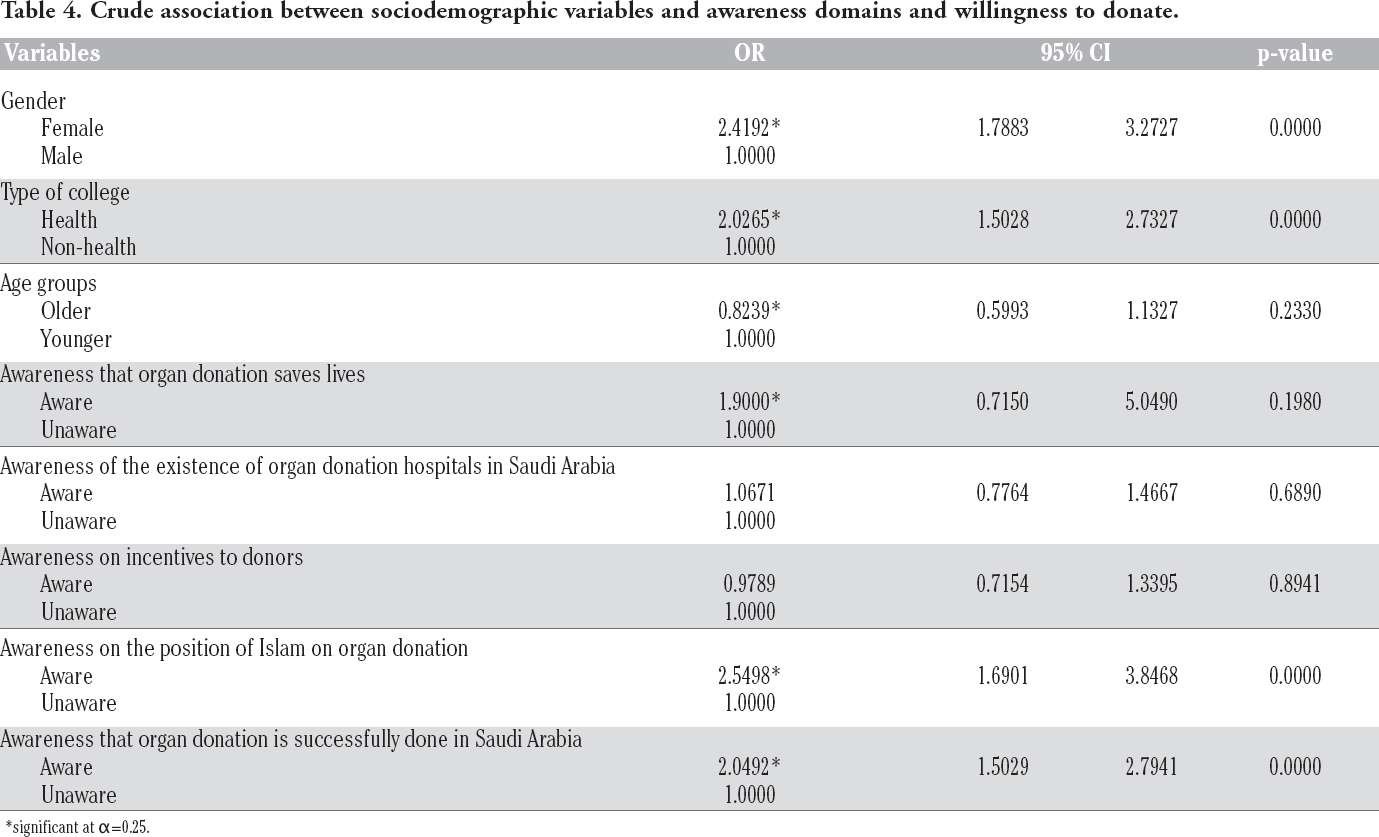
Using simple logistic regression, awareness that organ donation saves lives, awareness of the position of Islam on organ donation, and awareness that organ donation is successfully performed in Saudi Arabia were found to be significantly associated with willingness to donate (Table 4). Students who were aware that organ donation saves lives were 1.9 times more likely to be willing to donate their organs (p=0.1980). Those who were aware that Islam allows organ donation were 2.54 times more likely to be willing to donate their organs (p<0.0001). Additionally, those who were aware that organ donation is successfully performed in Saudi Arabia were 2.04 times more likely to be willing to donate their organs (p<0.0001). There was no significant association between awareness of organ donation facilities and willingness to donate (OR=1.0671, p=0.6890). Awareness that the government provides incentives to the family of organ donors was similarly not associated with the willingness to donate an organ (OR= 0.9789, p=0.8941).
Adjusted association between awareness on organ donation and willingness to participate in organ donation
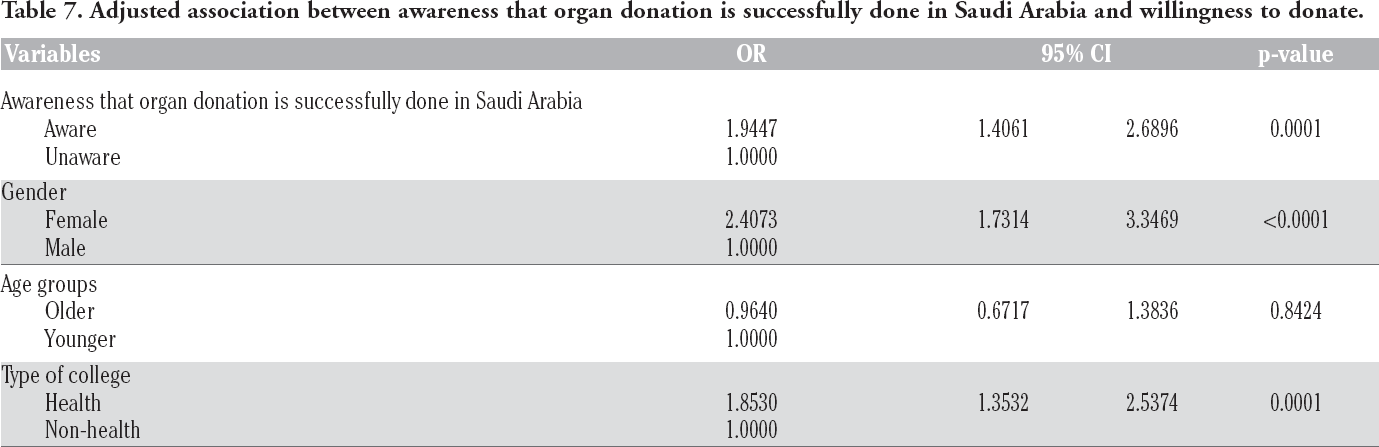
As seen in Table 5, when gender, age group and type of college were held constant, students who were aware that organ donation saves lives were 1.1 times more likely to donate their organs compared to those who were not aware of the benefits of organ donation (OR =1.1117, p=0.8383). Students who were aware that Islam allows organ donation were 2.7 times more likely to donate their organs compared to those who were unaware that Islam permits organ donation when the sociodemographic variables were held constant (p<0.0001) (Table 6). As seen in Table 7, when the sociodemographic variables were controlled, students who were aware that organ donation is successfully performed in Saudi Arabia were 1.94 times more likely to donate their organs compared to students who were not aware (p=0.0001).
Awareness on the benefits of organ donation among university students.

Discussion
The study assessed the organ donation awareness and organ donation willingness of university students in Al-Ahsa, Saudi Arabia. It also determined the students’ attitude toward organ donation and factors that affect organ donation willingness.
The result of the current study showed that almost all (97.65%) of the students were aware that organ donation saves lives with only slight differences in awareness between gender groups and type of college. There was a higher proportion of students from the health colleges (71.78%) than from non-health colleges (57.82%) who were aware that organ donation is successfully done in Saudi Arabia.
Distribution of university students based on awareness on donation.

College of Computer Science and College of Arts
College of Applied Medical Sciences and College of Medicine
younger than 22 years
22 years and over.
Knowledge on organ donation has previously been reported to vary among students of different college programs. 26 In the current study, only 84.09% of the university students in the current study were aware that organ donation is permissible in Islam. Regional variation in awareness levels within Saudi Arabia has been observed. A study in a university in central part of Saudi Arabia revealed that nearly half of the students think there were misconceptions of the Islamic perspective. 33 Another study in Al-Kharj showed that 64.4% of the respondents were aware that organ donation is permissible. 16 Willingness to participate in organ donation among the university students was lower than what was reported in a recent Saudi study where 74.1% of the study respondents were willing to donate an organ. 34 However, organ donation willingness in the current study was higher compared to another study conducted in Riyadh City which showed that only 47% of the participants had willingness to donate organs and tissues. 1
The current study showed that female students were more than twice as likely to be willing to donate their organs compared to male students. Female Saudi students’ attitude towards organ donation has already been reported to be higher than that of men in an earlier study. 35 The higher organ donation willingness among women found in the current study was also consistent with more recent studies conducted in Saudi Arabia.36,37 The current study revealed that nearly 30% of students who expressed non-willingness to donate lack of knowledge about organ donation. More so, although the respondents were all Muslims, the current study revealed that 12.78% of those who were unwilling to donate considered religious beliefs as a barrier for organ donation. A study conducted among Saudis in Madinah City showed that 21.7% of the participants lacked awareness on organ donation and 6.8% cited religion as the primary reason to refuse organ donation. 34 The current study showed that among the five awareness domains, only awareness on the position of Islam on organ donation and awareness that organ donation can be performed within Saudi Arabia were significantly associated with university students’ willingness to donate when all other variables were held constant. This supports hypothesis that religious belief influences organ donation attitude. Awareness on the existence of hospitals/facilities where organ donation can be performed in Saudi Arabia did not affect the students’ willingness to donate. This implies that awareness on the existence of facilities alone does not contribute to an increase in the willingness to donate. The same was true regarding awareness on the provision of incentives by the government to the family of donors.
Distribution of university students based on willingness to donate.

College of Computer Science and College of Arts
College of Applied Medical Sciences and College of Medicine
younger than 22 years; 422 years and over.
Crude association between sociodemographic variables and awareness domains and willingness to donate.
*significant at α=0.25.
The study has several limitations. The results apply to students of this university and do not necessarily reflect the organ donation awareness and organ donation willingness of other university students in other regions of Saudi Arabia or of the Saudi Arabia population in general. Because the data was collected using selfadministered questionnaires, misclassification of responses could not be completely discounted. A cause-and-effect relationship could not be determined because of the study design. The researchers merely asked the participants about their willingness to donate their organs. However, future organ donation cannot be predicted based solely from the collected data. Other demographic variables that could affect the willingness to donate organs were not investigated.
Adjusted association between awareness that organ donation saves live and willingness to donate.

Adjusted association between awareness that Islam allows organ donation and willingness to donate.

Adjusted association between awareness that organ donation is successfully done in Saudi Arabia and willingness to donate.
This study has shown that there was a very high level of awareness on organ donation among university students, particularly on the idea that organ donation may save lives. Awareness that Islam permits organ donation and that organ donation procedures are successfully performed within the country were positively associated with organ donation willingness.
Based on the study findings, the researchers recommend that inter-institutional collaboration between the Ministry of Higher Education, the Ministry of Health and the Saudi Centre for Organ Transplantation should be undertaken to promote organ donation among university students. The availability of facilities together with success rates and information campaigns about the safety of organ donation must be emphasized as these factors were shown to be perceived as obstacles to organ donation willingness. Education about organ donation and religion is crucial. 30 Because the cadaver is considered holy and sacred in Islam this may affect the perception of the population on organ donation as whole. There is a need to raise awareness that organ donation is not prohibited by Islam.31,38 The key messages that Islam permits organ and tissue transplantation that is intended to save human lives must be promoted as an understanding that religion allows organ donation is important in the development of positive attitude toward organ transplantation. 39 Organ donation awareness campaigns aimed at increasing the number of potential donors is still limited. The important role of health professionals as an important link between patients in need of organ donation and potential donors cannot be overemphasized. Likewise, family and friends have the highest potential to impact donation.40,41 The university should therefore partner with the community and advocate to health-care professionals to motivate people about the legal and procedural details of organ donation. Comprehensive community campaigns that link health professionals and the community is in order.
Future researchers should conduct a similar study in a community setting to collect more information from different population groups. Other demographic variables that may affect attitude towards organ donation should be investigated to identify other factors that may influence organ donation willingness. The study should be replicated in other universities to check the consistency of study findings among university students of different regions within the Kingdom of Saudi Arabia. The World Health Organization has called for countries to be self-sufficient in terms of organ donation and transplantation. 24 It has been reported that low proportion of organ donation is related to several factors including organizational structure of organ donation in the country, legislature and existing health care systems. 42 Therefore advocacy for policies in support of the opt-out option where a person has to formally declare non-willingness must be considered in Saudi Arabia. 17 The Saudi Centre for Organ Transplantation currently plays a central role in all aspects of transplantation in Saudi Arabia including education on all levels, allocation, coordination and procurement. 1,24–26 SCOT has published a directory that regulates the practice of organ donation and transplantation in the Saudi Arabia. 24 A recent development in organ donation in the Kingdom of Saudi Arabia is that Saudi residents may now register to become organ donors using the Tawakkalna, a mobile application developed by the Saudi Data and Artificial Intelligence Authority (SDAIA). 43
Footnotes
The authors declare no conflict of interest.
Acknowledgements
The authors wish to thank the study participants for their contribution to the research. The authors especially thank Dr. Edric Estrella for his guidance in the statistical analysis.