






Abstract
Not only the Central Government, local governments also have a role to shape, adapt and provide a holistic response to the COVID-19 pandemic. One of the most important actions taken by local governments during the COVID-19 pandemic is to make immediate, timely, and targeted decisions for the right institutions in order to give an effective response. Regarding financing, the main point is to focus on increasing support and accelerating fiscal transfer funds to local governments in an effort handle COVID- 19. This paper wants to observe the empirical practice of local governments in various countries in responding to the COVID-19 pandemic, especially in terms of financing various programs and activities related to the COVID-19 response. Literature was obtained from several databases, namely PubMed, ScienceDirect, Cochrane Library and Google Scholar. Of the 783 articles obtained at the start of the search, in the end only 11 articles met the inclusion and exclusion criteria of this study. The impact of the COVID-19 pandemic is aparrent in all parts of the world, including in countries’ local governments, that forced them to carry out various efforts of mitigating the severity of the pandemic. Although the detailes of local governments budgeting were not found in most of the articles studied in this literature review, it is sufficient to provide a fairly significant picture of the function of local government in tackling the spread of COVID-19.
Introduction
In recent times, the governments of every countries are facing the need for emergency response due to the COVID-19 pandemic. The impact of this pandemic is worldwide, with 218,946,836 confirmed cases of COVID-19 and 4,539,723 death globally as of September 3, 2021 at 6.16 PM CEST. 1 Since the first case was reported, the World Health Organization (WHO) has been working with the Chinese government and global experts to learn more about the virus, including the transmission of the virus, populations at the most risk, and the most effective way to detect, stop, and control the human-to-human transmissions.
Significance for public health
To handle a problem this big, a quick and targeted new guidelines was needed, as public policy is an act that assists government in overcoming problems faced by society. 2 The next step was to formulate the preparedness documents and strategic response plans that detailed the public health steps to help all countries prepare for the COVID-19 outbreak. The strategic response are:
Establish international coordination quickly to provide strategic, technical and operational support through existing mechanism and partnership.
Improve countries’ preparedness and response, including strengthening readiness to quickly identify, diagnose and treat cases; contact tracing, infection prevention and control, risk communication to the community, as well as community involvement.
Accelerate priority reseraches and innovations, especially those related to therapeutic modal candidates, vaccines and diagnostics. 3
In addition to country or national levels of interventions, COVID-19 shows the importance of quick and effective local or regional interventions in order to slow down the spread of the virus. The role of local governments is to shape, adapt and provide a holistic response to the COVID-19 pandemic. A study by Brandtner
In most countries, the effectiveness of the response to COVID- 19 varies widely in the sub-national level with different approaches. The experiences of China and South Korea demonstrate the importance of effective local government in mobilizing community responses. One of the most important actions taken by local governments during the COVID-19 pandemic is to make immediate, timely, and targeted decisions for the right institutions in order to give an effective response. Regarding financing, the main point is to focus on increasing support and accelerating fiscal transfer funds to local governments in an effort handle COVID-19. In China, although the overall response in Wuhan Province was coordinated by the central government, the actual implementation was the responsibility of the Wuhan province and local government. The Chinese Government set an initial transfer to Wuhan of USD 8.6 billion (120 trillion rupiah), then an additional USD 16 billion (227 trillion rupiah) was allocated from the central government to the local government for the period December 2019 to March 2020. 5 It is not surprising that this pandemic has put countries on financial restrain. Not only low- and middle- income countries (LMIC), higher income countries are also struggling directing their sources, protecting at-risk groups, and caring for the COVID-19 confirmed cases in their countries. 6 In Indonesia, for example, the effects of lockdown orders on several sectors had put the nation's finance state in a depressed situation, and is predicted to be so for some time. 7
To help navigate this inevitable financial hardship on regional level, The United Nations Capital Development Fund (UNCDF) has set local government financing responses to the COVID-19 pandemic situation that should cover six general areas, namely:
Increase the capacity of local healthcare services;
Improving risk awareness and community empowerment;
Improve social protection measures;
Enforce public order and regulations to prevent and control the infection;
Continued provision of essential services (such as education, staple foods);
Take action regarding local economic reliefs.
The scope of specific responses and actions depends on the competence and responsibilities of local governments and their fiscal capacity, which determines the amount of financial resources available. 5
To fund the response to this pandemic, local governments rely on three main sources: Regional Original Revenue (PAD), Balancing Funds, and Regional Loans. The latter is only available in countries with supportive legislative bodies and policies.5,8,9
Regarding PAD, it is actually the most flexible source of financing that can be easily allocated towards epidemic response. But in many countries, especially developing countries, PAD is usually less than 10 percent of the total local government budget and is insufficient for an effective pandemic response. In addition, the public health response to COVID-19 has significantly reduced PAD for three reasons:
Social distancing forcing work to be done from home and large-scale social restrictions, such as lockdowns, have a negative impact on the retail and transportation industries and eliminate tax revenues from local governments.
Increased unemployment reduces property and rent tax payments.
Reduced economic activity reduces business tax revenues.
Surely, with such great pressure on the health care system due to this pandemic, governments are required to overcome these pressures and provide broad-based fiscal support in response to the ongoing economic crisis. Public financial management systems are critical in supporting the success of the government's emergency response. Governments need to ensure that their systems are equipped to meet requirements and address challenges in terms of:
Support the delivery of emergency health services (including the direct provision of health services); purchase of goods and services; placing the necessary human resources to monitor, control, and mitigate the COVID-19 outbreak;
Ensure continuous delivery of essential public services that may be under pressure during the outbreak;
Implement new fiscal measures (including various support mechanisms) to help businesses and people under economic hardship; and
Ensure smooth public financial management services, even though the majority of government staff have to work from home.5,9
This paper observes the empirical practice of local governments in various countries in responding to the COVID-19 pandemic, especially in terms of financing various programs and activities related to the COVID-19 response.
Inclusion and exclusion criteria for study selection.

Design and Methods
The research was conducted using the literature review method. Literature was obtained from the PubMed, Science Direct, Cochrane Library, and Google Scholar databases which were accessed online. In searching the literature, inclusion and exclusion criteria were set to obtain relevant literature, as stated in Table 1. The study search was carried out with the following keywords on PubMed and Science Direct; (((Local government) OR (government response) OR (local government policy))) AND ((Covid- 19) OR (coronavirus) OR (SARS-CoV-2)) AND ((financial response) OR (financing))). The keywords used for Cochrane Library and Google Scholar searches are as follows; “Local government” AND “financing” OR “financial response” AND “Covid- 19”. The different search strategy was carried out because expected articles were not found with the previous search strategy. Both searches found a total of 715 articles from PubMed, 68 from Science Direct, 18 from Cochrane Library, and 34 from Google Scholar.
The reference list was then processed through Mendeley application to eliminate duplicate articles. The remaining articles were then selected according to inclusion and exclusion criteria. This process resulted in 11 literature that were included in this study. Critical appraisal was conducted using the STROBE (Strengthening the Reporting of Observational Studies in Epidemiology) guide to measure the quality of each article. From there, data extraction was done to properly group the information obtained from each literature into a table, to further facilitate information mapping.
Results
Selected literature characteristics
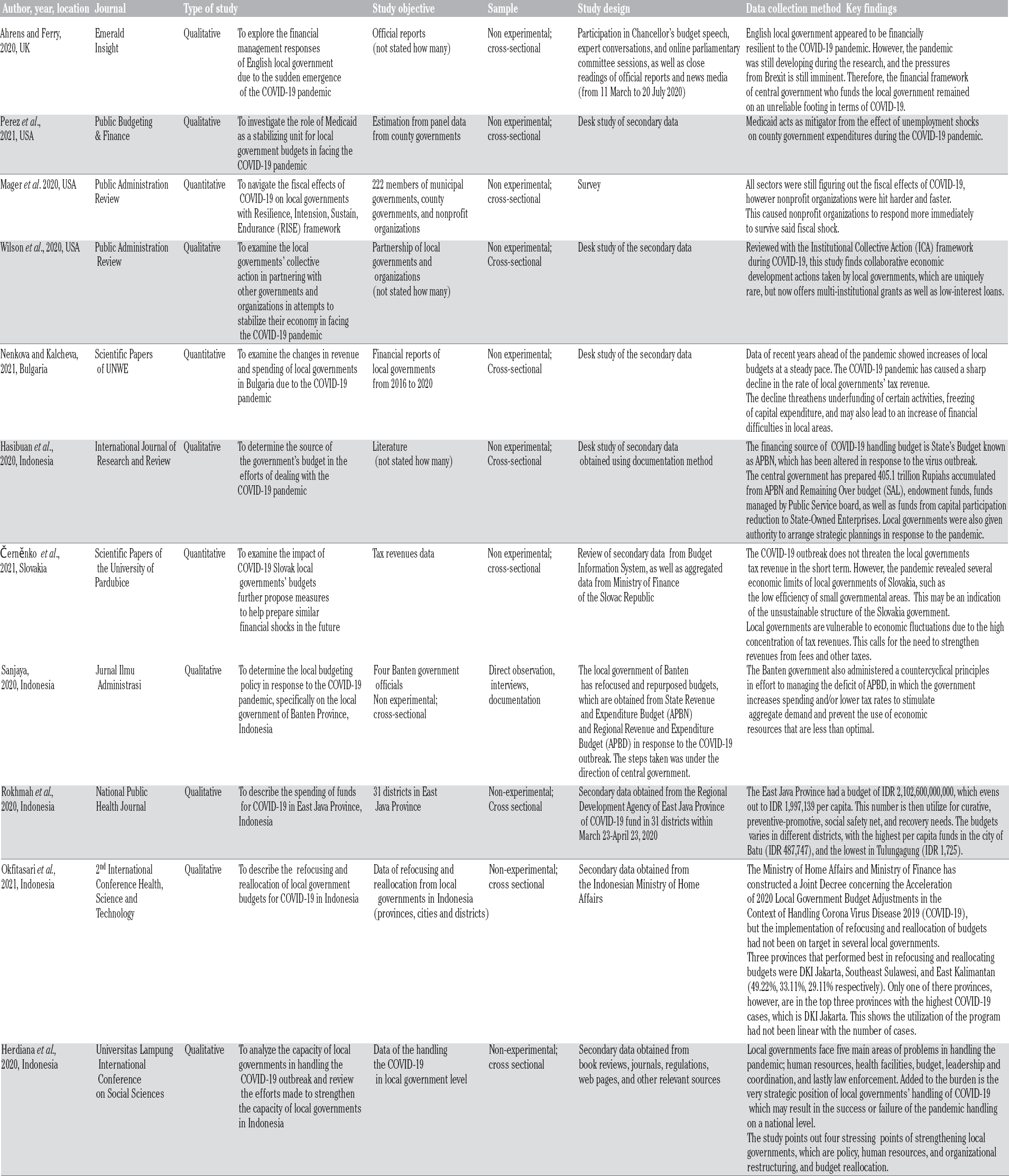
The documentation of the literature search flow is illustrated in Figure 1. Table 2. As seen on Table 2, five out of 11 of the selected literature were published in Indonesia, 3 articles were published in the United States and 1 article in United Kingdom. Two articles were published in Europian countries, Slovakia and Bulgaria. Given that the COVID-19 pandemic emerged at the end of 2019, all publication years are only between 2020 to 2021.
Increasing the capacity of local healthcare system
A study by Herdiana, Mukhlis, and Madya the four biggest problems local governments face is the lack of human resources, the lack of health care facilities, budgeting, leadership and coordination, and law enforcement.
10
In the efforts of strengthening local governments capacity in handling the Coronavirus outbreak, this study believes that a comprehensive assessment of the current performance of the local government, from which they can carry out several steps needed to increase the governments’ capacity. Budget reallocation is stated to be the key in determining the success or failure of each local governments’ response of COVID-19, given that a large amount of their budget would have to be allocated for handling the virus outbreak. Aligning with this study, Hasibuan
Rokhmah
Okfitasari
Community awareness and mobilization
In the efforts of reducing the virus transmission, Centers for Disease Control and Prevention (CDC) has stated that local governments in the USA have full control over local events, and therefore are responsible to limit any events, while also keeping in mind the revenue they might need from local events themselves.
15
Wilson
Social protection measures
Social protection measures on a local governmental level can be translated into social safety-net programs. A study on the role of Medicaid, USA's insurance program, in mitigating possible financial hardships on local governments due to COVID-19 showed that the presence of Medicaid helped soften the blows of unemployment shocks of the pandemic. 15 With people having the option to rely on their insurance, local governments’ expenditure on COVID-19 can be reduced, specifically safety-net programs and debt.

Documentation of the literature search flow.
Extraction of data from selected literature.
In the article of Okfitasari
Enforcement of public order and regulations
As stated on the previous section, law enforcement is one of the four biggest problems local governments face in mitigating COVID-19. 10 Though several article stated regulations in budget allocation in tackling the pandemic,11,13,14,17 only one article discussed the role of local governments in enforcing public order of lockdowns. 18 Nenkova and Kalcheva also pointed out the Bulgarian Government role in enforcing lockdown orders by discounting the garnishment of regional or local bank accounts for two months after lockdown orders had been lifted.
Continued provision of essential services
To ensure the continuity of essential services, Hasibuan
Relief measures for local economies
One study on collaborative economic development actions discussed how abrupt closings of non-essentials small businesses due to the spread of the Coronavirus has impacted local economies.
16
Wilson
Ahrens and Ferry 19 also highlighted grants given to local governments and business in the United Kingdom, in a total of over GBP 27 billion, however this study did not discuss in detail about said grants. Similarly, Nenkova and Kalcheva mentioned in their article that the central government of Bulgaria set EUR 70 million to support of small and medium-sized local government investment projects, though there was no further discussion about the utilization of the budget. 18 A recommendation was made by Herdiana, Mukhlis and Madya 10 of how both central and local government should develop policies concerning ease of lincensing in opening new businesses, so that communities and governments can work hand-in-hand in restoring the economy after the pandemic. A survey on non-profit organizations (NGOs) done by Maher, Hoang and Hindery also highlighted that a lot of NGOs favored to rely on government grants for financial assistance during the pandemic. 20
Conclusions
The impact of the COVID-19 pandemic is aparrent in all parts of the world, including in countries’ local governments. Added to the pressure is the big role local governments’ have to carry out in efforts of mitigating the severity of the pandemic. Although the detailes of local governments budgeting were not found in most of the articles studied in this literature review, it is sufficient to provide a fairly significant picture of the function of local government in tackling the spread of COVID-19. Further research is needed to make a more comprehensive calculation of the local governments budgeting response to the COVID-19 pandemic.
Footnotes
Any conflict of interest does not exist in this study.
Acknowledgments
This research was conducted related to the completion of Doctoral Program on behalf of the first author (VYP), whose doctoral study funding was funded by LPDP.