






Abstract
Background
Changes in social and behavioral rhythms (SBR) in the elderly are related to health status. Nevertheless, there is no data on factor analysis of the Brief Social Rhythm Scale (BSRS) an internationally well-known tool in this field. The aim was to analyze, in the elderly, the factorial structure of the Italian version of BSRS.
Design and methods
Principal Component Analysis of the BSRS carried out in elderly living at home.
Results
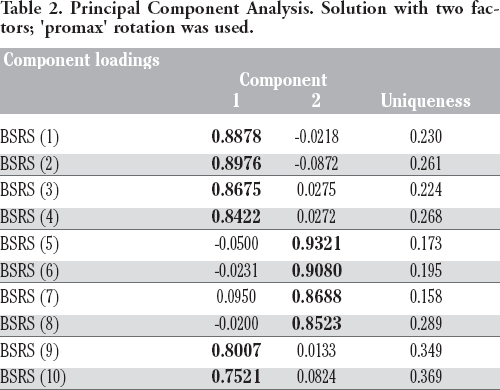
Sample of 141 participants (83 Females, 58,9%), aged 72.3±4.8. All the items of the questionnaire were related and could compose a single factor, explaining 56% of variance. A solution adopting two factors, the first (including items 1,2,3,4,9,10), the second (including items 5,6,7,8), covered cumulatively 78.8% of the variance.
Conclusions
The study confirms that the BSRS is consistent with the idea for which it was built and can be useful for the study of the regularity of SBR in old adults.
Introduction
Elderly have changes in social and behavioral rhythms and in related biorhythms. As regards sleep, they rise from and retire to bed earlier than younger people, 1 they have more awakenings at night and their rapid eye movement stages 3 and 4 are shorter. 2 Human beings have a loss of around 3 min of sleep every year from 40 years old onwards. 3 An accentuation of these changes is associated with risk of cognitive decline and risk of falls. 4 Studies on jet lag have clarified the difficulties in adapting to changes in social rhythms that increase with age. In fact, jet lag has a differential impact on elderly compared with young adults, with poorer sleep efficiency after jet leg, prolonged alertness state, and impaired body temperature. 5 Jet leg also causes an age-dependent dysregulation of the awakening phases. The dysregulation on waking up was found to be related to regulation of glucose and interferes with rhythms of nutrition. 6 This evidence underlines the close relationship between the (dys)regulation of rhythms of sleep, nutrition, and social and behavioral rhythms. It also explains why the study of social and behavioral rhythms is a relevant element in the field of the well-being of elderly. 7 Moreover, it is well known that social and behavioral rhythms have a relationship with circadian biorhythms,8,9 and therefore may be related to resilience/vulnerability to metabolic and inflammatory diseases.
Significance for public health
Changes in social and behavioral rhythms in elderly are related to health status. Nevertheless, there is no data on factor analysis of the Brief Social Rhythm Scale (BSRS) an internationally well-known tool in this field. The aim was to analyze, in elderly, the factorial structure of the Italian version of BSRS. Given the importance that the World Health Organization (WHO) has given to promoting active aging and the importance of social inclusion as a decisive factor, it is necessary to validate effective and sustainable tools to monitor this variable also in Italy.
In the past, the study of social and biological rhythms had been emphasized above all in the context of mood disorders, particularly of bipolar disorders. 10 Recently these issues have received more attention due to the Covid-19 pandemic as the lockdown could impact social rhythms by producing issues in peoples in with bipolar disorders. 11 The issue of social and behavioral rhythms has rightly also been specifically addressed in resilience/vulnerability studies in the elderly on returning to the pandemic. 12
Given these premises, the availability of research tools of recognized international validity for measuring social and behavioral rhythms is understandably a current priority. The Brief Social Rhythm Scale (BSRS) is a well-known international instrument for measuring social and behavioral rhythms. Several psychometric properties of the instrument, such as reliability and concurrent validity, had previously been measured in a transnational study, but there is no news of studies relating to factor analysis of the BSRS. The aim of the study is to analyze, in a sample of old adults, the factorial structure of the Italian version of Brief Social Rhythm Scale.
Design and methods
Principal Component Analysis of the Brief Social Rhythm Scale was carried out through its administration to a sample of elderly selected for a Randomized Controlled Trial 13 started on February 28, 2019.
Samples
A cohort of elderly living at home was recruited and evaluated prior to involvement in a Randomized Controlled Trial on physical exercise. 13 Inclusion criteria for RCT were: suitability in non-competitive moderate-intensity physical activity (by medical certificate), and BMI £35. Exclusion criteria were: unsuitability for moderate physical activity due to impairment for severe diseases (e.g., mild cases of hypertension or diabetes were admitted).
Study tool
The Brief Social Rhythm Scale (BSRS) is an instrument derived and simplified from the Social Rhythm Metric (SRM) [ 14 ]. The latter tool showed good psychometric characteristics, but was quite long and therefore unsuitable for large epidemiological samples or multidimensional evaluations in trials requiring concomitant use of several tools. BSRS is a ten-item tool that during a week assesses the (ir)regularity of daily activities such as: sleeping (at waking and at bedtimes); eating (in the different meals of the day) and social contacts (e.g., work if they have a job and leisure time). Each activity is rated in a scale from 1 (indicating maximum regularity in such activity) to 6 (maximum irregularity). Previous studies found BSRS had excellent internal consistency in different languages. 15 but currently there are no surveys on internal consistency in the Italian version and no data on component analysis at all.
Statistical analysis: Explorative component analyses with Varimax rotation and Kaiser normalization (including all components with an Eigen value >1) were carried out on the ten items of the questionnaire. Reliability was measured by means of Cronbach's alpha coefficient, the most common test score coefficient for single administration. Data were processed by means of the SPSS-SP 23.0 software package (SPSS Inc., Chicago, IL, USA).
Results
The total sample consists of 141 elderlies living at home (83 females, 58,9%), mean age 72.3±4.8. Cronbach's α value measuring reliability of the overall sample was 0.912. A single factor covers over 56% of the variance (Table 1). The component matrix illustrates how all items of the questionnaire are closely related and compose a single factor (Table 1). A better solution, however, is achieved by adopting two factors (Table 2): the first (including items 1,2,3,4,9,10) covers 42.8% of the variance, the second (including items 5,6,7,8) covers 32.0% of the variance. Together, the two items cumulatively reach 78.8% of the variance.
Principal Component Analysis. Solution with one single factor; ‘none’ rotation was used.

Principal Component Analysis. Solution with two factors; ‘promax’ rotation was used.
Discussion
The study confirms the strong reliability/internal consistency already highlighted by other language versions of the same tool. This datum confirms that version is in the range of previous evaluations as concerns this relevant psychometric element. 15
Concerning the Analysis of Principal Components, the study shows all the items of the instrument correlated to a single component. This model, with one single component alone, explain 56% of the variability.
An even better solution is produced by a two-factor hypothesis. This second model showed an internal correlation of items 1,2,3,4,9,10 (1: going to bed Mondays through Fridays; 2: going to bed on the weekend; 3: getting out of bed Mondays through Fridays, 4: getting out of bed on the weekend; 9: taking meals regularly Mondays through Fridays; 10: taking meals on the weekends), and, independently, of items 5,6,7,8 (5: meeting other people at school or work Mondays through Fridays; 6: meeting other people at school or work on the weekend; 7: meeting other people in leisure time Mondays through Fridays; 8: meeting other people in leisure time on the weekend). In essence, although the scale presents a fair inter-correlation between all items to the point that a single factor model can explain a variance of over 50%, the components of sleep regulation and nutrition appear more strongly inter-correlated, while the component that investigates social rhythms shows greater independence. The evidence that a single component can correlate with all the items on the scale with a good result from a psychometric perspective, is a confirmation of the validity of the construct that led to the creation of this tool. That is, the idea that the social and behavioral rhythms of sleep, nutrition and social contacts are related is confirmed by the results. Furthermore, the scale appears adequate to measure the construct of the starting hypothesis that led to the creation of the scale. 15 The fact that in the two-way solution the sleep and nutrition factors are more interrelated, while the social component appears more independent, is also quite in line with the literature. In fact, in the introduction we underlined how the rhythms of nutrition and sleep have close links: for example, dysregulation on wakening influences the rhythms of blood sugar and therefore the sense of satiety. 6 Although it is in fact understandable how social rhythms, and in particular adversities, can influence food rhythms, for example through the well-known responses of hormones such as cortisol, 9 it is in any case intuitive that these influences are less direct than the close relationships that bind nutrition to sleep.16-18
In conclusion, analysis of the principal components confirms that the SBRS is a tool consistent with the idea for which it was built and can be very useful in the study of well-being in the elderly constituted by the regularity of social rhythms. The importance of aging of the global population 19 imposes a growth in research on the well-being of elderly people,20,21for which it is necessary to have adequate tools.
Footnotes
The authors declare that they have no competing interests.
Acknowledgments
We want to thank the elderly who have all participated with constancy and dedication to the research study.