






Abstract
Background
Overweight and obesity and its problems are the most important health and nutrition issues of adolescents in developed and developing countries. This study aimed to determine prevalence of overweight and obesity among studied population.
Design and methods
This Persian Cohort Study is a population- based study of 10,000 men and women, aged 35-70 years in northwest of Iran. Anthropometric parameters such as height, weight, waist circumference and hip circumference were measured by interviewers. Body Mass Index (BMI) and waist-to-hip ratio (WHR) were used to assess the overweight and obesity.
Results
The mean age of all participants was 49.1±8.7 and 56.1% of them were female. The mean height of participants was 162.5±9.4 kg in range 126-196 and the mean weight of them was 78.5±13.1 cm in range 40-164. According to BMI, 42.7% of all participants had overweight and 45% had obesity. According to the WHR, 71.8% of male and 97.9% of female had high WHR (abdominal obesity).
Conclusions
Results showed that the rate of overweight and obesity in studied people was more than country rate. So programing for raising their Quality of Life and life style and also change their poor nutritional habits is essential in area healthy people.
Introduction
Obesity has been observed throughout human history and is a major medical and public health problem world-wide which causes many health problems like cardiovascular and cerebrovascular diseases, different types of cancers and hypertension and it could be the most important underlying risk factors for chronic diseases in future.1,2
Significance for public health
Overweight and obesity and its problems are the most important health and nutrition issues of adolescents in developed and developing countries. This study aimed to determine prevalence of overweight and obesity among studied population. This Persian Cohort Study is a population-based study of 10,000 men and women, aged 35-70 years in northwest of Iran. Anthropometric parameters such as height, weight, waist circumference and hip circumference were measured by interviewers. Body Mass Index (BMI) and waist-to-hip ratio (WHR) were used to assess the overweight and obesity. Results showed that the rate of overweight and obesity in studied people was more than country rate. So, programing for raising their Quality of Life (QoL) and lifestyle and also change their poor nutritional habits is essential in area healthy people.
Overweight and obesity are defined as abnormal or excessive fat accumulation that may impair health. Nowadays, obesity and overweight are recognized as important health problems in developed and developing countries which its prevalence is dramatically increasing in world countries in recent decades. 3 The prevalence of overweight and obesity are increasing worldwide and have frequently been associated with health risks. The relationship between obesity and many diseases such as type 2 diabetes, hyperlipidemia, hypertension, coronary heart disease and breast cancer has been proven in many studies.4-7
The prevalence of overweight and obesity in most developed and developing countries have been increasing markedly over the past two decades which includes all age groups, genders, racial and ethnic groups, income, and educational levels. 5 In Iran obesity from two million in 1980 increased and reached to 11 million in 2015. Also, overweight reached from five million at year 1980 to 18 million at year 2015. 8
Obesity as an important public health problem which has been discussed in recent few decades worldwide. Although the national reported prevalence of obesity in Iran was not considerably diverse, but remarkable differences were seen in the sub national prevalence which must be noticed more in national health programs especially among women and children. 1
Body mass index (BMI) is a simple index of weight-for-height that is commonly used to classify overweight and obesity in adults. It is defined as a person's weight in kilograms divided by the square of his height in meters (kg/m 2 ). For adults, WHO defines overweight, and obesity as follows: Overweight is a BMI greater than or equal to 25; and Obesity is a BMI greater than or equal to 30. BMI provides the most useful population-level measure of overweight and obesity as it is the same for both sexes and for all ages of adults. Worldwide obesity has nearly tripled since 1975. In 2016, more than 1.9 billion adults, 18 years and older, were overweight. Of these over 650 million were obese. 39% of adults aged 18 years and over were overweight in 2016, and 13% were obese. Most of the world's population lives in countries where overweight and obesity kills more people than underweight. Overall, about 13% of the world's adult population (11% of men and 15% of women) was obese in 2016. The worldwide prevalence of obesity nearly tripled between 1975 and 2016. By 2030 an estimated 38% of the world's adult population will be obese.2,6
Overweight and obesity are linked to more deaths worldwide than underweight. Globally there are more people who are obese than underweight – this occurs in every region except parts of sub- Saharan Africa and Asia. The fundamental cause of obesity and overweight is an energy imbalance between calories consumed and calories expended. Globally, there has been an increased intake of energy-dense foods that are high in fat; and an increase in physical inactivity due to the increasingly sedentary nature of many forms of work, changing modes of transportation, and increasing urbanization. Changes in dietary and physical activity patterns are often the result of environmental and societal changes associated with development and lack of supportive policies in sectors such as health, agriculture, transport, urban planning, environment, food processing, distribution, marketing, and education. Raised BMI is a major risk factor for non-communicable diseases such as: cardiovascular diseases (mainly heart disease and stroke), which were the leading cause of death in 2012; diabetes; Musculoskeletal disorders (especially osteoarthritis – a highly disabling degenerative disease of the joints); some cancers (including endometrial, breast, ovarian, prostate, liver, gallbladder, kidney, and colon). The risk for these non-communicable diseases increases, with increases in BMI. Many low- and middle-income countries are now facing a double burden of disease. While these countries continue to deal with the problems of infectious diseases and under nutrition, they are also experiencing a rapid upsurge in non-communicable disease risk factors such as obesity and overweight, particularly in urban settings. 6
Obesity and being overweight are increasing rapidly in the developed and developing countries.7,8 It is estimated that by 2030 up to 57.8% of the world's adults would suffer from being overweight or obese. Increase in population size, age and urbanization and a noticeable change in lifestyle had led to an elevated overweight and obesity, especially in developing countries. 9
Studies showed that Ardabil province with 29.8% was the most prevalent cities for obesity in country. The prevalence of obesity, overweight and central obesity in East Azerbaijan the nearest province for Ardabil were 24%, 39.6% and 76.4%, respectively. 10
Decreasing or unchanged in physical activity rates among people in various age groups lead to weight gain and then to overweight. So, obesity prevention has become an international priority in worldwide. Change in life habits and patterns, such as advancing in technology, dietary behaviors, low physical activity results in overweight and obesity in future. Obesity is related to increased mortality and morbidity rates due to many diseases. 11
Due to lack of more studies among Ardabil city population, the aim of this study was to investigate the prevalence of overweight and obesity in Iranian population.
Design and Methods
Study design and Persian cohort study
This study analyzes the data from the Ardabil cohort study, a large study in the north-west of Iran. This is a population-based cohort study with the objective of determine the anthropometric indices of Ardabil city population in age groups 35-70 years. For this study, we included data from 10000 participants during 2016-2017. The study is financially supported by DDRC at Tehran University of Medical Science, international agency for research on cancer (IARC, Lyon, France), and Ardabil University of medical science (Ardabil, Iran).
Study area and population
Ardabil Province is one of the thirty-one provinces of Iran (Figure 1). It is in the northwest of the country, in Region 3, bordering the Republic of Azerbaijan, the provinces of East Azerbaijan, Zanjan, and Gilan. Its administrative centre is the city of Ardabil. The total population of province estimated about 1.300.000 and 68% of them were in Urban Areas and 32% in rural areas and 665600 (51.2%) of them were male and 634400 (48.8%) were female.
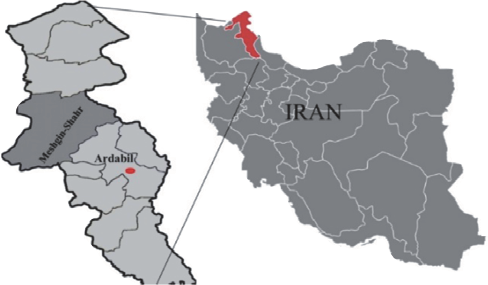
Map of the area.
Data collection
In first time the design of study and its goals was distributed in the health centers as a brochure and personal of centers described the study design for all people and invite them to the participate in the study. After referred to the research center a time for examination and necessary interview arranged and the sampling was done in the referral time and then followed by call in the future.
Before interview, a written informed consent was obtained from all study participants. Demographic data including age, sex, residence- city and also anthropometric data such as weight, height, waist and hip circumferences were collected for all participants and also all participant completed the medical and nutritional questionnaires by interview. The measurement of weight (kg), height (cm), waist and hip circumferences (cm) were recorded by interviewers. Subjects were wearing light clothes. Three anthropometric indices that were assessed in this study were body mass index (BMI), waistto- hip ration (WHR), and waist circumferences (WC). Also, we measured the Systolic and Diastolic pressures for all participant for calculate the HTN prevalence.
BMI was calculated using the formula weight (kg) / [height (m)] 2 and WHR was defined as the ratio of waist circumference (WC) to hip circumference. BMI is recognized as the measure of overall obesity. The BMI category is BMI≥25 kg/m 2 was defined as overweight and a BMI≥30 kg/m 2 was defined as obesity. Individuals with BMI in range (18.5-25) kg/m 2 was considered as normal.
WHR and WC were used as measures of abdominal obesity. A WHR≥0.95 in men and ≥0.85 in women were considered as high WHR (abdominal obesity). Also, a WC>102 cm in men and WC>88 cm in women were considered as high WC.
Systolic and diastolic pressures were obtained for each arm in sitting position. Hypertension was defined as any of these conditions: i) average SBP≥140 mmHg; ii) average DBP≥90 mmHg; iii) being known case of hypertension (diagnosed by a physician) or receiving medication for hypertension.
Statistical analysis
Collected data analyzed by descriptive statistical methods as table, graph and mean±SD; t-test and chi-square have been used to compare numeric and categorical variables, respectively. Also, we used the logistic regression model to determine the relation between variables. Data analyzed were performed using SPSS version 21. P<0.05 was considered as significant level.
Results
Prevalence of overweight and obesity
The study population consisted of 10000 participants (4393 men and 5607 women) with Mean±SD age of 49.1±8.7 years (range 35 to 70). Table 1 summarizes the general characteristics of the study population. The overall prevalence of HTN was 2.6%. The overall prevalence of overweight (BMI≥25 kg/m 2 ) was 42.7%. The prevalence of overweight was significantly higher in younger age groups in comparison to upper age groups (P=0.001).
Demographic data of all participants in the study.

The prevalence of overweight in men slightly higher than women but not significant. Most of men had overweight (51.2%) and most of women had obesity (57.2%) and the relation between sex and BMI was statistically significant (P<0.05).
The estimated total prevalence of obesity and overweight in province population based on census statistics in year 2018 were 675 per 100,000 that of them overweight was 328 per 100000 and obesity was 346 per 100,000.
The total rate of obesity and overweight in all male population of the Ardabil province were 194 and 338 per 100,000, respectively and in all female population of the Ardabil province were 505 and 318 per 100,000, respectively.
The overall prevalence of obesity (BMI≥25 kg/m 2 ) was 45% and this rate in women with 57.2% significantly higher than men with 29.4% (P<0.05).
The trend of change in the prevalence of obesity across different age groups was similar between male and female patients but the trend of overweight wasn't similar between two sexes (Figures 2 and 3).
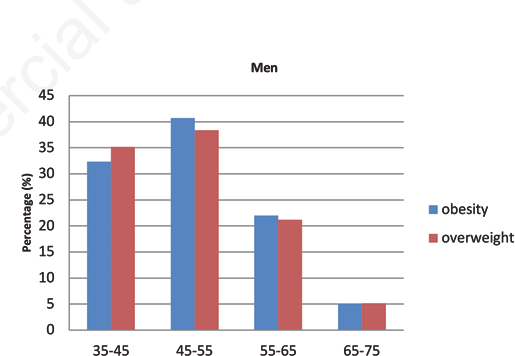
Prevalence of obesity and overweight in male patients.

Prevalence of obesity and overweight in female patients.
In our population the prevalence of obesity in women was more than men (57.2% vs. 29.4%, P=0.003) but the prevalence of overweight was similar between two sexes. In 65% of participants the HC was more than 102 cm/88 cm.
Of all participants, 85.8% had BMI≥25 kg/m 2 and high WHR, simultaneous. This rate was 74.7% among men and 98.1% among women. High waist circumference (more than 102 cm in men and 88 cm in women) was observed in about 65% of participants that of them 97.2% in women and 32.9% in men and the difference was significant between two sexes (P<0.05).
About 60% of men with normal weight had high WHR and 19.5% of obese men had low WHR. About 95.6% of women with normal weight had high WHR and 2.3% of overweight women had low WHR. The prevalence of high WHR in women was significantly higher than the prevalence of overweight among women (97.9% vs. 36%, P=0.001).
The prevalence of hypertension in men with 3.2% was more than women with 2.1% and this difference wasn't significant. The mean of BMI in participants with and without hypertension was 31.4 and 29.7 kg/m 2 and the difference was significant (P=0.001). In logistic regression model, gender, pulse rate and education were the only significant risk factors associate with hypertension.
The prevalence of current smoking use was 19.5%, in men was 42.2% and in women was 1.8% and the difference was significant (P=0.001).
The mean duration of smoking uses time was 2.2 years in mean and 1.9 years in women but no significant. The mean of onset age of smoking use was 20.6 years in men and 22.8 years in women and the difference was significant (P<0.05).
Discussion
In this study the prevalence of overweight and obesity was 42.7% and 45%, respectively which was upper than Jafari-Adli et al study that showed the prevalence rate of overweight and obesity in adult in range 27.0-38.5 (95% CI: 26.8-27.1, 37.2-39.8), and 12.6-25.9 (95% CI: 12.2-13.0, 24.9-26.8), respectively. 1 In our study the prevalence of abdominal obesity was 71.8% in male and 97.9% in female which was upper than Barzin et al. study results with 52.8% and 44.4% in men and women. 11 Azizi et al. showed that the prevalence of obesity in both sexes increased with age up to 60 years. 12 Hosseinpanah et al. in a study showed that the prevalence of abdominal obesity in women was greater than men (76.7 vs. 36.5%). 13
Cumulative incidence of obesity among Tehranian adults in a median 8 year follow up were 31.3, 38.1 and 23.4% for the whole population, women, and men, respectively. In both sexes, higher risk for development of obesity were higher BMI or WC, MetS and lower educational level at baseline. Men showed the highest incidence rate during their 20s and women during their 40s (Figure 3). 14
Zou et al. in a study showed that the prevalence of obesity was 10.1% among adults in urban area which was significantly lower than our study results. They also revealed that demographic and dietary factors could be associated with obesity among adults. 15
Tabrizi et al. in a study showed that the prevalence of overweight, obesity and abdominal obesity was 39.6%, 24%, and 76.4% respectively. Women showed the higher prevalence of obesity (32.2%) and abdominal obesity (81.4%) than men (obesity: 15.1%; abdominal obesity: 68.6%). Age, marriage and family history of obesity were independent predictors of obesity in the population (P<0.001). In men and women, nonsmokers (P<0.01) and subjects having more than two kids (P<0.001) were also more expected to be overweight or obese and abdominally obese respectively. 9
Ayatollahi et al. in a study showed that the prevalence of overweight or obesity (body mass index > or = 25) was 49.7% in men and 63.9% in women. The prevalence of obesity (body mass index > or = 30) was 10.5% and 22.5% in men and women, respectively, which shows an increased secular change of 5.8% in men and 17.4% in women during a 14-year period. Overweight and obesity are common in Iran. Obesity and overweight were significantly more common among women than among men (P=0.000). 4
According to our results, overweight and obesity should be considered as a significant health problem in Ardabil city especially among women. The higher frequency of obesity and overweight in our study may be due to the age of the participants in our study. Our results show that the prevalence of obesity and overweight among women is particularly high, and similar finding have been reported by others.5,16-20 The reason for the higher rate of obesity and overweight in Ardabil people could be due to improvement the economic and social status of people, reduce the daily physical activity, change in life style, nutritional behavior and using foods with low quality and more calories and non-access to sporting facilities.
Mirzazadeh et al. in a systematic review study at 2013 showed that the overall prevalence of obesity in adults with 18.5% significantly lower than our study rate and also they showed that the trend of obesity in men and women with 12.9% and 26.2%, respectively was the same which wasn't similar to our study results. 21
Amani et al. in a study showed that the overall prevalence of overweight and obesity in studied university medical students were 51.3% and 29.6%, respectively. The rate of overweight and obesity in girls were 53.7% and 81.7% which was significantly higher than boys. Also, according to WHR, 27.5% of participants had central obesity that of them 95.5% were girls. 3
Fattahzadeh et al. in a study showed that the rate of overweight in high school girls in Ardabil was 8.8% and central obesity was 35.1%. 22 Ghadiri-Anari et al in study on people aged >30 years showed that the prevalence of obesity and overweight were 9.5% and 29%, respectively which was very low than our study results and similar to our study results, the prevalence of obesity in women significantly higher than men in all age groups. 20 Success in preventive projects and providing health programs required necessary information in the field of obesity for different areas. 23
Our findings clearly indicate that the risk of obesity is greater in women. This difference might be partly attributed to women's tendency to be less active physically in their daily life. Based on three rounds of national surveys, WHO STEPs approach for non-communicable disease risk factors, physical activities in women were much less than men; in all categories of physical activity, women had reported lower levels of physical activity.24-26
For control the overweight and obesity among Iranian people, programs such as breast feeding until two years by neonate, encourage people to doing screening for obesity and overweight, providing nutritional advisors in health programs for people, limitation of using gases drinks and eating in fast foods by people, diagnosis and treatment of obesity and overweight from neonatal duration and more using fruits and vegetables among people have been suggested in future.
Conclusions
Results showed that the prevalence of overweight and obesity among Ardabil city people was significantly more than country rate and internal studies. So, programing for raising their Quality of Life (QoL) and life style is essential. In addition, for control the obesity and overweight higher rate, changing poor nutritional behaviors by managing eating habits among Ardabil province healthy people should be done in future.
Footnotes
The authors declare no potential conflict of interest.
Acknowledgments
The authors would like to thank all participants in the study.