






Abstract
Background
Adherence to self-care is the goal of nursing care for elderly people with hypertension to give them optimal functional health status. The purpose of this paper is to determine the effectiveness of self-management on adherence to self-care and management of health status elderly people living with hypertension in Pekanbaru City.
Design and methods
This study design was quasi-experimental with a pre-post test with a control group. The self-management intervention was provided through four home visits to elderly people living with hypertension with a caregiver. Samples were taken by the consecutive sampling technique, and a total number 134 elderly people were participants. The instruments used were the adherence to self-care questionnaire and the Short Form 12 Health Survey (SF12) for elderly people.
Results
The results showed that most of the respondents with hypertension were 60-74 years of age (84.3%), were female (67.9%), of Minang ethnicity (48.5%), had completed primary school (44%), were unemployed (81.3) %), had a family history of hypertension (50%), were non-smokers (52.2%), and had never drunk alcohol (95.5%). The effects of self-management were positive on adherence to caring for themselves (p<0.001) and on health status (p<0.001). The most influencing factor on self-care compliance and health status after being controlled by confounding variables was self-management (p<0.001).
Conclusions
This study recommends that nursing interventions on self-management for elderly people with hypertension in the community and should be integrated into the Community Health Nurses’ (Perkesmas) program in Indonesia.
Introduction
Older adults are considered to be among the most vulnerable groups with a high risk of experiencing health problems. Elderly people are vulnerable due to the aging process that affects their bodies physiologically. 1 A comparison of Basic Health Research (Riskesdas) Indonesia in 2018 and 2013 shows that hypertension had the highest increase in communicable diseases (8.3%) in those five years. 2 One of the causes for the increase in the number of cases of hypertension in older people is their failure to control their hypertension. Most of the older adults do not adhere to presecribed treatment, or to nutritional, weight management, physical activity, smoking, and alcohol consumption guidelines. A correlation has been shown between uncontrolled hypertension and nonadherence to treatment, physical activity, and avoidance of alcohol instruction. 3 The impact of nonadherence in older people with hypertension is commonly caused by the hypertension being asymptomatic, a decline in their cognitive abilities, a disbelief in the medical treatment, a psychosocial condition, or the costs of healthcare. Nonadherence may cause uncontrolled blood pressure, increased risk of complications, and mortality.4,5 Older adults with hypertension frequently do not adhere to health care advice, which increases their risk for complications.
Significance for public health
The self-management intervention was provided through four home visits to elderly people living with hypertension with a caregiver. Nurses direct the elderly people to have good self-management, so that older adults with hypertension have a sense of responsibility towards their health care. The effects of self-management were positive on adherence to caring for themselves and on health status. This research was conducted in the elderly people by involving family support systems. This study recommends that nursing interventions on self-management for elderly people with hypertension in the community and should be integrated into the Community Health Nurses’ (Perkesmas) program in Indonesia.
In elderly people's health issues, adherence involves their commitment to stick to their treatment plan at home. Nursing care for older people may involve their family through training, through giving a positive perception to family members who take care of them, and through counseling. 6 Receiving support from a family by who are enabled to provide health information influences the behavior of the older person who is receiving treatment for hypertension. 7 Another study also showed a positive correlation between self-management and family support in treating elderly people with chronic diseases. 8
Self-management thus influences self-care adherence and health status among hypertensive clients. Hypertension self-management comprises health education related to the disease process, physical activity, reductions in alcohol consumption, stress management, smoking cessation, adherence to treatment, dietary management, blood pressure monitoring, either at home or in a health facility, social or group support.9,10 A study on a two-week selfmanagement course showed that it could improve self-efficacy in pulmonary TB patients. 11
A preliminary study in Community Health Center (Puskesmas) Lima Puluh, Pekanbaru, showed that five elderly people with hypertension did not adhere to their self-care instruction and had low health status. The elderly people with hypertension were reluctant to visit the health facilities when they had complaints of headache or dizziness. They were unmotivated to check their condition at the integrated healthcare center for elderly people. It was suggested that, a nursing intervention was required that would improve self-care adherence and health status in the older people with hypertension. This would be supported during home care visit to the elderly people and the self-management would be supported by the family as the caregiver. The purpose of this study is to determine the effectiveness of self-management on adherence to caring for themselves and on health status among older people with hypertension in Pekanbaru City.
Design and Methods
The study's design was quasi-experimental using a pre- and post-test and a control group. Samples were collected by the consecutive sampling technique, and the total number of participants was 134 elderly people: 67 older people in intervention group and 67 older people in the control group. The inclusion criteria were for older people who registered at the Community Health Center (Puskesmas) with a medical diagnosis of hypertension. These older people should have blood pressure ≥ 140/90 mmHg and clinical symptoms of hypertension such as headaches and neck pain; could hear clearly; and they lived with family members who played the role of older people caregiver to the older person.
The self-management intervention was provided through home visits to the older people with hypertension and their caregiver. Topic self-management intervention based on the nursing outcome classification (NOC), nursing intervention classification (NIC), and intervention to optimizing self-management of older people with hypertension. 12 The intervention involved four sessions (55-60 minutes per sessions) spread over two weeks. At the first session, explanations were given about hypertension, home care methods, utilization of health services for medication and the monitoring of blood pressure, and identification of risk factors in the older person. The second session, involved daily physical activity management and social support. The third session covered nutrition management. The fourth session was about relaxation, and smoking and alcohol reduction according to the risk factors recognized by the older person. Demonstrations included nutrition management, scheduling of health services for medication and health checks, physical activity, daily menus, daily activities, relaxation, and reducing consumption of cigarettes and alcohol. Participants at this intervention received module and workbooks about self-management for the older person with hypertension.
Respondents in the intervention group received self-management intervention from researchers and from the Health Center such as pharmacological therapy or education from nurses. Respondents in the control group did not receive self-management intervention from researchers but received interventions from the Health Center, too. Home visits were carried out daily to 22 to 23 participants. Monday to Wednesday in the first week is the first session. Thursday to Saturday in the first week is the second session. Monday to Wednesday the second week is the third session. Thursday to Saturday in the second week is the fourth session. The process of collecting data from June-August 2020 is to test the validity and reliability, selecting respondents, pre-test, self-management intervention, and post-test.
The instruments used for the pre- and post-test were adherence to self-care questionnaire (modified),13,14 and the Short Form 12 Health Survey (SF12) for older people. 15 The adherence to selfcare questionnaire is considered valid and consists of 27 statements (0,773). Numbers 4, 8, 14, 16, 22, 23, 24, 25, 26, and 27 are positive statements, while numbers 1, 2, 3, 5, 6, 7, 9, 10, 11, 12, 13, 15, 17, 18, 19, 20, and 21 are negative statements. The questionnaire uses a Likert type scale with answers ranging from “never; sometimes, namely once / week; often, namely 3 times / week, and always, namely every day”. The positive statements had values ranging from “always” (value 4), “often” (value 3), “sometimes” (value 2), to “never” (value 1). The values were reserved for the negative statements so that “always” (had value 1), “often” (value 2), “sometimes” (value 3), and “never “(value 4). The SF12 questionnaire is valid and reliable and consists of 12 question items, also with answer valued at 1, 2, 3, 4, or 5.
The data analyses performed were univariate, bivariate, and multivariate. The results of the univariate analysis were presented as frequency and percentages. The bivariate analysis used the dependent t-test and the independent t-test. The multivariate analysis used general linear regression: the multivariate analysis of covariance (MANCOVA) test.
This research has obtained ethical permission because it has passed the ethical test of the ethics committee of the Faculty of Nursing, Universitas Indonesia (SK-74/UN2.F12.DI.2.1/ETIK 2020). This study has received permission from the health office, Community Health Center, Head of Rukun Warga (RW) and Rukun Tetangga (RT) where the study has conducted. The consent form was signed by the elderly people or their family witnessed by the older people. The principles of nursing ethics that are considered in this study are compassion, respect, intimacy, and advocacy. The process of collecting data by implementing health protocols, free from physical harm, free from confort, free from exploitation. During the research process, all respondents with hypertension and their families were not diagnosed with covid-19 and there were no complications of hypertension.
Results
The results showed that self-management interventions were effective in improving self-care compliance and health status after being controlled by confounding variables.
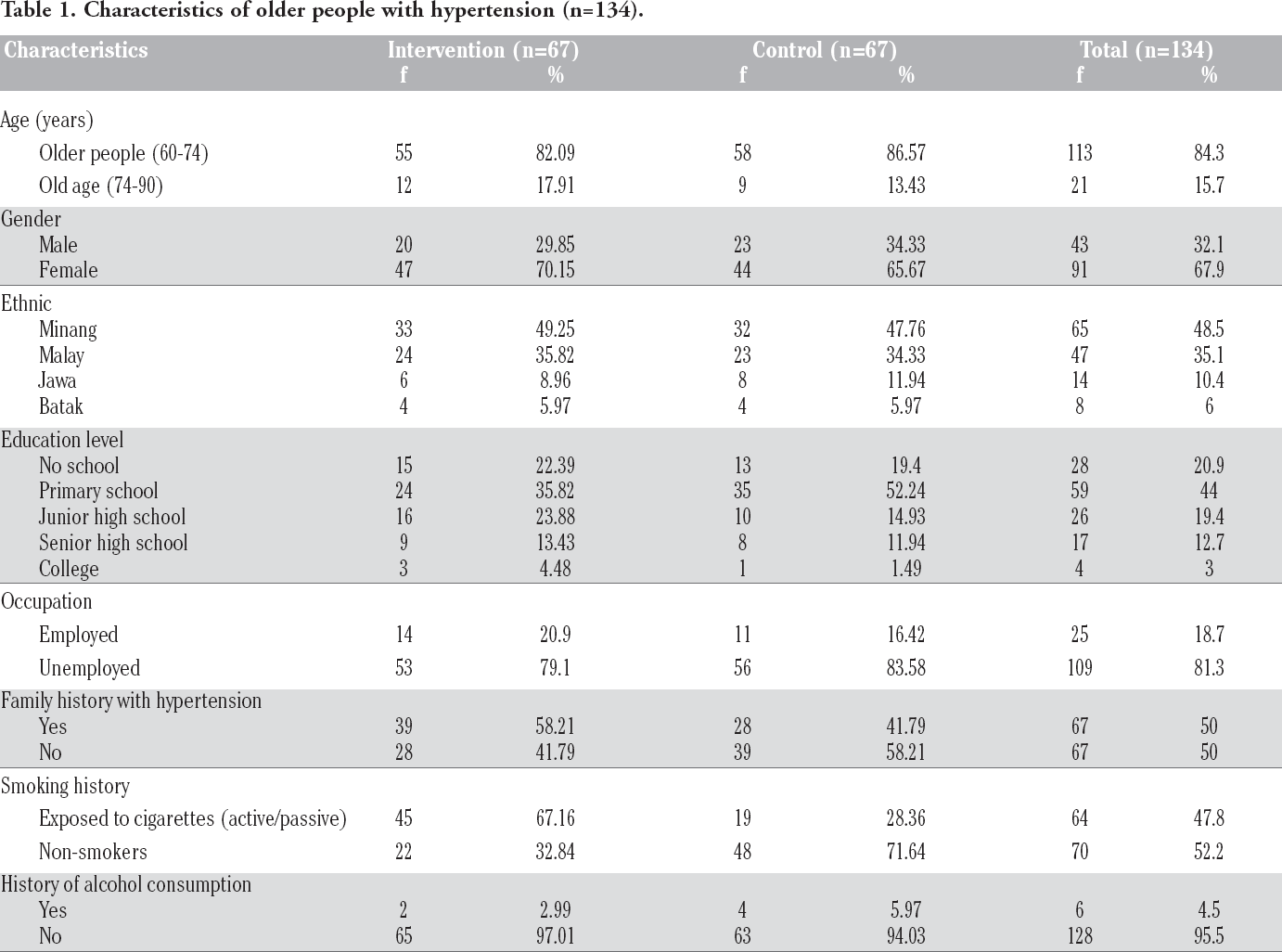
The sociodemographic among participants in the intervention and control groups are presenting in Table 1. Most of the respondents with hypertension were 60-74 years of age (84.3%), were female (67.9%), of Minang ethnicity (48.5%), had completed primary school (44%), were unemployed (81.3) %), had a family history of hypertension (50%), were non-smokers (52.2%), and had never drunk alcohol (95.5%).
Characteristics of older people with hypertension (n=134).
The participant's health status comparison between the groups before and after the intervention is provided in Table 2. The findings highlighted also a significant difference in the mean adherence in self-care for the intervention group before and after the intervention; Table 3 shows that the mean adherence in self-care in the intervention group significantly increased (p<0.001). Table 4 shows that the mean health status significantly increased in the intervention group (p<0.001). A significant difference has been found in the health status mean values for the intervention and control group after intervention; the effects of self-management were positive on health status (p<0.001) (Table 5).
Participants’ adherence comparison to care for themselves and health status between intervention group and control group before and after intervention (n=134).

Participant's self-management effect on adherence in self-care (n=134).

Influence of self-management on health status (n=134).

Effectiveness of self-management on adherence to self-care and on health status after controlling for confounding variables (n=134).

A significant effect of self-management on adherence in selfcare and health status of the older people with hypertension (p<0.001) has been retrieved, which increased after being controlled by ethnicity and smoking history (Table 6). The most influencing factor on self-care compliance and health status after being controlled by confounding variables was self-management (45.4%).
Effectiveness of self-management on adherence to self-care and on health status among older people with hypertension (n=134).

Discussions
The characteristics of older people with hypertension
The elderly people with hypertension in this study had experienced symptoms such as neck pain, chest palpitations, and headaches. Increasing age caused mutations in the fibrillin-1 gene, changed the structure and function of blood vessels that increased arterial stiffness, reduced arterial elasticity, increased pulse pressure, and aortic dilatation. Systolic blood pressure increased along with age, while diastolic blood pressure remained stable and might decrease spontaneously.16,17 Female older people had higher mean arterial blood pressure, systolic blood pressure, and pulse pressure because they had higher HDL and LDL than male elderly. Postmenopausal women had lower estrogen levels and were at greater risk of cardiovascular disease. 17 The ethnic culture in this study was also associated with eating habits and lifestyles, such as consuming coconut milk foods, high-salt diet, fatty foods, smoking, and lack of exercise. Another finding showed that most of the hypertension patients finished elementary school.18–21 The level of education influenced the self-care in people with hypertension (p=0.036). Lack of education and health literacy was one of the risk factors of the nonadherence to the recommended hypertension self-care. 22 The education level influenced the awareness, selfmanagement, ability to understand and adhere to the recommended hypertension self-care.
A conducive work environment and good economic condition can reduce hypertension risk. 23 Older people who were unemployed and needed treatment costs will cause an economic burden to the family. Most of the respondents in this study had health insurance paid by personal pension funds or government assistance. Family might affect eating habits, lifestyle, activity, and coping mechanisms. The finding of this study showed that most of the respondents admitted that they used to consume fatty and highsalt foods because of inherited habits from the family. The elderly who had a family history of hypertension should switch to a healthier lifestyle. 56% of hypertension cases prevent by eliminating hypertension's family history. 24 Smoking habits in older people might increase the risk of hypertension 96.8 times greater than those who did not smoke. 25 The more they consume alcohol, the higher the alcohol level, and the longer they consume alcohol, the higher risk of hypertension as it escalates arteriosclerosis. 23 Most of the respondents believed and did not consume alcohol because their religion and culture prohibited it, and it was not good for health.
The influence of self-management on adherence in selfcare and health status
The effects of self-management were positive on adherence to caring for themselves (p<0.001) and on health status (p<0.001). The older people with hypertension said they were tired of consuming hypertensive drugs for lengthy periods and preferred to consume medicinal plants and traditional medicines. These preferences influenced their perceptions and especially, their treatment adherence. The need to motivate behavioral change in older people with hypertension and to promote their self-care is the theory underlying the health belief model (HBM). The HBM is a protection theory that aims to prevent the development of advanced hypertension. Applying the HBM approach to hypertension selfmanagement creates positive perceptions and improves the sense of responsibility in older people and their families toward the hypertension treatment. The findings showed that the HBM-based health education influenced the older people's management of their hypertension (p<0.05). The intervention improved their performance, health beliefs, knowledge, awareness, sense of responsibility, self-efficacy, ability to judge, and their decision-making ability. 26 Involvement in hypertension prevention influenced the older people's perception of the threats, made them feel better about themselves, and prompted them to act as instructed in the HBM. 27
Older people with hypertension need a nonpharmacological approach to treatment, such as health education and healthy lifestyle coaching. The topics covered in the health education include an introduction to hypertension, the risk factors for hypertension, signs and symptoms, levels of urgency, treatments available for hypertension, treatment adherence, a low sodium diet, dietary approaches to stopping hypertension (DASH), the effect of alcohol and smoking on hypertension, physiological stress, weight loss, and physical activity.16,28 Most of the respondents in this study used to consume lontong. Lontong is a traditional dish made of compressed rice cake wrapped, boiled, and served with noodles and coconut milk curry as a breakfast, and fried snacks (sala lauak, fried tofu, fried banana, bakwan, fried tempeh). Coconut milk that has been heated many times and cooking oil that has been used many times increases the risk of hypercholesterol. Hypercholesterol is one of the risk factors for hypertension. Another finding was that coconut milk and oil, if heated at high temperatures repeatedly, might raise the LDL cholesterol level, which increases the risk of narrowing blood vessels.29,30
Adherence to self-care is the expression of the attitudes and behaviors of older people with hypertension who are willing to follow instructions about taking care of their health. Increased adherence to taking care of themselves has the potential to change their lifestyle toward being healthier and thereby, improving their health status. Another finding was that self-management programs delivered through a home visit to older people with hypertension could contribute to a healthier lifestyle (p<0.001). 31 The primary treatment for hypertensive patients requires an intervention that improves their awareness of the importance of adherence to selfcare. 32 Most older people with hypertension are motivated to conduct their own healthcare. The healthy behaviors that all people should observe are consuming healthy foods, being involved in social events, doing regular physical activity, and ensuring physiological well-being.31,33 Self-management programs can change behaviors and improve the health status of older people with hypertension. 34
The effectiveness of self-management intervention
Self-management interventions are shown to be effective in improving self-care compliance and health status after being controlled for ethnicity and smoking history. Ethnicity and smoking history strengthen the effect of self-management on self-care compliance and the health status of older people with hypertension: an increase of 42.3% in self-care compliance and health status was brought about by self-management. After controlling for ethnicity and smoking history, the effect of self-management on self-care compliance and health status increased to 45.4%. Good self-management can increase self-care compliance and the health status of older people with hypertension. Hypertension prevention measures and prevention of the impact of hypertension can be carried out if the older people with hypertension engage in good self-management. Self-management is useful for assessing the ability of the older people to manage and maintain their health. Another finding of the study was that hypertension prevention and control can be promoted by providing self-management counseling and coaching. This can maintain the health status of the elderly person and prevent complications developing. 35 Good self-management improves adherence to self-care, and health status improves due to reduced blood pressure, which prevents the effects of hypertension. Better self-management can lower the blood pressure of elderly people with hypertension. 18 Older people can achieve optimal health if they have knowledge about healthy living in old age. Their health status determines their survival more than other factors. 36
The nurse's role in the treatment of hypertension among elderly people is to find an effective and efficient strategy for controlling their health. One approach involves detecting and monitoring their blood pressure, making referrals, following-up, providing health education and counseling, skills development, and the coordination of care at the health service facilities. Nurses involve the family in playing an important role in blood pressure control and in supporting the older person with hypertension in taking care of their health. 37 This study involved the family who were present with the older people during the home visits. The findings showed that the elderly person felt happy to have their family involved in every session of the intervention. In this way, the family expressed their care and sense of responsibility for the older person's health. In the Melayu culture in Riau, most older people spend their old age with their family; therefore, the family becomes the most important support system for them as they participate in their health treatment. 33 Another finding identified a significant correlation between the social support received from the family and hypertension self-care behavior (p<0.05). Family support influences the elderly person's ability to control their blood pressure and adhere to treatment. 38 Involving the family caregiver in the nursing care of the elderly person showed positive benefits, such as emotional expressions, care, and respect for the elderly. 39 Elderly people are able to achieve optimal health if they have knowledge about living to a healthy old age. Their health status determines their survival more than any other factors. 36 Efforts to increase the awareness of the older person with hypertension of the need to care for themselves and to improve their health status requires active involvement by the nurses, the elderly person, and their family. The role of the nurse is to find an effective and efficient strategy to control the health of the elderly person with hypertension. Each teaching session covers different aspects, including the cognitive, affective, and psychomotor. After two weeks of intervention sessions, the burden of caring for the older person with hypertension falls on their children. The family now comes to play the major role in caring for the older person with hypertension. Older people who are not supported by their families find it very difficult to maintain self-management. Those whose task is to assist the elderly person in the management of their hypertension must accompany them to the health services to have their blood pressure and medication checked. The family must be involved in seeing that they take their medication regularly, and the family must provide nutritious food according to the diet recommended for the elderly person with hypertension. With increasing awareness of the need to care for themselves, the health status of elderly people with hypertension will improve.
This study's strength is that self-management intervention is a form of community nursing intervention given to the older people with hypertension through home visits. Nurses direct the older people to have good self-management, so that older people with hypertension have a sense of responsibility towards their health care. Self-management intervention in the older people with hypertension is an innovation in community nursing interventions. This research was conducted in the older people by involving family support systems. Outcomes of this research that will be submitted for patents are the community nurse module, the older people and family module, and the older people and family workbook. Providing four sessions of self-management intervention in two weeks made it easier for the Community Health Center (Puskesmas) to implement it in the field. Meetings twice a week provide encouragement and increase reminders for the elderly and families in self-management. This study's weakness is that after an increase in COVID-19 cases in Indonesia, especially in Pekanbaru, the intervention session was carried out in four sessions in two weeks, which means two sessions in one week. The four-session interventions consider the existence of large-scale social applications to prevent COVID-19 transmission. This change affects the internalization of self-management that the older people and their families do at home. Self-management interventions with home visits that carry out were four times as capable as in the future by nurses at the Community Health Center (Puskesmas). Researchers felt that home visits were efficient, and the older people and their families could understand the entire material well. Based on the result of this study, it can be concluded that self-management interventions were effective in improving self-care compliance and health status after being controlled by confounding variables. This intervention recommends the provision of nursing interventions in the self-management counseling on older people with hypertension in the community integrating with the Community Health Nurses (Perkesmas) program in Indonesia.
Footnotes
The authors declare no conflict of interest, financial or otherwise.
Acknowledgments
The authors would like to thank Direktorat Riset dan Pengembangan, Universitas Indonesia that provided funding for this study and publication (PUTI Saintekes 2020 No. NKB- 4633/UN2.RST/HKP.05.00/2020), nurses at the Community Health Center (Puskesmas), study assistants, community leaders, community health cadres, older people's and families who participated in this study.