






Abstract
Background
Violent behavior is one of the most common symptoms of people who have schizophrenia. Caring for family members who have schizophrenia can be a stressor for other family members. The stressors can be stressful for the caregiver. Family caregivers require coping strategies to overcome the stressors. This study aims to determine the relationship between stress levels and coping strategies of family caregivers who treat schizophrenic patients with a risk of violent behavior.
Design and Methods
The research design engaged crosssectional with the purposive sampling technique by involving 87 caregiver families who who treat schizophrenic patients. The data was collected by using the Perceived Stress Scale (PSS) and Ways of Coping (WOC) questionnaires. This study was analyzed by employing the Chi-Square test to determine the relationship between stress levels and coping strategies in the caregiver family.
Results
This study shows that stress levels are not significantly associated with coping strategies in family caregivers.
Conclusion
Good supports from health and social service professionals are required to help family caregivers cope with their stressors well.
Introduction
Schizophrenia is a chronic mental disorder that usually occurs at a young age and can affect brain functions, such as disrupting patterns of thought, perception, movement, and behavior. 1 It is estimated that more than 21 million people worldwide are affected by schizophrenia. 2 The data indicates that the number of schizophrenic sufferers had increased from 5.3 per mile to 7 per mile from 2013 to 2018. 3 The main problem that often occurs in schizophrenia patients is violent behavior 4 . The incidence of quarreling behavior in schizophrenics is 47%. 1 Nolan et al. documented the interviews and found that 11 out of 55 attacks in schizophrenic inpatients were directly associated with positive psychotic symptoms. 5 This condition must be treated immediately because violent behavior can harm patients, other people, and the environment. 4
Significance for public health
This study has important public health benefit because this study indicates that the stress level that occurs in the family caregivers is categorized as a moderate level. Even though the family caregivers’ stress level is at an intermediate level, this situation still requires attention, prevention, management, and treatment appropriately and effectively. Thus, it does not continue to a more severe level.
Caring for family members with mental disorders can be a stressor for other families. The stressor results in stress and a burden on the family. A study at Dr. H. Soewondo Kendal Regional Public Hospital in Indonesia shows diverse levels of stress in families whose family members suffer from mental disorders; 52 people (66.7%) experienced moderate stress, 18 people (23.1%) experienced severe stress, and 8 people (10.3%) experienced mild stress. 6 When caring for family members with mental disorders, families need coping strategies to deal with the stress they face. Meanwhile, another study shows diverse coping strategies used by families in caring for patients with severe mental disorders; 20 people (47%) utilized emotion-focused coping, 13 people (30%) utilized problem-focused coping, and 10 people (23%) used problem-focused coping and emotion-focused coping simultaneously. 7 The family's stress experience and ineffective coping strategies can have an impact on mental disorder patients because they need their family's participation. Based on the phenomena described previously, the researchers are interested in investigating the level of stress experienced by families whose family members are at risk of violent behavior and the coping strategies used by the family caregivers.
Design and Method
This research is a cross-sectional research study. The research design engaged cross-sectional with the purposive sampling technique. Therefore, the sample size of this research was 87 family caregivers. The sample of this study was family caregivers who treated schizophrenic patients with a risk of violent behavior in Komunitas Peduli Skizofrenia Indonesia (KPSI). The criteria for the patient to be taken are schizophrenic patients who have experienced violent behavior. Data collection was carried out online starting from May 18th to July 12th, 2020.
The data were collected using online questionnaire by considering research ethics, such as respect for human dignity, beneficence, non-maleficence, and justice. This research was approved by the Ethics Committee of the Faculty of Nursing, Universitas Indonesia, with decision number S- 741/UN2.F12.D1/PDP.O4.01/2020. The instrument employed in this study was the Perceived Stress Scale (PSS) and Ways of Coping (WOC) questionnaire. The stages of data processing were editing, coding, processing, and cleaning. The coded data were then analyzed by employing SPSS 23.0. The questionnaire in this study had previously been tested for its validity and reliability. The Ways of Coping (WOC) questionnaire has been tested for its validity and reliability. This questionnaire has a reliability level from 0.71 to 0.94.
Results
This research reveals that the respondents are adults, females, housewives, diploma graduates, siblings of the schizophrenic patients, employees with lower monthly income than the regional minimum wage in Indonesia, and 7 work hours (median) to treat schizophrenic patients. Besides, the duration of schizophrenic patients suffering from their illness is about 1 to 10 years (Table 1).
Description of the distribution of respondents’ characteristics in Komunitas Peduli Skizofrenia Indonesia (KPSI).

The description of the respondents’ stress was measured using PSS and the coping measured by WOC, the categorical results were analysed using frequency distribution values. Stress level and coping strategies discovered by looking at the total number and percentage of each category. Table 2 shows that the stress level of family caregivers is mostly in the medium category. However, there are still some family caregivers who experience severe stress levels. On the other hand, the lowest percentage shows that family caregivers experience a mild stress level.
Description of stress levels in Komunitas Peduli Skizofrenia Indonesia (KPSI).
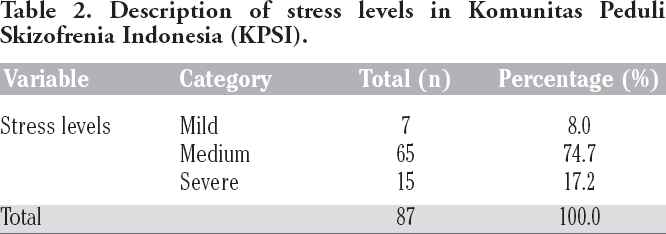
Table 3 shows that family caregivers use one of the two coping strategies to care for schizophrenic patients with a risk of violent behavior. They are problem-focused coping (PFC) and emotionfocused coping (EFC). The use of the two coping strategies tends to be balanced. On the other hand, only a few family caregivers use a combination of the two types of coping strategies.
Description of coping strategies in Komunitas Peduli Skizofrenia Indonesia (KPSI).

Table 4 shows that stress levels have no significant relationship to coping strategies in family caregivers whose patients are at risk of violent behavior.
Description of stress levels and coping strategies in Komunitas Peduli Skizofrenia Indonesia (KPSI).

Discussion
Stress is a physical and psychological response to the body when facing danger or threat. 8 Medium stress level is the level of stress in situations, such as excessive workloads and uncompleted or incomplete tasks that every individual frequently feel and face. Thus, it can affect one's health condition that lasts longer than mild stress levels. 9 When providing care to schizophrenic patients, family caregiver experience stress.
One of the roles and functions of the family is to provide affection for other family members in meeting their psychosocial needs. 10 A study concludes that caregivers’ caring for schizophrenic patients have a higher burden than caregivers caring for bipolar disorder patients, especially in terms of external supports, routine cares, and relationships with family members and other friends. 11 Most of the studies investigating caregivers’ burden of schizophrenic patients report that more than 90% of caregivers experience moderate to severe burden. 12 Furthermore, the management of unpredictable psychiatric symptoms (such as violent behavior) of schizophrenic patients, especially patients who have a history of violent behavior, can cause stress and pressures on the caregivers. 13 A study shows that 87.7% of caregivers experiencing psychological violence, and 75.8% of them experience physical violence by schizophrenic patients in Japan. 14 Besides endangering themselves, other impacts that possibly arise from the violent behavior of schizophrenic patients are social ostracism from their friends and the possibility of a loss of jobs. 4 Therefore, family caregivers who provide care to schizophrenic patients will be more at risk of experiencing stress. 15
Coping strategies are defined as individual responses when they experience stress or when levels of stress exposure increase. Coping strategies can be classified into Problem-Focused Coping (PFC) and Emotion-Focused Coping (EFC). Family caregivers who tend to use PFC will deal with the problems or burdens they face by looking for alternatives to solve them. PFC consists of planful problem solving, confrontative coping, and seeking social supports. Another study shows that the most frequently used coping strategy by family caregivers is seeking social support, while the least used coping strategy is confrontation. 16 Family caregivers tend to seek social supports and planful problem solving to reduce their burden because sharing the difficulties faced with others can relieve the perceived pressures. 17 Another advantage that the family caregivers possibly obtain when using these coping strategies is getting additional information to solve it.
Emotional-Focused Coping (EFC) is a coping commonly used mainly to treat health problems because a threat to one's health is an event that is compulsorily tolerated but cannot necessarily be followed up. Therefore, caregivers use a coping that focuses on emotions to face the fact that one of their family members has a mental illness. 18 This study reveals that several types of Emotion- Focused Coping (EFC) performed by caregivers have different percentages: distancing (65.06%), accepting responsibility (65%), escape/avoidance (58.97%), self-control (53.69%), and positive reappraisal (50.80%). Majority of the family caregivers of schizophrenic patients tend to run away (distancing). The caregivers to do distancing because it can reduce their stress. They take a break from concerning themselves with schizophrenic patients for a while.
Schizophrenia is a severe mental illness that affects not only the patient but also his family members. Family members are the primary support system and have the responsibility to care for each other. Caregivers usually provide physical, emotional, and financial supports to their family members who have a mental disorder, such as schizophrenia. 19 The sense of responsibility that is owned as a family can affect the physical and even mental health of the caregiver. 20 It is because providing care to schizophrenic patients is a tiring activity that demands patience.
The results of the bivariate analysis by using the Chi-Square statistical test shows that there is no significant relationship between stress levels and coping strategies in family caregivers who treat schizophrenic patients with a history of violent behavior. It is shown from the value of p=0.807, which is greater than the value of α = 0.05. The results of this study are similar to those of some existing studies. Furthermore, research in India that assesses the relationship between coping strategies and the level of stress suffered by caregivers shows that there is no significant correlation (p=0.258) between coping strategies and the level of stress experienced by caregivers. 21
Besides, a study conducted in a hospital in India shows no correlation between the coping used and the burden experienced by caregivers because the researcher assessed the coping strategies and the burden of nurse caregivers whose patients were undergoing outpatient treatment. On the other hand, in the following study, this condition happens because nurse caregivers are busy with the recovery process for inpatients with schizophrenia, and thus, they understand the problem. 22 The use of specific coping strategies may be relevant much later in the treatment. 22 However, a study investigating avoidance shows different results. The use of avoidance coping strategy shows a positive correlation with the burden on schizophrenic caregivers. Moreover, the research shows that there is no consistent correlation between the burden and the PFC strategy.
Based on the results of several studies previously discussed, it is concluded that each coping has different effects. The various research results are possibly influenced by internal and external factors of the caregivers. 23 Internal factors are individuals’ factors, such as health and energy, trust, knowledge, problem-solving skills, social skills, and an individual's communication ability to others. Meanwhile, external factors are factors that come from the outside of an individual. Individual external factors include social support and material resources. Besides, coping strategies can be influenced by several factors, such as life experience, gender, education level, and age. 8
This study indicates that the stress level that occurs in the family caregivers is categorized as a moderate level. Even though the family caregivers’ stress level is at an intermediate level, this situation still requires attention, prevention, management, and treatment appropriately and effectively. Thus, it does not continue to a more severe level. There are even family caregivers who experience stress at an intense level. If the family caregivers experience stress and do not get proper attention, prevention, management, and treatment, the condition will bring a negative impact on physiological, psychological, emotional, cognitive, and behavioral elements. Thus, the results of this study are significant to be implemented by nursing services as an information reference to improve health services through collaboration with academic institutions or universities in providing strategic promotional programs, such as health promotion, counseling, education, and mental nursing cares regarding the management of stress management appropriately and effectively for the family caregivers.
Footnotes
The authors declare no conflict of interest.
Acknowledgments
The authors acknowledge Direktorat Riset dan Pengembangan, Universitas Indonesia for granting the PUTI Saintekes 2020 Number NKB-4609/UN2.RST/HKP.05.00/2020. The author also like to thank the family caregiver of Komunitas Peduli Skizofrenia Indonesia (KPSI) who participated in this study.