






Abstract
Background
Drug abuse is one of the world's most serious and rapidly rising problems, causing a wide variety of health issues with significant morbidity and mortality. This study aimed to explore the association between part-time work and substance abuse among vocational students.
Design and methods
We conducted a cross-sectional analytical study that included all part-time working male students from five vocational male schools, and we used a standardized pretested questionnaire after obtaining written informed consent. A One- Step Multi-Drug Screen Test was used to assess the substances that were abused
Results
A total of 316 out of the 400 invited students participated in our study. Of the total screened subjects, 26.6 % were abusing substances. Twenty-five (36.2%) day working adolescents, nine (14.0%) night working adolescents, and forty (36.0%) day and night working adolescents were abusers.
Tobacco was the most widely abused drug (68%) in the form of smoking, followed by cannabis (24%), marijuana (16.4%), alcohol (10%), and opioid (6.3%).
Night workers had significantly lower rates of smoking, cannabis, Marijuana, alcohol, or opioids abuse, and Logistic regression was performed to ascertain the effects of the work schedule on the likelihood that participants have substance abuse; Night workers were 7.14 times less likely to have substance abuse than day workers, while day and night work did not differ from day work.
Conclusions
The prevalence of drug abuse in vocational students is considered high and a serious problem that damages the youth and the community.
Introduction
Substance abuse (SA) is one of the world's most serious and increasing concerns, causing a wide variety of health issues with significant morbidity and mortality. Substance abuse is one of the top 20 risk factors for health problems globally, and the cost of health insurance for those who abuse drugs is almost twice as high as for those who do not. According to the WHO, SA is described as the harmful or hazardous use of psychoactive substances, such as alcohol and illicit drugs, which results in the development of a dependence syndrome.1,2
Substance abuse, including the use of alcohol, tobacco, and illicit drugs, is common among adolescents in Africa and the middle east. 3 The General Secretariat of Mental Health and Addiction Treatment (GSMHAT) of Egypt's Ministry of Health (MOH) has been publishing reports on mental health and addiction treatment since 1996. 4 Egypt's substance addiction problem is being studied by “The National Research of Addiction, Egypt.” The prevalence of substance abuse is steadily rising. Due to the typical issues of late adolescence/early adulthood, peer influence and pressure, as well as family disturbance and a family history of substance use, young adults were the most represented age group among substance users, i.e., the most vulnerable age group. 5 In 2016, an estimated 6.8% of Egyptians over 15 years of age engaged in drug abuse. 6 SA is linked to negative outcomes, posing unique challenges for not only the students who abuse the drugs, but also their parents, friends, schools, peers, and wider communities.7,8 Shift work is widespread in society today, and shift workers are more likely to develop a variety of chronic diseases. Sleep disorders, stomach conditions, cardiovascular diseases, and cancers are all induced by night-shift work, which has a damaging influence on human biological adaptation to natural light and darkness cycles.9,10
Shift work has been linked to increased use of alcohol and illegal substances, as well as various deviant activities among school children; many negative consequences for working students, such as work-related accidents, low academic performance, substance use; and high rates of work-related injuries.11,12
Longer hours of work during the school year have been related to poorer academic performance, lower school participation, and increased psychological distress or somatic symptoms in studies of teenage students.8,13 Substance abuse among students who work part-time is a serious public health problem. However, few studies have examined the association between drug abuse and work schedules. Adolescents (including vocational students) abuse drugs at a growing rate. Since most vocational students work and study beyond the watchful eye of their parents for most of their time, they are the most vulnerable to drug use among the various youth groups in Egypt. As a result, a thorough empirical study on the prevalence and types of substance abuse among vocational students, as well as their relationship to work schedules, is necessary.
Significance for public health
Throughout human history, substance abuse has been a challenging public health issue, particularly among adolescents. Work schedules, families, friends, and religious commitments all play a part in the abuse of vocational students. Part-time employment and substance abuse among vocational students are major issues. We advocate that the authorities and planners involved in the area work together to solve this issue.
Objectives of the study
The primary aim of this research was to estimate the prevalence of drug abuse among part-time working vocational students in Menoufia governorates.
The following are the study's specific goals: Determine the prevalence of substance abuse among vocational students in the governorates of Menoufia. Identify the various types of substances that were commonly abused. Assess the relationship between a student's work schedule and drug abuse.
Methods
I-Technical design
Study design:A cross-sectional analytical study was conducted on male students in Menoufia governorate vocational schools.
Study setting: Five vocational male schools were selected randomly from the nine schools located in the Menoufia governorate, covering both urban and rural areas.
Study period: The research was conducted from September 2019 to December 2020.
Inclusion criteria: Male vocational students enrolled in one of the five selected vocational schools and working part-time were included.
Exclusion criteria: Vocational students who refused to participate in the study or were not working, and any participant regularly used any addictive drug for medical indications.
Sampling design
Sample size
The sample size calculation rendered 266 participants (5% margin of error at a 90% confidence level. The targeted sample size was increased by 50% of the calculated sample to avoid unresponsiveness and incomplete questionnaires.
The sample size was calculated using EPI-Info (Epidemiological information package) software version 6.1, 95% CI (confidence interval), and 80% power:

where
Z = Z value (e.g. 1.96 for 95% confidence level);
P = percentage picking a choice expressed as a decimal (0.5 used for sample size needed);
Standard error = expressed as decimal (e.g., 0.05).
Target population
After sample size calculation, and study design selection, all part-time working male students from the selected schools were invited to participate. A total of 400 questionnaires were distributed, and the total valid returned questionnaires were 316, which had undergone analysis making the response rate 79.0%.
Operational design
Pilot study
Before performing the main study, pilot testing was carried out, to assess tool clarity and applicability and to test the laboratory and intervention procedures used in this study and included 20 questionnaires that were excluded from the main study.
Content validity
Two experts from the Faculty of Medicine evaluated the tools for content validity (Public Health and Community Medicine). The experts assessed the tool for clarity, relevance, comprehensiveness, applicability, and understanding. All the suggested modifications to the tools were enforced.
Study process and data collection
Researchers translated the questionnaire into Arabic and provided it to the students to complete. Students who decided to participate in the study filled out the questionnaire on their own with the researcher nearby (but not closely attending) to answer any participant queries.
Study tools
The participants were subjected to a pre-tested, well-structured self-administered questionnaire, and its internal consistency was verified. The questionnaire was composed mainly of the following sections:
Sociodemographic data: age, school grade, class, romantic status, and residence;
Types and frequency of usage of abused drugs in the last month;
Religious commitment (praying and fasting Ramadan);
Items about current and past work experiences;
Family, friends, and co-workers’ abuse history and family relationships.
The average time to complete the interview questionnaire was 15-20 min. Data collection was performed four days per week from 10 a.m. to 1 p.m.
Determination of urinary levels of metabolic drug products was performed using the American Advanced Quality™ One-Step Multi-Drug Screen Test. 14 This test was used for the following drugs: cocaine, amphetamine, tetra-hydro-cannabinol (THC), morphine, barbiturates, and benzodiazepines.
Statistical analysis
Data are expressed as numbers, percentages, means, and standard deviations. Chi-squared test (χ2) was used to study the association between qualitative variables. Whenever any observed cells were less than five, Fischer's Exact test was used. A logistic regression model was used to ascertain the effect of the work schedule on substance abuse. All the analysis was done by SPSS statistical package version 23 (SPSS Inc. Released 2015. IBM SPSS statistics for windows, version 23.0; IBM Corp., Armnok, NY, USA). Two-sided p-value was considered statistically significant.
Results
The participants were all males, with a mean age of 17.27 ± 1.11 years ranging from 15.0 to 19.0 years, 22.8 % in the 1st grade, 30.4 % in the 2nd grade, and 46.8 % in the 3rd grade. Participants in rural areas made up 54.4 % of the total, while those in urban areas made up 45.6 %. More than half of those polled (59.5%) lived with their parents, 12.7 % with one parent, 12.7 % with a stepfather, 11.4 % with other family members, and 3.8 % with grandparents. Fifty-five % (55.7%) of those surveyed were single, while 44.3 % were in a relationship. Among the participants, 69 (21.8%) worked only during the day, 136 (40.0%) worked only at night, and 111 (35.1%) worked both days and nights. The total prevalence of drug abuse in the sample group was 26.6 percent (95%CI: 21.5-31.3). Twenty-five (36.2%) of the day working adolescents, nine (14.0%) of the night working adolescents, and forty (36.0%) of day and night working adolescents were abusers.
In contrast to day-only workers and day and night workers, those who worked only at night registered the lowest levels of smoking and violence. Smoking, tobacco, Marijuana, alcohol, and opioid misuse were all significantly lower among them (Table 1).
Smoking and types of substances abused as reported by the group under the study.

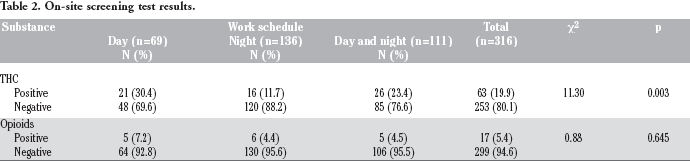
On-site drug testing showed that night-only workers had significantly lower rates of THC-positive results than day-only workers (p=0.001) or day-and-night workers (p=0.023). When it came to the positive results of opioids, there was no significant difference between the three groups. There was no positive cocaine, amphetamines, barbiturates, or benzodiazepines tests (Table 2).
On-site screening test results.
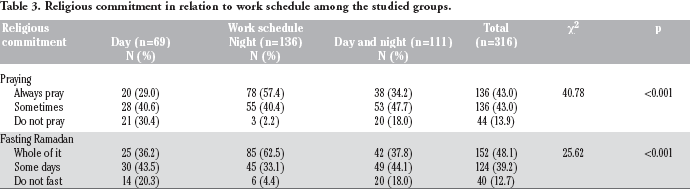
More than half (57.4%) of the night-only workers reported that they always pray, and 62.5% of them reported that they fast the whole of Ramadan. These percentages were significantly higher than a day, only worker and day and night workers (Table 3).
Religious commitment in relation to work schedule among the studied groups.
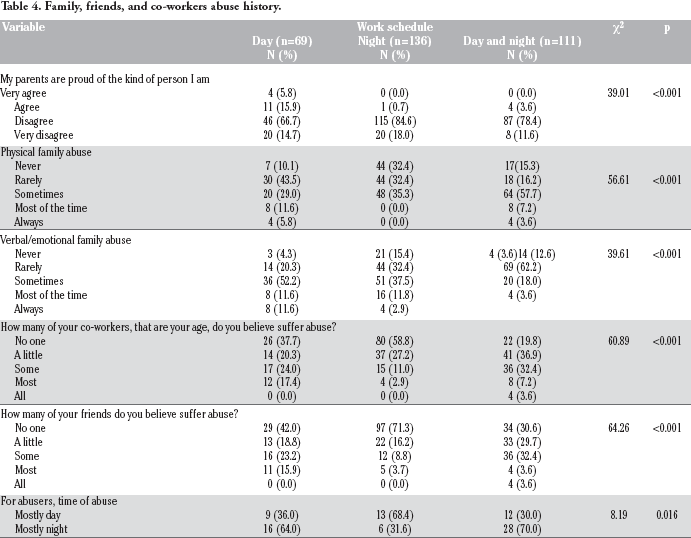
About one-third of the night-only workers reported that they were never subjected to physical family abuse, one-third reported rare physical abuse, and the other third reported “sometimes” physical abuse. This was significantly higher than day and night workers as 57.7% reported “sometimes” physical abuse, 7.2 % reported “most of the time” and 3.6% reported “always” abuse.
Verbal/ emotional abuse was slightly different but still with a significant difference among the three groups. About 15 % of the night-only workers reported that they were never subjected to verbal/ emotional family abuse; 37.5 % reported “sometimes” 11.6% reported most of the time, and 2.9% reported “always” abuse. About half of the day, only workers reported “sometimes” 11.6% reported “most of the times” and 11.6% reported “always” abuse. Nearly two-thirds (62.2%) of the day and night workers reported “sometimes” abuse, 18.0% reported “most of the times”, and 3.65% reported “always” abuse (Table 3). More than half of the night, only workers believed that no one of their co-workers was suffering from substance abuse. This was significantly higher than day-only workers or day and night workers where 37.7% and 19.8% respectively believed that no one of their co-workers was suffering substance abuse (Table 3). The situation did not differ much for friends (people outside work) as 71.4% of the night only workers believed that no one of their friends was suffering from substance abuse. This was significantly higher than day-only workers or day and night workers where 42.0% and 30.6% respectively believed that no one of their friends was suffering from substance abuse (Table 4). Among abusers, the preferred time for abuse was mostly night for day workers and day and night workers, while it was mostly day for night workers with a significant difference among the study groups. Logistic regression was performed to ascertain the effects of the work schedule on the likelihood that participants have substance abuse. The logistic regression model was statistically significant, χ2 = 20.50, p<0.001. The model explained 9.2% (Nagelkerke R2) of the variance in substance abuse and correctly classified 73.4% of cases. Night workers were 7.14 times less likely to have substance abuse than day workers, while day and night work did not differ from day work (Table 5).
Family, friends, and co-workers abuse history.
Binary logistic regression of the effect of work schedule on substance abuse, (day workers is the reference group).

Discussion
Part-time work is common among adolescents as the first step toward independence and transitioning to adulthood. 15 Substance abuse is a serious public health issue among part-time working students. 13 It is now regarded as a chronic relapsing brain condition that destroys the same neuronal scaffold that allows for self-control and proper decision making. 13 Thus, prevention, early detection, and intervention are critical in the battle against substance abuse and addiction.16,17 Substance abuse disorder is a health condition that can be avoided and treated by intensive, multidisciplinary treatments. Treatment proposals must be supported by evidence and scientific research.18,19 However, studies have scarcely investigated the relationship between substance abuse and the schedule of work. 20 Vocational students are the most susceptible to drug use among different youth groups in Egypt.21,22
In this study, tobacco was the most abused drug in the form of smoking, accounting for 68% of all cases, followed by cannabis (24%), marijuana (16.4%), alcohol (10%), and opioids (6.3%). Our findings were consistent with other research, such as a survey conducted in the United States that reported the highest rate of substance abuse among youth aged 18 to 20 (22.7%) and 21 to 25 (21.5%). 23 Further research showed that the least educated were heavier smokers and drinks more often, these findings show that educational attainment affects substance abuse decisions. 24
Our findings were also reliable with those of Rabie et al., 25 who conducted a study on male students in Fayom City and discovered that 75% of them were drug users. According to their findings, the most commonly abused medications were cannabis (40%), tramadol (37%), and benzodiazepine (23%).
The prevalence of opioid abuse was 7.41 percent in a crosssectional sample of 750 students in Zagazig city. Tetrahydrocannabinol (3.9%) was the most common, followed by tramadol (1.9%) and benzodiazepines (0.67%), whereas morphine and barbiturates each had a 0.47% prevalence, The prevalence of smoking was 16.81%, and the prevalence of alcohol abuse was 6%. 8 The multivariate stepwise logistic regression analyses identified male gender, studying at the secondary school level, smoking tobacco, living with a family member who uses tobacco, and feeling insecure within the family as risk factors for abuse.
Also, Ljubotina and his colleagues, 26 , screened 2,404 elementary and high school students (total age range, 13-23 years) from Zagreb; 90% of all examinees experimented with alcohol at least once, 80% with tobacco, 39% with marijuana, and nine % with ecstasy.
Another study examined the association between employment and substance abuse among 4800 public high school students in the United States. 27 They found white students (37.7%) to be working at an average higher rate than black students (15.4%). Among white males, 38.2% were smokers, 52.5% were alcohol abusers, 35.6% abused marijuana, and 7.7% abused cocaine. Among black males, 13.4% were smokers, 42.0% were alcohol abusers, 23.7% abused marijuana, and 2.1% abuse cocaine. They also found a statistically significant association for males (either white or black) and smoking at different working levels than nonworking males. The same was observed for alcohol and marijuana. The report released by the Substance Abuse and Mental Health Services Administration (SAMHSA) found that among males, working either full-time or part-time was associated with increased odds of using marijuana only, and being unemployed was associated with using other illicit drugs. 28
In this study, students who worked only at night (14.0%) reported the least percentage of smoking and abuse compared to the day only workers (36.2%), and day and night workers (36.0%), they had significantly lower rates of smoking, cannabis, marijuana, alcohol, or opioids abuse. This finding is explained by the fact that night-time labor necessitates extra attention during working hours, leaving only a short free time for those employees to engage in abusive behavior. Night workers had the highest levels of religious devotion, with 57.4% saying they “always pray” and 62.5% saying they fasted for the whole month of Ramadan. They also had the highest rates of “never” experiencing physical or emotional violence in the family. Most of them even stated “none” of their coworkers or associates was abusing drugs or alcohol. This religious devotion, combined with the conduct of family, coworkers, and friends, may have contributed to a reduction in the rate of abuse among them.
Unlike previous researchers, 29 who investigated the impact of shift work on drug abuse. The impact of shift-work-related problems on drinking among Japanese male workers aged 35 to 54 years was studied. The report, which included 350-day workers and 72 shift workers, found that night-shift workers with low sleep quality had the highest risk of heavy drinking (17.6%), with a 2.17 chance of heavy drinking (95%CI 1.20-3.93) The age difference between the two samples may be the cause of the discrepancy.
There are many possible explanations for the correlation between employment and increased drug use among adolescents.
First, working teens are more likely to be exposed to people who use tobacco, alcohol, or other substances (e.g., older coworkers). Young people who are exposed to those who use drugs are at a higher risk of early initiation. Students who are more involved in their work form friendships with older colleagues, who in turn initiate them into more adult-like patterns of recreation.30,31
Second, a high time commitment to work can be viewed as an important symptom of a potentially wide range of psychosocial difficulties, it has been suggested that the relationship between jobs and substance use or other problem behaviors among teenagers could be linked in part to their mental health or school adjustment issues.32,33
Third, increased disposable income could be to blame for some students’ higher rates of drug abuse among working adolescents. The majority of the money received from teenage part-time jobs was used as a disposable income, according to data from a national survey. 34 Previous studies suggested that adolescents who were frequent users of alcohol or other substances could be motivated by financial gain derived from the intensity of work to support their substance use. Since earnings and job intensity have a positive relationship. 26 Fourth, the use of alcohol or other drugs can be linked to work-related stress. Research of 10th and 11th graders discovered a connection between job stress (e.g., bad working conditions, poor organizational structure, or tension between work and other responsibilities) and the use of alcohol or marijuana. 33
In conclusion, results from this study indicate increased use of substances among vocational students. Another important observation was no positive results of cocaine, amphetamines, barbiturates, or benzodiazepines. A decreasing prevalence for alcohol with an upward increase for cannabis.
Finally, vocational students’ part-time work and substance abuse is a great occupational problem, and we recommend that concerned authorities and planners integrate their efforts, especially in the Menoufia region to look for this problem in this region.
The limitations of the study are that the cross-sectional nature of this study does not allow us to make causal inferences regarding the observed relationship, The lack of a female aspect to the study is a limitation. The co-morbidity of students’ persuasive or aggravating drug use was not investigated.
Footnotes
The authors declare no conflict of interest.
Acknowledgments
We would like to express our gratitude to all of the students who agreed to take part in this study.