






Abstract
Background
This study aimed to evaluate the knowledge, attitudes, and behavior (KAB) of the Jordanian society toward nutrition and diet during the COVID-19 era.
Design and methods
This study is an observational, crosssectional study using a structured, validated, reproducible, selfadministered online Arabic questionnaire. KAB of the study participants was assessed via a web-based, structured, validated, reproducible Arabic questionnaire. The tool for the assessment of the KAB was composed of 33-closed-ended multi-answer questions.
Results
A total of 672 people were surveyed, 70.2% were between 18 and 34, and 69.5% were females. Participants have paid little attention to the healthfulness of their diet in the last year. The majority of participant's attitudes towards using different approaches to manage weight in the next year were: eating smaller portions for weight management, tracking to maximize the amount of time of physical activity, and substituting lowercalorie foods for full-calorie alternatives. Only tenth of participants utilize the time to perform physical activity. The majority made changes to their diet and exercise, and strictly follow commitment in connection with planning for the following year.
Conclusions
Educators, legislatives, food manufacturers, household heads, and policymakers are called upon to improve Jordanians’ KAB on nutrition and diet. Furthermore, Jordanian nutrition and diet behavior can be invested to improve the dietary interventions designed by nutrition and dietetics professionals.
Significance for public health
This study is an observational, cross-sectional study using a structured, validated, reproducible, self-administered online Arabic questionnaire. No previous study evaluated KAB nutrition and diet among Jordanian society adults during the SARS-CoV-2 pandemic. This is the first valid survey to be used for Arabiclanguage speakers as a tool to initiate an assessment of community resources and needs at different periods of time and, most likely, after certain interventions. Jordanian nutrition and diet behavior can be invested to improve the dietary interventions designed by nutrition and dietetics professionals.
Introduction
The pandemic of COVID-19 has changed dietary behavior and lifestyle of people around the globe. Nutrition and dietetics knowledge is an integral part of health knowledge; whereby poor health outcomes are related to low health literacy. The science of nutrition and dietetics is an important and exciting field due to its impact on the population's health, well-being, and environment. Nowadays, internet websites are filled with information on health, nutrition, and diet. The news of food and nutrition were among the hot topics on TV channels and takes the lead headlines of newspaper columns. 1 A number of research has focused on food and nutrition related topics during COVID-19 pandemic. 2 The nutrition transition is the change in a population's dietary pattern from undernutrition to overnutrition with a diet high in refined carbohydrates, sugars, fat, and animal protein. Jordan has passed in urbanization and nutrition transition; 3 this is coupled with a shift in the disease pattern. The most common nutrient deficiency diseases in Jordan are iron, vitamin A, and iodine deficiencies. 4 On the other hand, the most common causes of mortality are nutrition- related such as cardiovascular diseases, cancers, diabetes, as well as chronic respiratory diseases. 4 Concomitant with this, the obesity rate is increasing worldwide and in Jordan.
The novel coronavirus disease of the year 2019 (COVID-19) caused the first mortality in December 2019. 5 Since then, the World Health Organization (WHO) has recommended the restriction of human outside movement. 6 Jordan was one of the first countries which tried to control the spread of COVID-19 via mandating 14-day lockdown in which most services switched into the electronic versions. The lockdown was renewed several times. 7 The era of COVID-19 has changed the dietary behavior of people.8-10 Dietary behavior is a result of interaction between human knowledge and attitudes. Knowledge is the awareness of things and processes which distinguishes specialists from nonspecialists. 11 Attitudes are opinions of humans that are affected by knowledge 12 leading to certain practices (behaviors). 13 Thus, behaviors vary from simple manners such as food chewing to complexes such as food preparation, etiquette, and policymaking. 11 Nutrition and dietetics knowledge is an integral part of health knowledge. Reduced health literacy is associated with poor health outcomes. 14
Knowledge, attitudes, and behavior (KAB) surveys are valuable tools to assess the opinion of people regarding certain topics via structured questionnaires. The collected data could be qualitative or quantitative. 15 . Besides, assessing knowledge, attitudes, and behaviors of a community or population is an integral part of assessing community needs and resources to initiate community nutrition. 16 To the best of our knowledge, no previous study has evaluated the nutrition and diet KAB in Jordan during the COVID- 19 era. This study, thus, aimed to evaluate the KAB of the Jordanian society toward these aspects during the COVID-19 lockdown period.
Study designing and setting
The data of this observational, cross-sectional study were collected consecutively during the COVID-19 lockdown period in July 2020 in the Hashemite Kingdom of Jordan. At the time of the study, COVID-19 situation in Jordan included 1110 confirmed cases and 10 deaths. Detailed presentation of COVID-19 in Hashemite Kingdom of Jordan during the study period is presented in Supplemental Table 1. Using a validated, reproducible, selfadministered online Arabic questionnaire with a reliability test (Cronbach alpha) of 0.9 for all questions. The questionnaire was adapted from a US version developed and used by the United States Department of Agriculture to assess food and health National Data. 17 The study design, structure, and quality were enhanced using the straightening of the reporting of observational studies in epidemiology- nutrition extension (STROBE -nut). 18
Sociodemographic and health characteristics of the study participants

NA, not applicable;
frequencies and percentages calculated for female participants.
Study participants
Using a cross-sectional design, we estimated the sample needed for our survey to be approximately 400 participants using the package ‘samplesize’. 19 These 400 or more surveys are needed to have a confidence level of 95% (95%CI) that the real value is within 5.0% (alpha level) and type II error about (20%) of the surveyed values assuming the total eligible Jordanian adult population is about 6.2 million according to the Department of Statistics, Jordan. 20 To increase the statistical power to 90% we aimed to include about 650 participants in the final analyses, thus we surveyed 1500 people assuming 40% non-response. The inclusion criteria for this study were as follows: Jordanian or non-Jordanian citizens living in Jordan, Arabic language speaker, aged above 18 years for both genders. Exclusion criteria were participants not meeting the inclusion criteria. The authors discussed all possible methods and sources for reaching the intended participants from the population before beginning the recruitment process.
Instruments
A structured, validated, reliable, translated questionnaire was used to collect the data. This questionnaire consisted of two main parts. The first part contained general questions, including sociodemographic characteristics such as gender, career, marital status, number of children, pregnancy, income, smoking, education level, nationality, health, and anthropometric data. The second part of the questionnaire contained knowledge, attitudes, and behavior of the study participants towards health and nutrition being assessed using question items number 4, 13, and 15, respectively. The survey tool was distributed and conveniently answered voluntarily by sophomores, juniors, and seniors studying at the Department of Nutrition/Faculty of Pharmacy and Medical Sciences, University of Petra in Amman, Jordan. After completing the questionnaire, the students were instructed to share the link with other adults (whether or not they lived in Jordan) and non- Jordanians living in Jordan through social media platforms including WhatsApp, Facebook, Instagram, and Twitter during the COVID-19 lockdown period. Compared to face-to-face methods, this type of recruitment has the advantages of covering a wider and more diverse demographic/geographic region as well as saving time, money, and effort. All data were saved in a protected Google Drive, accessible only to the principal investigators, and coded for the research team.
Ethical approval
This study was revised and approved by the Research Ethics Committee of the Faculty of Pharmacy and Medical Sciences, University of Petra, Amman, Jordan (REC: 7Q/1/2020). In this study, all ethical principles adopted in Helsinki, Finland in the 1964 declaration and its amendments were applied.
Statistical analysis
All missing and repeated data (217 responses) were excluded before starting the statistical analysis. Pearson product-moment correlation coefficient was used as a bivariate correlation to quantify the linear correlation between the question answers. A statistically significant correlation between the two questions indicates that the two questions correspond to the same concept. Correlation coefficients were visualized using the correlogram techniques. The correlation value is shown by a color mapping of two hues at varying degrees of brightness, where blue represents the positive values and red represents the negative values. Significant (*) and highly significant (**) correlations signified p-value <0.05 and <0.01, respectively. All data analyses were performed using R for statistical computing version 4.0.3.
Results
Table 1 shows the demographic characteristics of the participants, of which 83.3% had Jordanian nationality, 69.5% were females, 60.1% singles, and 60.2% had no career. Furthermore, 70.2% were between 18 and 34 years, and 21.3% between 35-39 years. Non-smokers constituted 60%, high school graduates 13.1%, and Bachelor's degree holders 69%. Most of the female participants (94%) were not pregnant during the foregoing 12 months, whereby 25.3% did not have children under 18 years of age within their households. The average body weight and height of the study participants were 70 kg and 165 cm respectively. The average body mass index was 25.3 indicating the overweight category. Besides, 61.6 % of participants were not currently being treated for any illness with 25% describing their health status as excellent and 41.7% as very good.
Knowledge, attitude, and behavior of the study participants towards health and nutrition
Knowledge
Table 2 summarizes the responses to the questions evaluating knowledge. Most of the individuals in the current study either saw or knew a lot about the MyPlate graphic. On the other hand, about 90% of them either had not heard about the local community nutrition programs or declined to answer this question. Besides, Tables 5 and 6 points to a highly significant positive correlation of familiarity with MyPlate graphic and a reliable source of food knowledge pointing to trusted personal health care professionals in Jordan as having accurate and informative data on the food choices for the general public.
Questions examining participants’ knowledge in diet and nutrition during the SARS-CoV-2 pandemic.

Table 3 lists the 13 questions and responses to assess participant attitudes toward diet healthfulness (4 questions), physical activity (2 questions), weight change (6 questions), and personality self-description (1 question).
Questions examining participants’ attitudes toward diet and nutrition during the SARS-CoV-2 pandemic.

Jordanians paid little attention to the healthfulness of their diet in the last year. In addition, the majority of our study participants were neutral about the level of physical activity they had performed over the previous year. Furthermore, only about a tenth of them would utilize the time to perform physical activity
A third of the participants described themselves as agreeable, trustworthy, generous, sympathetic, and cooperative; 6.2% of the study participants would spend more on dining out, 3.3% on groceries, while the majority of the participants would save, invest or pay off their debts. Furthermore, nearly more than a quarter strongly disagreed with the statement “I would rather lose 1,000 JOD than gain 10 kg”. Furthermore, the majority believed that having enough physical exercise would contribute the most to their success in maintaining/losing weight.
The attitudes of the majority of the participant towards using different approaches to manage weight in the next year were: eating smaller portions of what currently consumption for weight management in the coming year, eating snacks less often, tracking to maximize the amount of time of physical activity, eating smaller, more regular meals or snacks, eating meals less regularly, substituting lower-calorie foods for full-calorie alternatives, monitoring to limit the amount of calories in foods.
The significant correlations between participant knowledge, attitudes, and behaviors are shown in Figure 1. Details of positive correlations are shown in Supplemental Tables 2a and 2b require educators, legislatives, food manufacturers, household heads, and policymakers to pay attention to improving Jordanians’ knowledge in order to improve their attitudes and behaviors in nutrition and diet.

Correlogram display showing significant (*) and highly significant (**) correlations with p<0.05 and p<0.01. respectively.
The behavior of participants toward diet and nutrition was evaluated using 15 questions to assess the types of foods (4 questions), time (2 questions) and money spent (1 question), new year resolution (2 questions), food and beverage purchasing (2 questions), and body weight (4 questions) (Table 4).
Questions examining participants’ behaviors toward diet and nutrition during the SARS-CoV-2 pandemic.
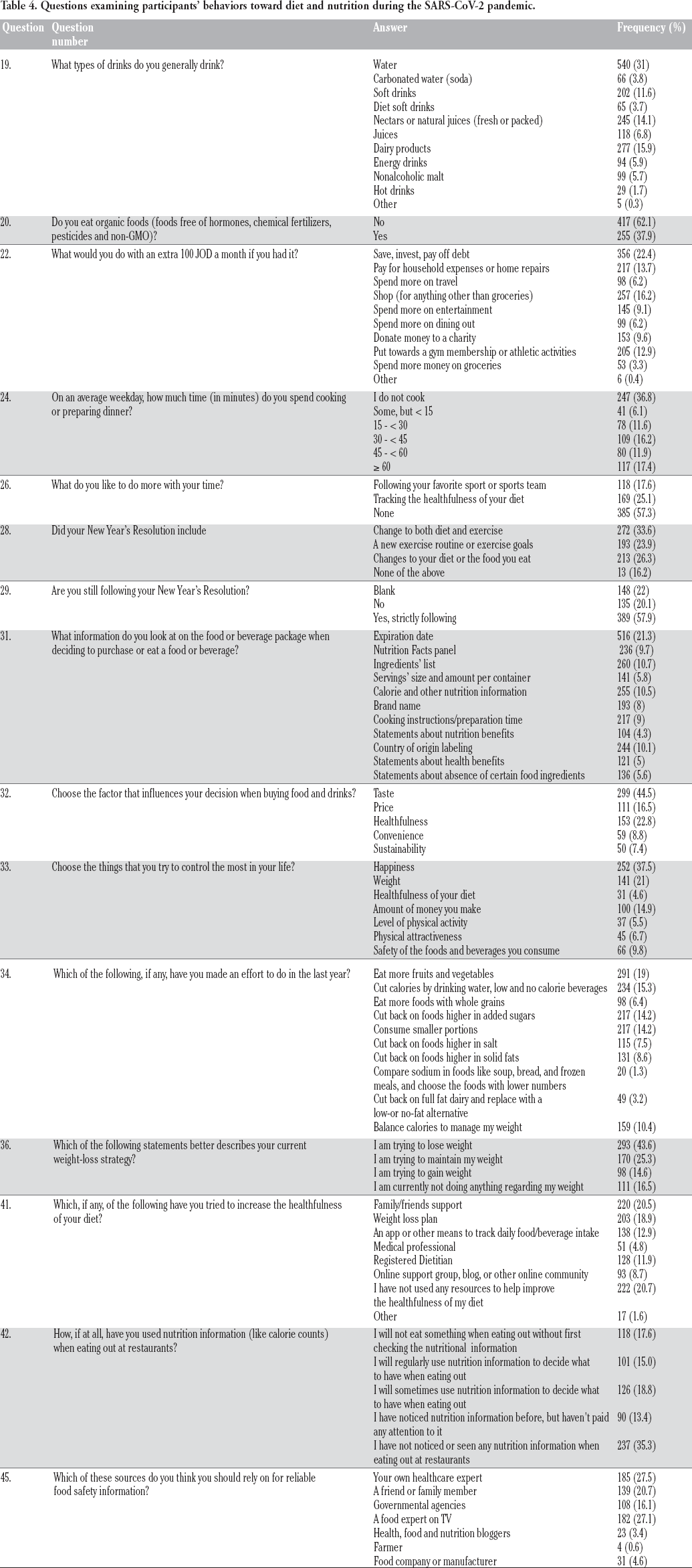
Almost a third of the respondents mainly drank water, while another third reported drinking dairy products and soft drinks. On the other hand, nectars or natural juices (fresh or packed), energy drinks, nonalcoholic malt, hot drinks, and other beverages were consumed by the last third of the study participants.
The respondents in our study reported that they had not noticed or seen any nutrition facts or information (such as caloric counting) when dining out in restaurants. As revealed by this study, participants spend more than 60 min for cooking on weekdays. Furthermore, the majority of the participants spent no time watching their favorite sport or sports team or keeping track of their diet's healthiness.
The finding of the current study shows that the new years’ resolution behaviors are linked to the study participant's attitudes (Tables 5 and 6). Furthermore, Jordanians are most concerned with the expiration date, which is the most important factor in deciding whether or not to purchase anything. On the other hand, the taste has the greatest impact on Jordanian food purchases. Nutritionists and food producers are required to produce healthy food products without affecting food taste in order to enhance nutrition and diet behavior.
Approximately one-fifth of the participants did not use any resources to help them improve their diet healthiness. Furthermore, the participants attempted to control body weight, physical attractiveness, food safety, and level of physical activity. Furthermore, Jordanians attempt to lose or manage their weight. With the abovementioned strategies, nutrition and dietetics professionals should question their clients about the most effective strategies for motivating nutrition and diet adjustments that suit their personalities.
Discussion
The responders in this study are comparable to those of the US Food and Health research survey 17 in terms of gender, adult age, and age of children within the household. It appears that females usually respond more to diet and health surveys,21,22 probably because they typically lead the household 23 being responsible for the diet and nutrition accordingly.24,25
In 2017, more than one-third of Jordanians had a BMI value >27 kg/m2, 26 which represents the Jordanian society despite ours being a convenient sample. Our results on self-description of the health status (Table 1) are similar to those reported by the International Food Council, 8 possibly because most of the respondents are aged 18-34 years. They are in agreement with those published by the High Health Council, 26 which rated the current health situation in Jordan as one of the best among the Middle Eastern countries.
Knowledge results are in agreement with those of the NDLUSA 17 in terms of the source of accurate nutrition information and the value of energy-yielding nutrients. Thus, compared to the NDL-USDA observation, most of the individuals in the current study either saw or knew a lot about the MyPlate graphic. On the other hand, about 90% of our study participants either had not heard about the local community nutrition programs or declined to answer this question. Thus, in terms of the local community nutrition programs and the value of energy-yielding nutrients, the knowledge of the sample in this study requires improvement. Besides, since there is a highly significant positive correlation of familiarity with MyPlate graphic and a reliable source of food knowledge pointing to trusted personal health care professionals in Jordan as having accurate and informative data on the food choices for the general public, it is recommended that diet and nutrition knowledge be enriched and communicated through the best-trusted sources, such as healthcare professionals and TV-food experts. However, food healthfulness can be described in many ways, whereby a healthy diet is defined by its ability to reduce the risk of potential chronic diseases27,28 and promote well-being. 2 Our respondent attitudes on diet healthfulness are similar to those of the Americans 17 in terms of trying food with customizable nutritional value/calories, given the chance to time-travel 30 years into the future and currently at restaurants, and hearing what they should eat over what they should not eat. However, in contrast to Americans,8,1 Jordanians paid little attention to the healthfulness of their diet in the last year, as indicated by the majority of adolescents displaying a negative attitude towards a healthy diet. 23 Based on The Dietary Guidelines for Americans 29 used by the US Department of Agriculture to describe a healthy diet, many factors influence a consumer's understanding of a food product's healthfulness, including the details provided to them, the color and shape of the packaging, the ingredient and category, sensory characteristics, and the organic origin. 30 Al-sheyab found that availability, perceived benefits, cost, and sensory appeal all influenced healthy food purchases by Jordanian adolescents. 31 Therefore, general population education initiatives on the healthfulness of foods in terms of benefits are needed. Besides, the cost of healthy foods must be lowered to make them affordable to the majority of the population. In contrast to Americans who gave a lot of thought to their physical activity, 17 the majority of our study participants were neutral about the level of physical activity they had performed over the previous year. Furthermore, only about a tenth of them would utilize the time to perform physical activity in comparison to more than a third of Americans, if given an extra four hours a week, for example. 17 Consistent with these results, in 2012, the majority of Jordanian adolescents did not engage in any physical activity. 32 Thereby, among schoolchildren, physical activity was determined by age, gender, academic achievement, maternal education, and family income. 23 Moreover, self-esteem and perceived benefits constituted barriers to physical activity among Jordanian university students in 2019. 33 In adults, self-esteem, barriers to change, perception of benefits, and sedentary activities appeared to be determinants of physical activity. 21 Thus, Jordanians are motivated to increase their physical activity in consideration of its cultural determinants. To implement its strategy to tackle obesity and other chronic diseases, the Jordanian Ministry of Health encouraged roadside walking, increased football play areas within local parks, and partnered with the Ministry of Education to establish free play areas and swimming pools within schoolyards for use in the summer vacations by the public. 34
With regard to Jordanians’ self-description, 61% of Americans describing themselves as conscientious. 17 On the question of weight change, our findings concurred with those reported among Americans towards gaining extra money. 17 Thereby, 6.2% would spend more on dining out, 3.3% on groceries, while the majority of the participants would save, invest or pay off their debts. Furthermore, nearly more than a quarter strongly disagreed with the statement “I would rather lose 1,000 JOD than gain 10 kg”, compared to about a third of Americans who strongly agreed. 17 Furthermore, the majority believed that having enough physical exercise would contribute the most to their success in maintaining/ losing weight, while Americans believed that changing the type of foods they consumed had the greatest impact in maintaining/ losing weight. 17 Indeed, managing energy intake is the essential way of changing body composition. Exercising, on the other hand, is critical for improving biomarkers of chronic diseases that are linked to obesity. 35 Therefore, Jordanians must change their attitudes toward balancing the importance of adequate consumption of energy and physical activity. Similarly, the study participants believed that improvement in health/overall well-being would be the most motivating factor in their effort to lose/maintain weight. According to the NDL-USDA in 2015, Americans believed that an increase in physical appearance has contributed to keeping them on track to lose or maintain weight.8,17 The respondents believed that lack of willpower would contribute/has prevented them from remaining on track in their effort to lose/maintain weight. Healthcare professionals and educators are required to encourage the public toward weight maintenance by emphasizing the importance of incentives such as improved health and overall well-being. 1 In comparison to Jordanians’ attitudes towards using different approaches to manage weight in the next year, Americans intended to use the following approaches to manage their body weight: changing the types of food eaten, making sure of getting enough physical activity, eating smaller meals or snacks, controlling higher calorie foods and beverages, changing the frequency of eating during the day, self-weighing regularly, tracking of energy intake, support of family/friends, participating in workout buddy, use of a digital tracker, engaging in a weight loss program, exercising with a personal trainer, working with a health professional, workplace wellness programs/incentives. 17 The responses of this study can provide some guidelines for healthcare professionals, educators, retailers, and policymakers to motivating weight loss, such as enhancing snack options, reducing purchased/sold serving sizes, implementing physical activity strategies, and producing healthier versions of local foods.
On the other hand, in terms of beverage consumption by Jordanians and according to the Americans dietary guidelines, adults should drink 1ml/kcal/day and limit the consumption of beverages with added sugars.36,37 In line with this, the Jordanian Mistry of Health 38 advised adults to drink 9-13 cups of water daily. In Jordan, drinking sugary drinks is one of the features of the western dietary trend linked to the incidence of cardiovascular disease risk. 39 Despite the report of 69% awareness of organic foods in Jordan by Altarawneh, 40 the majority of the respondents did not consume them. This is in contrast to the higher percentage of Americans eating organic foods. 17 This discrepancy might be due to the food prices. 41 In 2015, the majority of Americans chose to use nutrition facts to help them select what to consume when going out to eat. 17 The respondents in our study reported that they had not noticed or seen any nutrition facts or information (such as caloric counting) when dining out in restaurants. Accordingly, Jordanian policymakers and legislators are urged to enact laws and regulations related to nutritional facts on restaurant food packages/labels and to learn from the experiences of other countries such as Saudi Arabia. In fact, menu labeling has been shown to minimize food energy consumption, 43 which is an effective strategy for managing body weight and obesity-related chronic diseases.
Most of the study participants cook food at home. Indeed, cooking at home is a good habit to improve eating efficiency and avoid gaining weight. 44 Because of Jordan's high restaurant cost, the majority of the participants cook at home. 45 As revealed by this study, participants spend more than 60 min for cooking while on weekdays, Americans spend more than 15 min cooking dinner. 17 Furthermore, the majority of the participants spent no time watching their favorite sport or sports team or keeping track of their diet's healthiness, while Americans spent their time in both activities. 17 In agreement with the results of the NDL-USDA, the majority of respondents made changes to their diet and exercise, and strictly follow such a commitment in connection with planning for the following year’ resolution. 17 However, surprisingly the intended new years’ resolution diminishes by 77% after the first month, with just 19% remaining by the end of the year. 46 As suggested by Oscarsson et al. Sticking to the new year's resolution is usually linked to the knowledge, environmental support, goals, and the perceived measures of success rate. 46 Consistent with this, the finding of the current study shows that the new years’ resolution behaviors are linked to the study participant's attitudes (Tables 5 and 6). Furthermore, in line with Americans, Jordanians are most concerned with the expiration date, which is the most important factor in deciding whether or not to purchase anything. Concordant with this behavior, Jordanian food law requires the inclusion of production and expiration dates in packaged food.47 On the other hand, the taste has the greatest impact on Jordanian food purchases. Nutritionists and food producers are required to produce healthy food products without affecting food taste in order to enhance nutrition and diet behavior. Like the Americans in 2015,8,17 participants in this study made numerous attempts to eat healthy over the previous year. The support from family and friends, plan to lose weight, an application or other forms to monitor everyday food and beverage consumption, registered dietitian, online support group, blog, or some other form of an online network, and medical professional were among the participant habits to enhance the healthfulness of the diet (in descending order of the participants’ answers). Approximately one-fifth of the participants did not use any resources to help them improve their diet healthiness. To achieve this diet in 2020, Americans modified the types of foods and/or food ingredients they ate, the quantity of consumed foods, the frequency of eating, counting energy, and changing the use of dietary supplements. 8 Furthermore, the participants attempted to control body weight, physical attractiveness, food safety, and level of physical activity, which is similar to Americans. 17 Furthermore, Americans 17 and Jordanians attempt to lose or manage their weight. With the above-mentioned strategies, nutrition and dietetics professionals should question their clients about the most effective strategies for motivating nutrition and diet adjustments that suit their personalities. In terms of the types of drinks consumed, Jordanian eating and behavior are likely to require improvement. Furthermore, Jordanian behavior can be used to enhance nutrition and dietetics professional's dietary interventions.
Study strengths and limitations
No previous study evaluated KAB nutrition and diet among Jordanian society adults during the SARS-CoV-2 pandemic. This is the first valid survey to be used for Arabic-language speakers as a tool to initiate an assessment of community resources and needs at different periods of time and, most likely, after certain interventions. The analysis is restricted by a convenient sampling technique and the absence of a scoring system to provide a more reliable evaluation. Future research is needed for preexisting KAB nutrition and diet among Jordanian society before SARS-CoV-2 pandemic.
Conclusion
Knowledge of our sample requires improvement in terms of the local community nutrition programs and energy value of energy- yielding nutrients. Attitudes of the study participants may provide some hints for healthcare professionals, educators, manufacturers, and policymakers to be adopted to motivate weight change such as improving the types of snacks, reducing purchased/sold serving size, adopting strategies to increase physical activity, and manufacturing healthier versions of local foods. The assessed Jordanian population's nutrition and diet behaviors probably need improvement in terms of the types of beverages consumed.
Footnotes
Acknowledgement
The authors would like to express their gratitude to the participants and students who distributed the survey, as well as Miss Nour Hamed for her data acquiring and technical assistance.