






Abstract
Background
Adolescence is a period of life with specific health and developmental needs. Nutrition in adolescents is necessary to be considered because it has to be in a balanced form. The data of Sleman District Health Office 2016 showed that 114 adolescents in Public Health Center of Mlati 1 had undernutrition. Also, it showed that the highest prevalence was at Vocational High School of Muhammadiyah Mlati, which was 42% male and 31% female students. This study aims to know the association of nutrition knowledge, protein-energy intake and adolescents’ nutritional status at Vocational High School of Muhammadiyah Mlati, Sleman Yogyakarta.
Design and methods
This was an observational analytical study with a cross-sectional design. The subjects were adolescents aged 15-18 years, selected using stratified random sampling with a total of 58 persons. Data collected were analyzed using the Spearman Rank Correlation for bivariate technique (where α = 0.05).
Results
It was shown that 81.0% had a good nutrition knowledge, 91.4% had deficit energy intake, 82.8 % had deficit protein intake, and 58.6% had severe nutritional status. Bivariate analysis showed that there was no significant relationship between nutrition knowledge and nutritional status (p=0.394), but energy intake and nutritional status were related (p=0.010 <α =0.05). Furthermore, protein intake and nutritional status had a significant relationship (p=0.039 <α =0.05).
Conclusions
To be concluded, there was a correlation between the protein and energy intake and nutritional status of adolescents.
Introduction
Significance for public health
Adolescence is a critical period of growth and development. It is also the time to shape behaviors, but inadequate nutrition intake during adolescence delays growth and creates a high risk of chronic diseases in adulthood. This paper describes the importance of knowledge and protein-energy intake in influencing adolescents’ nutritional status.
According to the Health Resources and Services Administrations Guidelines, adolescents range from 11 to 21 years of age and are divided into three stages. These include early adolescents (11-14 years old), middle adolescents (15-17) and late teens (18-21). 1 Adolescents a fast period of growth due to hormonal and psychological changes. Because of all these changes, the adolescents require more intake of nutritional needs. Anemia and obesity are two of the most common nutritional disorders that often occurs in female adolescents. 2 Socioeconomic factors greatly influence nutritional status. 3 The Basic Health Research 2013 study for nutritional status of adolescents aged 16-18 years showed that nationally the prevalence of underweight is 9.4% (1.9% severely underweight and 7.5% underweight). 4 A total of 11 provinces with underweight prevalence were Aceh, Riau, Kalimantan Selatan, Maluku Utara, DKI Jakarta, Kalimantan Tengah, Banten, Sumatera Selatan, Nusa Tenggara Barat, Maluku, and Papua dan Nusa Tenggara Timur. The prevalence of teens’ underweight was relatively the same in 2010 and 2013, but that of severely underweight increased by 0.4%. Conversely, the prevalence of obesity increased from 1.4 to 7.3%. 4 Yogyakarta was one of the fifteen provinces with a prevalence of obesity above the national value. According to UNICEF (United Nation Children's Fund), factors affecting nutritional status are food intakes, infection status, availability and household intake habit, foster care patterns, hygiene and sanitation as well as environmental health services. 5
The nutritional status in society includes two factors, internal and external. Furthermore, the internal include genetic factors, food intake, and disease. While the external include agriculture, economic, social and cultural sectors, as well as nutritional knowledge. Besides, all of the factors are very important and in case one is lacking, it causes malnutrition or obesity. 6 Based on data from the Sleman District Health report 2016, up to 114 adolescents had undernutrition status. Moreover, the largest number was recorded in the working area of the Public Health Center Mlati 1. But the prevalence of malnutrition was highest at Vocational High School of Muhammadiyah Mlati, which was 42% male and 31% female students. 7 This study aims to know the association of nutrition knowledge, protein-energy intake and adolescents’ nutritional status at Vocational High School of Muhammadiyah Mlati, Sleman Yogyakarta.
Design and Methods
The study was observational analytics with a cross-sectional design. It was conducted at Vocational High School of Muhammadiyah Mlati Sleman Yogyakarta on grade X and XI students. The sample was 58 students selected using a stratified random sampling, where the number of students in grade X = 30, and XI = 28. A 30-item questionnaire was used to investigate nutrition knowledge, but the nutritional status was determined based on the BMI (body mass index) values. While the energy and proteinintake were calculated using a 24-hour recall questionnaire. Descriptive statistics were used to illustrate the univariate analysis. Also, Spearman's rank correlation coefficient (p<0.05) was used to evaluate the association between nutrition knowledge, proteinenergy intake and nutritional status.
Results and Discussions
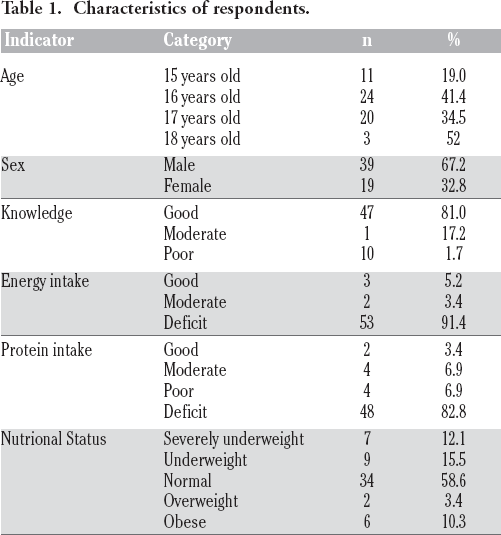
Table 1 shows that most students aged 16 years (41.4 %), males (67.2%), had good nutritional knowledge (81.0%), and had a protein intake deficit (82.8%). The respondents with a severely underweight nutritional status were 7 (12.1%), 34 people had normal nutritional status (58.6%) and 6 people had obesity (10.3%).
Characteristics of respondents.
Spearman's rank correlation test results in Table 2 show that there was no correlation between the two variables, but the large correlation that occurred was -0.114. Sig's number (2-tailed) was 0.394 which was still greater than the critical limit α=0.05, meaning both variables had no significant relationship (0.394>0.05).
The relationship between nutrition knowledge and nutritional status of adolescents at Vocational School Muhammadiyah, Mlati, Sleman Yogyakarta.

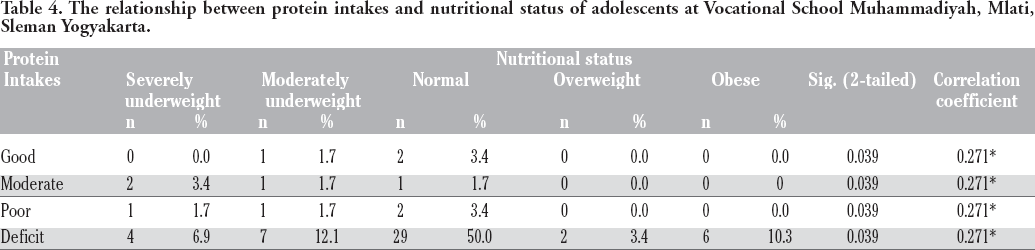
Meanwhile, Table 3 shows the number 334 (*) meaning there was a correlation between the two variables, but the large correlation that occurred was 0.334. Sig's number (2-tailed) was 0.010 which was still smaller than the critical limit α=0.05, meaning both variables had a significant relationship (0<0.05). Table 4 describes that the number 271 (*) means a very high relationship between the two variables, and the large correlation that occurred was 0.271. Sig's number. (2-tailed) was 0.039 which was still smaller than the critical limit α=0.05, meaning both variables had a significant relationship (0.039<0.05).
The relationship between energy intakes and nutritional status of adolescents at Vocational School Muhammadiyah, Mlati, Sleman Yogyakarta.

The relationship between protein intakes and nutritional status of adolescents at Vocational School Muhammadiyah, Mlati, Sleman Yogyakarta.
In this study, most respondents were aged 16 years (41.4%). At this age, teenagers are less concerned with personal nutritional needs and the type and amount of food consumed. 8 Nutrition knowledge means knowing about the concepts and processes related to nutrition. It is potentially influenced by several factors, one of which is education regarding nutrition. Also, it needs to be instilled early to ensure a person meets the body's energy needs based on personal eating behavior during adolescence or adulthood because the knowledge is very useful in daily food's consumption. 8,9
The study showed that most of the respondents had good nutritional knowledge. Meaning there was still a small percentage of teenagers that had no adequate nutrition knowledge, and such group of persons tends to have an inadequate nutritional concept as well. 10 Factors affecting knowledge: level of education, information, experience, age, interest and culture and environment. 11 Several reasons influence the lack of nutrition knowledge, which was due to the poor information obtained by the respondents both formally and informally. The formal information referred to the respondents’ inability to obtain lessons related to health or food in the class. In addition, the information was obtained informally from social media or newspapers.
According to the World Health Organization, adolescence is between 10-19 years old. About 350 million adolescents comprise 22% of the population in the countries of the South-East Asia Region (SEAR). Adolescents are not a homogenous population, but they exist in a variety of circumstances and have diverse needs. The transition from childhood to adulthood involves dramatic physical, sexual, psychological and social developmental changes, all taking place at the same time. In addition to opportunities for development, this transition poses risks to their health and wellbeing. 12 The usual nutritional problems experienced in the adolescence phase are obesity and anemia. 13 Each person's energy and protein intake vary and many factors that influence it are individual characteristics of the recipient such as age, gender, education, income, nutritional knowledge, cooking skills, and health. Food ratings are the appearance, taste and presentation of food. While environmental characteristics consist of seasons, occupation, mobility or displacement of the population, number of families, and social level in the society. 14
Based on the results, energy and protein intakes were deficient. The results of a 3x24-hour recall showed that they had energy and protein intake deficit. Lack of energy and protein intake led to inhibition in growth and maintenance of the body's cells, the formation of the body's essential bonds, and regulation of water balance. The controls of the body's neutrality, the formation of antibodies and lack of nutrients over a long-time cause lack of protein energy. 15 Most respondents rarely had breakfast, and some were on a diet or fasted. Some consumed rice and instant noodles with a frequency more than once within 24 hours, while at school or lunch, most consumed traditional fast food, such as cilok, cimol, batagor, and bakwan.
Nutritional status is an expression of the state of balance or the embodiment of nutrition in the form of certain variables. It is a measure of the condition of a person's body that is observable from the food consumed and substances used. 16 Based on the calculation of body mass index (BMI), the results showed that the respondents with nutritional status of severely underweight were 12.1%, while 58.6% were normal and 10.3% had obesity. Furthermore, the factors that caused the existence of students with less nutritional status category were potentially the insufficient amount of nutrient intake. This tends to be due to strict dietary patterns in young females that consumed snacks more often than staple foods such that their nutritional intake is not met. While the factors that caused respondents with obesity were due to consuming too much carbohydrate and fat, as well as lack of movement. The method of measurement that was a 24-hour recall just illustrated the food intake within the time range but did not capture the nutritional status directly. Furthermore, the results were in line with the previous study because most respondents had normal nutritional status, but there were still some that were severely underweight and obese. Many factors affected the adolescents’ nutritional status, which were categorized as internal and external. The internal consists of genetic, food intake and infectious disease factors. While the external consists of agricultural, economic, and socio-cultural factors, as well as nutritional knowledge.17,18
Based on the results of data analysis using Spearman Rank correlation, there was no relationship between nutrition knowledge and nutritional status. Factually, the nutritional status of adolescents was generally normal, and the knowledge of nutrition was good. These two data appeared to be linear, but they had no direct causal relationship. A good nutrition knowledge does not always underlie nutritious food choices but is still influenced by habits and purchasing power capabilities.
Previous study showed that there was no significant relationship between nutrition knowledge and nutritional status in junior high school students in Kerjo Subdistrict, Karanganyar District. Nutrition knowledge was essential in determining the behavior and type of food chosen by each of the subjects. 19 The cause of the absence of a link between nutritional monitoring and status due to knowledge tend to have an indirect effect on nutritional intake which rather had a direct influence on the status. 10 Meanwhile, another study showed a relationship between energy intakes and nutritional status due to several factors, such as mother's knowledge, educational level and family income. 20 The intake directly affects nutritional status, where energy was obtained from carbohydrates, proteins, and fats. Based on the results of the 24-hour recall interview, most respondents consumed rice only once daily and also traditional Indonesian fast food, such as cilok, cimol and batagor. It is concludable that the nutrition intake of Vocational High School Muhammadiyah Mlati l Sleman, Yogyakarta students was not good. Balanced nutrition for adolescents plays an important role for healthy growth and development. 21 Energy is the result of the metabolism of proteins, fats and carbohydrates, which is required of the body for growth, metabolism, utilization of food and activities. The energy that goes through food must be balanced with necessity, such that its input imbalance with long-term needs causes nutritional problems. 22 The protein intake obtained through 2x24 hours recall was in four categories, namely good, moderate, poor and deficit. This study shows a significant relationship between protein intake and the nutritional status of students at Vocational High School Muhammadiyah Mlati, Sleman, Yogyakarta. The adolescents’ required protein intake increases in line with the rapid growth process. The need for protein is directly proportional to a person's weight gain, hence when the quantity obtained from the food consumed meets the recommended protein adequacy rate, then the good nutritional status is achieved.23,24
Protein is a component of all living cells and the largest part of the body is made of water. It contains elements of carbon, hydrogen, oxygen and nitrogen. Some of the foods consumed are rich in protein, such as milk, eggs, cheese, meat, and fish. The protein functions in the body's growth and maintenance, regulating water pressure, controlling bleeding, and also serves as an important transport for nutrients especially as antibodies against various diseases, as well as nurtures the body and regulates blood flow in aid of heart work.19,25
Conclusions
The study showed most respondents had a good knowledge of nutrition, but the energy and protein intakes were deficient. Furthermore, the majority of them had a normal nutritional status which was not significantly related to nutrition knowledge. While the protein and energy intakes were significantly related to their nutritional status.
Footnotes
Acknowledgement
The authors are grateful to Vocational High School of Muhammadiyah Mlati, Sleman, Yogyakarta for allowing the research.