






Abstract
Background
Malnutrition has been identified as the leading cause of illness and death in almost half of children under 5 years. Hence, to prevent the impact of malnutrition on physical and psychological development, family physicians need to explore new approaches in the health care delivery models that go beyond the scope of practice. A holistic-comprehensive approach will help the physicians develop a more thorough assessment of nutritional status. This study aims to determine factors associated with the nutritional status of children under five years using holistic-comprehensive approaches.
Design and methods
A case–control design was implemented, with emphasis on the identification of cases and control groups; 48 children confirmed malnutrition cases and 48 control without malnutrition were recruited from a Community Integrated Health Center in East Java, Indonesia. The characteristics of agent, host and environment between groups were compared and analyzed using correlation coefficients, odds ratio, logistic regression analysis, and Structural Equation Modeling-Partial Least Square (SEM-PLS).
Results
The SEM-PLS results showed that environmental factors have a greater influence on nutritional status (t-value >1.96), compared to the host factors. Furthermore, environmental factors having significant associations with nutritional status were poor socioeconomic status, low maternal educational level and not having exclusive breastfeeding. Also, the results of correlation coefficients and OR showed that birth weight (p=0.000, OR=33) and socioeconomic status (p=0.000, OR=22.3) had strong correlations with nutritional status.
Conclusions
Holistic-comprehensive approaches can be used as new ways to determine factors that may be associated with nutritional status of children under 5 years of age.
Introduction
Significance for public health
Malnutrition among children under five years old causes a global developmental delay in many areas, namely physical, cognitive, and social, which is linked to increased risk of infectious diseases. The epidemiologic triangle is a model for explaining the causal factors of malnutrition, which include the health status of children under five years and other family health factors. This paper showed factors associated with malnutrition cases of children under five years of age using holistic-comprehensive approaches based on epidemiological triangle model.
Malnutrition was identified as the leading cause of illness and death in almost half of children under five years old worldwide.1,2 Global data from UNICEF, WHO and World Bank Group showed that about 144.0 million children under 5 years in 2019 suffered stunting, and 38.3 million were living with overweight. 3 This condition reflects an increase in associated risk factors of nutritional issues, ranging from agent, host, and environmental factors. Meanwhile, studies showed that maternal educational level, nutrition before and during pregnancy, antenatal care, exclusive breastfeeding, complementary foods practices, and socioeconomic status have been recognized as environmental factors that can affect nutritional status.4-7
Also, recent studies suggested that the presence of children's age, gender differences, history of birth complications, congenital abnormalities, low birth weight, immunization history, and history of infectious diseases can influence the risk of childhood nutritional problems, which are known as host factors.5,8-12 In the case of malnutrition, agent factors as the cause of diseases can include nutritional status. 13 Therefore, understanding these factors may affect family physicians’ judgments to develop strategies in clinical assessment or disease prevention that are more effective than others.
The consequences of malnutrition among children under five years old have been well documented which include global developmental delay in many areas, such as delay in physical growth, cognitive and social developmental delay, and increased risk of contracting infectious diseases. 14 However, there are widespread barriers that might be particularly challenging for Indonesian families of low socioeconomic status living in poverty as they have to manage many demanding jobs and require more efforts to pay the health insurance, as well as ensure their families health. 15 Therefore, family physicians need to explore new approaches in the health care delivery models that go beyond the scope of practice and improve quality of life in low income families.
Efforts to improve health care delivery for clinical assessment of malnutrition should be made to help physicians design interventions that prevent children infectious diseases. Meanwhile, the epidemiological triangle of agent–host–environment model has been commonly used to describe epidemiology and disease control in populations. It can also be adapted for understanding factors that are related to the nutritional issues during childhood. More importantly, assessing epidemiological evidence should be used to achieve consensus about intervention priorities for nutritional issues. Hence, holistic-comprehensive approaches are needed to help physicians develop a more thorough assessment of nutritional status among children under five years. The holistic-comprehensive approaches refer to the process of using whole aspects of biological factors, psychological conditions, and social characteristics (cultural and social issues) to continually gather information on children nutritional status, in order to provide feedback to improve disease prevention.16,17 Therefore, this study aims to determine factors associated with nutritional status of children under five years using holistic-comprehensive approaches. This study would be useful in the development of practices in family physicians to unravel malnutrition issues and also contribute to the literatures by providing facts on the determinants of nutritional status.
Design and Methods
A case-control study was designed to determine factors associated with nutritional status, with an emphasis on the identification of cases and control groups. 48 children confirmed malnutrition cases (using total sampling) and 48 control (using systematic random sampling) were recruited from a Community Integrated Health Center in East Java. All the respondents were registered in the selected health center as community outpatients, and gave their informed consent before they participated in the study. Ethical approval was obtained from the Ethics Committee of Faculty of Medicine, Universitas Muhammadiyah Malang. Also, data were collected using specially developed questionnaires, which covered all the cases data and control groups. In this study, the characteristics of agent, host and environment between groups were compared. Furthermore, cases and control groups were compared in terms of the following variables: nutritional status, children characteristics (age, sex, history of birth complications, congenital abnormalities, birth weight, immunization history, history of infectious diseases in the past 3 months), and environmental characteristics (socioeconomic status, cultural influence, maternal education, exclusive breastfeeding, complementary feeding practices). This study developed a framework of holistic-comprehensive approaches to improve nutritional status of children under five years (Figure 1). Briefly, according to epidemiological triangle, factors that influence nutritional status include: (1) host factors (X1): age (X1.1), sex (X1.2), birth complications history (X1.3), congenital abnormalities (X1.4), birth weight (X1.5), immunization history (X1.6), and history of infectious disease (X1.7). (2) Environmental factors (X2): socioeconomic status (X2.1), cultural influence (X2.2), maternal education (X2.3), exclusive breastfeeding (X2.4), and complementary feeding practices (X2.5). (3) Agent factors (Y): children nutritional status.

Framework of holistic-comprehensive approaches to improve nutritional status of children under five years of age.
In this study, correlation coefficients, odds ratio (OR), and 95% confidence intervals (CI) were assessed and variables whose values were statistically significant (p<0.005) were inputted into a logistical regression using SPSS Version 20.0. Furthermore, data were subsequently analyzed using Structural Equation Modeling- Partial Least Square (SEM-PLS) to identify factors that have a greater influence on nutritional status.
Results and Discussions
Table 1 showed the characteristics of host-agent factors, which illustrated that poor nutritional status was found to be higher in children aged 0-35 months (30.2%), birth weight less than 2500 grams (34.4%), and history of contracting infectious diseases in the past 3 months (34.4%), even though they had complete immunization status (32.2%). In addition, Table 2 showed the characteristics of environmental-agent factors, which demonstrated that poor nutritional status was higher in families with poor socioeconomic status (39.6%), low maternal educational level (45.8%), and not having exclusive breastfeeding (38.5%).
Characteristics of host-agent factors.

Characteristics of environmental-agent factors.

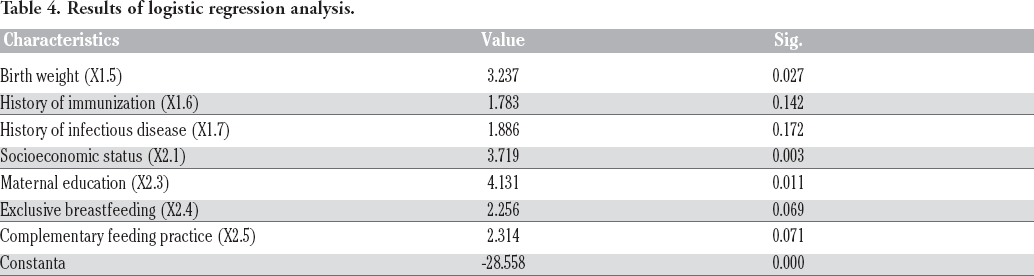
Table 3 showed the results of correlation coefficients and odds ratio between host-environmental factors. It described that birth weight (p=0.000, OR=33) and socioeconomic status (p=0.000, OR=22.3) had strong correlations with nutritional status. Meanwhile, history of infectious diseases in the past 3 months (p=0.000, OR=6.6) and maternal educational level (p=0.000, OR=22) had moderate correlations with nutritional status. Furthermore, Table 4 showed the results of logistic regression analysis. It described several factors associated with nutritional status among children under 5 years old: birth weight (X1.5), immunization history (X1.6), history of infectious disease (X1.7), socioeconomic status (X2.1), maternal education (X2.3), exclusive breastfeeding (X2.4), and complementary feeding practices (X2.5). The SEM-PLS results (Figure 2) showed that environmental factors have a greater influence on nutritional status (t-value >1.96), compared to the host factors. Meanwhile, environmental factors that have significant associations with nutritional status were poor socioeconomic status, low maternal educational level, and not having exclusive breastfeeding.

Structural Equation Modeling of holistic-comprehensive approaches to improve nutritional status of children under five years of age.
Correlation coefficients and odds ratio between host-environmental factors.

Results of logistic regression analysis.
The results showed that the use of holistic-comprehensive approaches to determine risk factors for nutritional status among children under five years of age was adequate. These approaches provided specific answers to study questions about epidemiological triangle in children nutritional status (the interaction of agenthost- environment factors), and it can be extended to develop strategic intervention to prevent malnutrition. Furthermore, these approaches are quite feasible and can be routinely included in the assessment, planning, and intervention phase of public health program in a Community Integrated Health Center in East Java.
Holistic-comprehensive approaches assess biopsychosocial aspects of nutritional issues among children under 5 years old. In fact, previous study demonstrated that this approach had a moderate correlation with children nutritional status (r=0.463). This approach not only help address nutritional issues that shape children health and development, but also promote effective strategies to improve childhood nutrition. 18
Malnutrition cases are complex and can take many forms, including under- and over-nutrition. The underlying causes of malnutrition presented in this study apply specific factors based on epidemiological triangle. The interaction of agent and host factors is important to determine whether or not the causative agents invade the human host. Furthermore, this study showed that poor nutritional status was found to be higher in children aged 0-35 months (30.2%), birth weight less than 2500 grams (34.4%), and history of infectious diseases in the past 3 months (34.4%), even though they had complete immunization status (32.2%). In addition, the prevalence of chronic malnutrition in Indonesia is generally high, hence it is important to carefully find the causes.
Also, environmental factors can include biopsychosocial aspects that influence nutritional status. This study found that poor nutritional status was higher in families with low socioeconomic status (39.6%), low maternal educational level (45.8%), and not having exclusive breastfeeding (38.5%). Aryastami et al. stated that there were factors related to stunting in Indonesia, such as low birth weight, male gender, history of previous illness and poor socioeconomic status. However, low birth weight was identified as the main factor that cause stunting. 19 Also, poor nutritional status among infant and toddler imposes a greater burden in low socioeconomic community. Lack of nutrients and adequate health care can affect children to suffer from infectious diseases.20-23 Furthermore, exclusive breastfeeding, adequate complementary feeding practices, maternal education and psychological factors have important role in malnutrition prevention. Also, mothers who experience stress can affect their quality of breastfeeding, therefore it will impact children health and nutrition.24-27
The results of logistic regression analysis described several factors associated with nutritional status: birth weight (X1.5), immunization history (X1.6), history of infectious disease (X1.7), socioeconomic status (X2.1), maternal education (X2.3), exclusive breastfeeding (X2.4), and complementary feeding practices (X2.5). Birth weight (p=0.000, OR=33) and socioeconomic status (p=0.000, OR=22.3) had strong correlations with nutritional status. This means that the odds of birth weight effects on nutritional status was 33 times greater, compared to socioeconomic status of only 22.3 times. Meanwhile, history of infectious diseases in the past 3 months (p=0.000, OR=6.6) and maternal educational level (p=0.000, OR=22) had moderate correlations with nutritional status. Also, studies showed that history of infectious diseases, maternal education or knowledge on children nutrition, birth interval, and types of health delivery were other factors related to environmental factors that cause children malnutrition.28-33
The SEM-PLS results (Figure 2) showed that environmental factors have a greater influence on nutritional status (t-value >1.96), compared to the host factors. Also, environmental factors with significant associations with nutritional status were poor socioeconomic status, low maternal educational level, and not having exclusive breastfeeding. This study identified factors that influence nutritional status among children under five years old using epidemiological triangle including agent (nutritional status) and host factors (birth weight, and history of infectious diseases in the past 3 months), as well as environmental factors (socioeconomic status, maternal education, and breastfeeding). It can be understood that malnutrition is such a complex condition when it comes to poor families, therefore family physicians need to address this issue using holistic-comprehensive approaches. Meanwhile, the population at the most vulnerable states are young children aged 0-35 months. These children need food security and social protection incentives from the government in order to benefit from micronutrients, and prevent the incidence of malnutrition.
Conclusions
There are no easy solutions to address nutritional issues among children under five years old, but using holistic-comprehensive approaches can make a significant difference. Furthermore, family physicians can play a role in improving the assessment of children nutritional status, and enhancing the health care of those families living in poverty. In conclusion, holistic-comprehensive approaches can help physicians determine all factors associated with nutritional status of children under five years old.
Footnotes
Acknowledgment
The authors would like to specially appreciate the Faculty of Medicine, Universitas Muhammadiyah Malang, Indonesia for their support and guidance during this study.