






Abstract
Background
Wound suturing is a procedure performed by medical and surgical specialists. While there are many different suturing techniques and materials used to treat patients, the choice of which to employ depends on different variables that affect the outcome of the procedure.
Design and methods
This is a cross-sectional study conducted to provide descriptive data regarding the practice of wound closure techniques, and to develop an awareness of scar formation factors. A total of 172 general surgery (GS) surgeons and emergency (EM) physicians in Makkah city hospitals in Saudi Arabia participated in the study.
Results
More than 50% of the practitioners favored the simple interrupted technique for the treatment of all types of studied wounds. The other most common techniques among participants were the subcuticular and vertical mattress methods, respectively, while the use of a stapler was limited to certain wound types. Regarding suturing material, polyglycolic acid was the most frequent material used by 50.1% of participants, whereas only 22% of the participants selected nylon material for wound suturing. However, this study showed a good level of awareness among participants, with significant p-values (p<0.05) of strongly agree and agree regarding the essential factors affecting wound healing and scar formation.
Conclusions
The result provides insight into the most common suture techniques and materials used in wound closure. There are wide variations in selecting these techniques and materials among the participants. Also, we found that there is good awareness amongparticipants about factors that lead to scar formation.
Significance for public health
Introduction
Wound suturing and laceration closure are frequent procedures performed at many surgical and emergency departments. Different suturing techniques and materials exist to treat patients undergoing wound closure and depend on wound location and/or type (e.g., skin suture, adipose, tendon, and muscle), as well as wound injury conditions or surgical operations. Several suture techniques and materials are available for surgeons and medical practitioners to repair skin and any wound defects. The selection of whichtechnique and material should be used depends on many different variables that affect theoutcome of the procedure. Many varieties of suturing materials and needles are available. However, the location of the lesion, type, thickness of the tissue at that location, and amount of tension exerted on the wound determine the choice of sutures and needles. 1 Several studies have compared different techniques according to specific variables and their effect on the outcomes. Some of these variables are wound complications, speed of repair, cosmesis, patient and physician satisfaction, and cost of reparation. 2 Identifying proper suturing techniques depends mainly on eliminating dead space in subcutaneous tissues and minimizing tension that causes wound separation, as well as ascertaining correct wound placement concerning relaxed tension lines. 3 Some complications can result from suture procedures such as scar formation. Approximately 100 million people develop scars yearly after trauma and elective surgery in middle-income countries, while 15% of this population will require surgical intervention for their scars due to aesthetic considerations. 4 Many studies compared different suturing techniques. One such study investigated a variety of techniques in relation to patient satisfaction, wound healing, and treatment cost in patients with a scalp laceration, finding that there are many alternatives (e.g., adhesions and staples) that have more advantages than simple suturing.5,6 Other studies showed that cosmetic pleasing and patient satisfaction (which tend to be significantly heightened in horizontal wounds and running subcuticular suture techniques in contrast with the traditional simple interrupted method) are considered essential factors that assess the effect of the suture technique. 7-9 Another randomized controlled trial reviewed subcuticular versus interrupted skin suturing, comparing the superficial incisional surgical site infection rate after cesarean section (CS) in obese women. The researchers found that “subcuticular skin closure during CS was significantly associated with better short-term cosmetic outcome, [and] less skin closure time”. 10
This study aims to investigate the practice of emergency (EM) physicians and general surgery (GS) surgeons regarding wound closure techniques by recognizing the common suturing techniques and materials used when treating different types of wounds in Makkah city hospitals in Saudi Arabia. Moreover, the study aims to assess practitioner awareness about factors that contribute to scar formation and improper wound healing.
Design and method
This is a cross-sectional study that aims to provide descriptive data regarding the practice of wound closure techniques and the awareness of scar formation factors among GS surgeons and EM physicians in Makkah city hospitals in Saudi Arabi. This study was conducted between the 20th of January and the 3rd of August 2020. In total, 172 EM physicians and GS surgeons participated. A random generator software was used for randomization, and a stratified random sampling technique was applied to represent an equal number of GS surgeons and EM physicians within seven different hospitals in Makkah. We included any surgeon or physician who had, at the time of study commencement, worked in these departments for more than three months and whoperform wound closure procedures during their usual daily or weekly routines. All others were excluded.
The objectives of this study are to investigate the practice of EM physicians and GS surgeons regarding wound closure techniques by recognizing the common suturing techniques and materials used in the closure of eyelid wounds, scalp wounds, facial wounds, breast wounds, buttock wounds, skin wounds (other than those mentioned above), and fascial plications at Makkah city hospitals. Moreover, the aim was to assess the participants’ awareness of factors that contribute to scar formation and improper wound healing. During the two-month study period, data were collected using a self- administered electronic questionnaire. The survey consisted of four parts, the first of which focused on the demographic information of the participants. In the second andthird parts, the participants were asked about the common types of suturing techniques and materials they use for the aforementioned different wound types. In the last part of the survey, they were asked about their awareness regarding some of the common factors that affect the rate of scar formation, which include wound position, wound tension, usingthe proper suturing technique, using the proper suturing material, nutritional deficiencies, systemic diseases, and age of the patient. The collected data were analyzed using SPSS software version 25 for windows, and sample descriptive statistics (mean, median, SD range) were applied to demographic data and different suturing techniques and materials. T-test was used to assess the level of awareness for GS surgeons and EM physiciansabout the factors that have a role in the rate of scar formation, which was evaluated via a Likert scale. Research committee approval was obtained, and verbal and written consent were obtained from all participants after an explanation about the nature and purpose of the study.
Results
Our study surveyed 172 participants, and our findings are summarized in Figure 1, whichshows the common types of suturing techniques. Most of the responses were about using the simple interrupted technique on the different kinds of wounds outlined above. Moreover, the number of participants who chose the simple interrupted technique over other types of suturing techniques exceeded 50% for all the different wounds mentioned, especially for the scalp and eyelid wounds, where 77.9% of participants selected the simple interrupted technique. Further, 80.8% of them also selected this technique for buttock wounds. The second most common technique is the subcuticular technique, with 42.4% of practitioners selecting it for use in breast wound treatment and 33.1% for use treating facial wounds. Moreover, the third technique was the use of a vertical mattress, with 14.5% of the participants using it to treat buttock wounds. However, the stapler selection was limited to some wound types, with 5.2% of participants selecting it for treatment of scalp wounds and 8.7% for treatment of skin wounds (other than those mentioned).

Different types of suturing techniques regarding certain types of wounds.
Figure 2 shows the total percentages of using different suturing materials among participants on a wide variety of wound types. The most commonly chosen suturing material in this study was polyglycolic acid (50.1%) for different wound types, followed by polylactic acid (46.2%). Other suturing materials were less frequently selected by our participants, with an approximately similar rate of selection that varies from 30.3% of participants using polyester to 43.7% using catgut material. Only 22% of the participants used nylon for wound suturing.
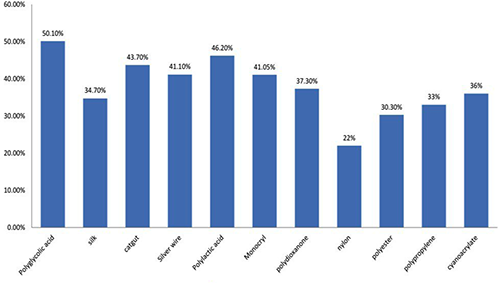
Different types of suturing material.
Figure 3 indicates that the results showed that participants possess a high level ofawareness regarding all the mentioned factors of scar formation. In contrast, the P-value was less than 0.01 for wound position, wound tension, using the proper suturing technique, using the proper suturing material, and nutritional deficiencies. More participants chose ‘strongly agree’ and ‘agree’ than the other options. Also, a high levelof awareness has been shown with a p-value equal to 0.017 for the factor of systemic diseases and 0.044 for the age of the patient.
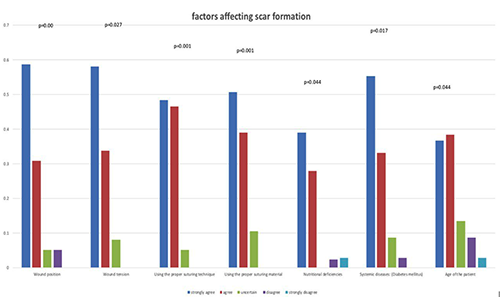
Factors that affect scars formation.
Discussion
The present study was conducted to investigate the practice of EM physicians and GS surgeons regarding wound closure techniques by recognizing common suturing methods and conventional suture types and materials used for the treatment of different wound types in Makkah hospitals. The findings indicate that no particular methods are used by all participants in their suturing practice regarding the specific types of wounds mentioned in the study. Every GS surgeon and EM physician selected and preferred somemethods in wound closure over other methods, which may affect varying wound closure outcomes among practitioners. However, previous studies have shown that certain suture techniques used nowadays are employed more frequently than others due to their advantages and suitability. The most common and fundamental technique of wound closure is a simple interrupted suture, 3 and we found that this was also the case amongst our participants, with most (>50%) choosing the simple interrupted technique over other types. Consequently, this led us to recognize the urgent need for increasing education and awareness for selecting this type of technique when treating skin wounds while avoiding its use for treating other sites, especially the face or breast. Interrupted sutures are easy to place and possess greater tensile strength. 3 However, the subcuticular suture technique, the second most common technique in our study, is used more frequently to treat breast and facial wounds. The extant literature shows that this technique is used more than the traditional simple interrupted technique when attempting to enhance the cosmetic result, with proven effectiveness, and it is also useful for closing wounds with equal tissue thickness in which virtually no tension exists.7,10 Another technique is vertical mattress suture, which was found to be the third most common technique in this study and used more frequently when treating buttock wounds. The literature also showed that it is a widespread technique and useful in maximizing wound eversion, reducing dead space, and minimizing tension across the wound. 3 The use of staplers in closing scalp wounds has more advantages than the use of simple interrupted sutures in regard to patient satisfaction, wound healing, and concerning cost. 5 However, in our study, only 5.20% of the participants chose staplers when treating scalp wounds, while 77.90% opted for the simple interrupted technique despite it not being considered the best method of treating scalp wounds according to previous studies. 6
Moreover, many different suturing materials can be used on a wide variety of wound types, apart from the most suitable types of material. The selection of excellent materialin wound closure may contribute to satisfactory outcomes in wound healing processes, cosmetic pleasing, or any other expected outcomes. This study has not shown certain types of material that are used by all participants in their practice. However, some materials are more frequently used than others, such as polyglycolic acid, polylactic acid, silk, monocryl, polypropylene, and catgut. Therefore, we call for a greater awareness andintensive education regarding the proper use of material in relation to the specific wound area and the wound's level because it seems there is a wide variety of material used without strict guidelines.
On the other hand, this study evaluated practitioner awareness of scar formation and improper healing factors that occur during their practice of wound closure. The results showed a high level of awareness with significant p values for all the study's mentioned factors. These findings may reflect a better practice attitude regarding scar formation. This study depends on its comparison with various previous studies that reviewed a fewof the suture methods mentioned, with the remaining techniques not yet reviewed. Our recommendation is to consider new criteria for selecting the most suitable type of suture technique and material that GS surgeons and EM physicians can apply to all the different types of wounds in order to enhance the optimum outcomes in any wound closureprocedure. Moreover, we call for consideration of a new monitoring system for the outcomes following skin closure procedures to acquire the optimum outcomes and improve the suturing practice quality.
This study's limitations were represented in the potential for information bias during data collection in receiving answers by using an electronic self-administered questionnaire, and also because this study was conducted among participants from a limited number of hospitals.
Conclusions
This study provides insight into the most common suture methods used among GSsurgeons and EM physicians in Makkah hospitals in Saudi Arabia. The results suggest different suture methods and materials are used when treating various types of wound closure, and that some techniques and materials are better and more frequently used than others in different wound conditions. Besides, there are wide variations in selecting these techniques and materials among GS surgeons and EM physicians, reflecting the results of wound suturing among them. However, intensive education and awareness must be offered regarding the proper use of techniques and materials in skin suturing and closure. At the same time, it has been noticed that there is good awareness among participants about factors that lead to scar formation and improper wound healing significantly.
Footnotes
Acknowledgments
The authors would like to extend their appreciation to Umm Al Qura University in Makkah, Saudi Arabia, as well as the Institutional Review Board of King Abdullah Medical City.