






Abstract
Background
Globally, nursing turnover has become a contemporary concern that significantly influences the financial proficiency of healthcare systems. Not only costs, but healthcare accessibility and quality also reverberate the consequence of the phenomenon.
Design and methods
The study explores the factors that attribute to turnover among foreign registered nurses working in Saudi Arabia. A quantitative-based cross-sectional descriptive study design that uses survey data to make statistical inferences about foreign nurse turnover in Saudi Arabia, was conducted to ascertain factors influencing the termination of foreign nurses working with the Ministry of Health (MOH) hospitals.
Results
Factors influencing turnover were categorized into 9 dimensions, professional growth and development, leadership style, management, wage and benefits, workload, interpersonal relationship, housing facilities and services, hospital facilities and intent to stay and turn-over intention, of which the professional growth (4.1±0.7) and development had the highest mean agreement scores (4.0±1.1), whereas housing (2.3±1.3) and hospital facilities (2.1±1.0) showed the lowest mean scores.
Conclusions
Wage benefits and workload factors were found to be the most significant causes of expatriate nursing turnover, closely followed by inadequate housing and hospital facilities. Recommendations from nursing staff on how to improve retention were also noted.
Introduction
Significance for public health
The nursing workforce is considered the backbone of the healthcare delivery system. In Saudi Arabia, foreign nurses employ a large percentage of human resources required in healthcare institutions. Thus, foreign nurses’ increasing turnover rates remain a significant problem affecting healthcare institutions across the country. Staff turnover rate is the prime source of workforce shortage that impacts the operational domain, thereby negatively affecting productivity and revenues. The high turnover rates negatively impact organizational in quality of care and resources to recruit and train new staff, prompts many scholars to investigate possible causes, and to develop a comprehensive staff retention strategies. Determining associated factors on staff turn-over, provides insights that will guide facility policy makers and stakeholders to keep pace with the demand of public health system.
Turnover is a challenging issue in terms of high quality, affordable healthcare. Globally, nursing turnover has become a contemporary concern that significantly influences the financial proficiency of healthcare systems.1,2 Not only costs, but healthcare accessibility and quality also reverberate/compounds the consequence of the phenomenon.1-3 The annual nursing turnover rates in Australia, Canada and the United States are around 15%, 20% and 27%, respectively. 4 The estimated turnover in Jordan, is relatively more at 32%. 5 Turnover rates appear to be superlative amongst recent nursing graduates and new recruits. 6 This in turn, negatively impacts the staff to client ratios and healthcare outcomes. In the last five years, only two relevant research articles,7,8 have been found related to foreign nurses’ turnover in Saudi. Aljohani et al. indicated that the common cause of turnover for Filipino nurses in the Saudi Arabian Ministry of Health (MOH) hospitals to be related to low salary, 7 18.3% of the recruited participate indicate the low salary and low nursing patient ratio to be the most significant factor in Filipino nursing turnover in Saudi Arabian hospitals, until now the sample not representative the Filipino nurses population. 7 Findings indicated that financial incentives, indeed are a primary driving force for those working internationally in healthcare organizations. 9 The second study ended in low tertiary care sites in Saudi Arabia randomly selected with a representative sample of 364 nurses, the majority of foreigners at a rate of 97%; the study indicated the low satisfaction of nurses of their quality of nursing work life and high turnover intention. 8 Existing studies have recorded significant facts determining the common reasons for turnover, and high lightening the areas of improvement to develop strategies that aim to improve retention. However, there are some limitations to the first study requiring further investigation. The primary limitation of Aljohani et al.'s study was the convenience sampling, which remains a weak basis to generalize a specific group of expatriates. 7 Convenience sample limits the generalization of specific study findings to the targeted papulation. Hence, this study desire to explore further issues associated with turnover among the foreign nursing staff working in Saudi Arabia, not only to improve staff nurses’ retention strategies, but also to establish factors related to turnover intention to address potential turnover behaviors.
Literature review
The nursing turnover are discussed through the view of the previously conducted studies and literature. There are several essential aspects in the general discussion of nurse's turnover. Nursing reworded the largest component of the healthcare workforce. 10,11 The nursing contributions considered fundamental to healthcare, particularly in view of the escalating aged population and the burden of chronic non-communicable diseases considering the chronic imbalance between nurses and physicians.1,10 With respect to human resource management, challenges are compounded. Investment scarcity 12 and growing indifference to the profession 13 are two of the critical issues associated with the scarcity of nurses. Additionally, psychosocial strain14,15 and high turnover 12-16 are strongly related to intentions to leave the nursing profession.17,18 Many studies have identified the intention to quit nursing as a predictor of the ultimate decision.1-19 The Nurses’ Early Exit Study (NEXT), 20 found that ultimately, the decision to leave nursing is mostly taken within 6 months of actually doing so. It also been reported by Hasselhorn et al. 20 that about 80% of nurses who left the profession began seriously considering the move within the previous year. Nurses are a very diverse group of professionals, culture and alternative employment opportunities can have an impact on their intention to leave, the mindset that strengthened the idea, was “intention to leave” has often been probed, particularly using quantitative methods to determine associations with many variables that can influence nursing resolution to leave.8,7,21 Occupational factors related to the “intention to leave” change the profession include hospital work environment, poor support from supervisors, lack of importance of the work, conflicting roles, and lack thereof in development opportunities.14-22 Nurses’ “intention to leave” in the professional capacity has been ascribed to psychosocial job strain ascertained by “demandcontrol- support” (DCS) 23 and “effort-reward imbalance” (ERI) 24 models. In this regard, the “intention to leave” is a phenomenon concomitant with the healthcare organization and occupational environment issues. Further studies have shown that the “intention to leave” can occur in the form of a causal nexus, with many nurses leaving first their unit, then their hospital, and ultimately the profession. 25,26 To present, nursing staff, work stress, and job satisfaction remain two significant areas of interest for researchers worldwide because of the continuum in shortage of nurses and high turnover. Earlier studies have suggested that work stress in healthcare providers is a dominant factor, particularly in nurses. Being front-line staff, work overload threatens physical and mental health.27,28 Markedly, the special working environments and work configuration impacts the immense rates of work stress that nurse's experience when compared to other professions. Nursing work stress is a pandemic, globally spanning 9.20-68.0% of nurses. 2 . Withen emergency nurses greater than 80% of nurses expressed moderate or even high levels of burnout and compassion fatigue. 30 A survey from Brazil reported that 15.2% of nurses perceived severe work stress. 31 A major aspect of burnout, work stress positively correlated with “intention to resign”. 32 Recently, a survey has confirmed that high rates of nursing turnover indirectly stress those who continue. 33 Thus, the stability of nursing teams is a widespread matter of contention. Conversely, job satisfaction was considered as the strongest predictor of nurses’ retention. Forfeiture of nurses could be potentially decreased by enhancing their job satisfaction.8,34,35 Recent studies conclude that? nearly early 40% of nurses in Hong Kong 36 and 56% in mainland China 37 have attested to job dissatisfaction. This heeds a warning for nursing managers and policymakers to concern themselves with addressing the issues of job satisfaction, especially with the looming shortage of nurses. Despite strong suggestions related to the common reasons and possible remedies, the turnover trends continue to still flux. Due to the identified causative factors of nursing scarcity globally, turnover warrants intense investigation with a deeper perspective to acquire insights and to address associated aggravating issues. Although we found a good body of literature investigate the turnover yet, even methodological limitations of the research were minimize, it might be challenging to produce data that were generalizable and useful globally, especially in Saudi Arabia context. This study explores a deeper and comprehensive psychological perspective of turnover intention by delving into issues from a wider group of foreign nurses working in Kingdom of Saudi Arabia.
Methods
Study design and participant characteristics
A quantitative-based cross-sectional descriptive study design that use survey data to make statistical inferences about foreign nurse turnover in Saudi, was employed using convenience sampling to recruit 639 study participants. The participants were as follows Indian, Filipino, Egyptian Sudan, Jordanian, Malaysian, and Pakistani. The target population was foreign nurses working for more than six months in eight tertiary hospitals under the Ministry of Health, Saudi Arabia. Consenting respondents, meeting inclusion criteria, answered questionnaires at their convenience.
Criteria of inclusion and exclusion
Foreign nurses with more than six months of experience working in MOH hospitals were considered for the study. Nurses of Saudi nationality and foreign nurses having less than six months’ service or employed in private hospitals were excluded.
Tools of the study
The instrument was used to answer the research objectives is an online self-reported questionnaire explicitly developed by the investigators based on questionnaires from earlier studies and extensive literature on nursing turnover.7,8,20,21 The instrument reliability measured using Cronbach's alpha was 0.97. The final scale consisted of nine dimensions explore the factors that attribute to turnover marked using a 5-point Likert scale (5 points: strongly agree to 1 point: strongly disagree) in two parts. The first part involved demographics data (including age, gender, professional qualification, experience in years, nurse position and nationality); the second part self-reported evaluation of the staff to identify factors influencing the termination and nurse's area of concern, consist of forty-nine sub-questions under the main study dimensions including the intention to leave or stay, professional growth and development, leadership style, management, wage and benefit, workload, interpersonal relationship, hospital facilities, house and services facilities, and foodservice. The online tool consisted of two sections and fifty-seven items overall. A pilot study carried out with 18 nurses, which was excluded from the final study sample, involved a panel of four experts in nursing, leadership, education, quality, and primary nursing. Their recommendations were taken into consideration. The pilot aimed to test the feasibility and clarity of the instrument intended to be used on a larger scale. It also aided the investigators to figure out the time needed to complete the survey, which was 15 min. Post this; the questionnaire was authorized and made operable in its final adapted form as an online survey. Informed consent for participation was obtained using the online survey interface through a statement that informed the participant that their response assumed that they provided informed consent. To guarantee data confidentiality, personal identifiers were not collected.
Study procedures
The Regional Bioethics Committee of the General Directorate of Health Affairs, Hail region, approved the study. Communication was established with ten hospitals under the Ministry of Health (n=10); eight positively replied to participate, yielding an 80% response rate. The consent for participation was by completion and submission of the survey. The data was collected by the developed Google form online survey sent to staff meets the inclusion criteria through WhatsApp. Anonymity, confidentiality of information and voluntary participation in the study were emphasized in the WhatsApp message. The data was collected from May 30 to June 15, 2020 resulting in 639 completed responses.
Statistical analysis
Categorical data was presented by frequency with percentage, while continuous data was portrayed using mean with standard deviation. Association with demographic variables were tested by using independent t-test and ANOVA. All the analysis were done by using SPSS 23.0 v. A p-value less than 0.05 was deemed significant.
Results
Table 1 established that the nursing population was predominantly female (622; 97.3%), revolving mostly around the ages 20-40 years (20-30 years) 47.6% and 31-40 years (40.1%). The majority held a bachelor's degree (528; 82.6%), had 5-9 years of experience (269; 42.1%) and were of the staff nurse cadre (462; 72.3%). The majority of nurses working in MOH were found to be Indian (313; 49%) and Filipino (280; 43.8%).
Demographic characteristics (n=639).

The questionnaire responses were scored from “strongly agree” at 5 points to “strongly disagree” at 1, with the mean and standard deviation values accordingly calculated (Table 2). High mean scores under professional growth and development, marked the importance of encouragement and improvement with “active staff development or continuing education” showing highest mean score (4.1±0.7). Most participants agreed that the leadership styles were creditable; all the questions having a mean of 3.6±0.9 or more, with “the nursing leadership is visible and accessible” ranking top (3.9±0.8). In the management section, “a clear, concise job description” ranked first (3.9±0.8), while many disagreed with “enough registered nurses providing quality patient care” (3.3±1.1). Overall response, however, showed a positive management impact. Regarding wages and benefits, many respondents did not agree that “extra work is acknowledged with monetary incentive” (3.1±1.2), but majority agreed with other questions, all showing a mean of 3.6±1.0/1.1, implying a strong effect on the staff turnover. The workload factors leveraged a negative impact with a high mean (3.7±0.8) of respondents agreeing that “the amount of work interferes with how well it is done” coupled with low agreement scores for other questions, thus, reinforcing the heavy workloads. Interpersonal relationships were found to be satisfactory with favorable mean scores, with the top ranked being “I have a chance maintaining interpersonal relationship, enjoying leisure time with proper distribution working hours and off.” (3.6±0.9). The housing facilities and services showed disheartening scores, highest mean being 3.6±0.9 for “There is reasonable privilege to go out for recreation” and “The staff are given option to take either raw or cooked food supply” and lowest being 2.8±1.3 for “There is variety and balance diet food items provided”. The hospital facilities were found less than adequate with only few agreeable scores, “There is available system to contact on-call staff and physicians” having the highest mean of 3.3±1.1. The intent to stay and turnover intention was established to be low wherein only a mean of 2.9±1.1 agreed that “Under no circumstance, I would probably be leaving this organization before my retirement age” while 3.4±1.1 conceded that “I plan to stay in this organization for as long as I am needed”.
Response score.

A comprehensive view of the various factor categories and significant associations with the demographic variables (Table 3) showed that the age of the nursing population did not have any significant association with any of the factor groups. The female gender of the nursing staff had a statistically significant relationship with leadership style and turnover intent, and a very high significance (p<0.001) when associated with the management. Diploma holders had a significant influence on all the factor groups except the workload. There was a strong association (p<0.001) between them and wage – benefits and an intent to stay. The relationship between the management and nurses with higher education showed statistical significance, like hospital facilities with bachelor's degree holders. Nurses with 1-4 years of experience had a statistically significant association with leadership style, management, wage and benefits, interpersonal relationships, and turn-over intention. Those with >10 years under the belt were significantly associated with management, wage and benefits, and turnover intention. Those with 5-9 years of experience had no statistically significant relationships. Only professional growth and development were affected significantly by the nursing position, mainly charge nurse.
Association with demographic variables.

Statistically significant.
Discussion
The primary aim of this research is to provide an overview of the factors influencing nursing turnover in the MOH hospitals of Saudi Arabia, especially in expatriates. Many studies have been conducted in private and MOH hospitals regarding the rates, cause and consequences of such an anomaly, but there is a paucity of studies that explored turnover intention in nurses of foreign nationality. 7,38 The data collected has been analyzed in 9 dimensions, calculating statistical associations and influence of these factors across various demographic parameters of respondents.
The nursing workforce was found predominantly female, analogous to most studies with nurses working in Saudi hospitals.38,39 The age of the nurses was mostly between 20 and 40, majority having Bachelor's degree and working in Staff nurse cadre, similar to studies by Kaddourah et al. and Saquib et al.8,39 In contrast to the <5 years tenure seen in these studies, a 5-9 year work experience was found common here. The multinational nursing population was dominated by Indian nurses, closely followed by Filipino, which is similar to Albougami et al. and Saquib et al.39,40 In contrast, the study by Kaddourah had a higher number of Filipino nurses. 8
Agreement scores evaluated by a questionnaire spanning nine sections charted the views of the participants on the various factors that can be considered influencing their turnover intention. Professional growth and development were found to the most propitious incentives considering long term employment. A study by Lu et al. on job satisfaction of nurses elicited a poor satisfaction in this arena, insinuating a lack thereof to be a criterion for increasing nursing turnover, especially in expatriate nurses. 41 Leadership styles and a management with clear job descriptions and adequate staff numbers for rotation have a vital influence on the nurses intention to stay as seen in previous studies.38,42,43 The findings in this study reflected a positive leadership and management experience, as compared to similar studies, where the satisfaction with leadership styles and management were not found acceptable. 41,44,45
The wages and benefits conferred invoked a lukewarm response, with a relatively lower mean agreeing to their adequacy. Many studies have emphasized this factor, showing a similar dissatisfaction in nurses working internationally.41,44,46,47 Although financial incentives alone do not significantly influence long-term job satisfaction, 48 they form a major driving force in expatriate nurses. A study by Aljohani and Alomari decreed low salary as the top cause for turnover in Filipino nurses. 7 The current study reveals a very strong association between wages and nursing qualification, especially in diploma holders and with working experience, those with <5 years and >10 years, implying the lack of satisfactory wage bracket in these demographic groups to be a factor influencing turnover intent, corroborating previous studies’ findings. 8,44,49 The MOH decision-makers must explore constructive options in terms of mutually profitable financial packages if nurses’ retention is to be attained.
A shortage of staff with ubiquitous emergency situations makes for an increased workload as hospitals ask nurses to work extra hours. 46 Nurses are under constant pressure influencing work quality and stress levels. This can cause early burnouts, depression and job dissatisfaction especially with the nurses being far away from their home countries, leading to increased turnover.41,50 Interpersonal relationships with colleagues and superiors can form a strong impetus to stay on. Interdisciplinary teamwork and importance to home and work life are important factors influencing nurse's intention to stay.45,51
Housing facilities and services are a key factor in nurses’ intent to stay. The results of the current study reinforce the findings of preceding studies that argued poor food quality, inferior accommodation and middling services as a further cause of turnover among expatriate nurses.7,38,45 Strategies to improve this by providing improved housing facilities and services like gym area, expanding scope of house matrons’ responsibilities and professional hospitality training, providing supportive services to temporary nurses, and other such conveniences must be duly considered to improve the home life of the working nurses.
The hospital environment is the cornerstone of job satisfaction forming a core influence in turnover intention and intention to stay. A positive work environment encourages nurses to implement their full scope of practice and qualifications into patient care.41,45 The dissent with the hospital facilities, policies and communication systems in this study reflect findings from similar studies both within Saudi Arabia and internationally.7,38,44,46,52
Organizational commitment in the form of intent to stay and turnover intention, was found to be low in this study, supporting findings in earlier documentation.46,53,54 This occurrence could be likely due to the cultural differences that impact non-Saudi nurses’ values, beliefs, and behaviors in the workplace, an inability to adjust inducing an intent to resign, along with other pertinent factors. Nurses’ demographics, including gender, educational attainment, wages, years of experience and nationality were observed to be determinants of nurse turnover and turnover intention. 41,42,46,55,56 The associations formed when these are crossed with the 9 dimensions can indicate areas that significantly affect turnover intention. Older literature described younger nurses to have higher level of turnover intention and age to be positively associated with intent to stay.62,63 In contrast,60 contended that age had no effects on turnover intention. The present study also did not encounter any association between age and factors influencing turnover intention across the 9 sections.
Contrary to Almaki et al., 48 the study found females to have significant association with turnover intent and organisational commitment, and also in relationships with management and leadership styles similar to previous findings.42,43
Nurses with diplomas showed a significant association to almost all the factors influencing commitment to stay, contrary to Almaki et al., 48 who established that respondents with an associate degree were more likely to indicate turnover intention. Nurses with higher education and those with post graduate degrees were significantly associated to management issues and interpersonal relationships respectively, although there are no similar studies to show the effect of nursing qualifications on these specific factors influencing turnover intention.
Staff with a work experience of less than 5 years had significant relationships with the leadership styles, management functions, wage and benefits aspect, interpersonal relationships and commitment to the organization, similar to findings of studies by Ayalew et al., 45 which established that turnover intentions peaked among nurses with two to five years of experience. Labrague et al., 44 also communicated that inverse relationships may exist between the nurse's years of work experience and turnover intentions although the present study confers that nurses with work experience greater than 10 years may show greater associations to management, wage and commitment related factors affecting intent to stay.
Studies to elicit associations between demographics and nursing turnover are many with varying results. Some studies have highlighted associations between age, experience and work tenure in an organization, and the intention to leave the organization,57,58 while others have found advanced age and longer job tenure to be a reason to leave jobs. 59 Almalki et al. 48 established that only four demographic variables, gender, dependent adults, positional tenure and payment per month, had strong relationships with turnover intention. However the current study shows a broader view of the factors involved in nursing turnover intention in expatriate nurses, demonstrating more detailed associations between demographic variables and individual factors.
Limitations
A limitation of this study was potential bias and misinterpretation being based on self-reports. Also, convenience sampling method limits this research to expatriate nurses in the MOH and cannot be used to make generalized policies regarding nursing population as a whole. Despite these, the strength of this study lies in the investigation of the nurses’ unique perspectives on their intent to resign, using a thoughtful questionnaire with myriad factors allowing a comprehensive understanding of the issues and problems provoking intention to leave.
Suggestions for future research
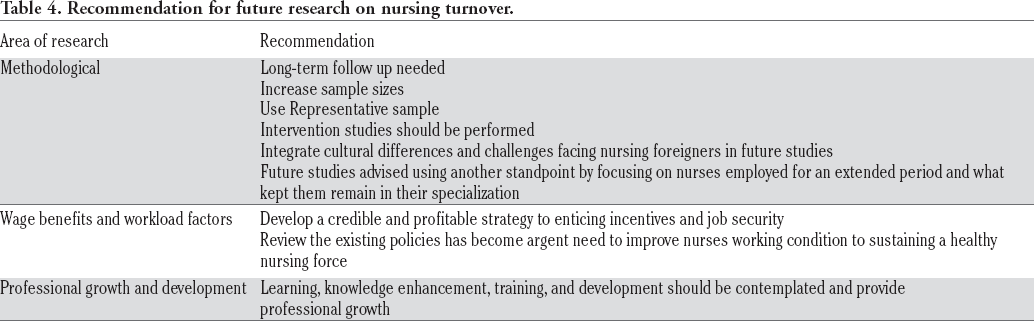
A cross-sectional design can limit observations of change over time. Longitudinal and experimental studies could be considered to link participants at different time points and enable monitoring of actual attrition against turnover intention with a focus on the influence of nurse turnover on cost as well as patient outcomes (Table 4). A series of comparative studies, comparing expatriate nurses to other non- Saudi health professionals in the MOH and Primary Health Care (PHC) or private nurses to MOH nurses may deliver determinants of turnover intention of nursing personnel.
Recommendation for future research on nursing turnover.
Conclusions
The challenges and transformations in the Saudi healthcare system especially MOH, demand astute navigation in identifying and addressing requirements of nurses, as they represent the quorum of the country's healthcare manpower. Wage benefits and workload factors were found to be the most significant cause. The influence of factors such as inadequate housing and hospital facilities are longstanding contentions that have not been sufficiently rectified. The abundance of Indian and Filipino nurses, along with others, may face extensive difficulties to adapt to cultural differences. Organizational commitment must be improved with creditable and profitable strategies such as culture induction and enticing incentives, or a longer contract indicating security in the job. Maintaining and enhancing strengths such as professional growth and development is also essential. Review the existing policies has become urgent need to improve nurses working condition. Programs for learning, knowledge enhancement, training and development should be contemplated. Sustaining a healthy nursing force is crucial to enhance performance, productivity and promotion of safe nursing care.
Implications to nursing management
Nursing administrators are central to policy setting and implementation, capable of improving job engagement. respecting propensity for quality contribution, envisaging need for incentives and other retaining strategies. In the fast- developing global healthcare scenario, the constant evaluation and re-evaluation of the requirements for nurses of foreign nationality to stay working in Saudi is paramount. Hospital leaders need to develop strategies and policies that will help mitigate foreign nurse turnover.
Nursing administrators are vital to policy development and implementation, respecting propensity for quality contribution, envisaging need for incentives and other retaining strategies. In the fast- developing global healthcare environment, the constant valuation and re-evaluation of the requirements of nurses of foreign nationality is imperative to determine and address the needs of all parties concerned.
Footnotes
Acknowledgements
A sincere thank you is extended to all Registered Nurses who participated in this study and assisted to make this study a reality.