






Abstract
Background
Poisoning is a critical public health problem. Toxic substances differ across time, region and age. Little is known about poisoning in Russia, and even less is known about lethal poisoning in children in Russia. We aimed to describe the characteristics of cases of lethal poisoning in children and adolescents.
Design and methods
Our retrospective study was based on autopsy reports from archives of the Moscow Region Bureau of Forensic Medical Examination for the period of 2009 to 2018.
Results
A total of 438 lethal poisoning cases were recorded. The average age of the poisoned children was 11.3 years. Deaths predominantly occurred in boys, mostly due to the higher frequency of poisoning with household and technical chemicals (P<0.01). Accidental deaths were also higher in males (P<0.01). Therapeutic drug poisoning (P<0.01) and suicide (P<0.01) were more frequent in females. The leading cause of lethal poisoning in children was exposure to carbon monoxide, especially in children aged 5 to 9 years (P<0.01) and 1 to 4 years (P<0.01). Carbon monoxide poisoning occurred more often in winter (P<0.01). Regarding the structure of poisoning with household and technical chemicals, the most frequent was poisoning by a mixture of utility gases.
Conclusion
Our study shows that carbon monoxide poisoning is a serious problem in the region. This may be associated with the ongoing use of individual heating systems. A significant increase in the frequency of fatal poisoning by chemicals, especially by propane-butane gas mixtures while sniffing, has become a disturbing trend.
Introduction
Globally, poisoning is a critical public health problem. Humanity loses 50.1 years of life per 100,000 people annually (DALY) because of lethal poisoning. 1 Poisonings in children, as part of childhood injuries, significantly contribute to child mortality and, disproportionally, to the increase in DALY loss.2-4
Significance for public health
Lethal poisoning in children plays a major role in mortality. While clinical toxicologists have worked with live persons and seen the tip of the iceberg, forensic experts have worked with children who died before being admitted to the hospital. It is only by analyzing both sources that we can obtain a comprehensive picture. This paper is an epidemiological study based on autopsy reports and shows another part of the problem.
The use of toxic substances changes over time, and variations by region and with age are enormous. Acute lethal poisoning in adults is well described, 3 but data on lethal poisoning in children are relatively scarce.5-7 The main causes are the organization of forensic practice 7 and the relatively small number of cases, which limit the perspective of the analysis.6-8 Due to limited data and a dominating agenda, some researchers cite the prevalence of drug poisoning in the structure of infant mortality, 3 while others point to the leading role of alcohol poisoning, 5 or exclusively examine the prevalence of alcohol poisoning, considering that this type of poisoning is the most significant.6-8 Systematic studies of poisoning in Russia are absent, and even less is known about lethal poisoning in children in Russia. 9 In this study, we aimed to describe the characteristics of lethal poisoning in children and adolescents in a large set of cases from the Moscow Region Bureau of Forensic Medical Examination. It serves one federal district that includes 56 cities with a population of 7.5 million as of 2018. The total number of autopsies in the Bureau in 2018 was 59,712.
Design and Methods
Our retrospective study is based on data from the Moscow Region Bureau of Forensic Medical Examination (not including the city of Moscow). We extracted data from the autopsy reports of children who died from January 1, 2009 to December 31, 2018, which included birth date, sex, autopsy findings, cause of death, diagnosis, circumstances of death from police reports (if available), and toxicology results. In total, there were 3,965 cases of children aged 0 to 19. Alcohols, acetone, acetaldehyde and other volatile organic compounds were quantitated by gas chromatography with flame ionization detection, and drugs were analyzed via high-pressure liquid chromatography mass spectrometry. A blood alcohol concentration greater than 0.3 g/l was classified as alcohol intoxication (in cases of combined poisoning).
Inclusion and exclusion criteria
We excluded cases of stillborn children (n=34), cases when it was not possible to establish the sex of the examined child (n=2), and cases when the cause of death was not determined due to decomposition (n=56). In total, we included 438 (274 males) cases of death caused by poisoning in our study. We categorized age as up to 1 year old; from 1 to 4 years; 5 to 9; 10 to 14; and 15 to 19.
We classified substances according to the purpose of their use: narcotic substances (illicit drugs), medicines (therapeutic drugs), carbon monoxide, ethanol, household and technical chemicals, other substances, and unknown substances. We assigned poisonings involving more than one substance (in addition to narcotics) to the narcotics group, and we assigned combined poisonings involving only medicines to the therapeutic drugs group. In cases of lethal poisoning by illicit drugs (for example, morphine), we checked for the presence of concomitant diseases, which could be a medical reason to use them (e.g., cancer). Moreover, in such cases, forensic pathologists usually know about medication therapy from police reports and mention it in forensic reports. There weren't such cases. We assigned cases with a combination of narcotics and ethyl alcohol or therapeutic drugs and ethyl alcohol to the illicit drug group and therapeutic drug group, respectively, disregarding alcohol. In all cases of poisoning with therapeutic drugs, we determined the precise active substances and their combinations. Unlike in clinical studies, this helped us avoid searching for trade names of generics; however, we could not obtain the brand names of drugs that caused the largest number of poisonings.
Statistical analysis
We prepared the data in an Excel table, and performed the statistical analysis with SPSS Statistics, Version 23. While analyzing the quantitative data, we calculated the mean arithmetic values and 95% CIs. We used the Kendall rank coefficient (τb) to study changes in the frequency of poisoning with specific substances over a 10- year period. We tested the differences in frequencies in different sex groups using the chi-square test (χ 2 ). We set the level of statistical significance at P<0.05.
The study was approved on November 15, 2018, by the Ethics Committee at the Moscow Regional Research and Clinical Institute.
Results
The total number of autopsies in the Bureau rose from 37,513 in 2009 to 59,712 in 2018, but the number of unnatural deaths fell from 12,877 to 8,561 in the same period. The number of autopsies for children and adolescents (under 19 years old) decreased from 423 (329 unnatural deaths) in 2009 to 391 (254 unnatural deaths) in 2018. Unnatural deaths accounted for 71% of cases (2,750 out of 3,873) in the total number of deaths of children and adolescents aged 0 to 19. In the structure of unnatural deaths, there were 438 (15.93%) cases of poisoning. Figure 1 depicts the distribution of unnatural and natural deaths by year. There was a small decline in the number of children who underwent autopsies (under 19 years old) in our organization due to a decrease in the absolute number of unnatural deaths in the region.
Among all cases of poisoning, in 235 (53.7%) cases, death resulted from carbon monoxide poisoning, which was statistically more often registered in the cold months of the year (P<0.01). Among all illicit drug poisonings, death was caused by opiates (N=35), opioids (5), amphetamine derivatives (7), and “designer” drugs (alpha-pvp, ADB-Fuminaca, 25I-NBOMe, JWH) (7). The first cases of poisoning with “designer drugs” were recorded in 2016 (n=3), and further cases remained rare: In 2017, there were 3 cases; in 2018, there was 1 case. In 52 cases, poisoning occurred as a result of exposure to therapeutic drugs: drotaverine (12), antidepressants (2), and barbiturates (2). In 50 cases, death was caused by household and technical chemicals: propane-butane gas mixtures (44), methyl alcohol (1), ethylene glycol (1), and acetone (1). In 9 cases, death was caused by ethanol at blood concentrations of 3.26 g/L (95% CI: 1.94 to 4.56, BACmax=5 g/L). In 19 cases, the poisoning agent could not be detected. Poisoning was established as the cause of death on the basis of the circumstances of death, the exclusion of other possible causes, and signs of acute death. Table 1 portrays the distribution of cases of poisoning.
The distribution of cases by type of toxicant, age and sex.
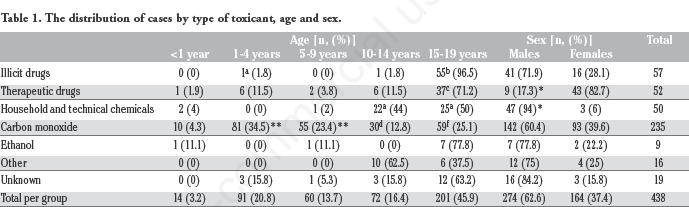
Compared to females: *P< 0.01. Compared to other toxicants in the same age group: **P< 0.01.
1 case was combined with alcohol;
10 cases were combined with alcohol;
10 cases were combined with alcohol;
8 cases were combined with alcohol;
16 cases were combined with alcohol.
The average age of death was 11.3 years (95% CI: 10.7 to 11.855, minimum age: 82 days, maximum age: 18 years and 11 months). The proportion of males during the period of study was at least 60%. The male to female ratio was only 1:1 at up to one year of age. In ages after 1 year the number of deaths in males increasingly higher, than in females. The higher frequency of poisoning in males was mostly due to the greater frequency of poisoning with household and technical chemicals and lower numbers of therapeutic drug poisonings. In one case, death was registered as in the ambulance. In 5 cases, death occurred at an inpatient facility; in the remaining cases, death occurred before medical help was sought (n=432).
The largest number of cases was in the 15- to 19-year-old age group (n=201, males: 65.7%). In 55 (27.4%) cases, death in this age group occurred due to illicit drug poisoning and in 59 (29.4%) cases due to carbon monoxide poisoning. Seven individuals (77.8% of all ethanol poisoning) died due to poisoning with ethyl alcohol, and 12 people (63.2% of all poisoning by an unidentified substance) were poisoned by an unidentified substance (n=12) in this age group. The cases of illicit drug poisoning in this age group accounted for 96.5% of all poisonings by this group of substances.

The number of examined bodies of children and adolescents aged 0 to 19 years.
In the 10 to 14 age group, death most often (n=30, 41.7%) occurred as a result of carbon monoxide poisoning and household and technical chemicals (n=22, 30.6%). Carbon monoxide was the significant leader among children 5 to 9 years old (n=55, 91.7%,) and 1 to 4 years old (n=81, 89%). It was also leading among the age group of <1 year (n=10, 71.4%), but the difference was not significant (χ 2 =1.17, P=0.279).
Age was significantly correlated with the total number (τb=0.077, P<0.01), carbon monoxide (τb= -0.467, P=0.036), illicit drugs (τb=0.332, p=0.026), and slightly correlated with the number of therapeutic drug poisonings (τb=0.16, P=0.04).
The largest number of cases was in 2015 (n=56), while the smallest number of cases was in 2012 (n=33). During the study period (from 2009 to 2018), there was a slight, but statistically significant, rise in the number of deaths due to therapeutic drugs (τb=0.059, P=0.043) and household and technical chemicals (τb=0.214, P<0.01), and a slight decline in the number of deaths due to carbon monoxide (τb= -0.149, p=0.04) and illicit drugs (τb= -0.015, P=0.041). Table 2 shows the distribution of poisonings in more detail. We noted a significant difference in the frequency of fatal poisonings by therapeutic drugs and household and technical chemicals from 2016 to 2018 compared to the previous time interval.
The distribution of cases by type of toxicant, year and sex.

The sum compared to the period before 2016: *P=0.024.
The suicide rate was higher in females in the older age group, but accidental deaths were higher in males. The proportion of homicides and undetermined deaths was equal. Table 3 illustrates the distribution of poisonings in more detail.
The distribution of manner of poisoning death, age and sex.
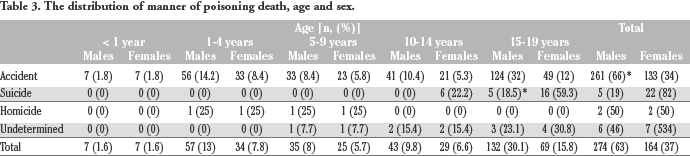
Compared to females: *P<0.01.
Discussion
Poisoning agent
According to studies performed in clinical facilities, alcohol was the leading toxicant in children in Croatia (55.74% of children aged 0 to 19) 10 and Poland (50.1% of children aged 0 to 18), 11 and it was the leading intoxicant in male children in Norway. 12 In Iran, in children aged up to 10 years old, the most frequent cause of hospitalization was poisoning with therapeutic drugs (58.1%), 13 which was also the case in Spain. 14 In the United Kingdom, adolescents aged 10 to 24 years old were poisoned most often with paracetamol, alcohol, NSAIDs, and antidepressants. 15 In the USA, most often, nonlethal poisoning of children aged up to 5 years old occurred because of analgesic agents. Poisoning with fumes/gas/vapors only ranked fourth. In older age groups, death occurred more often because of poisoning with analgesic agents and narcotics. 3 However, the forensic data are different. For example, there were 11 cases of lethal carbon monoxide poisoning in children up to 20 in Portugal, 8 and 40 (out of 63) in the eastern Black Sea region of Turkey. 5
The results of the study demonstrated that poisoning with carbon monoxide led to lethal poisoning in all age groups. Children may be more sensitive to carbon monoxide; 16 nevertheless, a high share of poisoning by carbon monoxide could also be caused by non-medical factors. The statistically significant rise in the number of deaths from poisoning by carbon monoxide in children during the winter season could be explained by socially economic causes. The high cost of district heating services and the mismatch between value and quality 17 are the most important reasons for not using central heating. 18 The high cost of electricity in Russia stimulates the demand for individual gas equipment and water heating, which, on economic grounds, is often installed with numerous safety violations. The systematic wear and tear of gas equipment and obvious defects in installation lead to tragic consequences not only for users of the premises, but also for their neighbors. Most likely, the highly toxic effect of carbon monoxide on children results in death earlier than children can receive medical help; thus, in clinical practice, such poisoning is registered quite rarely.
The leading role of drotaverine in therapeutic drug poisoning is probably specific to post-Soviet countries where this spasmolytic drug is widely used in pediatrics and is considered very safe by parents.
Researchers from the USA highlight the growing importance of the role of poisoning with opioids among children and adolescents in the country; the rate was 3.71 cases per 100,000 children in 2012. 19 The problem of poisoning with substances from these groups is one of the most significant in Russia. According to the present study, approximately 70% of poisonings through narcotics are caused by opiates and opioids.
A hypothesis on the rising spread of new “designer” drugs was not confirmed in the study performed by authors from Poland. 11 The authors stated that the first cases of poisoning with “designer” drugs in their country were registered in 2007, and there were no significant changes in the structure revealed. As mentioned before, the first cases were registered in 2016. Unfortunately, the limited data do not allow us to draw unambiguous conclusions about the significance of these drugs in mortality over time, but we plan to monitor the situation. There are also no data about the prevalence of poisoning by these drugs for children hospitalized in Russia, which does not permit us to draw conclusions about their significance.
In the structure of poisoning with household and technical chemicals, the leading place in the rank was occupied by poisoning with a mixture of utility gases. First, using fuel for heating equipment can cause the deaths of children under the age of 1 year (N=1). Second, as an absolutely legal component of lighters, this substance is used by adolescents to obtain a hypoxic/narcotic effect (N=44). a
“Sniffing” produces a narcotic effect after inhaling a gas mixture of hydrocarbons.
The threat of such misuse of widely available and normally safe substances and devices is continuing in the absence of any prohibitive educational actions.
Age
According to the present study, the average age of children who suffered from lethal poisoning was 11.3 years old (95% CI: 10.7 to 11.855). The limited data in forensic articles do not allow for comparisons with our data. This is why we also compared our data with hospital series.5-8 Similar values of the average age were observed in Poland [12.86±5.04 (M±SD)]. 11 Adolescents prevailed in Norway, with an average age of 15.5±1.5. 12 On the other hand, the average age of children with poisoning in Iran was 3.07±1.43 (M±SD), 13 in Spain it was 4.6, 14 and in Italy b it was 3.4±3.1. 20 Thus, in “warm” countries, poisoning was registered more often among junior groups of children and in “cold” countries among adolescents. This specific tendency requires further examination.
The study included children up to 14 years old.
The study of the profile of poisoning shows that the character of poisoning in children in southern countries was more accidental and primarily observed in junior children. In northern countries, there was an increase in the share of poisoning in older age groups with substances that are difficult to take accidentally. Our study revealed a similar microcosm, except for poisoning with carbon monoxide. The shift from accidental poisoning, mostly with carbon monoxide to illicit drugs, ethanol, and a mixture of utility gases with age is connected to more active use of substances by adolescents.
Sex-related differences
According to our results, male subjects prevailed in all age groups except for the age group up to 1 year old, wherein the distribution was equal. The obtained data agreed with numerous studies that found a higher proportion of males: in Italy: 56.2%, 20 Croatia: 63.6%, 10 Iran: 50.6%, 13 and Poland: 52.4%. 11 However, a study in Spain showed a higher proportion of males in junior age groups only, and a smaller share of males in the group older than 10 years (61.3%). 14 In the UK study, the proportion of females (52%) peaked at the age of 16 to 18, while in males, the highest proportion was registered at the age of 19 to 24 years. 15 Most likely, poisoning in junior age groups was primarily accidental, and sex-related differences in junior groups were small and depended on local factors. With age, the share of intentional poisoning increased, and the rate was higher in males.
Conclusions
The present study indicates that the leading cause of lethal poisoning in children is the exposure to carbon monoxide, especially in younger children – up to 9 years old. Carbon monoxide poisoning was more often registered in the cold months of the year which definitely led us to the conclusion that the cases are not medical but socio-economical. Among all illicit drug poisonings, most deaths were triggered by the opiates, opioids, and amphetamine derivatives. Of all cases of therapeutic drug poisoning, most often, poisoning occurred due to use of drotaverine, which is probably specific to post-Soviet countries. In cases of lethal ethanol poisoning, the average blood alcohol concentration was 3.26 g/L (95% CI: 1.94 to 4.56, BACmax=5 g/L).
The average age of death was 11.3 years (95% CI: 10.7 to 11.855). The number of lethal cases was higher in males, mostly due to poisoning with household and technical chemicals, especially resulting from a mixture of utility gases. This has become a disturbing trend because of prevalent sniffing. Accidental deaths were also more frequent in males. Females more frequently die from drug poisoning, and from suicide. There were no sex-related differences between the rates of death by poisoning with illicit drugs, carbon monoxide, and ethanol.
Our study shows that carbon monoxide poisoning is a serious problem in Russia, and we plan to monitor the situation. Additionally, we plan to observe cases of lethal poisoning with “designer” drugs.
This study has several limitations. Our data do not include cases when toxic agents found in the blood were not considered to be associated with the onset of death. The obtained data lacked reliable information about methods of administering the poisonous substance and source.
Footnotes
The authors declare no potential conflict of interest.
Acknowledgments
We would like to thank Aleksander V. Maksimov and the Toxicology Department of the Moscow Region Bureau of Forensic Medical Examination for help with data collection and Aleksey Glazkov for advice on the study design.