






Abstract
Background
The coronavirus disease (COVID-19) has affected the entire globe, and various mythologies argue about its diagnosis, cure, and prevention. Globally, as of September 18th, 2020, there have been 30.055 million confirmed cases, including 0.943 million deaths. The nationwide closures are impacting over 60% of the world's student population. This study aimed to explore the social distancing policies and universities’ reopening after COVID-19 in G20 countries (19 member countries and the European Union).
Design and Methods
The study is based on documentary analysis. G20 members represent around 80% of the world's economic output, two-thirds of the global population (including more than half of the world's poor), and 75% of international trade. Based on documentary analysis, the study revealed that there is a policy dilemma among G20 countries regarding school reopening and a variety of conflicting policies within each country.
Results
Based on a sample of 838 universities in the USA, 66% of universities (552 of 838) plan for in-person instruction, while only 7% are planning for a completely online teaching mode in the fall 2020 semester.
Conclusions
Interestingly, none of the private universities in this study are planning to implement an online teaching mode. Policymakers need an integrated set of policy guidelines for school reopening, considering the evaluation of current COVID- 19 pandemic circumstances and social distancing capacity.
Keywords
Introduction
The COVID-19 outbreak in early 2020 has been declared a Public Health Emergency of International Concern and has led to the closure of higher education schools worldwide. There are still thousands of research laboratories around the globe seeking a cure for this disease. The World Health Organization explained that “it is transmitted through direct contact with respiratory droplets of an infected person (generated through coughing and sneezing). Individuals can also be infected from touching surfaces contaminated with the virus and touching their face (e.g., eyes, nose, mouth)”. 1
Significance for public health
According to UNESCO, most governments worldwide have temporarily closed educational institutions to contain the spread of the COVID-19 pandemic. Due to nationwide closures are impacting hundreds of millions of students. Recently, several countries have implemented localized social distancing policy to open schools. In the background of the ongoing COVID-19 pandemic globally, the study reveals that school reopening policy guidelines are very important because gathering more students may spread the virus.
Consequently, countries had to limit further transmission, decrease the influences of the outbreak, and maintain control measures through social distancing. Sixty-one countries in Africa, Asia, Europe, the Middle East, North America, and South America all declared school and university closures on March 13th, 2020. 1 As a result, universities, and schools had no choice but to convert to online teaching platforms. 2
The spread of COVID-19 has led to a drastic change to billions of peoples’ emotional, physical, mental, social, and financial status. Therefore, countries worldwide are planning exit policies to lift the social distance constraints implemented in school and public site closures. 3 COVID-19 has infected over 2,182,979 people and killed over 118,286 in the U.S. and continues to spread. 4 As a result, U.S. citizens face many financial, mental, and physical challenges during this lockdown. 4 Scholars 5 in their ethics framework for the COVID-19 reopening process, opined that “[It] is a mistake to assume that social distancing policies are the best way to promote public health or that a reopening policy is the best way to bolster the economy”.
A large number of existing researches has been done to support teaching during the current situation.5–7 Scholars 8 presented three fundamental principles that support teacher e-ectiveness during the COVID-19 pandemic. The first principle is related to the support of teacher resilience, meaning that their jobs and salaries are secure, and they are supported by the motivation needed. The second principle focuses on teachers’ instructional knowledge, including educating them about the hygiene needed to stay safe, providing them with plans on how to assess the students, and conducting professional development workshops to strengthen their technical, social, and psychological skills. The third principle is centered on teachers’ technological knowledge, giving them access to various online channels for teaching. As Bernstein et al. and Nurunnabi et al.6–7 mentioned, these principles are mandatory regardless of the countries’ context during this pandemic. This study sought to explore the challenges and responses policymakers face as they decide when and how to reopen schools. Specifically, this study aimed to explore the following research questions: i) What are the implemented policies related to private and public institutions within the USA regarding social distancing and reopening schools? ii) What are the implemented policies within the G20 countries regarding social distancing and reopening of schools?
Given that there has been limited research conducted on the social distance constraints and policy implications within G20 countries, this study aimed to investigate how higher education institutions in the U.S. and elsewhere have adopted policies regarding reopening schools in the post-COVID 19 periods and to explore the different policies adopted by higher education institutions within and between G20 countries.
The following list includes the relevant terms discussed within this paper: i) The coronavirus disease (COVID-19) is caused by severe acute respiratory syndrome coronavirus 2 (SARS-CoV-2) and is described as “one of the major pathogens that primarily targets the human respiratory system” 9 with flu-like symptoms. ii) The term lockdown, in this context, represents the coronavirus response to the “conditions resulting from state and federal government regulations and advisories restricting government, organizational, personal, travel, and business functionalities.” 10 iii) Social distance: Social distancing and stay-at-home practices are governmental orders or advisements established in cities worldwide to decrease the chance of physical interactivity among people, particularly in urban areas where population density is higher. 11 iv) The new normal is a term being used to “represent the potentially transformed socioeconomic systems, as a result of COVID-19 issues, amidst the likelihood of multiple future waves of the Coronavirus pandemic”.10–12
Higher education responses during COVID-19
As a response to the COVID-19 crisis, recent scholars 13 issued the following set of learning recovery recommendations for reopening technical and/or vocational secondary schools and nontertiary postsecondary institutions: i) Social distancing and procedures that encourage proper hygiene and sanitation should be enforced to limit any health risks; ii) Work-based learning that exists on-site and remotely should be improved and, where possible, expanded; iii) The challenges of meeting the needs of different learners and the obstacles that developed during closures should be addressed when schools reopen; iv) Flexible opportunities for at-risk groups to begin or complete training should be offered.
These recommendations are in line with UNICEF, UNESCO, the World Food Programme, and the World Bank, which have all joined forces to produce directions that offer useful guidance for domestic and foreign authorities on how to deal with reopening schools. UNESCO also established a framework for reopening schools that mainly centered on “contextualization and continuous adaptation”.13–15 UNESCO further endorses the idea that “after safety, there must be a focus on the learning recovery process - from assessing learning consequences during school closures, ensuring their socio-emotional well-being and taking measures to address disparities through remedial approaches” 16 all of which are essential to a meaningful response to local needs and situations. Furthermore, learning and teaching strategies must be reviewed and updated by instructors and policymakers to identify students’ diverse needs, including those who were and still are at risk of being left behind, thereby providing these students with the support needed.17–20 As outlined in the World Bank report on the influence of the pandemic on global education, policymakers and school leaders must learn to profit from accessible and corroborated innovations and collect main lessons on the use of technology, at this unprecedented scale, to move to ‘the new normal’19–20 mentioned that this is the time to construct better learning environments, make education policies more inclusive, “better [prepare] to face and overcome the possible crisis in the future…[and] protect education—and education budgets—from the socioeconomic fallout of the pandemic”. 19 The focus should be on the appropriate ways to recover learning loss during the pandemic.
Researchers18–20 designed a framework of ethics for policymakers to use for the ethical assessment of reopening policy options. The framework incorporates the following seven steps: i) Step 1 identifies and assesses the feasibility of the policy or set of policies under consideration; ii) Steps 2–5 identify four broad moral values—well-being, liberty, justice, and legitimacy—and assess how the implementation of the policy would promote or undermine these moral values.; iii) Step 6 prompts an evaluation of how best to mitigate or remedy the negative effects of the policy; iv) Step 7 guides how to make an all-things-considered judgment about whether the policy or set of policies under consideration is ethically justified. 19 In the same line of thought, because reopening schools is considered an urgent national priority, researchers 20 outlined the following list of actions that need to be taken if and when policymakers decide to eliminate social distancing: i) Create the conditions for a successful reopening…[by implementing] a rigorous program of testing, contact tracing, isolation, and quarantine; ii) Establish distancing at each school…[by limiting] mixing, staggering drop-offs and pick-ups, closing common areas, adding transportation options to increase spacing (such as buses), limiting nonessential visitors, and canceling extracurricular activities that require close contact; iii) Prioritize at-risk learners from missing schools…[by providing] additional resources for space, new staffing, and educational technology; iv) Ready a strong public health and environmental response…[by screening] children quickly on arrival, [making] handwashing and other supplies readily available, and [adopting] schedules for cleaning high-touch areas and disinfecting classrooms, with appropriate protective equipment for maintenance staff; v) Respect the valid concerns of individual families and teachers…by [identifying] and [training] teachers at high risk to serve as remote learning experts, with the potential to flex and incorporate other students and teachers during periods of quarantine or school closure; vi) Link curricula, teaching strategies, and remote learning technologies… [by identifying] appropriate curricula that have both in-person and remote strategies, leveraging technology where age appropriate, and linked to specific learning objectives (pp. E1–E2). 19
Design and Methods
The study adopted a documentary analysis and quantitative data analysis to provide more robust answers to the research question.21,22 This method is appropriate “for answering research questions that neither quantitative nor qualitative methods could answer alone…and can facilitate different avenues of exploration that enrich the evidence and enable questions to be answered deeper”. 23 For documentary analysis, scholars 23 argued that document analysis is another type of qualitative research, which requires repeated review, examination, and interpretation of the data. According to Shorten and Smith, 23 documents may contain text (words) and images that have been recorded without a researcher's intervention.
Globally, as of 11:52 am CEST, June 15th, 2020, there have been 7,805,148 confirmed cases of COVID-19, including 431,192 deaths, reported to the WHO. This study focused upon G20 countries because, collectively, G20 members (19 member countries and the European Union) represent around 80% of the world's economic output, two-thirds of the global population (including more than half of the world's poor), and 75% of international trade. In this study, documents were collected from all G20 countries, which includes Australia, Canada, France, Germany, Italy, Japan, Republic of Korea, Saudi Arabia, United Kingdom, United States, India, Indonesia, Argentina, Brazil, China, Mexico, Russia, South Africa, and Turkey. The G20 was created in 1999 at the behest of each country's finance ministers and central bank governors. The G20 aims for high-level discussions on macro-financial issues. The documents that it produces include policy reports on school reopenings by government agencies, newspapers, and research papers. Some policy papers from several countries were written in the local language, and, therefore, such documents had to be translated into English through the use of official translators. Also, data, as they existed on May 21st, 2020, were collected from 838 universities across the 50 states of the USA (Figure 1). It should be noted that five states have over 20 universities within their borders: California (97), Texas (46), Georgia (31), Michigan (32), and Virginia (27). Figure 2 shows the majority of the sample (based on public and private) per state. In particular, four states in the sample were mostly home to public universities: California (66), Texas (29), Georgia (26), and Michigan (18). Three states contained mostly private universities: New York (37), Massachusetts (36), and Pennsylvania (35).
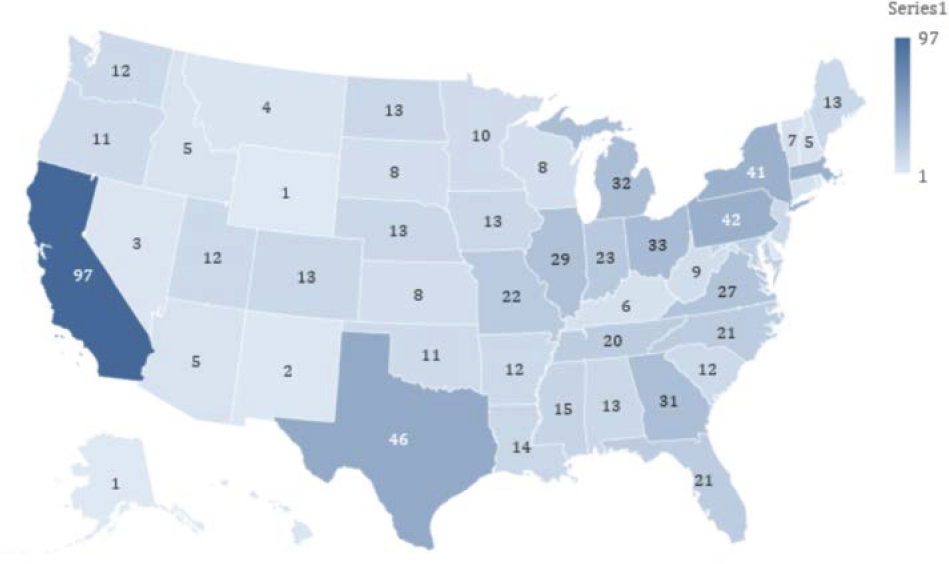
Number of universities per State of the USA.

The majority of universities are based on the private or public per State of the USA.
Results and Discussion
Policy implications from the G20 countries
Countries are concerned about the economic suffering and the loss of learning for the past months and urge immediate actions, including reopening schools (Table 1). France and South Korea reopened schools and had to close them again due to an increased number of COVID-19 cases. France planned to reopen schools on May 11th, with restrictions regarding classroom size and guidelines requiring face masks. 3 South Korea's Vice Education Minister, Park Baeg-beom, stated that students had to switch to remote learning. 24 Canada, Italy, Ireland, Turkey, Romania, Bulgaria, Finland, Malta, Czech Republic, and Spain plan to keep schools closed until September or later.25–27
Schools in Luxembourg reopened with precautions. The Minister of Education requested that everyone is provided with a kit of two masks made of fabric before classes began, and the use of masks was mandatory on the way to and from school. Vulnerable students and teachers were also advised to stay home. The learning materials of missed classes were to be made available via live or recordings. 28 The Netherlands planned to open in June with “installed plastic shields around students’ desks and disinfectant gel dispensers at the doorways”. 29
In Austria, schools announced that it would lift its lockdown on May 18th, with classes divided into two groups, each attending half the week to ensure their desks were far enough apart. Belgium, Portugal, and Greece released the school lockdown in May, following strict safety guidelines. 25 Germany also lifted its lockdown in May for senior students to take their final examinations. 30 Denmark reopened its schools and released restrictions on social distancing on April 15th due to the decline of new infections. 31 Sweden never followed school closure decisions but put distancing and sanitation rules in place. 25 Slovenian schools started to reopen on May 18th, gradually. In Slovakia and South Africa, it was announced that schools would reopen on June 1st. 32 Furthermore, in Lithuanian schools, students returned to classrooms for at least two weeks before the end of the academic year. 33 Correspondingly, schools in Hungary and Poland were permitted to reopen on June 2nd, but only for small groups and individual meetings. 34 Likewise, Estonia and Croatia reopened schools in May, and Croatia gave parents a choice as to whether or not to send their children to school. 1 Schools in Cyprus and Latvia will not be reopened, and remote teaching will continue until the risk of the coronavirus is low. Canada kept its closure and shifted to online teaching for the remaining school year, but some schools were expected to open in late May or June. Brazil and Indonesia had not decided against reopening their schools 35 but Mexico was expected to reopen schools from June 1st to July 17th. 36 In Argentina, the schools will be reopening in August, but only for two or three times a week with a “dual system” of face-toface instruction and online learning being put into place. 37 In Russia, the government announced an end of the 6-weeks national lockdown and reopened schools regardless of a record jump in coronavirus cases. 38 In India, the Minister of Education, divided schools into zones (i.e., green, orange, and red), based on a number of the COVID-19 cases existing within its cities, and declared that classes would start small in attendance to ensure social distancing.
In Saudi Arabia, the government decided to keep its schools closed for the remainder of the 2019–2020 school year, with virtual schools and distance education activated for all learners and examinations being conducted online. Saudi officials designed a new committee to ensure virtual online platforms’ success, making materials available and conducting daily evaluations to determine if, when, and how to reopen schools. 39 Countries like Canada, 40 Indonesia, 41 Italy,42,43 Japan, 44 South Africa, 45 England,46,47 and USA48–49 also shifted virtual learning. In China, students are expected to return in July for the entrance examinations under strict guidelines. China created an application for its health program, where students use color codes to signal their health status before entering class. Similarly, in Japan, Prime Minister Shinzo Abe encouraged reopening in early April for the new school year, but it was left to local municipalities to decide when to open by examining the number of coronavirus cases in the area. The Ministry of Health in Japan also declared strict school reopening guidelines. 44
Policy implications from the USA
In the United States of America (USA), from January 20th to 11:52 am CEST, June 15th, 2020, there have been 2,057,838 confirmed cases of COVID-19 with 115,112 deaths (Figures 3 and 4). The coronavirus cases mounting in the USA have impacted the higher education sector's policies on reopening. Figures 3 and 4 also show confirmed cases and deaths. With proposals from the White House and the USA Congress, the President announced the reopening of the economy and the workforce's activation by reopening school systems in the USA to permit parents to work and gradually elevate the. Many districts decided to close their schools until further notice despite political pressure to do otherwise. 50 Scholars stated that it is not safe to open schools in June due to the high infection rates. 51 This argument is further supported by the belief that citizen safety and health should be prioritized more than the country's economy.52–56

Daily confirmed cases in the USA.
Summary of G20 countries’ status of school re-opening (as of June 15th, 2020).

Several school leaders followed Trump's orders, but many, in some states, defied the order and required students to stay at home. 49 The Centers for Disease Control and Prevention (CDC) announced the reopening procedures for schools and childcare centers. Policies were put into place that mainly focused on educating administrators about safety, health training, social distancing, and cleaning procedures, including sterilization and airflow. 48 Teachers and parents are concerned about schools reopening for the first semester of the 2020– 2021 academic year and believe that it is not the right choice 49 with the argument that online education should continue until the virus is controlled. Scholars 53 stated that schools should design and restructure a fit and flexible curriculum to meet the hybrid or online model of instruction and allow for maintenance of social distance. They assert that face-to-face educational campuses and institutions include necessary laboratory, studio, and other hands-on activities requiring assembly. Therefore, administrators should assure safety and health measures including separate entrances and exits, distancing in desks or workspaces arrangements, eliminating physical education classes and school seminars, enhancing scheduled sanitation through passive air purification systems, and providing masks and hand sanitizers. 54 Online teaching and learning, on the other hand, need to provide equal educational opportunities, including special education services 55 and equal access to educational technology materials and facilities. However, neither money nor time is available to establish such an environment. Scholars 50 argued that if President Trump decided to reopen schools, he should persuade McConnell to support federal funds needed to restructure the school environment and ensure the safety of the U.S. and foreign residents. Based on the sample of 838 universities in the USA, it was found that a total of 552 (300 private and 252 public) universities are planning for in-person educational experiences, 87 universities are considering a range of scenarios, and 60 universities are planning for online learning only (Table 2). Interestingly, 73 universities in the sample are undecided (46 private and 27 public). Remarkably, the 60 universities that are planning for online teaching are all public institutions (Figures 5 and 6).
Conclusions
The COVID-19 outbreak is having a significant impact on the higher education reopening policy globally. Based on the documentary analysis of G20 countries, it has been determined that, except for India and Turkey, all countries have announced a reopening of schools. However, no clear guidelines have been provided by these governments. Also, universities within each country are following a different set of guidelines. In the U.K., the University of Cambridge announced that, until summer 2021, all classes would be virtual, while Aberdeen University plans to delay the start of term by two weeks to September 21st, the University of Edinburgh has adopted a hybrid teaching approach, and the University of Oxford has planned face-to-face teaching and research complemented by high-quality online activities, where necessary. Based on a sample of 838 universities in the USA, 66% of universities (552 of 838) are planning for in-person instruction, while only 7% are planning for a completely online teaching mode (Figure 7).
Reopening categories of universities in USA (n=838).


Daily confirmed deaths in the USA.

Reopening policy of public universities in the USA (n=404).

Reopening policy of private universities in the USA (n=434).

Comparison of the reopening policy of private and public universities (n=838).
One of the limitations of this study is the size of the sample of US universities. The sample includes only the universities that announced policies for reopening. Over 4000 higher education institutions in the USA enroll some 20 million students (40% are private, 39% are public, and 21% are for-profit). The majority of the private universities rely upon the tuition fees. Hence, this study's results indicate that none of the private universities are going for online teaching models in the fall 2020 semester. Also, the number of enrollments differs in this study's sample; for instance, a small liberal arts college such as Kenyon College has an enrollment of 1,700 and Ohio State University has 68,000 students currently enrolled, while for-profit behemoths, such as the University of Phoenix, have an enrollment of over 100,000 students.
It can be argued that in-person schools’ reopening will be valid with proper social distancing guidelines. Without appropriate protection and restraints, the risks of reopening might significantly increase the impact of COVID-19 on morbidity and mortality. Policymakers should consider and evaluate the current situations carefully. 18 Furthermore, learning and teaching approaches must be revised and restructured by instructors and policymakers to meet students’ diverse learning needs, including those who were and still are at risk of being left behind, and provide them with the support they desperately need.
Footnotes
The authors declare no potential conflict of interest.
Acknowledgments
The authors acknowledge the support from Prince Sultan University for publication fees (Article Processing Charge), Educational Research Lab (ERL), and Global Education Policy Network (GEPN).