






Abstract
Background
Modern contraceptive methods are considered more reliable for preventing and spacing pregnancy than traditional methods in sexual activity. The study aimed to analyze the association between recent sexual activity and the use of modern contraceptive methods among married/cohabiting women in Indonesia.
Design
The samples used were married/cohabiting women aged 15-49 years old. The sample size was 34,467 women. The variables analyzed included modern contraceptive use, recent sexual activity, age groups, marital status, education level, and wealth status. Analysis using multinomial logistic regression.
Results
It was found that women who were sexually not active last 4 weeks had the likely to use modern contraceptive non-LARC (long-acting reversible contraceptives) 0.416 times compared to women who were sexually active last 4 weeks. Women who were sexually active last 4 weeks were more likely to use modern contraceptive LARC 0.535 times than women who were sexually active last 4 weeks. The results of this analysis inform that women who are sexually active last 4 weeks have a higher possibility to use modern contraceptives, both non-LARC and LARC types.
Conclusions
Based on the results of the research analysis it could be concluded that recent sexual activity was associated with modern contraceptive use among married/cohabiting women in Indonesia.
Keywords
Significance for public health
We demonstrated the potential for the effects of sexual activity on the use of modern contraceptive methods among childbearing age women in Indonesia. We assume that sexual activity is one of the strong predictors of the use of modern contraceptive methods. In this article we analyze sexual activity variables multivariately together with several other variables that have the potential to influence the use of modern contraceptive methods.
Introduction
Issues related to the fulfillment of reproductive health rights are now a global priority. This is evidenced in the Sustainable Development Goals (SDGs) as a continuation of the Millennium Development Goals (MDGs) which target the fulfillment of reproductive health rights in the 3.7th goal. Besides, adequate reproductive health services are also targeted in the 5.6th SDGs goal. An important issue in efforts to fulfill reproductive health rights is the family planning program. 1 The National Population and Family Planning Board (BKKBN) considers that the development of family planning in Indonesia is still not encouraging. While there have been an increase in the contraceptive prevalence rate (CPR) and a decrease in the percentage of women with unmet need for family planning based on trend data from the Indonesian Demographic and Health Survey (IDHS), these indicators have not reached the target of the National Medium-Term Development Plan. 2
The use of contraception has been scientifically proven to provide health benefits, including preventing unplanned pregnancies, regulating birth spacing, reducing maternal and infant mortality, and improving the lives of women and children. 3 With contraception, couples who want to engage in sexual activity but do not want to get pregnant can do it restful. Including to prevent transmission of sexually transmitted diseases. 4 Nationally, women of childbearing age who use modern contraceptive methods according to the 2002/2003 IDHS until the 2017 IDHS tend to be stagnant in the range of 57-58%. On the other hand, the proportion of traditional contraceptive methods, such as interrupted intercourse, lactation amenorrhea, and the calculation of a fertile period, have increased albeit minimal. 5 Based on the 2002-2003 IDHS, women of childbearing age who use traditional contraceptive methods are around 4%, increasing to 5% in the 2017 IDHS. In the 2012 IDHS, there was a downward trend in traditional contraceptive use to 4%, but there has been an increase again to reach 6% in the 2017 IDHS. 2 The use of traditional contraception contributes quite significantly to the occurrence of unwanted pregnancy, especially in developing countries. 6 Statistics Indonesia (BPS) reports the use of traditional contraception contributes nearly 30% to the occurrence of cases of unwanted pregnancy. 7
The use of modern contraception methods is still considered low, around 57%, compared to other countries in Asia including South Korea (67%), Vietnam (69%), and Thailand as much as 70%. 8 The majority of the use of modern contraceptive methods in Indonesia is a type of short-term modern contraception namely pills (8.7%) and injections (20.9%). While the use of long-term contraceptive methods is still relatively low, namely 3.5% IUD, 3.4% implant, 0.1% tubectomy. 9 Data from the 2020 Performance Monitoring and Accountability (PMA) phase I also states that the percentage of modern contraceptive use is high at 97% in all methods, but the use of long-term contraception methods is still low at 23.5% and tends to be stagnant at PMA 2020 phase II at 23.8% of the national achievement target of 60%.10,11 The use of long-acting reversible contraception (LARC) is an effective way to prevent and adjust the distance between pregnancy when compared to using short-term contraceptive methods. 12 There are several factors related to the low coverage of long-term contraceptive use including high costs, side effects, still wanting to have children within 2 years, and the lack of partner support for using contraceptive methods. 13
The 2017 IDHS report states that 59% of women aged 15-49 had sexual intercourse within the 4 weeks preceding the survey and 12% were sexually active in the 12 months preceding the survey. Meanwhile, 1 in 5 (23%) women aged 15-49 admitted to never having sexual intercourse. 9 Based on the background description, the research problem was the association of recent sexual activity on modern contraceptive methods of use among childbearing age women in Indonesia. The study aimed to analyze the association between recent sexual activity and modern contraceptive methods of use among childbearing age women in Indonesia.
Design
Data source
The analysis in this study uses the 2017 Indonesian Demographic Data Survey (IDHS) as analysis material. The unit of analysis in this study was married/cohabiting women aged 15-49 years old. The sampling method uses stratification and multistage random sampling, so we get 34,467 respondents.
Data analysis
Recent sexual activity is the respondent's acknowledgment of the respondent's sexual activity in the past 4 weeks. Sexual activity is divided into 2 categories, namely active and not active in the last 4 weeks. Modern contraceptive methods use's are respondent recognition of contraception being used. The use of modern contraceptive methods is divided into 3 categories, namely not using, use of modern contraceptive methods of non-LARC types, and the use of modern contraceptive methods of LARC types. Modern contraceptive types that enter non-LARC types are pill, diaphragm, female condom, foam/jelly, injection 1 month, and specific method. 2 Modern contraceptive types that enter LARC are IUD, female sterilization, and implant/norplant.
Recent sexual activity was sexual activity in the last 4 weeks. Recent sexual activity was divided into 2 categories, namely not active and active. Besides recent sexual activity, other independent variables included in the analysis were age group, marital status, education level, and wealth status. Age was the last birthday that has passed. The age group was divided into 7 categories, namely 15-19, 20-24, 25-29, 30-34, 35-39, 40-44, and 45-49. The marital status was divided into 2 categories, namely married and cohabiting. The education level was divided into 4 categories, namely no education, primary, secondary, and higher.
The wealth status was based on a wealth quintile by a household. Households were scored based on the numbers and types of items they had, from televisions to bicycles or cars, and housing characteristics, such as drinking water sources, toilet facilities, and main building materials for the floor of the house. This score was calculated using principal component analysis. National wealth quintiles were arranged based on household scores for each person in the household and then divided by the distribution into the same five categories, with each accounting for 20% of the population.
In the first stage, Chi-Square is used to see the relationship between sexual activity and modern contraceptive use and other related variables. In the final stage, multinomial logistic regression was used to analyze the association between the recent sexual activity and the modern contraceptive use. All statistical analyzes were carried out using SPSS 22 software.
Ethical statement
Ethical approval from the National Ethics Commission at the Ministry of Health was obtained by the 2017 IDHS. The respondents’ identities have all been deleted from the dataset. Respondents have provided written approval for their involvement in the study. The author has obtained the data utilization permission from the 2017 IDHS data from ICF International through its website: https://dhsprogram.com/data/new-user-registration.cfm.
Results
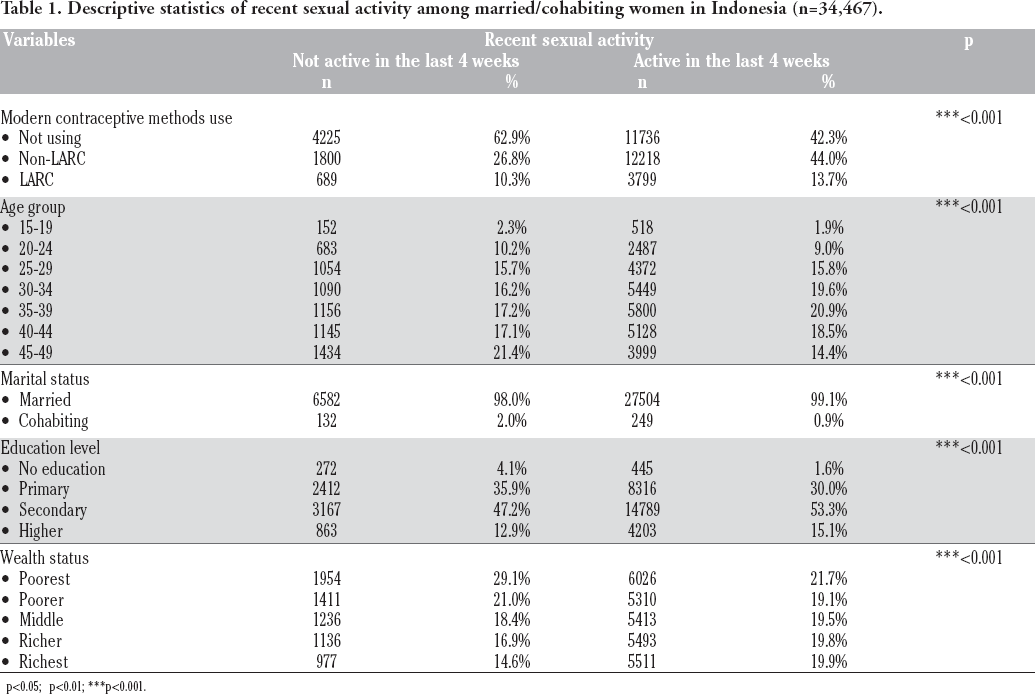
Table 1 displays descriptive statistics of recent sexual activity among married/cohabiting women in Indonesia. It shows that women who are sexually active in the last 4 weeks are dominated by women who use modern contraceptive methods non-LARC types. Women who were sexually active in the last 4 weeks were dominated by the 35-39 age group, and married women. There more sexually active women in the older age groups compared to the younger age groups, especially the 15-19 age group. Table 1 shows that based on education level, women who were active in the last 4 weeks of sexual activity were dominated by women with secondary education. While based on wealth status, women who have been active in sexual activities for the past 4 weeks have been dominated by the poorest women.
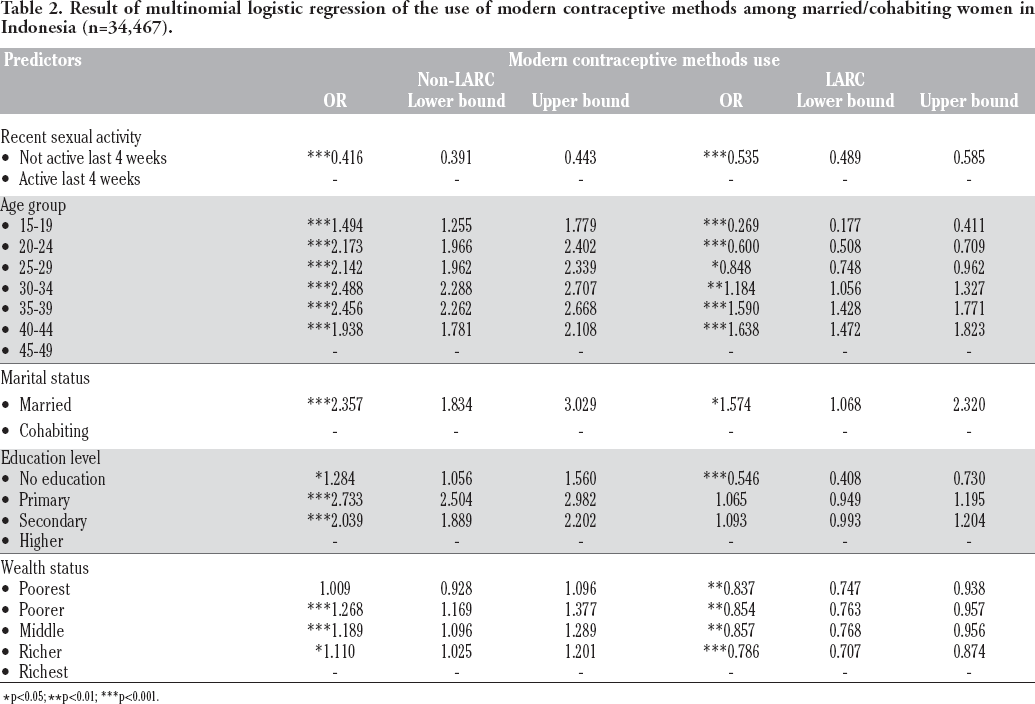
Table 2 displays the results of the multinomial logistic regression of the use of modern contraceptive methods among married/cohabiting women in Indonesia. It shows that women who were sexually not active last 4 weeks had the likely to use modern non-LARC contraceptive methods 0.416 times compared to women who were sexually active last 4 weeks (OR 0.416; 95% 0.391-0.443). Women who were sexually not active last 4 weeks had the likely to use modern contraceptive methods LARC type 0.535 times compared to women who were sexually active last 4 weeks (OR 0.535; 95% CI 0.489-0.585). The analysis results inform that women who are sexually active last 4 weeks have a higher chance of using modern contraceptive methods, both non- LARC and LARC types.
Apart from recent sexual activity, 4 other variables were also shown to be associated with modern contraceptive methods use. First, the age group. Table 2 informs that women in the 15-19 age group have the likely to use modern contraceptive methods of non- LARC 1.494 times compared to women in the 45-49 age group (OR 1.494; 95% CI 1.255-1.779). Women in the 15-19 age group have the likely to use modern contraceptive methods of LARC 0.269 times compared to women in the 45-49 age group (OR 0.269; 95% CI 0.177-0.411). Women with 25-29 age groups have the likely to use modern contraceptive methods of non-LARC 2.142 times compared to women with 45-49 age group (OR 2.142; 95% CI 1.962-2.339). Women with the 25-29 age group have the likely to use modern contraceptive methods of the LARC type 0.848 times compared to women with the 45-49 age group (OR 0.848; 95% CI 0.748-0.962). Women in the 40-44 age group had the likely to use modern contraceptive methods of non-LARC 1.938 times compared to women in the 45-49 age group (OR 1.938; 95% CI 1.781-2.108). Women with the 40-44 age group have the likely to use modern contraceptive methods of the LARC type 1.638 times compared to women with the 45-49 age group (OR 1.638; 95% CI 1.472-1.823). Therefore, the results of the analysis inform that the age group is proven to be associated with the use of modern contraceptive methods, both non-LARC and LARC.
Second, marital status. Married women have the likely to use modern contraceptive methods of non-LARC type 2.357 times compared to cohabiting women (OR 2.357; 95% 1.834-3.029). Married women have the likely to use modern contraceptive methods of LARC type 1.574 times compared to cohabiting women (OR 1.574; 95% CI 1.068-2.320). Therefore, the analysis results inform that married women are far more likely than cohabiting women to use modern contraceptive methods, both non-LARC and LARC types.
Third, education level. No education women have the likely to use modern contraceptive methods of non-LARC type 1.284 times compared to women with higher education (OR 1.284; 95% CI 1.056-1.560). No education women have the likely to use modern contraceptive methods of LARC type 0.546 times compared to women with higher education (OR 0.546; 95% CI 0.408-0.730). Women with primary education have the likely to use modern contraceptive methods of non-LARC type 2.733 times compared to women with higher education (OR 2.733; 95% CI 2.504-2.982). Women with secondary education have the likely to use modern contraceptive methods of non-LARC type 2.039 times compared to women with higher education (OR 2.039; 95% CI 1.889-2.202). The results of this analysis indicate that the education level is proven to be associated with the use of modern contraceptive methods, both non-LARC and LARC.
Fourth, wealth status. The poorest women have the likely to use modern contraceptive methods of LARC type 0.837 times compared to the richest women (OR 0.837; 95% CI 0.747-0.938). Women with wealth status in poorer category have the likely to use modern contraceptive methods of non-LARC type 1.268 times compared to the richest women (OR 1.268; 95% CI 1.169-1.377). Women with wealth status in poorer category have the likely to use modern contraceptive methods of LARC type 0.854 times compared to the richest women (OR 0.854; 95% CI 0.763-0.957). Women with wealth status in middle category have the likely to use modern contraceptive methods of non-LARC type 1.189 times compared to the richest women (OR 1.189; 95% CI 1.096-1.289). Women with wealth status in middle category have the likely to use modern contraceptive methods of LARC type 0.857 times compared to the richest women (OR 0.857; 95% CI 0.768-0.956). Women with wealth status in richer category have the likely to use modern contraceptive methods of non-LARC type 1.110 times compared to the richest women (OR 1.110; 95% CI 1.025-1.201). Women with wealth status in richer category have the likely to use modern contraceptive methods of LARC type 0.786 times compared to the richest women (OR 0.786; 95% CI 0.707-0.874). These results inform that wealth status is proven to be associated with the use of modern contraceptive methods, both non-LARC and LARC.
Descriptive statistics of recent sexual activity among married/cohabiting women in Indonesia (n=34,467).
p<0.05; p<0.01
p<0.001.
Discussion
Overall, the results found that women who were sexually active last 4 weeks were more likely to use a modern contraceptive, both non-LARC and LARC types. This information shows the high demand for sexually active women. This finding also indicates the successful dissemination of knowledge about the benefits of using modern contraceptive methods. The findings in this study confirm previous research analyzing sexual activity trends and the use of modern contraceptive methods in 74 countries. 14
The study results inform the age groups is proven to be a determinant of modern contraceptive methods use, both non-LARC and LARC. This condition is likely because the older someone is, the more likely they already have the desired number of children, so they decided to close the possibility of having more children. Information on research results that found age as a determinant of contraceptive use was also reported in studies in Sub-Saharan Africa, Zambia, and Ethiopia.15,16 The results of the study inform that married women are far more likely than cohabiting women to use modern contraceptive methods, both non-LARC and LARC types. As an eastern country, women in Indonesia are still bound by eastern customs, which considers that sexual activity is closely related to the institution of marriage. 17 So it can be understood if the use of modern contraceptives is higher in married women. This finding confirms the results of previous studies with the same theme in Thailand. 18 Information from the study shows that the education level is proven to be a determinant of modern contraceptive methods use, both non-LARC and LARC. A better level of education will provide a better understanding of the benefits of modern contraceptive methods, including an understanding of other health-related behaviors.20-22 A low level of education is a barrier in almost all types of health services. 23 Consistent findings were also informed in the findings of previous studies in Bangladesh, the United States, and Nigeria. 24
The results of the analysis information that the better the wealth status, the higher the possibility to use modern contraceptive methods of the LARC type. Wealth status is often found together with the level of education, giving a positive influence on each activity or health program achievements.25,26 Moreover, information on these findings confirms the results of previous studies that inform the contribution of wealth status to the use of modern contraceptive methods. 27
Finally, the main key to accelerating the use of modern contraceptive methods is practical education. Practical education that focuses on the benefits of modern contraceptive services. This focus is needed to help clear misconceptions and negative thoughts about modern contraception. 28
Study limitation
This study was conducted with a quantitative approach. The results of the analysis can only capture the phenomenon on the surface. The study results could not capture the phenomenon of local values which still strongly influence sexual activity. A further study with a qualitative approach is needed in order to dig deeper into the background to the sexual activity undertaken.
Result of multinomial logistic regression of the use of modern contraceptive methods among married/cohabiting women in Indonesia (n=34,467).
p<0.05
p<0.01
p<0.001.
Conclusions
Based on the results of the research analysis it could be concluded that recent sexual activity was associated with modern contraceptive use among married/cohabiting women in Indonesia. Women with sexually active in the last 4 weeks were more likely to use a modern contraceptive, both non-LARC and LARC types.
Footnotes
Acknowledgements
The author would like to thank the Inner City Fund for allowing the use of the 2017 IDHS.