






Abstract
Background
Stigma is one of the main factors causing
Design and methods
Quasi-experimental research with pretest and post-test analysis consists of 82 people with schizophrenia who go through
Results
There was a significant difference in the average stigma score in the control group (moderate category stigma) and the intervention group (mild category stigma) after multilevel stigma intervention (p-value = 0.04). The average stigma score of schizophrenia patients in the intervention group decreased by 8.2%, while the average stigma score in the control group increase of 20.4%.
Conclusions
Multilevel stigma interventions are effective in reducing stigma in people with schizophrenia who go through
Significance for public health
Introduction
“Keep him bound, he will never be healed, will definitely go on a rampage. I am calmer if I can still see him. I'm embarrassed if he goes berserk to be seen by many people”
The previous quote is a family expression of patients with schizophrenia who experience
Schizophrenia is a chronic mental disorder that attacks 20 million people worldwide.
4
Based on Riset Kesehatan Dasar (Basic Health Research) results,
5
the prevalence of schizophrenia in Indonesia reaches 7 per 1000 households where 14% of the schizophrenia has experienced
In almost every community, especially in developing countries, schizophrenia is closely related to stigmatization. Stigma is the negative labeling on a group of people that refers to the exclusion of individuals by community members. Stigma consists of two main factors, namely negative attitudes, and discrimination. In addition, stigma is then divided into three levels, namely public (
Stigma is related to the process of treating patients with schizophrenia. Stigma causes devastating consequences in patients with mental disorders, causing patients to lose self-esteem, leading factors to adverse mental health outcomes, delays treatment-seeking, and reduces the likelihood that a mentally ill patient receives adequate care.10,11 Family support is one of the factors that play a role in increasing self-esteem in patients with schizophrenia. Patients with schizophrenia who experience stigma lose the opportunity to work and lose the opportunity to live independently and safely. So it is important to reduce and eliminate the stigma that appears in the community.12-15 One intervention that can reduce stigma in society is by providing multilevel stigma interventions.
Stigma is a multilevel global phenomenon that requires an intervention approach targeting various levels, such as the individual, interpersonal, community, and structural levels. The provision of multilevel stigma interventions is expected to increase efforts to reduce stigma in the community because it can be more reaching out and more holistic than a single intervention. 16,17 Therefore, this study aims to identify multilevel stigma interventions in people with schizophrenia who go through
Design and Methods
This study uses a quasi-experimental design with a pretest and post-test with control group. This study's population was patients with schizophrenia who go through pasung that live in three districts in East Java Province, consisting of 150 respondents. The inclusion criteria are i) at least one month's retirement, ii) mature or at least 20 years old, iii) able to communicate well using Indonesian or Javanese. The exclusion criteria in this study were patients who experienced mental retardation. The sampling used in this study is the cluster random sampling. The sample size who met the inclusion and exclusion criteria was 82 people divided into two, 41 respondents for each control and intervention group. In addition to providing interventions for patients with schizophrenia who go through
This research was conducted in January until August 2019, and was carried out by applying multilevel stigma interventions in the intervention group of patients with schizophrenia and the target group (family, community leaders, health cadres, and health workers). Meanwhile, the control group was given standard intervention in the form of health education related to mental health, pasung, and stigma. Data analysis was performed using SPSS 16 for windows. The descriptive analysis includes the frequency distribution for demographic data in the target group. Independent
This study was approved by the Health Research Ethics Commission of the Faculty of Nursing, University of Indonesia (No.26 / UN2.F12.D / HKP.02.04 / 2018). Respondents were given detailed information about this study, then asked to sign the consent form. If the respondent is unable to make informed consent, a detailed explanation and consent form is given to the main caregiver (family) who is caring for the respondent. Respondents’ participation is voluntary, and the confidentiality of participant information is guaranteed. After the study was completed, the control group was given the same multilevel stigma intervention program.
Multilevel stigma intervention
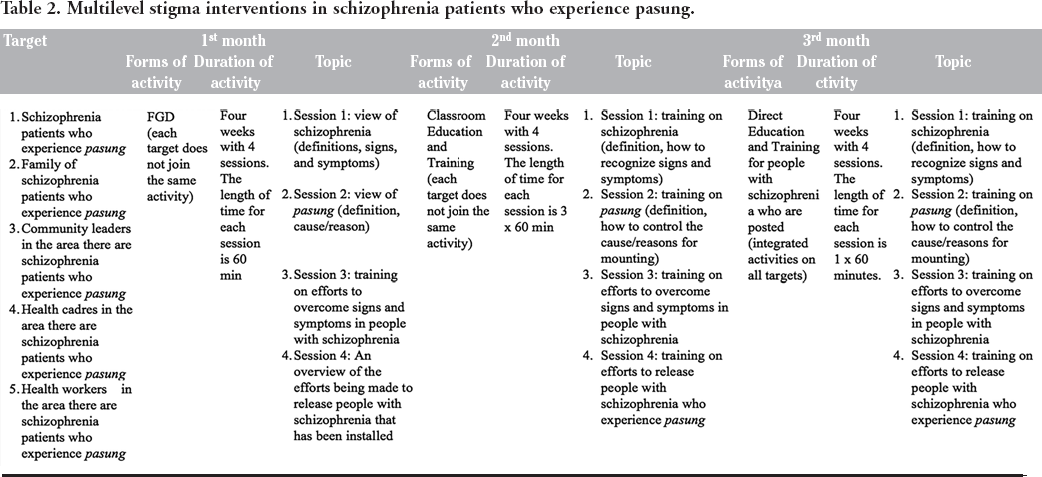
Multilevel stigma interventions are interventions with multilevel approaches covering three systems, namely intrapersonal, interpersonal, and structural levels. The intrapersonal level describes the provision of interventions directed at individuals to improve strategies in dealing with people who are included in the group stigmatized or change the attitudes and behavior of people who are not stigmatized. The intrapersonal level describes interventions directed at small groups. Meanwhile, the structural level describes interventions directed at the socio-political environment, such as law and policy.
18
Multilevel stigma intervention is an increase in awareness of stigma and all elements involved in releasing
Results
Descriptive analysis results on 82 participants showed that most of the participants were female (52.4%), aged 31-40 years 46.3%), junior high school education (32.9%), and not working (63.4%). The age characteristics of most participants in the intervention group (46.4%), and the control group (46.4%) were 30-40 years old. Participants in the intervention group had the characteristics of mostly female (53.6%), junior high school education (34.1%), and not working (63.4%). Meanwhile, in the control group, most of the participants were female (51.2%), junior high school education (31.7%), and not working (63.4%). More complete characteristics of schizophrenia patients can be seen in Table 3. Subsequent analysis was carried out to see the difference in average stigma scores in schizophrenia patients categorized as mild stigma with a score of 16-32, moderate stigma with a score of 33-48, and severe stigma with a score of 49-64. Results analysis of the difference in the average stigma score after giving the intervention showed that the average stigma score in the control group was 34.2195 (SD=4.37, 95% CI = 0.0893-4.569) (moderate category stigma) with a minimum value of 27 and a maximum value of 44. While in the intervention group, the average stigma score was 31.487 (SD = 3.98, 95% CI = 0.893-4.570) (mild category stigma) with a minimum value of 23 and a maximum value of 40. The results of the independent
Distribution of sampling.

The paired
The results of this study also showed that there were significant differences between before and after the implementation of multilevel stigma interventions in families (p=0.000), community leaders (p=0.000), health cadres (p=0.000), and health workers (p=0.000). The results of statistical tests on families and community leaders indicated an increase in scores of 46.390 and 37.660, respectively, which means there was a significant decrease in stigma. All respondents had an increase in scores between before and after the intervention for health cadres and health workers. The results of a more complete paired
Multilevel stigma interventions in schizophrenia patients who experience pasung.
Characteristics of schizophrenia patients who experience

Discussion
The results of this study indicate that before the intervention, the average score in the intervention group was in the moderate stigma category. It showed that the stigma in patients with schizophrenia who go through
The current study results indicate that there is a significant change in stigma scores between before and after the implementation of multilevel stigma interventions in schizophrenia patients who were placed in the intervention group and the control group. The intervention group's average stigma score decreased by 8.2%, while the average stigma in the control group increased by 20.4%. Although both were significant, the intervention group experienced a decrease in stigma scores, while the control group experienced increased stigma scores. So it can be concluded that the provision of multilevel stigma interventions effectively reduces stigma scores in schizophrenia patients who experience
The results of this study are in line with the research of Cook
Analysis of average stigma scores after getting multilevel stigma interventions in the control and intervention groups.

Differences in stigma score before and after getting interventions (paired

Differences in stigma score before and after getting interventions (Wilcoxon test).

Discriminatory, labeling, and stereotyping can be prevented by providing the correct information about mental health. 22 Research shows that better knowledge about mental health that is owned is associated with low public stigma in people with mental disorders. 23 Low mental health literacy has an impact on oneself and others, for example, not being ready to decide exactly what to do when feeling symptoms related to mental health problems and resistance to interacting with mental health patients. Individuals who have learned about mental health knowledge tend to have positive attitudes toward people with mental disorders. 24
Stigmatization is a negative and chronic interaction between the environment often faced by most people with schizophrenia. Public stigma, self-stigma, and avoidance labels are various types of stigma, each of which has a detrimental impact on patients with schizophrenia.
25
Community empowerment and public empathy are social capital able to reduce stigma in patients with schizophrenia.
26
Family and community resilience needs to be built so that the stigma against patients with schizophrenia must be eliminated.
27
Thus the stigma can be controlled and does not cause a wrong understanding related to mental health. Decreasing stigma can reduce people's attitudes towards
Conclusion
Social, interpersonal stigma and discrimination in patients with schizophrenia contribute to health disparities. Multilevel stigma interventions have been shown to reduce stigma in patients with schizophrenia who go through
Footnotes
Acknowledgments
We would say thank you to the many people in our countries who contributed to this research.