






Abstract
Background
Individuals tend to develop metabolic disorders and other chronic diseases, due to the poor conduction of physical activities. Meanwhile, a high level of physical activity positively affects the quality of life. However, irrespective of the numerous studies reported on the correlation between age, weight, and physical activity, there is limited study on the differences of physical activities in the geriatric and adult groups of obese and non-obese people. This study, therefore, aims to investigate the effect of age and weight on physical activity in geriatric and adult groups.
Design and methods
The purposive sampling technique was used to obtain data from 154 respondents from community-integrated health care in Surabaya, East Java, Indonesia. These respondents were equally divided into two groups of adult (21-60 years) and geriatric (>60 years) groups.
Results
The Chi-Square test showed that there were no significant differences between physical activity in the obese and nonobese people of the geriatric groups (p>0.05). Conversely, in the adult group, there were significant differences between physical activities and the age of obese and non-obese groups (P<0.05).
Conclusions
In conclusion, age affects physical activity in adult and geriatric groups.
Keywords
Significance for public health
Introduction
Physical activity gradually declines with age as people lose their muscle mass and strength. During the aging process, physical activity decreases by 40%-80%, thereby increasing the likelihood of individuals developing metabolic disorders and other chronic diseases, such as cancer, diabetes, cerebrovascular and cardiovascular diseases. Studies showed that an increase in physical activity tends to lower the risk of having cognitive disorders and improves the overall well-being of the human body.1-3 High level of physical activity is proven to have positive effects on the physical, social, emotional, and healthcare qualities of life.4,5
Age and weight are considered as two factors that influence physical activity. According to research, this activity tends to remain stable in middle age and reduces at old age. Studies demonstrated that moderate physical activity decreased in the elderly, although they still manage to carry out leisure and recreational activities during retirement. Age-related changes were associated with biological, psychological, and social aspects of human life. For instance, the older adults, are bound to suffer from chronic diseases, cognitive impairment, poor social interaction and obesity due to poor physical activities.6,7
A previous study found that high Body Mass Index (BMI) and low physical activity were related to the incidence of cardiac failure. Pandey
Obesity is not merely defined as an excessive gain in body weight against height, and it is also related to excessive adiposity, leading to metabolic consequences. It increases the risks of chronic diseases, such as diabetes, cardiovascular diseases, and cancer. This excess of body fat leads to disability and depression, as people have to face several health issues resulting from high BMI and low physical activity. In addition to this, economic and healthcare costs increase significantly, along with pressures from family members. Therefore, there is an increase in economic costs, a decrease in productivity and a greater psychosocial risk on obese people.12-15
Physical activity has been linked to various health benefits. Previous studies have shown that it was inversely correlated with metabolic and inflammatory biomarkers. Incorporating physical activity into the daily routine activities moderately or vigorously, such as going upstairs, walking, doing household chores, or cleaning up the yard, helps to keep the body fit and healthy. Structured activities, on the other hand, are carried out by walking or running on a treadmill, lifting weights, and other cardiac training programs. The amount of energy expenditure in moderate and vigorous physical activities is expected to be 3 – 5.9 and above 6 METs (Metabolic Equivalent Tasks), respectively. Higher physical activity contributed to a decrease in the occurrence of metabolic diseases.16-18
Despite the numerous studies analysing the correlation between age, weight, and physical activity, there is limited information on differences in physical activity levels in obese/nonobese geriatric and adults. This study, therefore, aims to investigate the effect of age and weight on the physical activity level in the geriatric and adult group.
Design and methods
This research utilized a case-control study design to investigate the effect of age and weight on physical activity in adults and the geriatric group. A purposive sampling technique was used to obtain data from 154 respondents from community-integrated health care in Surabaya, East Java, Indonesia. These respondents were equally divided into two groups: adults (21-60 years) and geriatric (>60 years). Those suffering from cardiovascular, cerebrovascular, respiration, and liver diseases were excluded. The Body Mass Index (BMI) and the International Physical Activity Questionnaire (IPAQ) were also used to assess the healthy weight of obese and non-obese respondents. This study has been approved by the ethics committee of Universitas Surabaya, and the data were processed and analysed by using SPSS 22. In addition, the Chi-Square tests were also used to analyze the effect of age and weight on physical activity.
Results and Discussion
Table 1 shows the demographic characteristics of respondents according to age, sex, and BMI. It shows that in the adult age group, obesity values were the same regardless of gender. Almost three-quarters of women had the highest percentage of non-obesity (72.7%) compared to men, however, as they aged, their chances of being obsessed increased (84.4%). The rate of geriatric obesity, also known as type 1, is 80% compared to type 2 at 27.3%.
Demographic characteristics of respondents.

Studies showed that more than 60% of middle-aged women in low socio-economic status were obese or overweighed. This condition was influenced by factors such as employment status, high blood pressure, arthritis, and other issues related to activities of bending, moving at a regular pace, sitting, and getting up from chairs. A multi-sector partnership program was recommended to achieve better results in obesity treatment in low-income areas. In addition, health care professionals also need to recognize that psychosocial and other nutritional problems affected obesity in the elderly.19,20 Therefore, a low-budget physical activity is essential for people to carry out the adequate exercise with maximum benefits. 21 A number of different measurement methods need to be applied to measure the relationship between physical activity and quality of life. According to previous studies, physical activity needs to be objectively measured using an accelerometer. In addition, subjective measurement needs to be conducted by asking questions on the different types of daily physical activities. 6 This study used the International Physical Activity Questionnaire (IPAQ) as a valid and reliable instrument to measure the physical activity of adult and geriatric respondents.
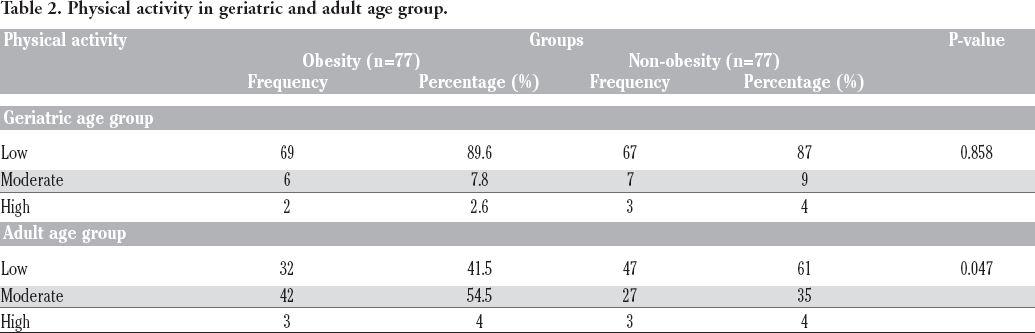
Table 2 showed that obese adults have moderate (54.5%) to low (41.5%) physical activity level, with the lowest at 61%, found in non-obese adults. On the other hand, both geriatric obese and non-obese group tends to have poor physical activity level. Chi- Square test results show that there are no significant differences between the physical activity level of geriatric obese and nonobese groups (p>0.05). Conversely, in the adult group, it is found that there are significant differences between the physical activity level of obese and non-obese groups.
Physical activity in geriatric and adult age group.
Insignificant results of physical activity indicate other confounding factors, such as dietary habits, psychosocial issues, and physical weakness. 22 Weight loss therapy targeting obesity in geriatrics has been considered controversial because it leads to a loss in lean muscle mass of 25%. Additionally, bone mineral density tends to decrease as weight loss occurs, 23 and geriatrics suffering from obesity experienced metabolic and functional problems. 24
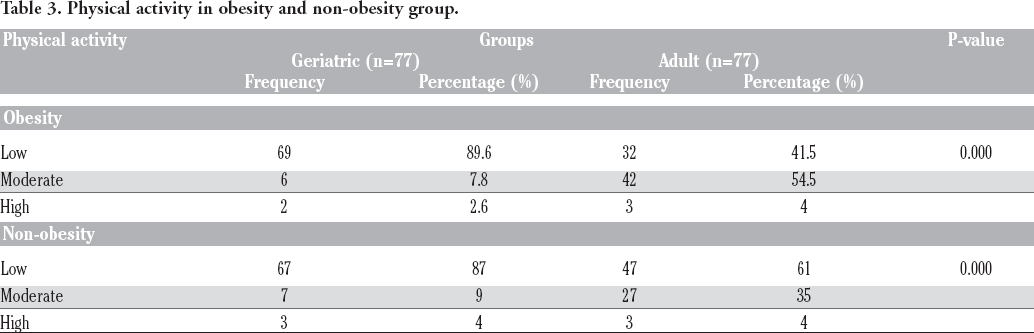
Table 3 shows the differences between physical activity levels in the adult and geriatric group, with significant differences in the obese and non-obese groups at P<0.05. Physical activity is a nonpharmacological treatment available to most people, and it plays an essential role in preventing various metabolic diseases in overweight and obese adults. 25 A clinically significant weight loss (≥ 5% of initial weight) has been identified as predictors of metabolic disorders such as metabolic syndrome, insulin resistance, type-2 diabetes mellitus (T2DM), dyslipidemia, hypertension, lung diseases, cardiovascular diseases, and inflammation.26-28
Physical activity in obesity and non-obesity group.
Conclusions
In conclusion, age affects physical activity in adult and geriatric groups, but only obese adults have shown these changes.
Footnotes
Acknowledgements
The author are grateful to Faculty of Medicine, Universitas Surabaya, Surabaya for their kind support