






Abstract
Background
People with severe mental illness have the ability to live a satisfactory and independent life with the help of the community. Their adaptation to life's challenges is a dynamic process, and the community plays an important role. This research, therefore, aims to address the question of how social capital, demographic factors, and coping strategies affect the community's ability to adapt to people with severe mental illness.
Design and methods
The multi-stage random sampling was used to obtain data from 137 respondents from rural society using an analytic observational design and cross-sectional approach. In addition, the Somers’ D test was used to measure the effect of social capital, demographic factors, and coping strategies on community adaptation.
Results
The results showed a significant effect of social capital, demographic factors, and the coping strategy of community adaptation (P<0.05). Based on empirical research, access to social capital is critical in fostering community adaptation through its social participation, network, trust, coping strategies, and cooperation.
Conclusions
In conclusion, social capital, demographic factors, and coping strategies are significant factors in developing community adaptation of people with severe mental illness.
Significance for public health
Introduction
Severe mental illness is often defined as a disorder that affects a person's way of thinking, feeling, and behaviour. Its symptoms include distortions of perception, delusions, hallucinations, and various types of disorders. People with severe mental illness (PSMI) have difficulties in carrying out daily tasks, therefore they tend to avoid social interaction. A supportive community is vital for the mentally ill as it provides a caring and supportive system capable of improving their quality of life. The goal of every community is to ensure PSMI live an independent life by assisting them in dealing with the consequences of mental illness. A greater number of PSMI are characterized by low-levels of psychotic symptoms and less likely to be diagnosed with other serious physical conditions. Therefore, it is essential to address any co-occurring conditions in their recovery process. 1
According to previous studies, a strong sense of community provides opportunities for PSMI to learn new skills, thereby encouraging independent life style. Community participation typically affects mental health, social functioning, and overall wellbeing. However, a strong sense of belonging and social commitment helps to build security, trust, feeling valued, and acceptance. People create new relationships through hobbies or social groups, managing the mental illness.2,3 In addition, when the community provides assistance to PSMI, their mental state of health improves, and this helps to reduce the amount of hospital readmission cases.4,5
Most communities adapt and respond to changing circumstances and environments by creating positive impacts on individuals’ with mental health through the development of resilience, improving their capacities, and reducing their vulnerability. However, this adaptation process needs to be established with local policies, plans, and programs for proper mental health development. The following indicators are related to the success of community adaptations: (1) establishment of acceptable mental health programs for supporting PSMI, (2) development of health care centers, and, (3) creation of supportive employment programs and ongoing education policies.6,7
Some of the factors related to community adaptation processes are social capital, demographic factors, and coping strategies. Social capital refers to the connecting factors among individuals, such as norms, network, trust, and livelihoods. It is also defined as the relationship between community resources and mental health.8-10 Most studies show that social capital has the ability to improves both physical and mental health through interaction, active relationship between members by motivating each other when dealing with daily stress. Approximately 60% of their wellbeing was positively affected by social and human capital.11-13
According to research, demographic factors also have a significant impact on the social, economic status, and coping strategies of the adaptation process. However, a cross-sector partnership is needed to ensure greater collaboration between the public and private health sectors in order to increase social resources. Previous studies showed that migration and social changes had negative effects on the mental health issues of parents with an adverse impact on other family members.14,15
Over the years, little attention has been paid to community adaptation in supporting the recovery of a patient with mental illness. The ability of communities to understand the stress associated with PSMI enables them to tackle the constraints. This research, therefore, aims to answer the question associated with the social capital, demographic factors, and coping strategies of communities in coping with mental ill people.
Design and methods
Data were obtained from a total of 137 society members randomly selected from a rural community in Malang, East Java, Indonesia, by using observational and cross-sectional approaches. Furthermore, confounding variables were controlled by applying inclusion criteria on adults ≥20 years that interacted with PSMI at least 1 hour/week and living in the area for the last 6 months. The exclusion criteria consist of respondents unable to participate in the study and those that refused to give their consent.
The first stage of the selection process utilized the cluster sampling process to select each member from the five rural communities. Respondents were provided with adequate information on the study objectives, procedures, with their right to participate or withdraw from the study at any time. In addition, questionnaires were tested for validity and reliability before being distributed to the respondents. Finally, the Somers’ D test was used to measure the effect of social capital, demographic factors, and coping strategies on community adaptation.
Results and discussion
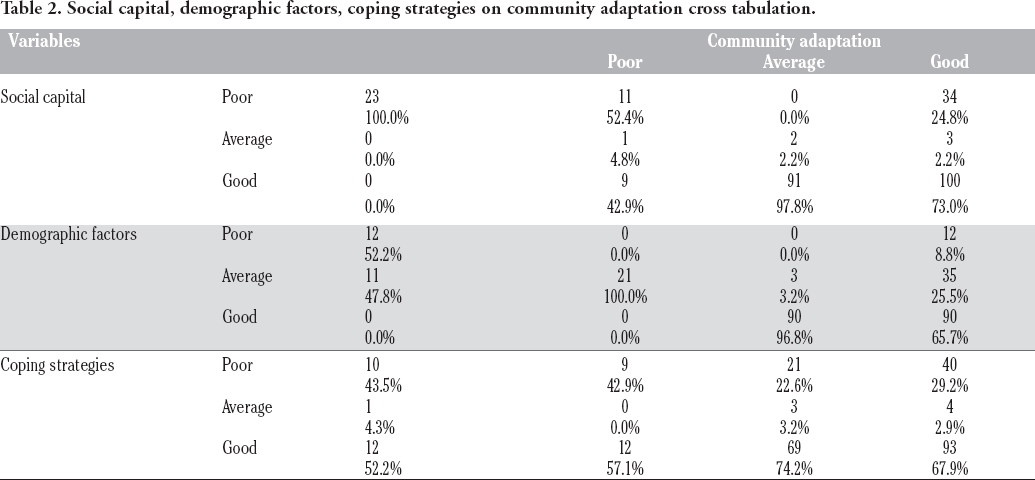
The results of the study were used to identify factors related to community adaptation, namely social capital, demographics, and coping strategies. Tables 1 and 2 show the means/standard deviation of each variable and the cross-tabulation analysis of the three factors related to community adaptation. Somers’ D test result was used to analyze the association between variables, as shown in Table 3.
Means and standard deviation of variables, N=137.

Social capital, demographic factors, coping strategies on community adaptation cross tabulation.
Somers’ D results.

Based on Table 1, social capital and coping strategies had the highest mean score of 33.01 (SD=15.47) and 32.81 (SD=15.25), respectively. The social capital of the community contains networks, residents’ participation in community events, trust and safety, religious activities, adequate training/education, and caring neighbours. It also provides innovative ideas that influence social interactions, cohesion, and community actions for improving health and wellbeing.16-18 The demographic factors include respondents’ education, occupation, and income per month. This study found that 30% of respondents were left behind at home as their partners working abroad. Furthermore, the migrants and their family members left behind were at higher risk of experiencing severe mental illness (aHR: 1.00, 95% CI 0.93–1.08).14,15
Community support mediates the stigma associated with mental illness, and this makes PSMI to feel emotionally safe and protected (90% CI = 0.093 to 0.125). Mental health services need to be integrated with local community programs, stakeholders, and local government.19-21 A wide range of community coping strategies used to help the healing process include self-introspection, expressed feelings, improved spiritual well-being, and volunteers. Community adaptations are related to local resources and mental illness. Therefore, they need to possess the ability to cope with PSMI and determine social changes related to members.21-23
Table 2 shows the correlation between social capital, demographic factors, coping strategies, and community adaptation. Findings showed that these factors influence the way the community adapts to PSMI lives.
This research showed a significant correlation between social capital, demographic factors and coping strategies on community adaptation (P<0.05). Based on empirical research, access to social capital is critical in fostering community adaptation through participation, network, trust, and cooperation. Community adaptation is a complex process that involves the characteristics of individuals in a population and its environment. A number of factors have been identified as parameters of community adaptation, such as demographic aspects, availability of resources, facilities, political aspects, social norms, cognitive and emotional responses. Demographic factors are significant in the lives of PSMI. Each member of the society has considerable experience in coping with challenging tasks, with age used to reflect knowledge and experience. In addition, these factors are used to create health policy options that allow for the recognition and representation of community members and stakeholders to support PSMI with an opportunity for them to participate in social activities.24-26
The role of community adaptation in supporting PSMI is yet to be determined, therefore, a growing number of such individuals has the ability to affect the responses of individuals and societies. Studies showed the strategies used to develop community adaptation by examining competence and resources to improve action towards the problems. Community support tends to improve resilience through social skills development, interaction, and interpersonal relationships between members, thereby preventing psychological trauma. Community support is imperative to maintain mental health and wellbeing.27,28
Studies have also shown that living close to a person suffering from mental illness is a challenging situation. People tend to experience fear, a sense of guilt, anxiety, panic, and sadness. According to ongoing medical treatment, there are three strategies used to improve community adaptation to helping PSMI seek health services and providing adequate emotional support. These include general inequity, standards and values, discrimination, and local economic opportunities. Community adaptation helps individuals, families, caregivers, and other residents to support PSMI. However, this adaptation process takes time. Therefore, it needs to align with the local health center program and government to achieve greater success.29-31
Conclusions
In conclusion, social capital, demographic factors, and coping strategies are significant factors in the development of community adaptation of PSMI.
Footnotes
Acknowledgments
The author thanks to Faculty of Public Health, Universitas Airlangga for their tremendous support and help during this study.