






Abstract
Background
The number of female workers in Indonesia has increased and female workers have been discovered to be very vulnerable to several hazards and health problems in the workplace environment linked to their menstrual cycle and pregnancy. Therefore, this study was conducted to analyze risk factors associated with pregnancy disorders in female workers.
Design and methods
The research was conducted through the use of a cross-sectional design with 307 female workers using simple random sampling. Furthermore, a descriptive analysis was conducted to describe the conditions of the respondents during pregnancy to childbirth process.
Results
The results showed 45% of respondents had pregnancy disorders, 16% had miscarriages, and despite the fact most of the prenatal care processes was assisted by doctors or midwives, 2.6% of the respondents consulted Traditional Birth Attendants, who were also recorded and was found to account for 2.9% of the deliveries. Moreover, the risk factors associated with pregnancy disorders include vibrations (P=0.004), irritants (P=0.002) and repetitive works (P=0.009).
Conclusions
It is recommended that companies should provide maternal and child health protection and control for any risk associated with female workers.
Significance for public health
Introduction
The number of female workers in both the formal and informal work sectors of Indonesia has been discovered to be increasing over the years, with most of them reported to be spending 8 hours per day at work. 1 This means they are exposed to certain processes within this period which makes the monitoring of their reproductive health very important through the use of indicators such as the Maternal Mortality Rate (MMR) and Infant Mortality Rate (IMR). However, the values for these indicators have been observed to be below the SDGs target in the country. 2 Therefore, several reproductive health strategies need to be considered in the workplace: these include the prevention and treatment of infertility, maternal and newborn health, family planning, prevention and control of Sexually Transmitted Infections (STIs), and prevention and detection of cancer in the relevant organs. Moreover, some of the possible health problems associated with reproduction among female workers include menstrual cycle disorders, high anemia prevalence, spontaneous abortion, risk of abortion in chemical exposures, and reduced time of breastfeeding and taking care of babies or children. 3
In Indonesia, the law provides some special protection for female workers such as permission to take leave during their first and second days of menstruation, rest before and after giving birth as well as the restriction from working at night and for over 40 hours a week. 4 However, the laws are not fully implemented, with some of the women observed to be working more than the set limits as well as the difficulties attached to their rights to obtain maternity leave during the pregnancy. 5
Female workers possess different abilities and physiology from their male colleagues and have been reported to be very sensitive to some hazards in the workplace environment such as noise, heat, dust, and vibrations. 6 Moreover, those working for longer periods of time are likely to have higher possibility of exposure 7 while excessive workload has been found to be affecting their physical and mental health. 8 This means female workers need to be protected especially during menstrual period, pregnancy, and breastfeeding periods, due to the possibility of several disorders attached to their exposure to hazardous activities during these moments of their lives. 9 This study was conducted to analyze the situations and factors associated with pregnancy disorders in female workers before, during, and after pregnancy, such as heavy or irregular menstrual bleeding, premenstrual syndrome, dysmenorrheal disorder, and menstrual cycle disorder 10 as well as abortion or low birth weight infant.
Design and Methods
A cross-sectional study was conducted on female workers in the Sidoarjo industrial area in East Java Indonesia. It involved the selection of 307 female workers as sample through simple random sampling. The primary data were obtained by using questionnaires designed to determine the conditions of female workers during pregnancy and through the childbirth process in relation to disorders and hazards in the workplace. Moreover, field observation was conducted to cross-check the validity of the information obtained while the data were analyzed using SPSS 23. It is important to note that this research was conducted after ethical approval was obtained from the Faculty of Public Health UniversitasAirlangga Research Ethics Committee.
Results and Discussion
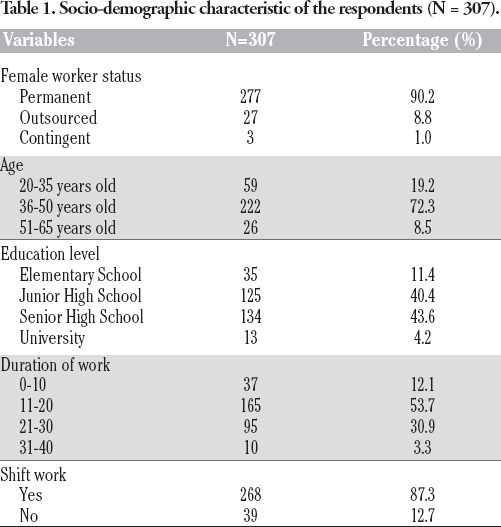
Table 1 illustrates the socio-demographic characteristic of the respondents (N = 307). A total of 310 questionnaires were distributed in the study area by the field research team and a very high response rate of 99.03% was recorded: 307 of the respondents answered the questionnaire. The data showed that female workers were present in several industrial locations: 90.2% of them had the status of permanent employee with binding rights and obligations, 72.3% was between 36-50 years, and the highest levels of education were Junior and Senior High School (40.4% and 43.6% of the respondents respectively). Furthermore, 53.7% were recorded to have worked in the company for 11-20 years while 87.3% work on a shift system of 1-3-2 every week.
Socio-demographic characteristic of the respondents (N = 307).
As can be seen in Table 2, all of the respondents reported they had been pregnant while working in the company, but the frequency varies with 46.3% of the respondent having experienced two pregnancies while working. The age at first pregnancy varied: most of the respondent (73.3%) had it between 17-25 years of age while 4.9% had it at the age of <17 years and 1.6% at > 34 years. 45% experienced pregnancy disorders in the form of nausea, vomiting, menstrual issues, and several other problems.
Pregnancy history of female workers.
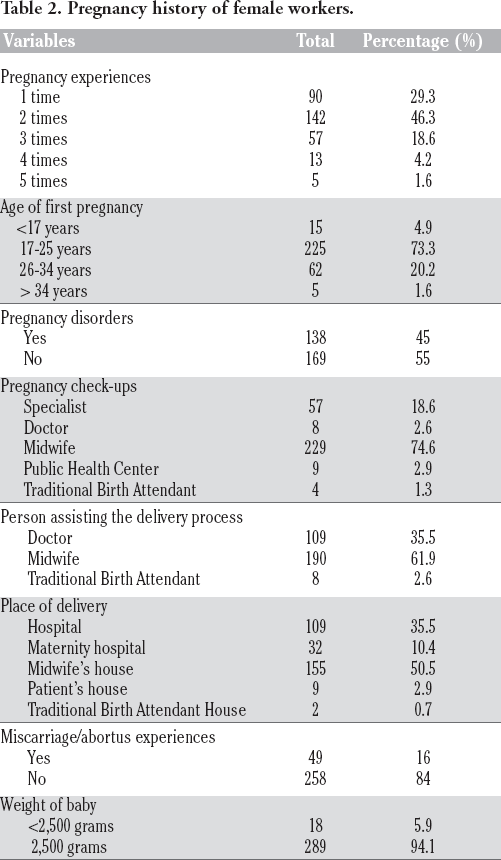
Pregnancy check-ups and antenatal care were routinely conducted: the majority of the visits (74.6%) was carried out by midwives, followed by obstetricians with 18.6%, while only 1.3% consulted Traditional Birth Attendants (TBAs). Moreover, 61.9% of the child delivery process was assisted by midwives, 35.5% by doctors, and 2.6% by TBAs; and the majority (50.5%) was recorded to have happened in the midwife's house, 35.5% in the hospital, 2.9% in the respondents’ house, and 0.7 at the TBAs. Furthermore, all the babies were found to be generally in good condition with only 5.9% weighing less than 2500 grams. However, 16% of the respondents experienced a miscarriage.
Table 3 describes the hazards in the work environment, which include noise, dust, pungent odor, irritant material, vibrations, overload loads, and repetitive works and, according to the simple logistic regression, those affecting pregnancy disorders include vibrations (P = 0.004), irritants (P = 0.002), and repetitive works (P = 0.009).
Hazard in the work environment.

This study aimed to describe the influence of the hazards in the work environment on pregnancy disorders. Most of the female workers studied have been working for more than 10 years, meaning they are more likely to be have been exposed to several hazards 11 with the possibilities of several effects on their health. 12 Moreover, the 1-3-2 work shifts indicate there is an alternation of work duties in the morning, evening, and night each week and this may cause health problems such as sleep and hormonal disorders 13 and also affect the circadian rhythm inside the women's body, which further leads to irregular menstrual cycles. 14 This means irregular work and night shifts can cause pregnancy problems.15-17
The age of first pregnancy was considered to be generally good but a small percentage was found to have gotten pregnant at a very young age when the reproductive organs are not anatomically and physiologically ready to function properly, thereby causing several disorders such as miscarriages, babies born with weight less than 2500 grams, and others.18,19
The Indonesian government has implemented different policies to improve maternal and child health and protect menstruating, pregnant, and postpartum workers, but these efforts do not consider the fact that the current Maternal Mortality Rate has not yet reached the SDGs target. 20 This has been reported to be caused by inappropriate antenatal care and examination by Traditional Birth Attendant (TBA). 21 However, several efforts have been made by the government to collaborate with midwives and traditional birth attendants to reduce the incidence of maternal mortality 22 but difficulties have been observed in implementing these strategies in remote areas. Furthermore, pregnancy check and childbirth processes are usually conducted in hospitals or midwives houses through the assistance of trained medical personnel, but few people were reported to be still making use of the TBA and this was found to be causing several problems such as miscarriage, bleeding after birth, maternal death, and unhealthy babies. 23 Therefore, there is a need to improve the knowledge of TBAs through training in order to provide adequate assistance to midwives during the birth process. 24
Some of the working conditions observed to be causing pregnancy disorder include
WBV (Whole Body Vibration)
Whole-Body or Hand-Arm vibration in the workplace has detrimental effects on the health of workers through its effects on several organs and systems such as the reproductive organs, 25 causing health problems and pregnancy disorders. It has been reported to cause abnormal uterus positioning, abnormal menstruation, and abortion 26 and in extreme cases, menstrual disorder, anomalies in foetal position, and stillbirths. 27 Therefore, there is a need for protection and administrative efforts to reduce the impact of WBV on workers, especially the female ones who are very vulnerable to such hazards in the work environment. 28
Irritant
An irritant is a chemical causing damages to the body directly through inhalation, skin contact, and the digestive tract. It can affect the hormones, which further causes pregnancy disorders in female workers. 29
Repetitive work
These are works often repeated in the workplace and with the ability to cause psychological and health problems. According to OSHA, any activity conducted repeatedly in less than 30 seconds is categorized as repetitive motion, and any work done permanently and repetitively for 6 hours has effects. 30 Therefore, repetitive work and motion have the ability to increase risks of miscarriage, preterm labor and birth, low birth weight, preeclampsia 31 and directly affect the development of the fetus in the body. Moreover, in a continuous condition, it causes abortion and premature babies 32 and if conducted in a standing position, it is more dangerous due to its ability to cause restriction or symptoms of preterm labor. 33 Therefore, the company is required to pay more attention to the health of female workers in order to avoid several health problems during pregnancy. 34
Conclusions
Female workers in industrial environments are prone to experience pregnancy disorders. This is associated with the pregnancy check-ups and deliveries conducted by TBAs and the exposure to several hazards in the work environment such as vibrations, irritants, and repetitive works. Therefore, companies are required to focus on reducing the hazards in the work environment to protect female workers from pregnancy disorders.
Footnotes
Acknowledgments
We would like to thanks to civitas academica Universitas Airlangga.