






Abstract
Background
Infectious diseases such as diarrhea and Acute Respiratory Infection (ARI) lead to loss of appetite in children and stunting growth. This study analyzes the relationship between the incidence of stunting and the frequency/duration of diarrhea and ARI in children under five years.
Design and methods
The stratified random sampling method was used to obtain data from 152 children in 4 villages in Surabaya, East Java, Indonesia.
Results
The results showed that children under the age of five, experience higher stunting duration and longer frequency of diarrhea. The Rho Spearmen Test showed differences in the incidence of stunting with the frequency of diarrhea P = 0.005 (P<α = 0.05), P = 0.003 (P<α = 0.05), with ARI of P =0.001 (P<α = 0.05).
Conclusions
In conclusion, stunting is related to the frequency and duration of diarrheal diseases and ARI, therefore, community- integrated health center need to carryout counseling activities on children less than five years to determine their health status.
Significance for public health
Stunting is the marred growth and development that children usually experience due to poor nutrition, inadequate psychosocial stimulation, or infection. It leads to a decrease in the body's immune system, therefore increasing the risk of infectious diseases. Infectious diseases such as diarrhea and Acute Respiratory Infection (ARI) lead to loss of appetite in children and stunting growth. This study describes relationship between the incidence of stunting and the frequency/duration of diarrhea and ARI in children under five years.
Introduction
Stunting is the marred growth and development that children usually experience due to poor nutrition, inadequate psychosocial stimulation, or infection.1,2 The literatures show that children experience stunting due to the reoccurrence of infection such as diarrhea and Acute Respiratory Infection (ARI) between15 to 27 days a year.2,3 The incidence of Stunting, ARI and Diarrhea are mutually related in children under five years. 4 Currently, this growth impairment is one of the nutritional problems experienced by toddlers across the world. According to a 2017 analysis, 22.2%, or 162 million children under five years, experienced stunting. 5 In addition, a 2018 study found that 12.9% and 9.9% of children within this age bracket were diagnosed with ARI and diarrhea respectively in East Java region according to doctors, nurses, or midwives. 6 In 2018, the percentage of stunting, very short and short toddlers in Surabaya was 8.92%, 0.4% and 6.88%. 7
Based on the results of preliminary studies conducted on 10 infants, 4 had a history of diarrhea and ARI with the frequency of illness > 3 times a day and also suffered from ARI 3 times a day for 6 months. The remaining 6 children without a history of diarrheal illness experienced stunting > 3 times for 2 days, with cured ARD.
Stunting in children leads to a decrease in the body's immune system, therefore increasing the risk of infectious diseases. 8 However, those under 5 years and suffering from acute diarrhea for more than two weeks, are at risk of becoming short. 9 Therefore, a toddler experiencing cough, runny nose, fever, and vomiting up to 14 days is at the risk of becoming short, assuming these symptoms continue for the next 14 days.10,11 Further research stated that toddlers with diarrhea often stand a high risk of stunting. 12 Nurses play a role in addressing this issue as health educators by providing preventive measures to mothers through exclusive breastfeeding, nutritious food, clean life behavior, physical activity, as well as the balance between energy expenditure and nutrient influx in the body.
Design and Methods
The study utilized the analytic correlation with a cross-sectional approach. The stratified random sampling method was used to obtain data from 152 children in 4 villages in Surabaya, East Java, Indonesia. The relationships between variables were analyzed using SPSS 20.00.
Results and Discussion
Characteristics of respondents include the gender of those living with their parents, age, mother's education, occupation, those that are still breastfed, and complementary feeding administration. Specific data covered the incidence of stunting and the frequency/duration of infectious diseases such as diarrhea. Table 1 shows the characteristics of the sample study: 60.5% were aged between 24-36 months, and 39.5% were 12-23 months, while 41.5% under five received exclusive breastfeeding.
Characteristics of respondents.
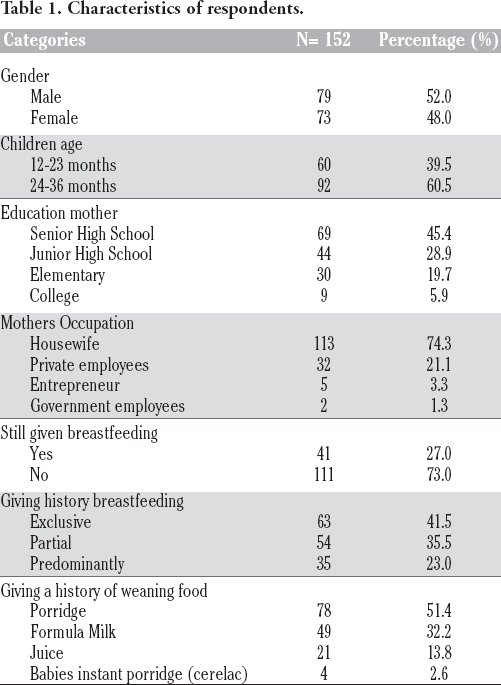
Table 2 shows the incidence of stunting, frequency/duration of diarrhea events, and ARI in toddlers. The results showed that 44 children (28.9%) are in a short category, while 32 (21%) are very short. Toddlers that frequently had diarrhea for less than 6 months were 22 (14.5%), and those above 6 months were 55 (36.2%). On the other hand, toddlers that experienced ARI less than 6 months were 39 (25%), and above 6 months were 68 children (44.7%). Those that rarely experienced ARI less than 6 months were 100 (65.8%) and above 6 months were 70 children (46.1%).
Stunting, frequency and duration diarrhea and acute respiratory infection.

Table 3 shows the statistical test result of the spearman rho with a P-value <0.005, and a significance level 0.01, therefore, it is concluded that there is a relationship with stunting, incidence of diarrheal diseases and acute respiratory infections in toddlers.
Relationships between stunting, frequency and duration of diarrhea, Acute respiratory infection

Diarrhea is one of the leading causes of morbidity and mortality in children below five years. The incidence of this disease in infants at an early age negatively correlated with their cognitive development and activities. Various factors such as nutrition, living environment, parents’ education, and presence of infectious diseases influence the incidence of stunting in infants. 12
ARI is very closely related to the parents’ education, as those with higher knowledge are able to prevent its occurrence in toddlers. 13,14 The level of mother's knowledge on exclusive breastfeeding is also an important factor that has been proven to protect children below five years from various diseases including ARI. 15 Statistically, it also contributes to the low level of toddler morbidity for ARI. Toddlers exclusively fed with breast milk, with the occurrence of ARI, tend to grow appropriately with growth deficiency. 16 According to Sinha et al. d, ARI is the main factor causing underweight, while diarrhea causes stunting. The relationship between the two infectious diseases with the occurrence of underweight cannot be separated.
Based on the data obtained from breastfeeding, it was found 35.5% of normal toddlers received partial breast milk. The results of the interviews with parents stated that children were exclusively fed with breast milk only for 4 months, followed by a combination with formula milk. However, according to the World Health Organization, children need to be breastfed for at least six months, therefore, when it is conducted for less than 6 months it increases the risk of stunting because the baby's digestive tract is not perfect, therefore, it becomes more susceptible to infectious diseases such as diarrhea and ARI. Children that are not exclusively breastfed for 6 months are 1.3 times more likely to experience stunting. The interview results conducted on mothers stated that children were still provided with exclusive breastfeeding for 1 year, because they felt it wasn't necessarily spending money on formula milk. Exclusive breastfeeding is also clinically proven and statistically able to increase toddler immunity to diarrhea and ARI. Therefore, those that do not obtain it are susceptible to ARI diseases.17-19
Conclusions
In conclusion, stunting is related to the frequency and duration of diarrheal diseases and ARI, therefore, community-integrated health center need to carryout counseling activities on children less than five years to determine their health status.
Footnotes
Acknowledgments
The authors are grateful to civitas academica Universitas Airlangga and Sekolah Tinggi Ilmu Kesehatan Hang Tuah Surabaya.