






Abstract
Background
The percentage of complete immunization in urban areas is higher than rural areas. The purpose of the study was to analyze the relationship between ownership of Maternal and Child Health (MCH) books with Complete Basic Immunization (CBI) coverage in slums and poor areas.
Design and methods
A rapid survey was conducted in selected slums and poor groups based on medical records from Public Health Center. Informants were mothers with a sample of 325 infants aged 12 to 23 months.
Results
The lowest coverage of CBI for slum and poor residents is Pasuruan, which is 55.4%. The results of statistical analysis showed that there was a significant relationship between ownership of MCH books and the complete coverage of basic immunization in Malang (P = 0.000; PR = 3.682); Pasuruan (P = 0.002; PR = 1.854); Sidoarjo (P = 0.000; PR = 4.042); Surabaya (P = 0.000; PR = 2.425).
Conclusions
It is recommended that the government should improve access to complete immunization programs in slums and poor population.
Significance for public health
Low immunization coverage makes people living in a slum unhealthy and at high risk of developing infectious diseases. Maternal and Child Health (MCH) Book is a source of information about the program and immunization status of the community. This study analyzes the relationship of MCH ownership with basic immunization completeness status in the slums and poor area. Supporting and increasing access to immunization programs is expected to increase immunization coverage in the slums and poor groups.
Introduction
Immunization Program for vaccine preventable diseases in children is one of the most important contribution in reducing child mortality and increasing life expectancy. It is also known as the most effective and inexpensive primary prevention against infectious diseases. 1 Indonesia is one of the priority countries identified by WHO and UNICEF to implement acceleration in achieving the 100% UCI target for villages. 2 According to WHO data, the incidence of illness, disability, and death due to vaccine preventable diseases is estimated at 2 to 3 million deaths annually. 3 National complete immunization coverage rates from 2013 to 2014 in rural and urban areas have the same coverage rate of around 60%. 4 This number has declined by more than 20% since 2015. 5 Data from the 2016 National Socio-Economic Survey shows that the percentage of complete immunization in urban areas is higher (69.06%) than in rural areas (63.70%). The percentage of complete immunization coverage in 2017 has decreased both in urban areas (51.90%) and in rural areas (48.49%). 6 This shows that access to complete basic immunization tends to be influenced by the level of economic status.
World Bank data (2013) on immunization rates for children show striking differences across urban quintiles. Children who get vaccinated against polio, measles, BCG and DPT, account for 60% of complete vaccinations in the poorest urban society quintiles, compared with 74% in the richest groups. 7 Increased morbidity and mortality have been observed in measles, diphtheria, influenza and typhoid in slums in South Africa, India.8,9 Bangladesh,10,11 and Kenya. 12 Low immunization coverage for vaccine preventable diseases contributes to poor health outcomes in poor urban populations especially in slums area. The low immunization coverage makes slum and poor people one of the high-risk groups that have the potential to become a high risk for outbreaks.
Knowledge and ownership of the Maternal and Child Health (MCH) Book is a strategic factor to improve the immunization program. The MCH book is also a source of information about the program and immunization status for the community. Basic Health Research 2018 data shows that 60% of targets have and can show MCH books, 30% do not have MCH books, and 10% cannot show whether they have MCH books. 13 This study aims to analyze the relationship of MCH ownership with basic immunization completeness status in the slums and poor area. The study was conducted in the cities of Surabaya, Malang, Pasuruan, and Sidoarjo in the Province of East Java, Indonesia. This city is an industrial area with a high level of urbanization and the presence of slums and poor area.
Design and Methods
A rapid survey was conducted in selected slums and poor groups based on medical records from Public Health Center. Informants were mothers with a sample of 325 infants aged 12 to 23 months. Research sites in selected sub-districts and villages in the cities of Surabaya, Malang, Sidoarjo and Pasuruan located in East Java Province. Rapid Card Check was used to identify the history of immunization. Data were analyzed by using Chi-Square test and Prevalence Ratio (PR).
Results and Discussions
Statistical analysis showed that there was a significant relationship between the ownership of the MCH book and the complete basic immunization in Malang (P = 0.000; PR = 3.682); Pasuruan City (P = 0.002; PR = 1.854); Sidoarjo City (P = 0.000; PR = 4.042); and Surabaya (P = 0.000; PR = 2.425) (Table 1). The ownership of the MCH book has an impact on the completeness of the immunization status.
Relationship of MCH Book Ownership with Complete Basic Immunization.
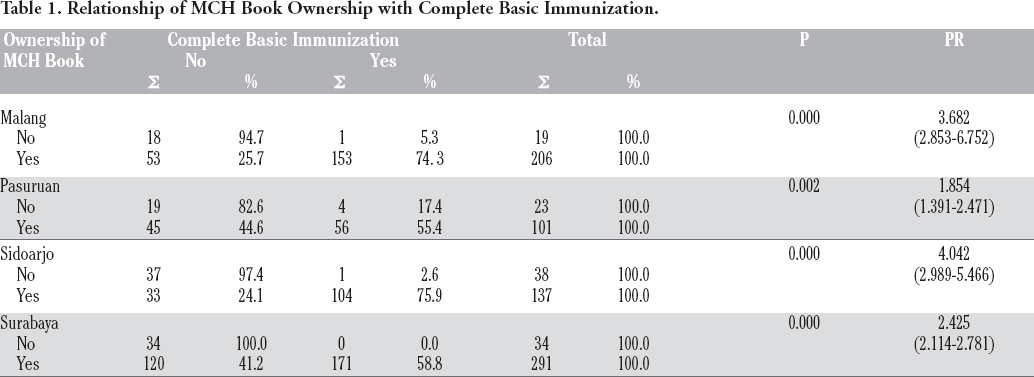
The results of the study show that the ownership of the MCH book is significantly related to basic immunization coverage. Significant gaps exist in immunization coverage in poor groups in urban areas, 14 for example in Nigeria, Ethiopia, Cameroon and Pakistan. 15 World Bank data (2013) shows that in Indonesia there is a correlation between low level of education and economic status, and low the coverage of each type of immunization. 7 The urban poor also have a lower education than the non-poor, with one third having less than education primary education.
Low immunization coverage was also found in new arrivals from villages.16,17 Slums are often the first entry point for new arrivals from villages to urban areas. 18 This migration process impacts the difficulties in accessing health services which leads to low immunization coverage.19,20 Most children who come from families with low socio-economic backgrounds, suffer from poverty, live in slums and receive inadequate parental education have also low immunization coverage. 21 There is evidenced that in urban areas the availability of services supported by easy access results in people becoming healthier than in rural areas. 22 Lack of knowledge about immunization makes mothers reluctant to immunize their children because of financial difficulties. 23
Randomize control trials conducted in Pakistan through the provision of educational sessions by medical students to mothers in slum dwellers indicate an increase in complete immunization in the intervention group. This indicates the need to increase knowledge about immunization 24 to increase parents’ awareness of the importance to give immunizations to their children.25,26 Providing incentives to mothers has also been shown to be successful in increasing immunization coverage in Brazil and Pakistan.24,25
Access to basic health services for the poor in urban areas is lower compared to non-poor urban areas. Urban infrastructure is also generally unable to keep pace with rapid urbanization, especially in the informal settlements where poor people live. 7 This has led to vaccine programs designed for the general population that may not be effective in urban slums and are characterized by the large number of newcomers who do not have a resident status there. This condition limits access to basic health services, in addition to the poor quality of sanitation in their homes.18,26 Children who live close to health facilities will find it easier to get complete basic immunization. 27 This makes it necessary to support and increase access to immunization programs in the slums and poor groups.
The ownership of MCH books supports the promotion of health and preventive programs for public health, including immunization. Previous studies have shown that the absence of MCH book is a contributing factor for not vaccinating. A quarter of children who get vaccinated cannot be properly tracked due to the absence of the immunization book.28,29 The MCH book has an important role for recording and reporting the immunization program. The MCH book is used to reduce the immunization status constraints caused by the mother forgetting whether her child has been immunized or not, how many times she has been immunized herself, and the exact type of immunizations. This unless the notes in the MCH are not filled, or the MCH book record is lost or misplaced. The MCH Handbook may be provided by any party including private organizations concerned with maternal and child health. 30
Conclusions
Poor and slum dwellers in urban areas that do not have a MCH book are significantly related to the low coverage of basic immunization. Supporting and increasing access to immunization programs and increasing knowledge are expected to increase immunization coverage in the slums and poor groups.