






Abstract
Background
The Public Health Center (Puskesmas) is a primary care center in Indonesia that focuses on promotive and preventive efforts, as opposed to exclusively curative approaches. However, a major challenge has been identified in relation to the limited number of health personnel available to provide education to patients. The objective of this study, therefore, was to determine the impact of personal factors, severity of health problems, environmental situation, and patient activities on the level of attention payed to the audiovisual media.
Design and methods
The study involved the screening of 12 kinds of health education video, which ran in the LCD panel in the waiting room. The population consisted of visitors/patients that were 15 years old or older, and a sample size of 124 was selected randomly during the study period.
Results
Based on the statistical analysis, it was established that age, severity of health problems, environment situation, and visitor activity influence patient awareness to audiovisual media in the waiting room of the Public health center.
Conclusions
It is recommended that public health centers improve their environment to encourage the patients to pay attention to health media.
Significance for public health
Health education's main aim is to improve the knowledge, attitude and behavior of the individual and the community to improve their health status. The adoption of audio visual aid as media for health education can be one example of strategy to overcome the limitation of health counselling. This paper describes the patient attention toward audio visual media and the factors influencing their attention toward media at public health center.
Introduction
The Public Health Center is primary health care facility, which prioritizes promotive and preventive efforts on the individuals and the community, in order to achieve the highest level of wellbeing in the region. 1 Health promotion is the primary activity conducted, which is difficult to implement optimally alongside the curative services. 2 The results of a study in 2017 also demonstrated showed a shortage from the technical specifications set by the Indonesia government regulated in Law no. 38 of 2014, in many health promotion workers. 2
The health educational activities in Ngadi Public Health Center, Kediri Regency, East Java have been conducted once a month in Ngadi Health Center, Kediri Regency, particularly in the visitors’ waiting room by the health counselors, which include nurses and midwives. The reduced effectiveness resulted from the inability to reach all targets, and the limitation in health personnel creates a major challenge in improvement approaches, as no staff is specifically assigned to such activities.
Health Promotion is an effort to promote self-help, and develop community-based activities that are in accordance with the local socio-culture, and supported by public health-oriented policies. 2 Moreover, health education is viewed as impart health related information to influence values, attitude and motivation of person/group as well as change their health behavior.3,4 The delivery of messages through media (leaflets, posters and videos) at the Public Health Center is expected to help convey health-related information to patients and visitors, and also create good and positive attitude to foster and develop an atmosphere fit to acquire the relevant knowledge. 2
Video as a audio visual learning media has been used from the era of the Second World War. 5 The possible benefits of audio visual media in education has been widely investigated in Indonesia, as seen in the study of Syahlani, Ahmad; Tanwiriah, Tanwiriah & Latif, Abdul (2017) wich expolored the effectiveness of health promotion through audio visual media toward motivation of youth, and study of Arneliwati; Agrina; and Dewi, Ari Pristiana (2019) who explored the effectiveness of health education using audio visual media on increasing family behavior to prevent dengue hemorrhagic fever (DHF).5,6
The main challenge in this study was the lack in information on the natural response of Public Health Center outpatient visitors toward audio visual education media in the waiting room, and also on the influencing factors. The purpose of this study, therefore, was to determine the impact of demographic factors, including age, sex, occupation, and education level, and also the effect of environment, disease severity and level of activity on the visitor attention to audio visual education media in the waiting rooms of Public Health Centers.
Design and Methods
This research used quantitative methods with experimental design, which involved the creation of educational videos and information (about the available services) in the waiting room. This process required the use of the Sparkol Videoscript software: where the videos produced contain music, pictures and words, each one for a 60-180 seconds duration. The 12 educational videos covering Public Health services, as well as health and related behaviors, were displayed in the visitors’ waiting room. This includes the area for registration and general treatment, examination of pregnant women and dental care, and also in the place where drugs and cash are taken. A sample of 124 study visitors aged over 18 years was selected by using systematic random sampling. In addition, the Data was collected within the first two weeks of video media installation in the waiting room of the Public health center. Ordinal Regression was used data analysis to identify the strength of each factor in influencing the patient's attention.
Results
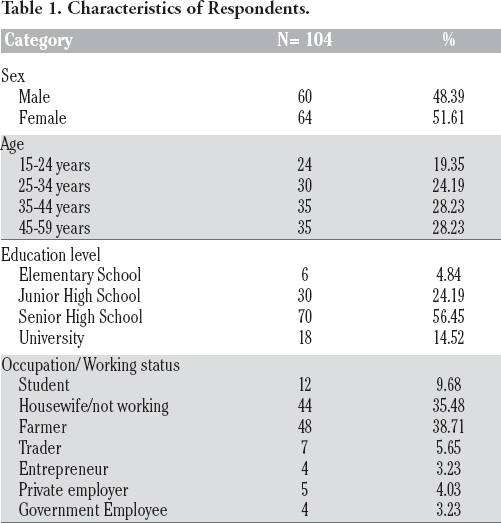
The results of study showed demographics of respondents, respondent perception of disease, respondent perception toward enviroment, respondent activity, respondent's level of attention as shown in Tables 1–3 respectively.
Characteristics of Respondents.
Perception of environment situation, Activity, Attention Towards Media.

Factors Influencing Patient Attention Towards Audiovisual-Health Education Media.
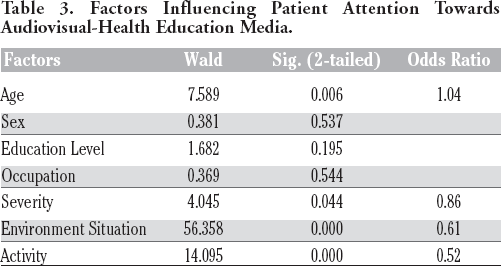
Table 1 show that the gender of respondent distributed equally, highest level of education is Senior High School, and most participant are farmers. Age of participant is equally distributed.
The perception of disease severity was obtained through measurements conducted with a semantic differential scale in the range of 0-10. The results showed 0 as the lowest severity degree value, while the highest was attained at point 3, with an average perception of 3.411, and a standard deviation of 1.672. These values indicate mild severity, hence public health center is assumed to provide basic/essential services to the immediate community.
Table 2 show that most respondents (44.35%) perceive the environmental conditions/situations in the waiting room as a source of mild disturbance. Based on the results as show in Table 2, a majority of respondents (52.42%) were engaged in no activities while awaiting the services. However, some individuals tend to perform light actions, including talking, and the use of mobile phones, while a small number participated in moderate activities, which include holding or inviting children to play. Respondent's level of attention respondents attributed to the media was subjectively measured as show in Table 2. The results showed moderate to high level of attention by most respondents.
The results of ordinal regression test in Table 3 with the Complementary Log-Log function approach showed an intercept only value (without an independent variable) of 338.275, which became 147.824 after adding a final variable in the Fitting Information 2log likelihood Model. Furthermore, the difference in value represents a Chi-Square of 190.451, which is significant at a level of 5% (Sig 0.000). The Goodness of Fit from Pearson and Deviance was Sig. 0.994 and 1.000, which were both greater than 0.05, indicating the suitability of this model to explain the effect of independent on dependent variable. In addition, a pseudo R Square Table shows Cox and Snell value of 0.785 and Nagelkerke of 0.840, which indicate the ability for independent variables (severity, environmental influences, and activities of respondents) to respectively predict the dependent (attention) at 78.5% and 84.0%.
The parameter estimation table shows the effect of each factor as follows in Table 3. The statistical results identified the Wald's value for age to be 7.589 (sig. 0.006), which was 0.381 (sig. 0.537) for gender, with education level at 1.682 (sig. 0.95), employment 0.369 (sig. 0.544), severity of 4.045 (sig. 0.544), environmental situation of 56,358 (sig. 0,000) and 14,095 (sig. 0,000) for activity. These results, therefore, indicate that the influence of disease severity, the environment, and the respondent activity variables influence the attention of Public Health Center visitors to the videos.
Discussions
Age is a factor that is closely relates with the mental development of an individual, as well as attention. The results show greater alertness in younger people rather than in older people (in this study, the lowest age category is 18-21 years, while the oldest age group is 61-87 years). 8 In addition, attention is a psychological phenomenon known to interact with other cognitive processes, including perception, memory, production of linguistic output, as well as spatial orientation and behavioral planning. 9 This functional development is general influenced by the neurological maturation of certain areas in the brain. Conversely, executive operations are often associated with the slower maturation of frontal and prefrontal cortex, while those in the parietal and back (visual or spatial attention) are involved in basic attention processes. This study outcome implies that age influences personal attention performance during development.10,11
In addition, the male and female respondents encompass 60 (48.39%), and 64 (51.61%) individuals, respectively. These values are congruent with the outcome of a previous study by Arneliwati, Agrina and Dewi, which showed a larger number of female than male visitors. 6 Meanwhile, the Public Health Center provides services for women experiencing health challenges, and also for the routinary pregnancy and postpartum checks, and contraceptive services.
Some differences were observed between both sexes in the level of attention payed to an object, and women had a higher tendency to pay attention to symbolic items. 12 In addition, gender is assumed to contribute towards the ability to provide selective attention, which was dependent on the type of information provided, as reported in some studies. 13 However, these results showed the absence of any genderbased effect.
The highest level of education for most visitors (70 individuals, 56.45%) was high school, which is probably due to the rural location of the Public Health Center facility in Ngadi. This result was consistent with a research byArneliwati, Agrina and Dewi. 6
Other investigations linked a higher level of education with better attentiveness, especially at advanced levels, as seen with divided and sustained attention. However, the inverse is observed with students at low-class, which also indicates the influence of age, hence it is believed that education trains an individual to increase attention. 14
A total of 48 people (38.71%) were reported to work as farmers, which is possibly due to the fact that most people live in the surrounding rural area. The results showed the absence of any impact of work type on the visitors’ attention level.
Some occupations tend to promote certain forms of cognitive functions, which is strongly influenced by the length of time allocated to work, and types of activities performed. 15 In addition, the habit of working in stressful, noisy, or hot situations enhances the acclimatization of workers to the management of these stimuli. 15 However, the availability of relatively quiet and comfortable conditions in the waiting room was believed to suppress the feeling of interruption, hence the type of work has no influence on the attention attributed to the audiovisual media.
The assessment results showed disease severity in the average range of 3.411, with a standard deviation of 1.672 in a majority of visitors. This indicates the first-level health care services at Public Health Center were at mild levels, based on the basic services provided: more complex health challenges are generally referred to higher health institutions.
An individuals’ health status or biological condition was observed to strongly influence attention, which consists of several tasks in the focused, sustained, shifting, and divided forms. Therefore, people with challenges are assumed to participate in inhibitory control, characterized by the allocation of more attention to the conditions, and less to the surrounding. 16
Most respondents (44.35%) described the environmental conditions/ situations in the waiting room as a source of mild disturbance, which subsequently influences the degree of attention.9,16 Therefore, humans have a high tendency to make adaptive efforts towards various environmental circumstances. 16 The results obtained also showed the poor ability for the health center environment to influence attention, which was probably due to the number of visitors, and the relative noise. Most of the visitors were not engaged in any activities while in the waiting room, as excessive levels have been affiliated with reduced attention to a stimulus. This phenomenon possibly results from the energy and special concentration required, 16 which is actively focused on self or the activity without distractions from other stimuli. Meanwhile, sustained attention is defined as the ability for an individual to retain concentration over prolonged periods. 8
Conclusions
Based on the results and discussion of this study, we concluded that the attention attributed to audiovisual education media was influenced by the age of the visitor, patients’ disease severity, envirommental situation and visitor acitiviy. The gender, level of education and type of work did not influence the individual toward their attention to audiovisual education media.
Footnotes
Acknowledgments
The authors are grateful to the teachers of Universitas Airlangga, and colleagues at Pamenang School of Health for the support.