






Abstract
Background
Dietary habits are of substantial concern related to the health of college students. Medical students are expected to have better dietary habits and healthy lifestyle, but due to various factors they are least bothered to follow recommended healthy diet. The present study assessed and compared the eating habits, nutritional awareness and BMI in females from health departments of King Khalid University (KKU), Saudi Arabia.
Designs and Methods
The cross-sectional survey was conducted in undergraduate females from eight health departments: Public Health, Nursing, Medical Laboratory Science, Physiotherapy, Medicine and Surgery, Dental and Oral surgery, Diagnostic Radiology and Pharmacy. Participants completed online questionnaire that include demographic, anthropometric information, questions related to food preference and nutritional awareness. BMI, food preferences, and nutritional awareness responses were assessed and compared among different departments at 0.05 and 0.001 level of significance.
Results
Total of 377 females were analysed and the mean BMI differ significantly at p<0.05 in all departments reporting the highest BMI mean in medicine and surgery department. Upon further stratification of BMI 53% of total analysed students comes under normal BMI. The utmost frequency of overweight students (55.3%) were observed in physiotherapy with no obese category followed by nursing with least obese students (2.2%).
Conclusions
Inadequate food preference with unhealthy dietary habits but satisfactory nutritional awareness was observed in students of all departments with no significant difference. Designing of nutrition promotional programs and motivation is required for the acquisition of healthy dietary habits.
Significance for public health
Unhealthy dietary habits are a preliminary cause of poor health among adults. The escalated prevalence of chronic diseases in adults is matter of public health concern. Medical students are expected to follow healthy diet for the pursual of excellent career and health, and keep the society informed about the benefits of healthy eating. Unfortunately, students from various Health Departments were often least concerned with respect to diet. Possibility of barriers like exhausted time, and easy availability of fast food are the reasons behind improper food choices. Among 377 students, 53% showed normal BMI, 22% overweight, 17.5% underweight and 7.5% obese. The underlying cause of normal BMI even after unhealthy diet could be due to physical exercise. Following the present results, the nutritional and health programmes should be designed to promote the physical exercise and to explain the importance of time for oneself so to adopt healthy lifestyle from the stringent schedule.
Introduction
The dietary habits play a vital role in maintaining health of any population. 1 In Saudi Arabia, the dietary habits are enormously changed over the past decades in all the age groups, mainly children and adolescent. In recent years, Saudis are more oriented to the importance of maintaining health and taking precautions to diseases.2,3 The prevalence of obesity in Saudi Arabia is reported 36%.4,5 The poor dietary habits in adults have been shown by researchers as a cause of obesity prevalence among the population of Saudi Arabia. 6 College students are more susceptible to engage in risky health behaviours known to deteriorate health such as poor dietary habits, physical inactivity and stress. 7 Many researchers studied the prevalence and impact of the dietary habits and life style of the children, adolescent and university students in Saudi Arabia, and showed that the dietary habits and life style were unhealthy and not following the international guidelines. Dietary habits of young adults, especially college students, are influenced by the fast-food market. With profound knowledge of medical science, the medical students are expected to have better dietary habits and healthy lifestyle, but they face certain barriers like lack of time, inconvenience in searching healthy food, and least bothered to follow recommended healthy food.8,9 In the present study we assessed and compared the eating habits (food preference and frequency), nutritional awareness and BMI in females of different health departments of King Khalid University (KKU), Abha (Aseer region) located in south-western region of Saudi Arabia.
Design and Methods
Study population
The cross-sectional survey was conducted from January to April 2020 in undergraduate female students of KKU, Saudi Arabia. Total of 377 female students aged between 20-30 years from eight Health departments (Public Health, Nursing, Medical Laboratory Science, Physiotherapy, Medicine and Surgery, Dental and Oral surgery, Diagnostic Radiology and Pharmacy) were included and analysed in the study. Students from level IV and onwards were allowed to take part in the study for the reason that by this level they gain the basic knowledge of diet and nutrition. Participation in this study was voluntary and information was collected following the declaration of maintaining confidentiality. All the participants were of Saudi ethnicity.
Online questionnaire
The standardized, self-administered food frequency and nutritional knowledge questionnaire was acquired and made available online through KKU website portal. The questionnaire was adopted from previously published study and the permission was obtained from author prior to the study. 1 The questionnaire comprised of three sections: Section 1: Demographic and anthropometric questions like age, department, level of study (semester), height (cm), weight (kg); Section 2: food preferences and frequency (15 questions); Section 3: nutritional awareness (11 questions). From Section 1, the body mass index (BMI) was calculated using Cole's formula to categorize the weight of students. 10 As per guidelines of National Institutes of Health, the weight status was categorized as underweight (BMI ≤18.5), normal weight (BMI 18.5-24.9), overweight (BMI 25-29.9) and obese (BMI ≥30). Exclusion criteria were pregnancy and chronic illness.
Statistical analysis
Statistical analysis was performed using SPSS software, ver. 21. Quantitative variables were analysed using ANOVA to figure out the difference at 0.0001 level of significance. Categorical variables were examined by chi-square test and examined at 0.05 level of significance.
Results
Table 1 shows the number of students participated from each health department, with a total of 377 participants. Number of participants from each department was: public health n=47, nursing n=45, the least represented among all departments was medical laboratory sciences n=23, physiotherapy n=38, medicine and surgery n=34, dental and oral surgery n=49, diagnostic radiology n= 26, and the majority of participants were from pharmacy n=115.
Characteristics of participants with their frequencies from different study level and health departments.

BMI, body mass index; NS, not significant.
Age, height, weight and BMI were reported in the form of mean±SD. The mean age of participants from all departments differ significantly at 0.05 level of significance. Anthropometric measurements also showed significant difference at P<0.05, in all groups. The maximum mean weight was observed in medical laboratory science students (63.4±25.4), public health students were more heighted (160.2±5.8), but the highest BMI mean was noticed in medicine and surgery students (27.3±19.2). The frequency distribution of participants at different study level from respective departments is also present in Table 1. Highest percentage of pharmacy department students from level V to IX and 68% of nursing students from study level IV took part in the study. However, no significant difference was observed in frequency at study levels of various departments.
Figure 1 depicts the frequency of rank (underweight, normal, overweight and obese) of participants depending upon BMI. A high percentage of normal weighted students was commonly seen in all departments except physiotherapy (26.3%). The utmost frequency of overweight students (55.3%) was observed in physiotherapy with no obese category and nursing department showed least frequency of obese students (2.2%).
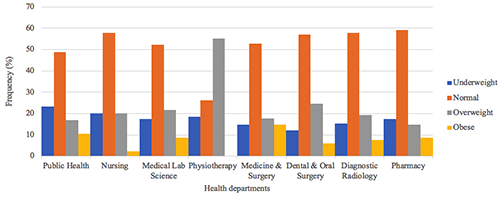
Frequency (%) of students depending upon BMI categories in Health Departments.
In Table 2 category-based BMI is presented. The number of obese students was less in all departments with their high BMI ranging from 29.3±1.2 to 38.3±2.9. Despite having high frequency of overweight students in physiotherapy, the nursing students showed high BMI (28±1.5). Students with underweight category with least BMI were observed in diagnostic radiology (13.4±1.7). Upon comparison of BMI categories among all health department the significant difference was observed at p<0.0001.
Mean±SD of participants BMI based upon different categories.

N, number of participants as per BMI categorization.
Students’ food preference frequency was compared between all health departments and found majority of students prefer dairy products (79%), bread (87.2%), fruits (50.9%) with the frequency of one to two times daily (84.35, 74.5, 89.6 respectively). Students from nursing (93.3%) and medical laboratory sciences (95.7% and 95.7%) reported high frequency of dairy, bread and fruits intake in all groups. In consumption of meat and eggs, 69.6% of medical laboratory sciences and 40% of nursing students prefer to have one or two times per week. Dental and diagnostic radiology preferred the intake of fish and processed cheese once in ten to fifteen days (53.1% and 30.8 respectively). Medicine students (41.2%) choose to have sweets three to four times a week, while 8.8% never. Once to twice per week public health (48.9%) and 46.9% of dental and oral surgery students showed intake of fries. Students from all departments with high frequency (41.3%) with preponderance in medicine and surgery department (44.1%) choose restaurant eating. However, with varied frequencies no significant difference was observed among all departments.
Results from the dietary awareness section showed maximally correct responses from all departments. Plurality of students (89.3%) answered that carbohydrates are present in bread not in cheese, meat does not contain dietary fibres (37.6%), grilled meat containing less fat (67.3%), potato have high calories (70.8%). 93.9% of students from dental department reported Majority of students (88.8%) answered that a diet with all nutrients in proper quantities is a balanced diet from them 93.9% students belongs to dental and oral surgery department.
Public health student (63.8%) responded that daily calories required is energy consumed in whole day and 53.2% acknowledged that food grown without chemical fertilizers are biological foods. For genetically modified foods, students from all departments (83.5%) selected the correct answer but predominance was observed in diagnostic radiology (96.2%).
Discussion
The purpose of this study is to assess the dietary habits, its awareness and the BMI in female students studying in different health departments of KKU. Numerous researches had studied the dietary habits and its impact upon health of opposite sexes.1,11-13 In our study, out of eight departments higher number of pharmacy students (n=115) from all levels participated, followed by dental and oral surgery (n=49) and the lowest number of participants from medical laboratory sciences (n=23). The overall BMI of students from five health departments (public health, nursing, physiotherapy, dental and oral surgery and diagnostic radiology) were normal while medical laboratory sciences, medicine and surgery, and pharmacy students weight range in overweight and obese category.
Previous studies reported males with higher BMI while females were within the normal range.1,14,15 However, upon further BMI categorization of female subjects, the majority of students from Public Health (48.9%), Nursing (57.8%), Medical Laboratory Sciences (52.2%), Medicine and Surgery (52.9%), Dental and Oral Surgery (57.1%) Diagnostic Radiology (57.7%) and Pharmacy (59.1%) were of normal BMI. Total of 53% (n=200) students from all departments were of normal BMI. This may be because young females are more conscious about their body weight, figure and the feeling of being socially appreciable to carry the paradigm of beauty. 16,17 Our findings are consistent with Najat et al. in context with female students. 13 The noticeable total overweight subjects were n=83 out of which maximum were from physiotherapy department n=21 with not even a single reported obese n=0. From the total studied participants only 28 were obese. The underweight, normal, overweight and obese categories of BMI differ significantly at p<0.0001 among all health departments. Studies have suggested that overweight and obesity in young age probably continue in future life and could be a risk factor for multiple health conditions like high blood pressure, cardiovascular disease, metabolic syndrome and dyslipidemia.18,19
Various studies have assessed nutritional habits relation with health and the awareness regarding proper diet among future healthcare practitioner which may help them achieve substantial health.20,21 In regard to dairy products 79% of total participants prefer to have it on regular basis, especially from nursing department (93.3%), the results near to Zagreb college study 22 where 83% of medical students consumed dairy products regularly. In our study only 50.9% of total students tend to eat fruits, of which 89.6% prefer one to two times daily and more frequent intake of cheese, fries, sweets and restaurant eating was observed among all. Galore et al. also reported unhealthy eating habits of university students with more orientation towards fatty diet instead of fruits and vegetables. 23 A study by Wardle et al. grade that a healthy diet consists of more fruits, vegetables and less fat. 24 Our results depict improved fruits and vegetables intake in students when compared to a study of Saudi Arabia where 78% of students rarely consumed fruits and vegetables and only 22% followed the recommended daily intake. 25 Masella suggested that males preferred non vegetarian protein rich food than females and other studies advised college students should consume variety of proteins and omega-3 fatty acids in fish on weekly basis, as they have significant effect on academic performance.26,27 We observed 51.7% of total students of which 69.6% from medical laboratory sciences choose to eat meat once a week while majority of dental and oral surgery (53.1%) students prefer fish once in 10-15 days, only 19.1% of public health students consume eggs once every day. This picture of protein consumption reflects the unhealthy dietary preference. Despite having varied food preference and frequency in students no significant difference was observed among different health departments. Nevertheless, the poor food choice of students may affect the BMI and categorize them as overweight and obese. In KKU some students are not living with the family because they come from distant villages or other cities. Although this information is not the part of questionnaire, it may be a predisposing factor of unhealthy dietary pattern. Two separate studies have found higher dietary score in students staying with family than those living alone.11,28
Kolodinsky observed that among college students improved nutritional awareness is related to healthy eating patterns. 29 Correctly answered dietary awareness questionnaire from respondents showed the satisfactory dietary knowledge. Predominance of correct dietary awareness was observed from all departments with no significant difference indicating that health departments females have almost similar and appropriate level of basic nutritional awareness. Our results agree by Wardle et al. and Turconi et al. where females had superior dietary awareness due to their intrigue involvement in cooking and keen interest towards body shape.1,24 Being medical students, the majority of participants were well acquainted with questions like food containing dietary fibres, less protein, less fat, higher calories. Similar image was obtained regarding function of vitamins and minerals, balanced diet, biological food and genetically modified food. Contrarily Stockton et al. and Sam et al. alarmed that college students’ dietary habits not often corresponds with their knowledge. Students often prefer fast food due to its easy availability, taste and least time consumption. 30,31
Various studies were performed earlier to assess dietary habits and awareness among males and females of medical colleges, but no such study was conducted before where the dietary habits, awareness and BMI was assessed only in female students and compared among different medical departments. Our study revealed the surprising and interesting results in medical students of different departments. In spite of having substantial understanding of dietary awareness and unhealthy food preferences of participants, the preponderance of students comes within the normal range of BMI. A study by Barnes suggests that physical activity controls the weight gain. 32 In context with this reference the schedule of medical students is quite stringent and keep them active according to the respective departmental activity. The limitation of the study of not assessing the physical activity of the participants, which might have shown the rigorous activity of students in respective departments and its effect over BMI. The unique feature of the study is that none of the earlier studies have been conducted focusing only on females and comparing students among various Health Departments.
Conclusions
Diverse food choice of medical students due to the effect of probable reasons must be contemplated in designing nutrition promotion programs and motivate the student for the adoption of healthy dietary habits by explaining the pros and cons of healthy and unhealthy food choices upon academic achievements, career goals and future life.
Footnotes
Acknowledgements
The authors are grateful to the Deanship of Scientific Research, King Khalid University for supporting the research and would like to thank all participants of the study.