






Abstract
Background
Brazil is one of the world's largest meat exporters. However, there is a paradox in this situation due to existing non-inspected meat trade and technical-sanitary failures in retail marketing.
Design and methods
This study aimed at characterizing the issues of trade, food safety and quality of raw beef in the street market of a municipality in the state of Bahia. An exploratory, quantitative and census study was carried out, at 17 raw beef vending locations. A questionnaire was administered and meat samples were collected (n=34), which were submitted to a physicochemical assessment, color analysis and microbiological analyses.
Results
Meat sellers were between 20 and 64 years of age, predominantly males (82.4%), with limited education and without professional training (64.7%). Medians for temperature and pH in the small butcher shops samples were 18.10ºC and 5.75 respectively, and 21.80ºC and 5.50, in small supermarkets samples. The difference in pH was significant (p<0.05). The filtration test suggested quality changes in 17.65% of the samples. No frauds were detected. Total coliform count medians were 4.90 and 4.78 log CFU/g, for the samples taken from butcher shops and supermarkets, respectively. E. coli was identified in approximately 40.0% of the samples. Salmonella spp. were confirmed in two samples collected in the butcher shops. There was a significant association between inadequate storage conditions and microorganism counts (p<0.02).
Conclusions
The results evidenced a meat supply with preservation failures and non-compliance with hygiene requirements, constituting a consumers’ health hazard, not in line with an agroexporting country model.
Significance for public health
The protection of food sold in street markets is of great importance for public health and food security. In this study, the microbial load of raw beef, as well as reported conditions of trade, processing and storage indicate a need for interventions with the aim of preventing health risks, continuing training of food handlers and investments in education, which contribute to reduce cases of food poisoning and foodborne diseases. The risks to consumer health are related to the contamination, survival and multiplication of pathogenic microorganisms, which can access food through numerous pathways, reflecting precarious hygiene conditions throughout the process. Thus, strengthening Official Inspection and Health Surveillance systems can contribute to disease prevention and health promotion, minimizing healthcare expenditure and favoring the efficient allocation of resources.
Introduction
Beef is one of the main foods in the world, with per capita human consumption estimated at 43.4 kg/year, between 2013 and 2015. 1 The USA, Brazil and the European Union are the largest producers worldwide, with recognized product quality, both safety and physicochemical characteristics.2,3 Brazil ranks second in production, registering a slaughter of 30.83 million head of cattle in 2017. 4 However, the country faces challenges in the domestic trade, characterized by different health and technical contingencies, which are of concern, considering food safety and public health. 5
In spite of the efforts by the regulatory agencies in the area of animal health and protection, sales of non-inspected slaughtering meat are a fact in the informal sector in this country. 5 Thus, cattle diseases and the presence of contaminants raise concerns with safety and with the monitoring of all stages of the production chain. In addition, improper hygiene practices in the final stages of the production chain is evident, especially in the retail industry, including supermarkets, street markets and working class markets. 6
The risks to consumer health are related to the contamination, survival and multiplication of pathogenic microorganisms, which can access food through numerous pathways, 7 reflecting precarious hygiene conditions throughout the process. In particular, contamination can occur through endogenous or exogenous pathways since the initial microbiota of fresh beef is influenced by factors related to slaughter and technological processes8,9 and factors, such as exposure to room temperature, storage conditions, handling and distribution at the place of sale, which determine the microbiological quality of the meat.10,11
As a principle, it is known that meat vending locations should implement hygiene sanitary conditions and processes, in order to foster protection and control measures, with the aim of preserving product quality.12,13 Moreover, those handling the product should undergo continuous education, paying particular attention so that activities and responsibilities are not jeopardized by environmental inadequacies and production chain upstream failures. 12 However, in this country's retail market practices, there are still challenges to be faced in order to reach this condition. 5
Thus, considering the lack of studies focused on trade and distribution of fresh meat in small Brazilian cities, as well as the contrast between the exporting country model and the coexistence of a domestic market that evidences food safety problems, this study aimed at characterizing the issue of food safety in the trade and quality of raw beef in the street market of a municipality in the state of Bahia.
Design and Methods
Sampling
This is an exploratory, quantitative study carried out in the city of Santo Antônio de Jesus, Brazil, as part of the project “Promotion of food safety in the raw bovine meat trade: diagnosis and intervention in the Recôncavo area of Bahia”. Fieldwork was performed between January and July 2019.
The selection of the municipality of Santo Antônio de Jesus as a study scenario stems from its regional importance as a commercial center and service provider in the Recôncavo Baiano area. According to estimates, the municipality has a population of 100 thousand inhabitants, 14 with the retail trade being one of the largest in the region, characterized by a large circulation of local and surrounding cities’ consumers.
The study was conducted in the main street market of the city, where raw beef vending locations concentrate, with collection of information from the sellers and meat sampling.
To form the sample, a preliminary census was carried out to identify the vending locations, 15 based on information obtained from the Department of Agriculture and Supply of the municipality. All vending locations were identified, including small supermarkets and small butcher shops.
All owners and/or shopkeepers were informed about the motivations and purpose of the study. Among those approached, 17 agreed to participate, corresponding to an acceptance rate of 70.8%. The main justifications for non-participation included: lack of time and participation in other surveys.
Data and sample collection
At the vending locations, information collection was performed using a semi-structured questionnaire, developed by the researchers to obtain information about the knowledge and practices of the meat handlers, marketing conditions, as well as hygiene/sanitary conditions of the activity. The instrument was peer reviewed and tested in a pilot study, before application of the final version at the vending locations considered in this study. The questions were organized into four dimensions, comprising: part 1. identification of the respondent and socioeconomic characteristics; part 2. work practices; part 3. purchase and storage of raw material; and part 4. sanitary/hygiene conditions.
The first part of the questionnaire addressed questions of food handler characterization, such as gender, age, time in the activity, function, educational level and participation in training in the food area, as well as characteristics of commercial operations (working hours, days and work shifts and remuneration in the activity).
The working practices, acquisition and storage of raw beef (parts 2 and 3) section sought to determine the type of sales structure, conditions of exposure and storage, origin of the beef, transport and destination of the non-commercialized beef.
Hygienic-sanitary conditions section (part 4) sought to explore sanitary criteria observed by handlers, frequency of cleaning utensils and work surfaces and hand hygiene.
The questionnaires were filled out by duly trained interviewers, who carried out direct observation at the site and an interview to collect personal data and opinions regarding the activity.
A total of 34 samples were collected for the purpose of physicochemical and microbiological analyses. In each vending location, two samples of semimembranosus muscle (topside) were obtained. The median weight of beef cuts was 0.520 kg, IIQ (0.507 – 0.541).
Each sample was cut and placed in an individual sterile plastic bag by the seller himself. Afterwards, the bags were coded and put in cool boxes with recyclable ice and forwarded to the Research Institution's Food Quality Control Laboratory within three hours after sampling. Lean cuts of fresh beef without apparent fat were obtained and kept under refrigeration temperature, until analysis.
Microbiological and physicochemical analyses
The temperature was measured initially by means of the probe digital thermometer, TP101, accuracy +/- 1ºC. Two measurements were performed in points considered as the geometric center of the pieces of raw beef.
Microbiological analyses for fresh beef samples included: total coliforms, Escherichia coli and Salmonella spp. counts.
For the analysis of total coliforms and Escherichia coli, 225 ml of 0.1% peptone water 16 were added to each 25 g sample in a homogenization bag, allowing the obtainment of the first dilution (10−1). Subsequently, two dilutions were selected considering the probable range of microbial counts. To enumerate total coliforms and E. coli, two aliquots of 1.0 ml of two dilutions of each sample were inoculated on Petrifilm E. coli plates (3M Microbiology Products, St. Paul, MN, USA).
All plates were incubated at 35°C for 24 and 48 hours, following the AOAC method 991.14. 17 After incubation, counting was performed considering the phenotypic characteristics of each group. Thus, after 24 hours of incubation, gas-producing red and blue colonies were identified as total coliforms, while blue colonies with gas, formed after 48 h, were identified as E. coli.
The detection and biochemical confirmation of Salmonella spp. were performed using the Petrifilm Salmonella Express System (3M Microbiology Products). Samples (25 g) were incubated at 41.5°C for 18-24 h on a Salmonella enrichment basis, supplemented with Salmonella Enrichment Supplement (3M Microbiology Products). After incubation, samples with high contamination levels (> 104 CFU/g) were transferred to the R-V R10 broth growth medium (Difco, BD) and incubated at 41.5ºC, for 8-24 h.
Subsequently, using a sterile 10 μL loop, each enriched sample was seeded in duplicate to Petrifilm SALX plates (3M Microbiology Products, St. Paul, MN), previously hydrated, and was then incubated at 41.5°C for 24 h. Positive presumptive results were confirmed biochemically by the use of Petrifilm SALX confirmation plates (3M Microbiology Products) and incubation at 41.5°C for 4-5 h.
In order to evaluate the physical and chemical characteristics of the samples, in addition to the initial temperature, pH and color parameters were determined, as well as quality tests by filtration and cooking and assays for fraud detection, including for the presence of sulphite, nitrite and formaldehyde. For the pH determination, 10 g of each sample were weighed, macerated and then homogenized in 100 mL distilled water. The pH was measured using the MS Tecnopan digital potentiometer, model MPA 210, previously calibrated with buffer solutions pH 4.0 and 7.0. 18
The color was assessed with the objective method, using a CR- 400 portable colorimeter (Konica Minolta Sensing Inc., Japan), D65 illuminant, using the CIELab scale, as recommended by Ramos and Gomide. 19 In the CIELab method, the luminosity (L*), the intensity of red (a *) and the intensity of yellow (b*) were measured.
The cuttings were standardized with a minimum thickness of 20 mm and exposed to room atmosphere for 30 minutes to obtain oxygenation of the myoglobin. The color reading was performed at five different points on the exposed surface of each sample, and the mean and standard deviation for each unit were calculated. 19
The filtration, cooking, sulfite, nitrite and formaldehyde assays followed the standards recommended by the Ministry of Agriculture 20 and by the Adolfo Lutz Institute. 18 For this purpose, meat portions without large vessels, bones, adipose tissue, skin and aponeuroses were randomly selected.7,20
Data analysis
The data collected from the questionnaire were tabulated for database formation using the Statistical Package for Social Sciences (SPSS, ver. 20.0), in which descriptive analyses of the variables involved were performed.
For the results of the microbiological analyses, the prevalence of samples contaminated by indicator and pathogenic microorganisms was calculated, and gross prevalence was defined as the number of contaminated samples, divided by the total samples analyzed. To evaluate the normal distribution of the discrete and continuous variables, the Shapiro-Wilk test and the asymmetry and kurtosis coefficient evaluation were used. The variables associated with the meat profile were arranged as mean and standard deviation for symmetric data or for median and interquartile range (between 25th and 75th percentiles) for asymmetric data. Fisher's exact test was used to evaluate associations between variables for the qualitative variables, while the Mann Whitney U test was applied with the quantitative variables. The significance level adopted was p<0.05.
Ethical aspects
In order to ensure compliance with the principles of ethics in research in humans, the project was approved by the Institutional Ethics Committee (Opinion: 2208565) and the agreement of the vendors to participate in the study was obtained with the signature of a Free and Informed Consent Term.
Results and Discussion
Identification and socioeconomic characteristics
Table 1 exhibits information that allows the demographic, social and economic characterization of the meat handlers, as well as the characteristics of the working conditions at the vending locations.
Characteristics of fresh beef handlers and of the street market operations, in Santo Antônio de Jesus, Bahia, Brazil.
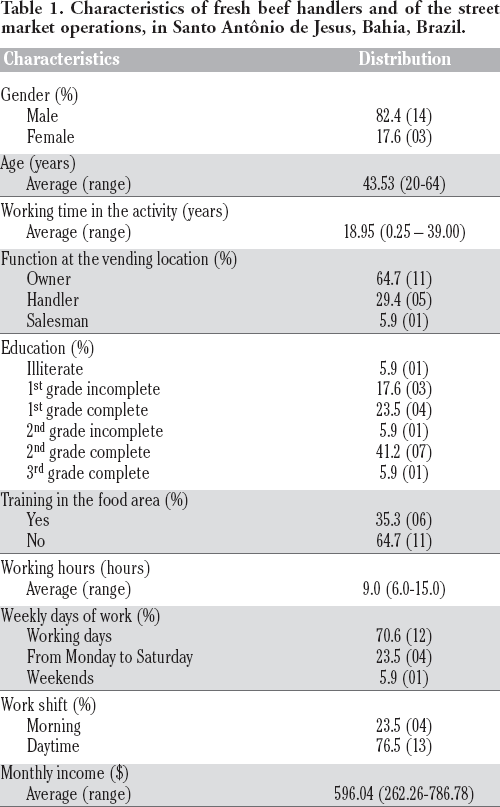
As shown, most of the meat handlers were male, in line with the results obtained by Santos et al., 12 who identified meat handlers in Portuguese butcheries, and by Grace et al., 21 in Ibadan, Nigeria.
With regard to age and time in the street market, the insertion of men and women, still young, who experienced long lasting activity, often giving continuity to family businesses, was observed. In Bahia, in the street markets meat trade, there is a family tradition which passes from father to son, without specific professional training. Similarly, in Nigeria, in the city of Ibadan, Grace et al. 21 report family involvement as a tradition in the meat trade at the local street market.
The meat handlers considered in this study, were predominantly owners of the vending locations, had low-level formal education and no professional training regarding handling, preservation and/or food safety. Those who reported having taken courses or some type of training pointed out entities such as the Brazilian Service for Support to Micro and Small Enterprises, the National Business Apprenticeship Service and the city's slaughter house as leading training entities.
In this framework, it is evaluated that the lower level of education and the less specific training of vendors constitute indicators that are unfavorably associated with the adoption of Good Food Production Practices.12,22 The information of the respondents indicating low professional training is similar to findings reported by Haileselassie et al., 23 who pointed out that 38.5% (10) of the meat handlers in the city of Makelle, Ethiopia, received personal hygiene training.
In another scenario, Santos et al. 12 exhibited more adequate data regarding Portuguese butcher shops, since 97.7% (86) of the handlers reported having participated in training programs on good handling practices, work safety and food hygiene. For 62.5% (55), training had occurred less than one year before.
At the Santo Antônio de Jesus street market, in general, meat vendors worked during daytime, from Monday to Saturday, in accordance with the days and time of larger flow of people in the place. With regards to the working day, an extensive workload was observed varying from 6 to 15 hours, a condition that, in some cases, was tempered by the shifting of work activities with family members and/or employees.
Owners of beef vending locations reported earning an average of US$596.04/month 1 . This amount may reflect the family income of 76.5% of the participants, since they reported that earning as being the only income, constituting their family's support (data not submitted).
This amount represents 2.3 times the Brazilian minimum wage.
In this context, it is assessed that the sellers’ socioeconomic conditions, the lack of specific training, the working conditions and the limited budget for improvements in trade contribute negatively to the preservation and quality of the marketed meat.
Working practices, acquisition and storage of meat
In 70.6% (12) of the vending locations surveyed, the handlers operated in small butcher shops, while the remaining 29.4% (5) were employed as butchers in small supermarkets that also marketed other foodstuffs.
When observing the commercial structures, specifically the small butcher shops, a progressive attempt of improvement in hygiene and safety conditions of raw beef in the local street market was noticed. This framework resulted from the efforts of regulatory bodies and also the adhesion of some traders themselves.
According to city reports, the street market historically offered fresh beef in wooden shacks, in a very rustic condition. After the spatial organization and sectorization of the market by type of merchandise, and the set up of the small butcher shops, the wooden shacks were removed. The new constructions, built in masonry, offered better infrastructure, with tiled flooring, sinks and water points and space for the installation of refrigerating equipment, such as refrigerated counters, refrigerators and freezers. The installation of the refrigeration counters reduced meat exposure to the external environment and to direct contact by consumers.
One exception, however, should be made to this process of change: the small butcher shops with better structure were intended only for the sale of the front and rear cuts, while marketing of the viscera remained in the shacks, which, despite the modifications, still present many inadequacies. Perhaps, due to the higher consumption of offal by the low-income population, the butcher shops only met the interests and demands of a more affluent public. In 94.10% (16) of the vending locations surveyed, equipment for the preservation and/or storage of the meat was available. Refrigerated counters 35.3% (6) and refrigerators 29.4% (5) were predominant. Freezers, 17.6% (3), and cold chambers 11.8% (2) were also mentioned, but in many cases, failures were observed, such as temperature outside the proper range (>5ºC); meat storage not in compliance with the maximum capacity of the equipment, making it difficult to effectively cool the pieces; in addition, frequent opening of the refrigerator doors putting the content in contact with ambient air (+/-30ºC during the study period) resulted in high temperatures inside.
Moreover, inappropriate use of temperature and improper handling of meat pieces persisted. In 23.5% (4) vending locations, meat exposure at room temperature and within reach of consumers could be observed.
This finding may be partly explained by the introduction of incorrect, culturally established practices and behaviors of vendors who attempt to meet customers’ expectations or “demands”. As an example, they kept the meat at room temperature still considered “fresh” by the consumers or allowed direct hand contact for evaluation of the meat, which, according to Minnaert and Freitas, 24 is also a cultural practice that associates food quality with the sensory characteristics, recognized by the appearance and touch.
The in loco observations detected insufficient hygiene measures taken by the meat handlers, i.e., poor personal hygiene, absence of uniforms, sanitizer for cleaning knives and other tools or cleaning products for the sellers’ hands, although the majority reported daily cleaning of utensils (70.6%) and hands hygiene performed several times throughout the working day.
In the literature, different scenarios were found, often linked to the level of development of the countries. In studies by Seeiso and McCrindle 25 in Lesotho, by Almeida et al. 6 in the street market of Paranatama, Pernambuco, Brazil, and by Bogere and Baluka 26 in slaughterhouses and butcheries in Kampala, Uganda, all developing countries, totally inappropriate trade structures were reported as well as meat exposure in wooden structures covered with cardboard and canvas, in addition to temperature abuses that promoted high levels of contamination.
On the other hand, the studies of Ramalho, Moura and Cunha 27 and Santos et al. 12 performed in Portugal, a developed country, describe better structural situations. As inadequacies, the use of wood or rust-contaminated surfaces and utensils was highlighted and inappropriate practices of the meat handlers, which hindered effective control of critical points and implementation of the Hazard Analysis and Critical Control Points (HACCP).
In Santo Antônio de Jesus most of the interviewees reported buying meat from the local slaughterhouse and a minority 11.8% (2) reported supply by local cattlemen operating in the region. Although they all referred to refrigerated truck transport and receipt of chilled half carcasses, one of the vendors admitted not knowing whether the meat purchased came from inspected slaughterhouses.
Regarding the destination of surplus meat not marketed during the same day, the majority, 52.9% (9), reported to freeze or refrigerate that meat, while salting was an option for 35.3% (6) of the sellers, as a way to preserve the raw material allowing for subsequent trade, in the same street market and in other street markets. Other destinations, 11.8% (2), were also mentioned, such as the use as domestic animal feed or the use as an input in the production of snacks.
As to the results of the microbiological and physical chemical analyses, they will be presented in reverse order to the methodology described herein, since the preservation conditions and intrinsic meat characteristics are factors of great influence in the determination of their microbiological quality.
Physicochemical and microbiological quality
Temperature data at the time of collection, pH and color of beef cuts are summarized in Table 2, grouped according to the sales structure, observing the structural differences evidenced in the field.
Temperature, pH and color measurements of fresh beef cuts purchased at the Santo Antônio de Jesus street market, Bahia, Brazil.

IIQ, interquartile interval; L*, luminosity; a*, red index; b*, yellow index. Medians of the same line, followed by different letters, differ significantly according to the Mann Whitney U test (p<0.05).
Regarding temperature, quite high temperatures are observed, which are far from those recommended for the preparation and preservation of fresh beef by refrigeration, from 0 to 4ºC, or freezing at -18ºC. Although available in the large majority of the vending locations, refrigerators were overloaded, with poor cooling capability, presenting fluctuations and insufficient temperature control, which contributes to failures in the cold chain to maintain raw beef quality. Despite the higher temperatures for the supermarket group, the medians did not differ statistically (p=0.88).
In general, studies conducted in street markets and workingclass markets describe temperature abuses by the lack of refrigeration equipment.10,11 In this study, despite the availability of refrigeration and/or freezing equipment, both small butcher shops and small supermarkets presented poor temperature control.
Distribution of samples according to the pH range 20 revealed that the pH of 70.6% (24) of the samples was lower than 5.8; 26.5% (9) of the samples were in the range considered appropriate for consumption (5.8-6.2); and one sample (2.9%) had a pH greater than 6.4, consistent with initial decay or DFD (Dark, Firm and Dry) cut. In this connection, there was a significant difference in pH among vending locations (p=0.01), being higher in the small butcher shops.
Most of the samples had pH values below 5.8, which may indicate recent maturation and short storage times at points of sale. In this sense, some factors may influence the pH, such as the species, diet offered, pre-slaughter stress and carcass temperature. 19 The occurrence of a faster decrease in pH associated with high temperature in the carcass causes denaturation of myofibrillar proteins, which are responsible for the water retention capacity. Thus, the meat will present greater water loss, lighter color and more flaccid consistency, favoring the development of lactic acid bacteria. 28
In the pH range of 5.8 to 6.2, meat preserves its characteristics and nutritional properties, such as water retention capacity and texture, while meat in the pH range over 6.4 exhibits a darker color and firmer texture. 7 In addition, meat with a pH superior to 6.4 provides optimal range of proteolytic enzyme activity, increased bacterial growth and decreased shelf life, 28 representing the beginning of the decomposition stage. 7
The pH is directly related to the conservation and quality of beef, as it influences several physical aspects of the product such as color, water holding capacity, juiciness and tenderness. The literature also establishes the relationship between the pH and the color of the meat, used as the main sensory characteristic when purchasing beef cuts.19,29
Regarding the color, it was verified that the values of L*, a *and b* obtained in the small butcher shops and supermarkets did not differ statistically (p>0.05). There was no significant influence of pH on color parameters, although it is a factor intrinsically associated with the color of the meat.19,30,31
Chmiel et al. 32 evaluated the relationship between pH and color components in bovine cuts (semimembranosus). In this study, the average value of the L* component was 23.7 units for DFD beef, while the normal meat registered 34.7 units, with significant difference. Component a* showed a similar trend to L *while b* did not reveal differences.
According to the literature, in addition to the pH, the intensity of meat color depends on the concentration and chemical status of myoglobin. 30 It is worth noting that the beef sample investigated remained under very similar conditions of temperature and oxygen exposure in the two commercialization structures, which may, in part, explain the findings.
In addition, studies in the field of veterinary medicine point to pre-slaughter factors, such as the level of physical activity of the animal, race, sex and age more influential in the increase of muscle myoglobin and color intensity19,30 than the post-slaughter factors addressed in this study.
Regarding the tests for quality assessment, all the cooking test samples showed satisfactory behavior, i.e., no changes were detected in the sensorial characteristics of odor and texture after heating. On the other hand, the results for the filtration assay indicated quality changes in at least 17.65% (6) of the samples, considering that soluble protein decomposition products will slow down the filtration process. The other samples’ filtration time was consistent with the classification of fresh meat (35.29%) (12), while 47.06% (16) of the samples were filtered between 6 and 10 minutes, being classified as meat of medium preservation. 20
Mesquita et al., 7 when analyzing bovine cuts received at a university restaurant in Rio Grande do Sul, Brazil, identified sensorial changes in 46.7% (n=30) of the samples, according to the cooking test, while 43.3% (n=30) of the samples presented filtration time outside the limits established by the legislation.
As to the assays for the detection of fraud (addition of sulphite, nitrite and formaldehyde), all samples yielded negative results, in compliance with the legislation, which prohibits the presence of these additives in fresh beef. 20 This result can be considered positive, in view of the different problems of meat authenticity, which include the addition of forbidden ingredients as a form of economically motivated adulteration.
Table 3 summarizes the results of the microbiological analyses of the meat samples, considering the procurement sites. Results were expressed as presence or absence of Salmonella spp. in a 25 g sample, while the total coliform and E. coli counts were expressed as CFU/g and converted to log CFU/g. The results of the microbiological analyses were checked against the limits established by Resolution 12/2001 of the Joint Board of Directors of the National Health Surveillance Agency. 33 The product analyzed was classified into the category: Meat and meat products, category A, that includes chilled or frozen fresh beef of which standard is no Salmonella spp. in 25 g. As can be seen, the total coliforms group was present in all samples, in the two categories of vending locations, with no significant difference in the median value. However, in the small supermarkets, the count range showed discretely lower values than in the small butcher shops. As to E. coli, a lower prevalence was observed in the samples (about 40%) and a smaller population of microorganisms, although this is a very unfavorable result, considering the contamination of enteric origin and the potential presence of pathogenic strains. 34 Thus, the findings demonstrate inadequate meat handling and preservation conditions, leading to initial contamination and microbial multiplication, at unacceptable levels, implying that such meat is not safe for consumption.
Characteristics of the meat samples purchased in the street market of Santo Antônio de Jesus, Bahia, Brazil, regarding microbiological contamination.

Only positive sample counts were converted to log CFU/g. Medians of the same column followed by equal letters do not differ significantly according to the Mann Whitney U test (p<0.05). IIQ, interquartile interval; ND, not detected.
Regarding Salmonella spp., the microorganism was identified in two samples collected from the small butcher shops. Although, this microorganism presents low prevalence in unprocessed beef, 8 according to Rivera-Betancourt et al., 35 feces and animal skin represent the main sources of Salmonella contamination. Thus, contamination of carcasses may suggest cross-contamination during the slaughtering process and indicates the need to adopt good hygiene practices.8,9
Other studies have described bacteriological load in meat marketed in several municipalities, expressing results as average and standard deviation values. In this study, median and quartiles were used. Therefore, the comparisons were made considering statistical specificities. Findings by Phillips et al. 9 enhance the concern with the use of adequate hygiene practices and temperature in the entire meat production and distribution chain. In addition to registering a median of 1.30 log CFU/g for E. coli and the identification of Salmonella spp. in 1.1% (4) of the samples, the authors highlighted relevant counts of coagulase-positive staphylococci and consequent contribution of the handling procedures to the bacterial load of the raw material examined. Erdem et al., 36 when evaluating ground beef marketed in butcher shops and supermarkets in Istanbul, Turkey, reported average values of 6.00 log CFU/g and 4.30 log CFU/g for total coliforms and E. coli, respectively. Also in Turkey, in the provinces of Aydin and Afyon, Siriken 37 identified 30% (21) and 10% (7) samples contaminated with E. coli and Salmonella spp. respectively. Descriptions provided by Bogere and Baluka 26 in Kampala, Uganda, show similarities to those of the present study. According to the authors, the counts of coliforms and E. coli, 6.69 log CFU/g and 5.02 log CFU/g, respectively, were higher in butcher shops, when compared to the average counts of more controlled environments, such as slaughterhouses, with 2.69 log CFU/g and 4.92 log CFU/g, in the same order.
Brazilian sanitary legislation for the food trade does not establish tolerance limits for total coliforms and Escherichia coli count in chilled or frozen fresh meat of bovine, porcine and other mammals origin. 33 This regulation only requires the absence of Salmonella spp. Specifically, the Ministry of Agriculture, Livestock and Food Supply highlights Resolution 1233 as the legal basis for production and establishes standards for chilled boneless bovine meat that includes limits for: Salmonella spp.; coliforms at 45°C and Coagulase-Positive Staphylococci (CPS). Similarly, the Commission of the European Communities, Commission Regulation (EC) No 2073, 38 determines absence of Salmonella spp. In the United States, in turn, slaughter establishments are required to carry out tests for E. coli and Salmonella spp. detection in bovine and porcine carcasses. 39 In both cases, the monitoring of products and processing plants through the HACCP system is mandatory. The Indian government regulatory body, Food Safety and Standards Authority of India (FSSAI), establishes limits for total coliforms, molds and yeasts, E. coli, Staphylococcus aureus, but is omissive to Salmonella spp. and Listeria monocytogenes in fresh meat. 40
In this connection, it is estimated that the counts recorded in Santo Antônio de Jesus can be considered high, when compared with studies that revealed data of the same magnitude for ground meat,22,36 a raw material which reflects environmental and equipment contamination, as well as handling issues and temperature abuse.
The results obtained from the Fisher test evidence the influence of the storage conditions of the raw material on microorganisms count, since there was a statistically significant association (p<0.02). The hygiene conditions of the utensils (p=0.39) and of the environment (p=0.87), as well as the sellers’ habits (p=0.79) were not significantly associated with the microbial load. Filtration time had no statistically significant association with the microbial load of the samples, as well as with the pH ranges.
Conclusions
This study aimed to characterize the problem of food safety and quality of raw beef in the street market of a municipality in the state of Bahia, Brazil, considering the trade conditions and the physical, chemical and microbiological assessment of the meat. Based on the results, it may be concluded that the activity occurred in unfavorable conditions for the maintenance of meat quality in both vending locations structures.
The physicochemical analyses did not indicate signs of adulteration or fraud in the samples, however, they revealed, in general, supply of a product of medium preservation, with faults in the cold chain maintenance and changes that were imperceptible to the consumer. The microbial load found showed contaminations, mainly by coliforms and E. coli, which can be associated with the improper storage conditions, temperature abuse, as well as non-compliance with hygiene requirements for food commercialization, maximizing the risks for consumers. Despite the improved structural condition of the supermarkets, no difference was found in the temperature range for meat preservation, as well as in total coliforms and E. coli counts in the two sales structures.
This description corroborates with other studies in the country, and reaffirms challenges for the meat supply in the domestic market. Therefore, the results indicate the need for strategies that can promote raw material protection as well as maintenance of the cold chain, in order to preserve meat quality, preventing consumers’ hazards.
Given the scenario of concern, it is worth mentioning that the hygiene and sanitary control at the vending locations are essential to ensure food quality. Meat trade in street markets demands attention of the regulatory agencies, as a defense system to promote food safety and public health. By doing this, in addition to providing safe meat to the international markets, the country would fulfill its role in supplying quality meat also to the domestic market.