






Abstract
Background
A large number of occupational accidents happen at steel industries in Iran. The information about these accidents is recorded by safety offices. Data mining methods are one of the suitable ways for using these databases to create useful information. Classification and regression trees (CART) and chisquare automatic interaction detection (CHAID) are two types of a decision tree which are used in data mining for creating predictions. These predictions could show characteristics of susceptible people exposed to occupational accidents. This study was aimed to predict the outcome of occupational accidents by CART and CHAID methods at a steel factory in Iran.
Design and methods
In this study, the data of 12 variables for 2127 cases of occupational injuries (including three categories of minor, severe and fatal) from 2001 to 2014 were collected. CART and CHAID algorithms in IBM SPSS Modeler version 18 were used to create decision trees and predictions.
Results
Five predictions for the outcome of occupational accidents were created for each method. The most important predictor variables for CART method included age, the cause of accident and level of education respectively. For CHAID method, age, place of accident and level of education were the most important predictor variables respectively. Furthermore the accuracy of CART and CHAID methods were 81.78% and 80.73%, respectively for predictions.
Conclusions
CART and CHAID methods can be used to predict the outcome of occupational accidents in the steel industry. Thus the rate of injuries can be reduced by using the predictions for employing preventive measures and training in the steel industry.
Significance for public health
The aim of this paper is to show that classification and regression trees (CART) and chi-square automatic interaction detection (CHAID) techniques can be used for detection of vulnerable individuals exposed to the occupational accidents at steel plants.
Introduction
Occupational accidents threaten the lives of many people annually and are also the cause of a high percentage of disabilities. Occupational accidents can lead to negative consequences such as fatalities, disability and missed work days.1,2 The international labour organization (ILO) announced every 15 seconds, 153 workers experience occupational accidents and one worker dies owing to the work-related illnesses. In addition, ILO stated that approximately 4% of the gross domestic product (GDPs) of countries is spent to compensate for damages caused by accidents. 3 In Iran approximately 14,000 occupational accidents occur annually. 2 The steel industry is one of the world's most dangerous industries. The frequency of occupational accidents in the steel industry is higher than others. Data on occupational accidents are usually recorded, but the main challenge is the extraction of useful information from suitable sources. 4 One solution to this problem is the use of data mining methods.5-7 Data mining techniques are one of the most useful methods of extracting meaningful data. This includes using a set of statistical methods.4,8-12 Studies in many different countries have been conducted using these data mining methods in various scientific fields.7,13-15 Data mining methods can be used to reduce accidents by uncovering the vulnerable individuals at industrial workplaces.2,7 Among the different methods of data mining, the decision tree is one of the powerful and common tools for creating predictions. 10 In this study, classification and regression trees (CART) and chi-square automatic interaction detection (CHAID) methods were chosen. The CART method was designed by Breiman et al. in 1984. The CART method generates a decision tree by Gini index. 16 The Gini index is a data categorizing scale that creates nodes.16-20 The CHAID method was introduced by Kass in 1980. 21 In CHAID method, production of nodes carried out by the chi-square test. 21 Previous studies show that it is possible to predict the outcome of occupational accidents by using the CART and CHAID methods.14,15 Furthermore, the results obtained by the CART and CHAID methods are easier to understand and have a desirable accuracy.22,23 The current study was carried out to predict the outcome of occupational accidents by the CART and CHAID methods at a steel factory in Ahvaz, a south-western city of Iran.
Materials and methods
Study design
The current retrospective study was conducted at a steel factory in Ahvaz, the centre of Khuzestan province in south-west Iran at the year 2015 (Figure 1). The study site (factory) was a manufacturing complex of 6 units (steel making, pipe rolling, beam rolling, bar rolling, kowsar rolling and machinery). The inclusion criteria for cases were included; 1) accidents with complete data for 12 variable of this study, 2) accidents took place between 2001 and 2014. The criteria for exclusion of cases were included; 1) accidents with no data for any variable of this study, 2) accidents that happen before 2001 and after 2014. Informed consent was taken from all individuals that their information was used in this study. In this study, data of 2127 occupational injuries were collected. All data were related to male workers. Then, 207 cases were ignored owing to missing data. The injuries were categorized as minor (1554 cases), severe (357 cases) and fatal (9 cases) damages based on working day lost. 22 The data were related to 12 variables (Figure 2). The outcome of occupational accidents was the main (target) variable. The predictor variables included age, level of education, work shift, place of accident, time of the accident, the season of the accident, the day of the accident, the cause of the accident, using protective equipment, work experience, and marital status (Figure 2). They were categorized based on previous studies (Figure 2).7,23

Diagram of the study.

Classification of predictor variables for prediction of the outcome of occupational accidents and demographic characteristics of participants (The colors in all charts represents the outcome of occupational accidents, green; minor injury, yellow; severe injury and red; fatal injury).
Statistical analysis
Data were processed by CART and CHAID algorithms in IBM SPSS Modeler version 18. To prepare and test the model, data were categorized into two groups of training and testing, about 70% of data were randomly assigned to model training and the rest 30% was considered for model assessments. 22
Results
Accuracy of models and important predictor variables
The predictive accuracy of the CART and CHAID methods were almost similar (81.78% and 80.73%, respectively). The most important predictor variables based on the CART method in predicting the outcome of occupational accidents included the age, the cause of the accident, level of education, using protective equipment, the day of the accident, marital status, working experience and place of accident respectively. The most important predictor variables based on the CHAID method included age, place of accident, level of education, using protective equipment, and time of accident respectively. For both methods, age was the most important predictor variable.
Decision tree and predictions
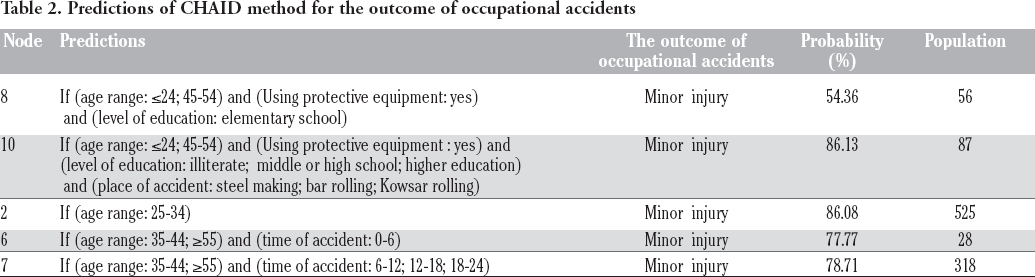
A decision tree and five predictions were created for the CART and CHAID methods (Figures 3 and 4; Tables 1 and 2). All predictions achieved by the CHAID and CART methods were related to minor injuries, except for one prediction by the CART method that was related to severe injuries (Tables 1 and 2).

The decision tree for prediction of the outcome of occupational accidents based on the CART method.

The decision tree for prediction of the outcome of occupational accidents based on the CHAID method.
Predictions of CART method for the outcome of occupational accidents.

Predictions of CHAID method for the outcome of occupational accidents
Interpretation of the CART model
Node 0 was divided into two branches based on the age. This indicates that the most important predictor variable in the categorization and prediction of the outcome of occupational accidents was age (Figure 3). Node 1 on the left side of the tree was related to injured subjects in an age range of 25-34 years. This indicates that people within this age range are more vulnerable to occupational injuries when compared to others (Figure 3; Table 1). In terms of the causes of accidents, node 2 on the right side of the tree was branched into node 5 and node 6. With respect to node 6, the frequency of minor injuries (78%) among individuals within the age ranges of ≤24, 35-44, 45-54, and ≥ 55 years who were injured owing to slipping, falling, explosion and fire, struck by something, contact with high temperature, or multiple cases was higher than those of workers injured owing to other factors (trapped, contact with hazardous substance, or electrical shock) (Figure 3; Table 1). Node 9 was branched into nodes 17 and 18 based on the accident site. This indicates that the risk of severe injuries was higher in the pipe and beam rolling units, compared with other sections (units for steel making, machinery, bar rolling, etc.) (Figure 3; Table 1).
Interpretation of CHAID model
The similarity to CART model, in CHAID model also age was the most important predictor variable in the categorization and prediction of the outcome of occupational accidents (Figure 4). Node 0 was branched into the node 1, node 2 and node 3 (Figure 4). Node 1 was branched into node 4 and node 5. Node 4 was branched into node 8 and node 9. Node 8 shows that the frequency of severe injuries among workers with an elementary education was higher than that of others (45.63%) (Figure 4; Table 2). Node 9 was branched into node 10 and node 11. This shows that the risk of severe injuries was higher in the pipe and machinery units (37%) compared with other sections (units for steel making, beam rolling, bar rolling, etc.) (Figure 4). Node 5 shows that the frequency of minor and fatal injuries among individuals within the age ranges of ≤24 or 45-54 years (who did not use protective equipment) was 70% and 3%, respectively (Figure 4). Node 2 shows that the risk of minor injuries was higher in the age range of 25-34 years (88%) compared with other age groups (Figure 4; Table 2). Node 3 was branched into final nodes 6 and 7. Node 6 shows that the frequency of fatal injuries in individuals within the age ranges of 35-44 or ≥55 years was 5%, during 00:00-5:59 (Figure 4; Table 2).
Discussion
More than 300,000 workers die annually due to occupational accidents worldwide. 24 In addition, occupational accidents impose huge financial losses on industries and society. 25 The steel industry is among the industries that workers face many dangers due to the nature of their jobs. 26 Therefore, the possibility of occupational accidents is high in steel industry. 27 Predicting the outcome of occupational accidents is useful when implementing preventive strategies. 25 Safety managers can reduce the prevalence of accidents by using the predictions of CART and CHAID for detecting susceptible people. According to this study, age was the main predictor variable in predicting the outcome of occupational accidents for both models. Age is a personal factor that can change the physical and cognitive skills of workers, and affect their ability to perform their duties. 28 The highest rate of injuries occurred in the age range of 25-34 years, in both methods (Figures 3 and 4). This result can be justified owing to unfamiliarity with environmental conditions, low experience, and lack of skill in using the equipment. In the older age ranges, the rate of occupational accidents was lower, but the outcome of occupational accidents was worse. The higher rate of severe injuries in the older age ranges may occur because employees were accustomed to the work and consequently do not comply with safety procedures. These results were consistent with previous studies.28-30 According to CART and CHAID method, the prevalence of injuries among individuals with high school education and lower ones were 69.56% and 54.36% respectively (Figure 2C). This may be related to their inadequate awareness of safety measures. These findings correlate with previous studies.28,31 Meanwhile, in the CART model, the maximum rate of injuries (61%) occurred from Sundays to Wednesdays (Figure 2B). This may result from a heavy workload during these days. These results were similar to those of Rahmani et al. 25 The higher frequency of minor and severe injuries during the morning shift (6:00-11:59) may be related to the high workload of the staff at morning shift. In this regard, the current study was in agreement with the previous studies.7,31 In addition, the higher frequency of fatal injuries during the night shift (00:00-5:59) may be associated with drowsiness during this time interval. In this study, accidents mostly occur among married subjects, regardless of the outcome of occupational accidents, the reason can be attributed to the high number of married subjects. These results were similar to those of Rahmani et al. (Figure 2D). 25 Moreover, this study shows injuries mostly occurred in subjects with work experience <5 years (Figure 2K). This finding was in agreement with the study of Ujwala et al. The reason can be attributed to less experience, inadequate skill, and lower concentration over job among younger workers, compared with their older counterparts. 24 According to the result of this study, the CART and CHAID algorithms are two useful methods for safety offices in order to develop a strategy for prevention of accidents at steel plants in Iran.
Conclusions
The CART and CHAID algorithms were suitable for predicting the outcome of occupational accidents in a steel factory. Furthermore, safety officers can reduce the rate of accidents by using the predictions for detecting vulnerable workers in steel plants. The data of accidents that happen before 2001 were not available and it was limitation of the current study. Finally, it is recommended to employ other methods of data mining such as C5, support vector machine (SVM) and Bayesian networks to predict the outcome of injuries in steel industries for future studies.32-34
Footnotes
Contributions: MVN, study concept and design, acquisition of data, drafting of the manuscript, critical revision of the manuscript for important intellectual content, administrative, technical, material support, analysis and interpretation of data. GAS, ASM, study supervision. Conflict of interest: the authors declare that they have no conflicts of interest.
Funding: This study was financially supported by Ahvaz Jundishapour University of Medical Sciences (Grant no. U-94161).
Acknowledgments
The authors thank the managers and workers of steel production company in Ahvaz, Khuzestan province in Iran, for their help and assistance.