






Abstract
Background
Environmental pollution has become a global health risk. Exposure to pollutants at the work place, i.e. occupational exposure, is one of the areas that need immediate attention. The civic drainage workers are exposed to pollutants present in the wastewater they handle and most of them are toxic heavy metals. Exposure to such pollutants may be a health hazard, since it can lead to the imbalance in nutrient elements status.
Design and Methods
In the present study, profiling of trace elements in the blood of drainage worker population from an Indian megacity, Kolkata, was carried out by energy dispersive x-ray fluorescence (EDXRF) and compared with the control group population of the same area.
Results
The elements detected by EDXRF spectrometry include P, S, Cl, K, Fe, Cu, Zn, Se, Br, and Rb. By using ANOVA with 5% significance level, we observed significant alterations in the trace elements status, iron over loading, selenium deficiency, and in Cu-Zn ratio. Gender specific variations within the same population were also observed.
Conclusions
The results indicate that the drainage workers have altered elemental profile in comparison to that of control population.
Introduction
Evaluation of health hazards due to occupational exposure to pollutants is gradually growing as a major public health concern around the globe. Working population is exposed to a wide range of contaminants from various sources like industrial, vehicular, municipal wastes etc. Individuals dealing with the municipal wastes like sewage and/or drainage cleaning are occupationally exposed to a broad range of pollutants like volatile organic compounds (VOCs), poly aromatic hydrocarbons (PAHs), heavy metals, endotoxins,1,2 and also pathogens such as bacterial aerosols present in the municipal waste water. 3 Such chemicals and pathogens affect the health of employees of the related jobs. The lack of safety measures and associated life style risk factors, i.e. addiction to tobacco and alcohol, make the workers more vulnerable to occupational health hazards. 4 Symptoms associated with adverse health effect due to occupational exposure have been well documented by several authors.5-8 A study has pointed out the occurrence of skin ailment in farmers engaged in agriculture handling the waste water. 9 It has been already observed that there is a difference in the concentration of trace elements in nail and hair between the rural and urban population. 10 However, there is a lack of reports on the status of trace elements in the drainage worker population.
Significance for public health
Environmental pollution is a global health risk and awareness among sewage workers is growing very slowly in many developing countries. Due to this fact, workers are often exposed to different pollutants which are responsible for several health complications. Imbalances in the presence of trace elements in blood are a symptom of different health status and could also indicate new health perspectives for the future. In the present scenario, this paper is essential since this kind of analysis has not been done yet, especially regarding the health status of sewage workers. We hope this initial study will be a starting point for future investigations.
In human, 23 elements have physiological activities, and 11 can be classified as trace elements. They include the transition metals such as Vanadium (V), Chromium (Cr), Manganese (Mn), Iron (Fe), Cobalt (Co), Copper (Cu), Zinc (Zn), Molybdenum (Mo), and the non-metals such as Selenium (Se), Fluoride (F), and Iodine (I);11,12 they are trace elements opposed to elements considered macronutrients such as Phosphorus (P), Chloride (Cl), etc. Some trace elements such as Mn, Zn, Cu, help in catalytic activity and act as an integral part of enzymatic activity. Imbalance in the trace element status, i.e. both deficiency and surplus, lead to alterations in physiological processes which ultimately result in decline in health condition. 13 Homeostasis of trace elements is a cascade of regulations that include uptake, accumulation and release of concerned elements to maintain the optimum concentration required for normal physiological activity. Elemental interactions, both synergistic and antagonistic, are integral part of homeostasis. Sewage or drainage workers may be contaminated with heavy metals, VOCs and PAHs through ingestion or through damaged skin, 14 and this may lead to alterations in trace elemental profile. The present study aims to carry out the blood trace elemental profiling of 95 workers involved in sewage work in Kolkata Metropolitan Corporation (India) and compare the same with that of the healthy population living in the same environment.
Design and Methods
Sample collection
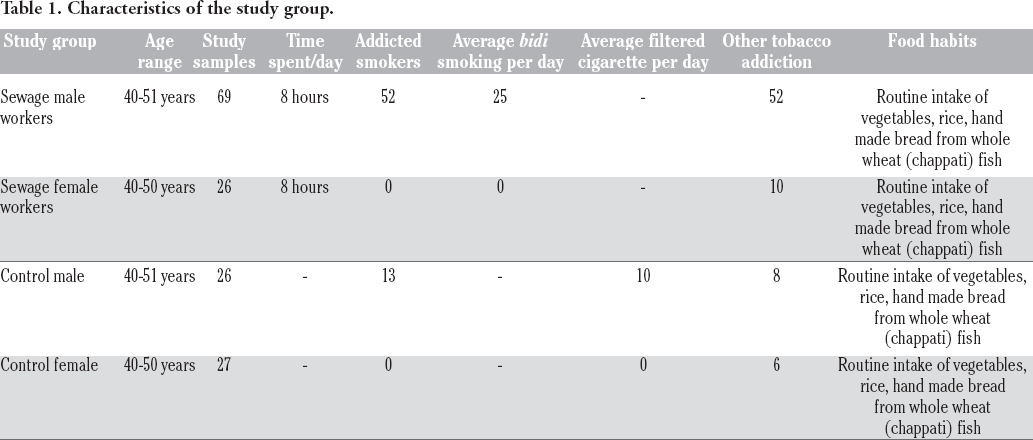
Ninety-five sewage workers having a fixed and compatible monthly income and 53 control population donated blood voluntarily. The sample size of the control and the investigating group was unequal, although they were matched in respect of variables like food habits, locality, study area, drinking water source, age profile and the economic background. As a consequence, we cannot apply any paired test between the two groups and this unequal sample size should not be a problem. People who were not permanent residents due to job requirement were also excluded for this study as control group since the working place and environment might be different from the residential area from where blood were collected and control groups were involved in small scale business. Hence the samples of two groups (control and workers) are not equal in number but very akin to all characters except for the occupation, which is responsible for health complication. Again, women sewage workers are less in number due to the socioeconomically structure where still women prefer to be home makers and are reluctant to do this type of heavy shifting job. In India women hardly smoke, so there were no working woman with smoking habit and working males are addicted to bidi, a non-filter smoke. Another tobacco habit included tobacco dust, tobacco tooth cleaner etc. Very few control subjects take it and those few who do, do it rarely. The study subjects were briefed about the purpose of the study and written consent was obtained from each subject. Blood was collected from the anterior cubical vein following clinical procedure at the beginning of the working hours and transported in containers containing citrate (3.85%). To prevent coagulation the samples were kept at –80°C refrigerator until further processing for trace element estimation.
The study population was very important and steamy since those collected subjects had some common factors like same food habit, same working time span, more or less equal numbers of years exposure to this occupation and age range lied between 40-50 years. Their lifestyle pattern is given in Table 1.
Characteristics of the study group.
Trace element estimation by energy dispersive x-ray fluorescence spectroscopy
The blood samples (2 mL) were lyophilized at –80°C. The blood samples were dried powdered using mortar and pestle. One hundred and fifty mg of powdered sample was taken and compressed to form a pellet of 13 mm diameter, with a table top pelletizer using 100 kg/cm2 pressure. The pellets were subjected to Energy Dispersive X-ray Fluorescence (EDXRF) Spectrometer (EX3600; Jordan Valley Semiconductors Ltd, Austin, TX, USA) which consists of an oil-cooled Rh anode x-ray tube (maximum voltage 50 kV, current 1 mA). The measurements were carried out in vacuum. Different filters were used between the source and sample for optimum detection of elements. The concentration of trace in the blood samples was measured by EDXRF technique – a highly sensitive, non destructive, multi elemental technique. The main principle of the EDXRF is based on the principle of bombardment of x-rays onto the samples followed by analysis of the characteristic x-rays using a liquid-nitrogen-cooled Si (Li) detector having a resolution 150 eV at 5.9 KeV. The quantitative estimation of the trace elements were carried out by analysing the spectra using the nEXT software integrated with the EDXRF system. Representative spectra for different elements in terms of channel number versus intensity were given in Figure 1. The spectrometer was standardized for quantification of the elements using different Standard reference materials (SRM) such as SRM1515-Apple leaf; SRM 1577b- Bovine liver from National Institute of Standards and Technology and IAEA-A-13- Animal Blood reference material from Analytical Quality Control Services, International Atomic Energy Agency (IAEA).

Representative spectra for different elements detected by energy dispersive x-ray fluorescence spectrometer.
Statistical analysis
ANOVA was performed for evaluating statistical significance at the 5% probability level.
Results
EDXRF analysis showed presence of P, S, Cl, K, Fe, Cu, Zn, Se, Br, Rb and Sr in the blood samples collected from the drainage workers and control population. Out of these elements Fe, Cu, Zn, Se and Br showed remarkable difference between working group and control population. Data are given in Table 2.
Trace elemental status of different group (all units are in mg/L).

The statistical significance (P-values for t-test) of the variations between different groups is depicted in Table 3.
P values for different group after t-test.

C all, control group irrespective of gender; W all, working group irrespective of gender; CM, control male group; WM, working male group; WADC, working addicted group irrespective of gender; WNADC, working non addicted group irrespective of gender; CF, control female group; WF, working female group.
Concentration of Fe was found to be approximately 3% increased in case of whole working population with respect to control population. The standard values for healthy male are 1800-1900 mg/L and for female 1700 mg/L. 15 there is 13.2% increase in Fe concentration in working female was observed in comparison to control female population. Interestingly a reversal trend has been observed in case of male where ∼6% less Fe was found in worker male population with respect to control male population. However, working males have ∼ 4% less Fe when compared with working female group. When compared to the control population, the non-addicted working population has shown 2.86% higher Fe levels irrespective of gender (Table 1).
In the present study, it has been found that in case of working class there is a tendency of increasing blood Cu concentration (Tables 1 and 2). Standard value for healthy human is 6 mg/L. The working population has an increased Cu level (4.5%) compared to the control population. Similarly in working male population, the Cu level is ∼15% higher than the respective control male. But working females have ∼9% less Cu compared to the control female population. Comparison between working male and working female group shows, working males have higher Cu (∼6%) in blood, whereas control males have less Cu concentration compared to the control female population. Addicted workers also have high blood Cu concentration (∼12.6%) than the non-addicted workers irrespective of gender.
Zn concentration also showed considerable difference between working group and control population (Table 2). Standard value is 25-28 mg/L. The overall working group has higher Zn level (∼1.5%) than the control population. This is more prominent in case of working female, whose Zn concentration is higher by ∼15% compared to the respective control population. But control males have higher blood Zn concentration than that of control female (10%). When compared between working male and working female, it is observed that working males have less Zn concentration (∼6%) than the respective working female. In addition, the male workers have 5.67% less blood Zn concentration than the control male population. Further it has been observed that addicted workers irrespective of gender have lower Zn (∼9%) than the non-addicted workers. Besides, the data point out that non-addicted worker group has higher Zn level (∼7%) than the control population; however, addicted population has lesser Zn (∼1.3%) concentration than the control population (Table 1).
The Cupper (Cu) and Zinc (Zn) ratio also varied between the working group and the control population. In the working group it was higher by ∼13.42% than the control population. In male workers, Cu/Zn ratio is ∼20% higher than the control male population. The working male population also has higher (12.5%) Cu/Zn ratio in comparison to their female counterparts. However, control female population has higher (∼8%) Cu/Zn ratio than the control male population. It was observed that within gender specific working groups, addicted male workers have very marginal difference (only 1.2%) with the non addicted male worker whereas, addicted female workers have an elevated (17.4%) Cu/Zn ratio than the non addicted female workers.
In case of Se, a reverse trend has been observed (Table 1). The standard value is 3 mg/L. The working group has lower (41.66%) Se compared to control population. Gender specific variation in case of Se showed 109.8% lesser Se in working female population than the control female. Similarly, observation showed 48.4% lesser Se in working male than their respective controls. However, worker males have higher (∼52%) Se concentration than their working female population. The control male population group has higher (∼32%) Se concentration than the respective control female. On the other hand, addicted workers have more (∼10.5%) Se concentration than non-addicted workers.
Trend of Br concentration in the blood is parallel to that of Se (Table 1). Standard concentration 12-14 mg/L. The working population have less Br 24.38% compared to that of control population. Compared to control male and control female groups both working males and working females have lesser Br concentration 13% and 35.2% respectively. Data showed that the control males have lesser Br (∼21%) than the control female population; likewise working male group has lesser Br (∼6%) than the female worker group (Figure 2).

Variation (%) iron, copper, zinc, selenium, bromine concentration between different groups. a) Working-control, b) working male-control male, c) working female-control female, d) control male-control female, e) working male-working female.
Discussion
The present study emphasizes the imbalances in trace element concentration in blood of the drainage/sewage worker population. Major highlights of the findings are the significantly higher level of Fe in blood of the working population compare to control group, alteration in Cu/Zn ratio and changes in the levels of Br and Se.
Fe, one of the most essential trace elements in the body, is commonly associated with the oxygen carrying function. In the present study, it has been observed that Fe concentration in the whole blood of working group is higher than the control population and also Fe overload in the working females (Table 1). In case of control population there is very little chance of food contamination so it is almost impossible to release more Fe from gut to bloodstream. Thus it is easier for them to maintain constant blood Fe concentration. This Fe overload is sometimes also responsible for releasing different free radicals which are also responsible for premature aging and age related complication. 16 In addition absorption of any element via inhaled air varies between 7-10%. But when people have unhealthy habits like lack of proper hand washing, ingestion of contaminated food or smoking during occupational exposure, 17 Fe adsorption from alimentary tract may increase up to 20% and this may be one of the probable causes for increased Fe in the working group. 18 This may be also due to alteration of Fe transportation protein and this is also responsible for Fe overload in duodenum and subsequently is released in blood. 15 This mismanagement of Fe in cellular system can lead to production of Reactive oxygen species, cell damage apoptosis. Poor Fe concentration in working males in comparison to their female counterparts may be attributed to their random tobacco consumption habit, as it has already been established that heavy tobacco intake lowers the serum Fe concentration. 19 Such imbalance and decrease of Fe concentration in the working population makes them prone to infections and/or inflammations and may lead to carcinogenic development. 20
Cu and Zn are both essential trace elements present in the body. Both the elements are involved in enzymatic and other physiological processes. 21 But it has been reported that increased Cu is pro-oxidant where as Zn acts as an anti-oxidant. 22 Higher concentration of Cu may cause inflammatory reaction in body. 23 In the present study it has been found that in case of working class there is a tendency of increasing plasma Cu concentration. The total working population has higher Cu level compared to the whole control population (Table 2). The most probable explanation is that sewage water is overloaded by Cu and previous workers have already reported that waste water specially urban runoff is enriched with Cu, since it is contaminated from different industrial and painting waste and Cu has the ability to form different complex with organic matters, 24 so the presence and accessibility to the sewage workers is high and higher in case of male sewage workers because of social structure they are first in the queue to get inside the manhole and in higher exposure level. However, excessive copper is toxic or even lethal for the cells because it participates in generation of ROS through Fenton chemistry and in the direct oxidation of lipids, proteins and DNA. 16 However, in case of female working population the Cu level is found to be less in comparison to the respective control population. This lower level of Cu in serum may be attributed to gastrointestinal disease, 25 or may be induced by higher level of Zn. 26 Our results also suggest Zn accumulation in the working female population. Cu and Zn generally interact with each other, especially when Zn level is high. High Zn level interfere with Cu absorption since both compete for the same absorption site in the gut. 13 Cu, depletion in women is generally associated with depressed enzymatic ceruloplasamin and Cytrochrome C- Oxydase in platelets and mono nucleated white blood cell. 27 Comparison between working male and working female shows, increased Cu level (∼6%) in the working male, indicating their vulnerability to inflammation.
Zn concentration was found to be more in worker class population, suggesting possible Zn sequestration in the blood. Zn is a common pollutant having several anthropogenic and automobile sources. Increased Zn concentration may be attributed to the fact that, the sewage workers handle the waste and toxic water randomly with bare hand without any protection. Another probable cause is that Zn acts as an antidote for cadmium (Cd) toxicity. It has already reported that blood Cd concentration in sewage workers is high and this is the reason for increasing the Zn concentration since it is trying to defence against Cd toxicity. Nonetheless addicted working population also have higher Cu-Zn ratio than the control population. 28 The male workers have highest Cu-Zn ratio indicating that they are more prone to health hazards. There is evidence that Cu-Zn ratios reflects oxidative stress status, 23 inflammation, 29 and aging, 23 and also have been used as a biomarker of cancer of gallbladder, and breast. 30 In this present study the drainage workers have high Cu-Zn ratio than the control population indicating a possible health risk for this exposed group.
Our data shows reduced Se and Br levels in the blood of sewage worker population (Table 1). The possible explanation is that sewage workers are under stress due to occupational exposure, and heavy metal contamination during working period is responsible for creating different reactive oxygen species which has a direct interaction with Se. Se is conjugated with proteins to make selenoproteins, which are important antioxidant enzyme. 31 There is evidence that Se deficiency may contribute to a form of heart disease, hypothyroidism and weakened immune system. Its deficiency makes body more susceptible to illness. Essentiality of Br as micronutrient has not yet been estimated. Br is nutritionally good for health and its deficiency has been reported in malnourished people. 32 Though apparently sewage workers are not unhealthy and seek but this elemental imbalances arise lots of questions about their future heath status. In control population Br concentration higher compare to the sewage workers. This may be one of the reasons for dietary and quality food habits and if any control subject has elevated Br concentration in blood and further individual follow up is very essential because some time different soft drinks also responsible for increased Br concentration. Previously, it was observed, metabolic perturbations viz, anomalies in carbohydrate, lipid or mineral metabolism due to Br deficiency. 33 On the other hand some researchers reported endocrine disturbances in relation to thyromegaly adrenal adenomatosis in subjects with congenital Br deficiency. 34 The possible reasons for the deficiency may be the eating habit and lack of such micronutrients in the food or also may be due to elemental interaction. However, further in depth study is needed to understand the exact mechanism as there is lack of research report for such kind of observation.
Conclusions
It can be concluded from the present study that the drainage workers are under nutritional imbalance. This kind of imbalance i.e. increased Cu-Zn ratio, Fe overloading and deficiency of Se and Br, indicates the occupational hazards that the drainage/sewage worker population are exposed to. Such imbalances may result in oxidative stress and related diseases like inflammation, cancer and premature aging. This study also highlights the pressing need for further in-depth research on trace element homeostasis with respect to occupational health hazards of sewage workers.
Footnotes
Conflict of interest: the authors declare no potential conflict of interest.
Acknowledgements
The authors are grateful to the Institute of Haematology and Transfusion Medicine, Medical College, Kolkata for medical support, to Centre Director, UGC-DAE CSR, Kolkata Centre for laboratory facilities including EDXRF facility and to Mr Debasis Sengupta for coordination with municipal workers in Kolkata.