






Abstract
Background
The increasing prevalence of HIV in Uganda during the last decade (7.5% in 2004-05 to 8.3% in 2011 among women and 5.0% in 2004-05 to 6.1% among men in 2011 of 15 to 49 years) clearly shows that women are disproportionately affected by HIV epidemic. Hence, we assessed the prevalence of HIV and focused on differences in risky sexual behaviour and knowledge of HIV among Ugandan youth.
Design and Methods
Uganda AIDS Indicator Survey 2011 data was used. The total samples of men and women (15 to 24 years), interviewed and tested for HIV, were 3450 and 4504 respectively. The analysis of risky sexual behaviour was based on 1941 men and 3127 women who had ever had sex and were tested for HIV. Pearson's Chi-square test and multivariate logistic regression analysis were used.
Results
Findings showed that young women were almost two times more vulnerable than young men in acquiring HIV (OR=1.762, P<0.001). Women who had first sex under age 15 (7.3%), had more than 2 sexual partners (9.2%) and did not use condom during last sex (6.4%) were more HIV-positive. Higher risk was found among women (6.3%) than men (2.2%). Significantly (P<0.01) less percentage (81.3%) of women as compared to men (83.8%) perceived that the probability of HIV transmission may be reduced by correct and consistent use of the condom during sex.
Conclusions
Hence, there is an urgent need for effective strategies and programmes to raise awareness on sexual health and risky behaviour, particularly targeting the youth, which will reduce the gender gap in risky sexual behaviour and new transmission of HIV in Uganda.
Introduction
Uganda, with HIV prevalence rate pointed at 18.5% in 1995, was the foremost country in sub-Saharan Africa to reverse its epidemic. 1 The prevalence rate of HIV infection was fallen to 16.3% in 1996 and 14.7% in 1998. By 1999, the HIV prevalence rate had been halved to 8.3%. 2 The registered declines had been attributed to strict anticipatory measures including condom use, public awareness raising campaigns and behaviour amend messages.3,4 But, the achievements of last two decades are getting eroded rapidly by the growing number of new infections. The country is trailing the fight against HIV/AIDS, with the infection rates steadily rising. Uganda is among the few countries where there are signs of an increase in unsafe sexual behaviours and the number of sexual partners among youths. The number of women and girls living with HIV continues to grow fast. 5
Significance for public health
The present study represents the evidence of a recent increase in HIV infection in Uganda from the latest round of AIDs indicator survey. This manuscript describes how young women (15-24 years-old) are disproportionately HIV-infected compared to young men in Uganda. They are more vulnerable to HIV than young men. Moreover, it is also observed that young women are at greater risk of acquiring HIV because of their risky sexual behaviour and inappropriate knowledge of HIV transmission. Some educational programmes, growing gender equity in HIV/AIDS activities and services, dropping violence and coercion, addressing male norms and behaviours, improving women's legal protection, and rising women's access to income and productive resources can be very effective in minimising the vulnerability of young women to HIV/AIDS.
The increasing prevalence of HIV in Uganda during the last decade (7.5% in 2004-05 to 8.3 in 2011% among women and 5.0% in 2004-05 to 6.1% in 2011 among men of 15 to 49 year age) clearly shows that women and girls are disproportionately affected by HIV epidemic. 6 In Uganda, HIV infection cases begin to intensify in the age group 15-19 year and high in the 25-30 year age group. Girls, aged between 15-19 year, are two to six times more susceptible to be infected than boys of that age by the end of 1999. 7 The significant contributors to this trend consist of early age at marriage, early age at first sexual experience, low level of condom use, and a long alleged pattern of older men engaging in sex with adolescents, particularly with girls to avoid contact with HIV. 7 Uganda Demographic and Health Survey (2000-2001) reported that 11% of women aged 15-24 year had first sexual partner of 10 year older than them. 8 The higher rate of HIV transmission among women advocates either discrepancy in the rates of transmission between women and men, higher rates of female sexual disclosure to infected men, or longer survival among HIV-positive women compared to men. 9 The most shocking fact is that, women at their early reproductive span are more infected with HIV, by risking their reproductive health, childbirth and health of their children. 10
Furthermore, Ankrah observed that teenagers are at higher risk of constricting AIDS because of socio-cultural pressures, physical maturity and behavioural factors including early commencing into sexual activity, and the risk was aggravated by short-term relationships, repeated partner changes, multiple partners, low rate of condom use and pessimistic attitudes. 11 Hence, in this context it is imperative to study sexual behaviour in the different sections of the population, to understand the behavioural change, which is still the key approach to controlling the outbreak of HIV. 12
Among Ugandan youth, some aspects of sexual behaviour may vary between the two sexes. It has been reported that roughly one-fourth of girls aged 15-19 year had their first sexual familiarity with someone who is 6 to 20 years older, 13 whereas the comparable figure for boys of the same age group was 2 percent. This pattern of behaviour may have significant proposition for HIV transmission among female adolescents and may be partially responsible for the difference in the prevalence of HIV among women and men. Further, in almost all African societies, masculinity is associated with virility. A UNAIDS report found that notions of masculinity encourage young men to view sex as a form of conquest. 14 In another study, it is found that among 15-19 year olds, 28 percent of males and 27 percent of females believed that a girl did not have the right to refuse sex with her boyfriend. 15 Again, peer pressure of young men encourages to exercise their rights to multiple sexual partners, which signifies their power and masculinity, while for women it is being conditioned to submit to men's leadership and to accept men's infidelity and polygamy. This is a grave concern, as young generation is more vulnerable to STIs and HIV (particularly on the first sexual encounter) due to possible abrasion and tearing of the immature reproductive tract. The level of engagement in high risk-sexual practices, specifically premarital sex and low condom use among youth also contribute to the high prevalence of HIV. 16 Moreover, alcohol intake, chewing of khat (a green leaf) or addicted to other drugs, smoking, low educational background, and being male are also found associated with having sex with multiple sexual partner. 17
Since, it is at this period (i.e. age between 15-24 year) that young person achieve the highest stage of cognitive and physical development, undergo behavioural changes, strive to define their self-identity and possess strong desire to explore sexual accomplishment, 17 and in a situation, when a country is hit by an increasing number of new HIV infection where women are disproportionately infected with HIV, it is important to focus on current situation and contributing factors of HIV prevalence at the national level. Notably, growing difference in the HIV prevalence among young men and women also requires in-depth research and attention of the researchers and policy makers. Hence, there is urgent need to address the current scenario of HIV prevalence among young men and women in Uganda, mainly focussing on their different risky sexual behaviour, and level of knowledge and awareness of HIV transmission.
With this backdrop, the present study has attempted first time to assess the current prevalence of HIV among adolescents and youth (15-24 year) according to their demographic and socio-economic characteristics and by their sex from the latest round of AIDS indicator survey in Uganda. Furthermore, the study has also tried to measure the differentials in the HIV prevalence by risky sexual behaviour, knowledge, and awareness of HIV transmission among young men and women. Moreover, special attention is paid to understand the different risky sexual behaviour and awareness of HIV transmission in association with HIV status among youth from a gender perspective.
Design and Methods
Data and sample
The study is based on data, sourced from Uganda AIDS Indicator Survey (UAIS), 2011. 18 The UAIS, 2011 is a nationally representative, demographic, HIV serological survey. The survey was designed to achieve national and sub-national estimates of the prevalence of HIV and syphilis infection as well as information about other indicators of programme coverage, such as knowledge, attitudes, and sexual behaviour related to HIV/AIDS. The Ministry of Health implemented the UAIS, 2011. ICF International provided financial and technical assistance for the survey through a contract with USAID, Uganda.
The sample was allocated equally across all ten regions to allow sufficient size to produce reliable estimates in each region. The survey used a two-stage sample design. The first stage involved selecting sample clusters from a list of enumeration areas (EAs) covered in the 2002 Population Census. A total of 470 clusters was selected (47 in each region), comprised of 79 urban and 391 rural points. The second stage of selection involved the systematic sampling of 25 households per cluster from a list of households in each cluster that was produced by the Uganda Bureau of Statistics prior to the UAIS data collection. All women and men aged 15-59 years who were either permanent residents of the households in the sample or visitors present in the household on the night before the survey were eligible for interviews. All women and men who were interviewed were asked to give a blood sample voluntarily for testing. In addition, blood samples were drawn from children under age 5, after obtaining a consent from their parents or caretaker. 6
The total samples of men and women (15 to 24 years age), interviewed and tested for HIV, are 3450 and 4504 respectively. Whereas, the analysis of risky sexual behaviour is based on 1941 men and 3127 women who have ever had sex and were tested for HIV.
Variables
All the variables used in the analyses are discussed in two categories: i.e. predictor variables and outcome variables.
Predictor variables: The main predictor variables are re-coded for the purpose of analyses, and for effective comparison with the results. The important variable are sex, age group of young men and women, place of residence, marital status, education level of men and women, wealth quintile, religion, ethnicity and region. Other important predictor variables, related to risky sexual behaviour of youth, are age at first sex, number of sex partner, condom used at first sex, condom used at last sex, consume alcohol during sex, higher risk sex (i.e. sex with a non-marital, non-cohabiting partner), ever heard of AIDS, reduce risk of getting HIV: do not have sex at all, reduce risk of getting HIV: have one sex partner, can get HIV from mosquito bites, can get HIV by sharing food with a person who has AIDS and Healthy looking person can have HIV.
Outcome variables: Most important outcome variable is HIV prevalence, which is re-coded in yes and no.
Statistical analyses
Bivariate and multivariate analyses are used. Significance level of the bivariate association has been shown by Pearson's Chi-square test, whereas significance level of multivariate association is shown by binomial logistic regression analysis. Advantage of logistic regression analysis is that it requires no assumption about the distribution of the independent variables and the regression coefficient can be interpreted in terms of odds ratio (OR). In the present study, logistic regression model is applied to analyse the effect of selected socio-economic factors on men and women's status of HIV. Therefore, binary logistic regression has been used to estimate the adjusted effect of background characteristics as independent variables.
All the statistical analyses in the present study are performed by using the statistical package SPSS, version 20.
Results
Distribution of sample
Table 1 represents the distribution of men and women samples by their background characteristics. Among 7954 samples, 43.4% are men and 56.6% are women of age group 15-24 year. Among total samples, 55.9% youths are 15-19 year old, whereas 44.1% are aged between 19 and 24 year. 22.7% of the total samples are from urban areas, whereas 77.3% are from rural areas. About 65% youths are never in a union, whereas about 30% youth are married and living with their partners. Percentage of women, who are widowed, divorced, separated or no longer living together, is higher (6.6) than the men (2.3) sample with same status. Proportion of Catholic (about 39%) and Anglican/Protestant (about 35%) is much higher in the total samples than the other religious groups. Mean of the total sample is 1.566, and the mean of the standard error is 0.006 (Table 1).
Distribution of sample (15-24 year old) by background characteristics.

Gender differentials in HIV prevalence among youth in Uganda
The present study has found considerable difference in the prevalence of HIV/AIDS among young men and women in Uganda. Huge gap in HIV prevalence among men and women by their risky sexual behaviour, and awareness and knowledge of HIV transmission is also observed. Young women are more HIV positive than young men are in their early reproductive period (Figure 1).

HIV prevalence among youth by sex in Uganda, 2011.
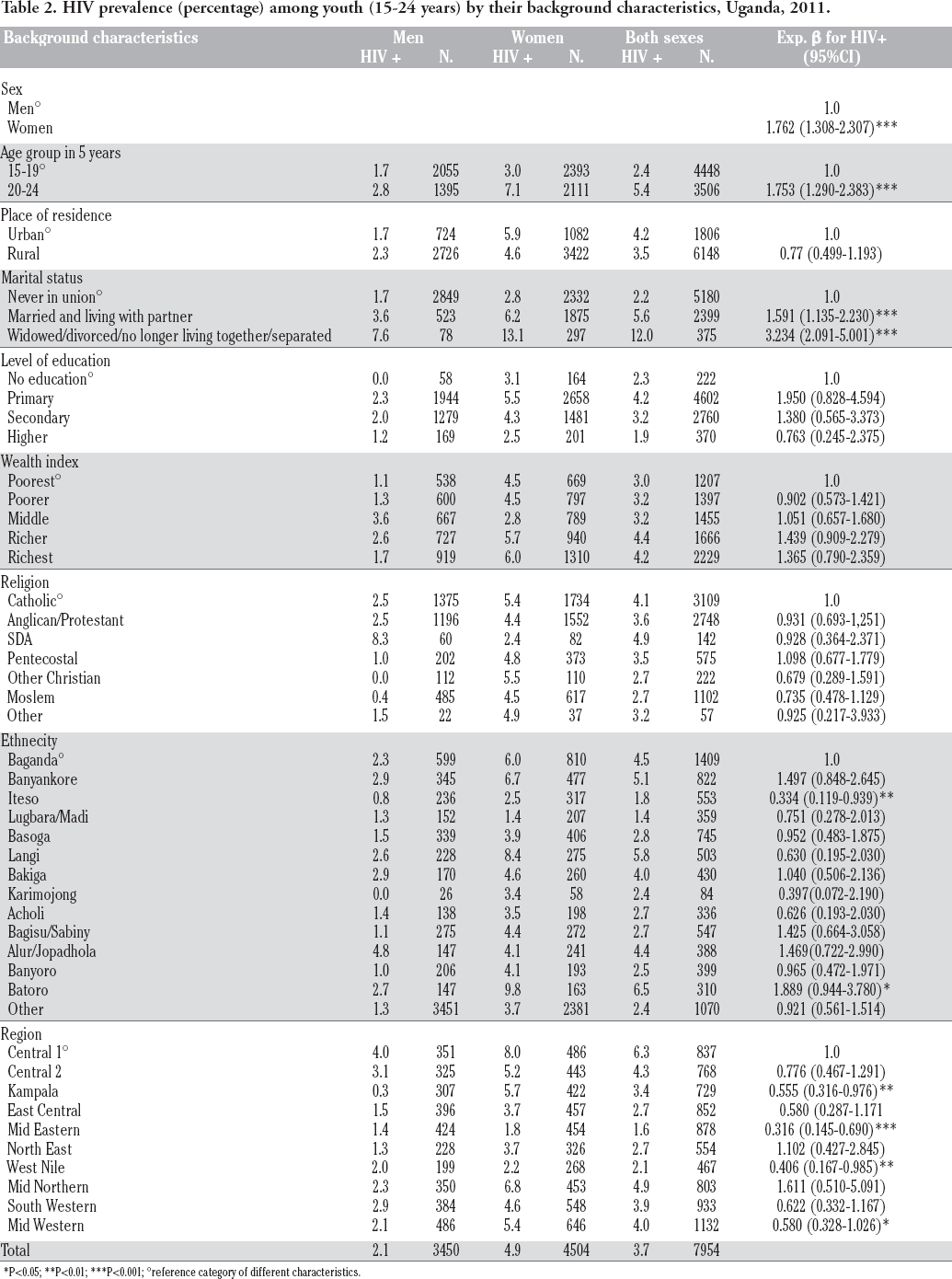
From the bivariate analysis, it has been observed that, young women are much more vulnerable to HIV infection than young men are, irrespective of their other demographic and socio-economic characteristics. Women belonging to the richest wealth quintile (6%); Catholic and other Christian (5.5%) religion; Batoro (9.8%) and Langi (8.4%) ethnic groups, and from Central-1 (8%) and Mid-Northern regions (6.8%) are found to be more HIV positive than men.
The results of logistic regression analysis show that young women (4.9%) are almost two times more vulnerable than young men (2.1%) in acquiring HIV/AIDS (OR=1.762, P<0.001). HIV prevalence is significantly higher among youth aged 20-24 year than youth aged 15-19 year (OR=1.753, P<0.001). Prevalence of HIV is found higher among women than men in all age groups, irrespective of the place of residence, marital status, level of education and economic status. Women married and living with their husband are significantly more (OR=1.591, P<0.001) vulnerable to HIV than women who were never in a union. Further, women widowed or divorced or no longer living together or separated are significantly three times more (OR=3.234, P<0.001) at the risk of acquiring HIV than the women who were never in an union (Table 2).
HIV prevalence (percentage) among youth (15-24 years) by their background characteristics, Uganda, 2011.
P<0.05
P<0.01
P<0.001
reference category of different characteristics.
Risky sexual behaviour and HIV prevalence among youth in Uganda
The study has found increased prevalence of HIV among Ugandan youth associated with their higher risky sexual behaviour. Women are significantly two times more (OR=2.578, P<0.001) likely to be HIV positive for their higher risky sexual behaviour than men. Women who had their first sex at below 15 year's age (7.3%); had more than two sex partners (9.2%, P<0.001) and did not use a condom during last sex (6.4%) are found to be more HIV positive than other groups of women and men. Either partner consumed alcohol during sex (OR=1.509, P<0.01, for men 6.2% and for women 6.9%), and women had higher risk sex, i.e. had sex with a non-marital and non-cohabiting partner (6.3%) were very high threat to get HIV infected (Table 3).
HIV prevalence among youth (15-24 years) who ever had sex and tested for HIV by risky sexual behaviour, Uganda, 2011.

Percentage not shown for fewer than 50 unweighted cases and values not available.
P<0.05
P<0.01
P<0.001.
Reference category of different characteristics.
Excludes missing cases.
Sex with a non-marital, non-cohabiting partner.
Gap in knowledge and awareness among young men and women
From the bivariate analyses, a considerable gap in the knowledge and awareness of HIV/AIDS between young men and women is also found. Results showed though 99% women and 97.9% men had heard about HIV, still 14.2% women and 11.8% men think that HIV can be acquired by sharing food with a person who has AIDS. About 90.8% men and 91.0% women of 15 to 24 year age think that the risk of getting HIV can be reduced by not having sex with many partners. Significantly less percentage (81.3%) of women as compared to men (83.8%) think that always using a condom during sex can reduce the risk of getting HIV/AIDS. Besides, 26.8% women and 28.5% men think that HIV can be spread through mosquito bites (Table 4).
Comprehensive knowledge and awareness of HIV among youth (15-24years) by sex, Uganda, 2011.

P<0.05
P<0.01
P<0.001.
Discussion
Uganda witnessed a significant decrease in HIV prevalence during the period of 1990-2000, because of the strict implementation of ABC model (i.e. Abstinence, Being faithful to one partner, and Condom use). 19 However, the fact is that, recently the prevalence of HIV in Uganda has been increased which has also raised the question of the success of ABC model, 6 as well as also indicates a wider gap in HIV prevalence between men and women.
The findings of the study show that on an average, HIV prevalence is 2.8 percent higher among young women (4.9%) than among young men (2.1%) in Uganda. Further, high HIV prevalence, observed among well-educated and wealthier women, is directly or indirectly more related to economic status of women rather than their educational level. Similar findings also emerged from Berhan and Berhan's study. 20 Besides women's physiologic vulnerability via heterosexual sex, several investigators recognized unemployment and lack of education as revealing factors for women's susceptibility to HIV infection as compared to men.21-24 The findings of the present study also replicate the same piece of evidence that uneducated and less educated women are much more vulnerable to HIV transmission than the higher educated women. Surprisingly, women are becoming more HIV positive than men are, with the increase in their education level. It is also found that, women irrespective of their marital status, are much more vulnerable to HIV than men.
The spread of HIV is mainly due to higher risk sex (UNAIDS, 2010). 25 In a study, it was reported that HIV transmission among three-fourths of HIV positive women was through higher-risk sex. 26 Similarly, the present study shows that, HIV prevalence associated with high risk sex, is much greater among women than among men. For women, other contributors to this trend comprise early age at first sexual experience, early age at marriage, low level of condom use, and a long-standing pattern of older men engaging in sex with adolescents, particularly girls in an attempt to avoid contact with HIV. 1 In this respect, it is mention worthy that women's economic empowerment has been proven to fail at improving women's bargaining positions when it comes to condom use. The young women tend to focus on immediate problems such as poverty and homelessness but not HIV prevention. 27
However, almost 98% Ugandan youth are aware of HIV, still there is a gap between young men and women in terms of level of knowledge of HIV transmission and its prevention. Our research has shown that, young women in Uganda are much more vulnerable to HIV prevalence by their unsafe sexual behaviour than young men are. We have found that women are much more exposed to higher risk sex than men. Several literatures have shown that real knowledge about consequences of unsafe sexual practice does not necessarily result in behaviour change and reduction in HIV and STI prevalence.28-30 Furthermore, young women consumed alcohol during sex, are found to be more HIV positive than young men. Hence, our findings are consistent with those recent studies which showed that men and women who reported alcohol use during their sexual intercourse were likely to engage in unprotected sex.31,32 Our study also shows that, women had more than 2 sex partners, are more vulnerable to HIV than men. The reason behind the practice of having multiple sexual partners could be to find social security by adolescents women. 26 Inconsistent condom use among Ugandan youth in combination with multiple sexual partnerships often increases the risk of HIV transmission. 33 Here, it is mention worthy that because of poverty, many youths in Uganda lack basic needs, and poverty leads some youth, especially girls, to engage in survival sex, commercial sex work, and early, sometimes forced marriages. 34
The only positive change in the high risk groups is the use of a condom to prevent HIV epidemic. In this regard, regular use of condoms by women also seems to be easily compromised when experienced a situation where their anticipated monetary gain is higher than their usual earnings. 1 Higher infection rates in women have significant implications for women's health and survival of their children in Uganda and indicate the need for specially targeted interventions to reduce HIV transmission in this group. 9
Therefore, it is high time to instigate and implement the program focussing the youth especially vulnerable women who are engaged in higher risk sex, which extends but not limited to, unprotected sex (i.e. without use of condom), early sexual activity, especially before age 18, having multiple sex partners, unprotected mouth to genital contact except in a long term monogamous relationship, and exchange of sex for drugs or money.35,36
Conclusions
The crucial factors contributing to high HIV prevalence among Ugandan youths are the risky sexual behaviours which are substantially different from men to women, and lack of proper awareness and existing knowledge gap between men and women with respect to spread of HIV/AIDS. The fact needs to be addressed that despite having proper knowledge to get protection from HIV infection, sometimes, women are getting infected by HIV due to negligence and forced sex by their partner and due to male domination over women's sexual health and their reproductive rights. We need to remember that the potential for the HIV pandemic depends on young people, and the need to scale up programs targeting this group is comprehensible. Now, how they behave and how they'll maintain their sexual lives, will determine the course of HIV pandemic in the future. 37 Therefore, persistent challenges to effective HIV prevention efforts for adolescents and young people should include adequate access to high-quality, youth-friendly HIV and sexual and reproductive education and health services, and diminish sexual violence against young women and girls.
Recommendations
Change in behaviour and spread of appropriate knowledge and awareness of HIV/AIDS prevention are the fundamentals to control the AIDS epidemic in Uganda. Youth should be involved in the intervention design in order to ensure application of program to them. Similarly, the local governments, development partners, civil society organizations in the region should involve youths. School-based programs can be effective in improving youth's knowledge of HIV/AIDS and reducing risky behaviour. Making health services more youth-friendly may lead to increased use of facilities by young people in Uganda. Targeted media and social marketing campaigns should be used in communities to improve young people's knowledge about HIV and AIDS. Promoting peer education i.e. training peers to be positive role models that can certainly influence young peoples’ behaviours, assisting access to and creating a belief among young people.
Moreover, the oversight of woman's sexuality in Ugandan society that has increased the gender discrimination needs to be abridged. Vulnerable women who are on the verge of the risk of getting HIV require protection to reverse the feminization of HIV/AIDS. Some of the programmes can be very effective in this regard, such as growing gender equity in HIV/AIDS activities and services, dropping violence and coercion, addressing male norms and behaviours, improving women's legal protection, and rising women's access to income and productive resources.
Therefore, effective strategies and programs with the collaboration of government and non-government organizations, targeting young women, should be launched and encouraged to cut the rate of HIV prevalence in Uganda. Moreover, proper monitoring and evaluation of AIDS control programs is required to minimise the knowledge gap between men and women.
Footnotes
Conflict of interest: the authors declare no potential conflict of interest.
Acknowledgements
The authors would like to thank to MEASURE DHS+ (assists countries worldwide in the collection and use of data to monitor and evaluate population, health, and nutrition programs) for providing the data.