




Abstract
Background
Methods
Results
Conclusions
Introduction
HCV infects approximately 71 million people worldwide. Patients with chronic HCV infection are at a high risk of developing cirrhosis and hepatocellular carcinoma [1]. An estimated 700,000 annual deaths are attributable to chronic HCV infection [2,3]. The development and approval of new combinations of direct-acting antiviral (DAA) drugs yielded HCV infection cure rates over 95% globally in both large-scale clinical trials and the real-world setting when these combinations were used according to international liver society guidelines [4,5]. Despite the high rates of virological cure achieved with these treatments, HCV infection is not eliminated upon first-line therapy in up to 10% of cases, depending on the patient's profile and the administered regimen. In the French HEPATHER cohort study, the incidence of HCV DAA treatment failures was of the order of 6% globally [6]. Most DAA-based treatment failures are relapses, and they occur more frequently when one or several of the following parameters are present: treatment-experienced patients, cirrhosis, infection with HCV genotype-1a or 3a, presence of the Q80K polymorphism in the NS3 protease region, presence of resistance-associated substitutions (RASs) in the NS5A region at baseline, and/or short treatment duration [7].
The viral populations that constitute the HCV quasispecies differ by amino acid polymorphisms that emerge by mutation during replication and are subsequently selected based on their effects on viral fitness [8]. Natural polymorphisms may confer reduced susceptibility to a given DAA or, more frequently, to a DAA class. As a result, DAA administration selects viral strains carrying RASs on their genome which bear reduced susceptibility to the drugs administered, thereby contributing to treatment failure. Some international liver society guidelines recommended to perform HCV resistance testing at baseline of first-line therapy with certain combination regimens, in order to tailor treatment in patients harbouring RASs in the NS5A region [9,10]. However, the most recent version of the European Association for the Study of the Liver (EASL) guidelines does not recommend using HCV resistance testing prior to first-line therapy, because of the high barrier to resistance and global efficacy of new pangenotypic regimens [11]. Liver society guidelines all recommend performing HCV resistance testing covering the NS3 protease, NS5A and NS5B polymerase regions prior to retreatment in patients previously exposed to a DAA-containing regimen [10,11].
DNA sequence analysis has been based for many years on so-called ‘population’ sequencing (that is, direct sequence analysis of a PCR product) by means of the Sanger method [12]. Population sequencing detects 20% to 30% of the viral populations present in the quasispecies [13]. Thus, minor populations are not detected by this method. They can be identified by clonal sequence analysis, but this approach is time-consuming and cumbersome and cannot be applied to clinical practice. Thus, more sensitive sequencing methods were required. Deep sequencing methods now offer new opportunities for the detection of minor viral populations present at frequencies as low as 1%.
Currently, no standardized assays have been developed as purchasable kits for HCV resistance testing. Resistance testing therefore relies on homemade techniques based on population or deep sequencing. A limited number of laboratories has made these tests available in Europe and in other regions, and the performance of their assays has not been externally validated. The Sentosa® SQ HCV Genotyping Assay (Vela Diagnostics GmbH, Hamburg, Germany) is a novel, fully automated deep sequencing-based assay comprising a customized version of the epMotion 5075 robotic liquid handling system for RNA extraction and sequence library preparation (Sentosa SX101), a customized version of an Ion One Touch device for template preparation including emulsion PCR (Sentosa ST401), the Ion Torrent technology for deep sequencing (Sentosa SQ301), and software for data analysis and reporting (Sentosa Link and Sentosa Reporter, respectively). This assay has received CE-IVD mark in Europe for HCV genotype determination and resistance testing in clinical practice. We recently reported on the ability of this assay to correctly identify the HCV genotype and subtype [14]. The current generation of the assay also has the capacity to identify RASs in the NS3 protease (nucleotide position 1–798 according to the H77-1a prototype strain), NS5A (nucleotide position 39–600) and NS5B polymerase (nucleotide position 990–1677) regions for patients infected with HCV genotypes-1a and 1b.
The aim of the present study was to evaluate the performance of the Sentosa® SQ HCV Genotyping Assay for the determination of HCV resistance profiles in patients infected with HCV genotype-1a or 1b who failed to achieve a sustained virological response (SVR) after receiving a DAA-containing treatment regimen.
Methods
Clinical specimens
Nineteen serum samples collected from patients with chronic hepatitis C infected with HCV genotype-1a (n=14) or 1b (n=5), followed in the Department of Hepatology of the Henri Mondor University Hospital, were studied. All patients had been previously treated by a DAA combination and failed to achieve SVR. The samples were taken at retreatment baseline for HCV resistance testing, frozen and stored at −80°C until testing. Serum HCV RNA levels were measured by means of a real-time PCR assay (Abbott RealTime HCV Assay, Abbott Molecular, Des Plaines, IL, USA) [15]. The HCV genotype and subtype were determined by means of our in-house population sequencing technique targeting the NS5B gene followed by phylogenetic analysis, the reference method for HCV genotype determination [16].
Study design
The presence of HCV RASs in the three regions of interest was assessed in all samples at baseline of retreatment by two methods. The reference method was population sequencing of the NS3 protease, NS5A protein domain I and NS5B polymerase coding regions by means of our in-house techniques [17]. The results were compared with those generated by the deep sequencing-based Sentosa SQ HCV Genotyping Assay. The study was conducted in accordance with the International Conference on Harmonization guidelines, applicable regulations, and the principles of the Declaration of Helsinki. All patients gave written informed consent for the use of leftover specimens.
HCV Resistance Testing by Means of in-house Population Sequencing Methods
Briefly, total HCV RNA was extracted from 400 μl of serum by means of QIAsymphony DSP Virus/Pathogen kit (Qiagen GmbH, Hilden, Germany), according to the manufacturer's instructions. The RNA pellet was eluted with 60 μl of RNAse-free water with 0.04% NaN3. Complementary DNA synthesis was performed with the OneStep RT-PCR kit (Qiagen GmbH) with sets of primers adapted to the viral regions targeted (Table 1). A nested PCR was used to amplify NS3, NS5A and NS5B coding DNA fragments. PCR products were purified by means of NucleoFast 96 PCR plate kit (Macherey-Nagel GmbH & Co. KG, Düren, Germany) and directly sequenced by means of the BigDye Terminator Cycle v3.1 sequencing kit (ThermoFisher Scientific, Courtaboeuf, France) on an ABI 3100 sequencer (Applied Biosystems, Foster City, CA, USA), according to the manufacturer's instructions. Nucleotide sequences were manually corrected and aligned to genotype-1a or 1b reference sequences, respectively, and amino acid changes were deduced from the nucleotide sequences.
Primers used for nested PCR amplification prior to population sequencing of the HCV NS3 protease, NS5A domain I and NS5B polymerase genes, according to the HCV genotype (1a or 1b)

HCV Resistance Testing by Means of Sentosa SQ HCV Genotyping Assay
Briefly, nucleic acid extraction was performed from 530 μl of serum on the Sentosa SX101 robotic instrument using Sentosa Virus Total Nucleic Acid Plus II kit (Vela Diagnostics). The NS3, NS5A and NS5B coding regions were RT-PCR-amplified by means of Veriti Dx 96-Well Thermal Cycler (Applied Biosystems). After purification of PCR products using magnetic beads, a 200-nucleotide fragment library was prepared on Sentosa SX101. The samples were barcoded by ligation, pooled into a single tube and amplified by emulsion PCR on Sentosa ST401i. Deep sequencing was performed by means of the Sentosa SQ Sequencing Kit on the Sentosa SQ301 Sequencer, based on Ion Torrent technology. Primary data analysis was automatically performed using Sentosa SQ Reporter software. Assembled NS3 contigs (944-base pair fragment), NS5A contigs (604-base pair fragment) and NS5B contigs (685-base pair fragment) were aligned with genotype-1a and 1b reference sequences, respectively. The raw sequencing data generated by the Sentosa assay were also analysed by means of the commercial web-based software NGS HCV Module (SmartGene, Lausanne, Switzerland).
Sequence data
The GenBank/ENA/DDBJ accession numbers of the sequences reported in this paper are PRJNA397404.
Results
Characteristics of the study population
Nineteen patients previously exposed to different DAA-containing regimens were included. Most of them (78.9%) were males, with a mean age of 57.8 years (Table 2). The patients were mainly infected with genotype-1a (73.7%) and 12 of them (63.2%) had a baseline HCV RNA level >800,000 IU/ml. Of the 19 patients, 13 (68.4%) had compensated cirrhosis and 4 had advanced fibrosis (F3 in the METAVIR scoring system). Prior DAA-containing regimens included: pegylated interferon (IFN) with ribavirin plus daclatasvir (n=8); pegylated IFN plus daclatasvir and asunaprevir (n=3); sofosbuvir and ribavirin (n=1); sofosbuvir and simeprevir (n=2); sofosbuvir and ledipasvir with or without ribavirin (n=2); daclatasvir and asunaprevir (n=1); daclatasvir and simeprevir (n=1); and ritonavir-boosted paritaprevir, ombitasvir and dasabuvir with ribavirin (n=1). Fourteen patients were retreated, according to the European recommendations available at the time, with the combination of sofosbuvir and simeprevir for 12 weeks (n=11), sofosbuvir plus ledipasvir with ribavirin for 24 weeks (n=1) or sofosbuvir, simeprevir and daclatasvir with ribavirin for 24 weeks (n=2). An SVR was achieved in 10 patients (71.4%). The remaining four patients failed, including three patients who received the combination of sofosbuvir and simeprevir for 12 weeks and one patient treated with the combination of sofosbuvir, simeprevir and daclatasvir plus ribavirin for 24 weeks who discontinued treatment prematurely owing to a severe pulmonary arterial hypertension.
Demographic and virological features of the 19 patients included

DAA, direct-acting antiviral; IFN, interferon.
HCV Resistance Testing by Means of in-house Population Sequencing Methods
Our in-house population sequencing techniques were used for NS3 protease, NS5A domain I and NS5B resistance testing. NS3 RASs were found at retreatment baseline in 11 of the 19 patients (57.9%), including 5 who had never been exposed to any protease inhibitor. All of the amino acid substitutions found (at positions 55, 56, 80, 122, 155 and 168) had been previously reported to be associated with protease inhibitor-containing regimen failures in vivo [18]. The RASs were present in single (n=9), double (n=1) or triple (n=1) mutants. The most frequent amino acid substitutions were at positions 80 (Q80K in three patients and Q80L in one patient) and 155 (R155K in four patients; Table 3). RASs at both positions are known to confer resistance to simeprevir in vitro and in vivo, and reduced susceptibility to second-generation protease inhibitors, including grazoprevir and voxilaprevir [18].
RASs in the NS3 region found by in-house population sequencing and Sentosa SQ HCV Genotyping Assay, respectively

NS3 resistance-associated substitutions (RASs) reported to be associated with resistance to NS3 protease inhibitors in patients infected with genotypes-1a or 1b failing a direct-acting antiviral containing regimen [18].
NS5A RASs were found at retreatment baseline in 17 of the 19 patients (89.5%). All of the NS5A RASs found (at positions 24, 28, 30, 31, 58 and 93) had been previously described to be associated with NS5A inhibitor-containing regimen failures in vivo. The RASs were present in single (n=6), double (n=8) or triple (n=3) mutants. The most frequent amino acid substitutions were at positions 31 (L31M in six patients and L31V in two patients), 30 (Q30R in two patients, Q30K in two patients, Q30E in two patients and Q30H in one patient) and 93 (Y93H in five patients and Y93C in two patients; Table 4). All of these RASs confer various levels of reduced susceptibility to first- and second-generation NS5A inhibitors [18].
RASs in the NS5A domain I region found by in-house population sequencing and Sentosa SQ HCV Genotyping Assay, respectively

NS5A resistance-associated substitutions (RASs) reported to be associated with resistance to NS3 protease inhibitors in patients infected with genotypes-1a or 1b failing a direct-acting antiviral containing regimen [18].
NS5B RASs, including L159F and C316N, were detected in only one patient infected with genotype-1b who had been previously exposed to a combination of sofosbuvir and ledipasvir (Table 5). Both substitutions have been reported to be associated with reduced susceptibility to sofosbuvir [19].
RASs in the NS5B polymerase region found by in-house population sequencing and Sentosa SQ HCV Genotyping Assay, respectively
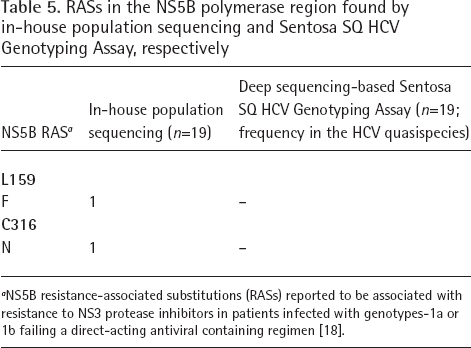
NS5B resistance-associated substitutions (RASs) reported to be associated with resistance to NS3 protease inhibitors in patients infected with genotypes-1a or 1b failing a direct-acting antiviral containing regimen [18].
NS3 Protease RASs Found by Sentosa SQ HCV Genotyping Assay
NS3 RASs were found at baseline of retreatment in 12 of the 19 patients (63.2%) with the Sentosa assay, using the internal assay software for interpretation. All of the RASs found with population sequencing except three were detected by Sentosa HCV SQ Genotyping Assay in high proportions (>80%). The three RASs not identified by the assay were V55I, Y56F and S122T, which confer reduced susceptibility to asunaprevir, grazoprevir and simeprevir, respectively.
Some RASs were detected by the deep sequencing-based Sentosa assay and not with our in-house population sequencing method, including V36A (n=1) and V36M (n=1), Q80R (n=1), D168E (n=1), D168V (n=1) and D168Y (n=1), and V170A (n=1). In all but three cases, they were present as minor viral populations, representing 1.1% to 7.1% of the viral quasispecies (Table 3). The remaining RASs (D168E/V/Y) represented between 15.9% to 33% of the viral quasispecies, as reported by the Sentosa assay software (Table 3).
NS5A RASs Found by Sentosa SQ HCV Genotyping Assay
NS5A RASs were found at retreatment baseline in 18 of the 19 patients (94.7%). All of the NS5A RASs detected by population sequencing except two were also identified by the Sentosa HCV SQ Genotyping Assay in high proportions (>50%). The two RASs not detected by the Sentosa assay included L28M and P58S, which both confer reduced susceptibility to first-generation NS5A inhibitors in genotype-1b-infected patients.
Several RASs were detected by the deep sequencing-based Sentosa assay, but not by our in-house population sequencing method. They included M28V (n=3), Q30E (n=1), Q30R (n=3) and Q30H (n=1), L31M (n=2) and Y93C (n=1), which were generally present as minor viral populations, representing 1.5% to 6.1% of the viral quasipecies. Five NS5A RASs (L31M and Q30E/R) present as more than 10% of the viral quasispecies in the Sentosa assay were not detected by Sanger sequencing (Table 4).
NS5B Polymerase RASs found by Sentosa SQ HCV Genotyping Assay
NS5B RASs at retreatment baseline were not detected in any patient using the Sentosa HCV SQ Genotyping Assay (Table 5).
HCV Resistance Testing by Means of Sentosa SQ HCV Genotyping Assay plus sequence Analysis by Means of the SmartGene NGS HCV Module
Raw sequencing data from the Sentosa HCV SQ Genotyping Assay were reanalysed by means of the web-based NGS HCV Module software developed by SmartGene. Using this method, three additional RASs were identified as compared with using the Sentosa SQ Reporter internal assay software, including a RAS at position 122 in the NS3-coding region and RASs at positions 28 and 58 in the NS5A-coding region.
Discussion
Treatment failure with DAA-based regimens is often associated with the selection of viral variants with reduced susceptibility to the administered drug(s) and, most often, to other drugs from the same class(es). HCV resistance testing may be useful to guide treatment decisions with specific regimens in particular patient populations, when the presence of pre-existing RASs in certain proportions has an impact on treatment outcomes. A number of factors should be taken into consideration, such as the availability of resistance testing in clinical practice, the availability of alternative treatment options, and the consequences of treatment failure associated with resistance. Because treatment options that do not need to be tailored to the baseline RAS profile are available, it is not justified to recommend systematic HCV resistance testing prior to first-line therapy, as stated in the EASL Recommendations on Treatment of Hepatitis C 2018 [11]. In contrast, HCV resistance testing is useful to guide retreatment decisions in patients who have previously failed an IFN-free DAA-based regimen. Nevertheless, no standardized commercial assay is yet available for HCV resistance testing, which still relies on homemade methods using population or deep sequencing.
Sentosa SQ HCV Genotyping Assay, the first available kit for HCV genotyping and resistance testing, is a new automated deep sequencing-based assay that is standardized and easy-to-use without intensive training or specialized skills. In the present study, we assessed the ability of this assay to characterize the HCV resistance profile in clinical samples from patients infected with genotype-1a or 1b who failed a prior DAA-based treatment. Resistance profiles were in keeping with the exposure to different DAA-containing regimens, except in some failing patients who had never been exposed to one or more drug classes.
Our results show good concordance with population sequencing in most cases, especially when the web-based SmartGene software NGS HCV Module was used to analyse the assay's raw sequence data. Our data suggest that the Sentosa SQ Reporter software used for bioanalysis of raw sequence data needs to be improved, in particular its database of prototype reference strain sequences used for alignment. Interestingly, the design of the assay did not allow it to correctly identify RASs in the NS5B-coding region, especially those able to confer reduced susceptibility to sofosbuvir (RASs at positions 159, 282 and 316) because these mutations are localized outside the target region, which is amplified by the assay.
As expected, the deep sequencing-based assay was more sensitive than population sequencing to detect minority variants, representing less than 10% of the viral populations, but also some variants representing up to 30% of the viral quasispecies. This is in keeping with the estimated sensitivity of both methods (1% for deep sequencing, 20–30% for population sequencing). Discrepant results could be explained for at least NS3 RASs by the time between failure and HCV resistance testing. As suggested NS3 RASs are replaced by the wild type within 24 to 48 weeks [20,21]
Despite the relatively small number of patients studied, our study suggests that the deep sequencing-based Sentosa SQ HCV Genotyping Assay can be confidently used to characterize the HCV resistance profile prior to retreating patients who failed a DAA-based regimen. The study included only genotype-1a- and 1b-infected patients, the most prevalent subtypes in industrialized countries, because the Sentosa SQ HCV Genotyping Assay has been designed so far only for these subtypes. However, the assay has the capacity to identify RASs for all genotypes and a second version of the assay with improved genotype coverage and with the ability to detect RASs that are associated with resistance to sofosbuvir is in development.
Our study has limitations. First, it was performed with a relatively small number of patients. Secondly, the performance of this assay in non 1a- or 1b-infected patients was not tested.
In conclusion, the present study assessing the clinical performance of HCV resistance testing with the new deep sequencing-based assay Sentosa SQ HCV Genotyping Assay showed excellent concordance with population sequencing in patients infected with genotypes-1a and 1b, suggesting that this assay can be confidently used in clinical practice in the indications of HCV resistance testing for these subtypes. Technical improvements are now required to allow for pangenotypic coverage and enrichment of the database with reference prototype strains for determination of amino acid changes, as previously reported for HIV resistance [22].
Footnotes
Acknowledgments
We would like to thank VELA Diagnostics GmbH, Hamburg, Germany for providing the Sentosa SQ HCV Genotyping Assay kits.
This work was supported by internal funding.
JMP acted as advisors for Abbott and SC acted as advisors for Abbott and Cepheid. The remaining authors declare no competing interests.