




Abstract
Background:
Nucleoside reverse transcriptase inhibitors (NRTIs) are an effective class of agents that has played a vital role in the treatment of HIV infections. (−)-β-D-(2R,4R)-dioxolane-thymine (DOT) is a thymidine analogue that is active against wild-type and NRTI-resistant HIV-1 mutants. It has been shown that the anti-HIV activity of DOT is limited due to poor monophosphorylation. Methods: To further enhance the anti-HIV activity of DOT, an extensive structure-activity relationship analysis of phosphoramidate prodrugs of DOT monophosphate was undertaken. These prodrugs were evaluated for anti-HIV activity using Hela CD4 β-gal reporter cells (P4-CCR5 luc cells).
Results:
Among the synthesized prodrugs, the 4-bromophenyl benzyloxy L-alanyl phosphate derivative of DOT was the most potent, with a 50% effective concentration of 0.089 μM corresponding to a 75-fold increase in activity relative to the parent nucleoside DOT with no increased cytotoxicity. The metabolic stability of a selected number of potent DOT phosphoramidates was also evaluated in simulated gastric fluid, simulated intestinal fluid, human plasma and liver S9 fractions.
Conclusions:
A series of new phosphoramidate prodrugs of DOT were prepared and evaluated as inhibitors of HIV replication in vitro
Introduction
Currently, there are 26 approved antiviral agents for the treatment of HIV infections, including nucleoside reverse transcriptase inhibitors (NRTIs), non-nucleoside reverse transcriptase inhibitors, protease inhibitors, a viral fusion inhibitor, a CCR5 corecep-tor inhibitor and an inhibitor of the viral integrase [1]. NRTIs have been shown to be the backbone of HIV HAART [2]. However, the emergence of drug resistance and toxicity continues to be a concern with existing therapies [3–5]. Therefore, efforts to improve efficacy and address the issues of drug resistance and toxicity have led to the exploration of novel nucleosides for the treatment of HIV.
(−)-β-D-(2R,4R)-dioxolane-thymine (DOT) is a thymidine analogue that is active in vitro against wild-type and clinically significant NRTI-resistant HIV-1 [6,7]. It has been shown that the anti-HIV activity of DOT is limited because of poor monophosphorylation, the first step in the phosphorylation pathway to the triphosphate. It is the nucleoside triphosphate that is the active inhibitor of DNA synthesis. The nucleoside triphosphate acts as a substrate for the reverse transcriptase, becomes incorporated into the growing DNA chain and consequently acts as a chain-terminator of viral DNA synthesis, thus inhibiting viral replication. However, in many cases, nucleoside analogues are poor substrates for the nucleoside kinase [8] that converts the nucleoside or nucleoside analogue to the required monophosphate, while the subsequent phosphorylations to produce the di- and triphosphate derivatives are usually not rate-limiting. In order to bypass this first rate-limiting step required for nucleoside analogues, nucleoside phosphoramidate derivatives have been developed as a potential nucleotide delivery strategy. The phosphoramidate strategy permits the bypass of the initial nucleoside-kinase-dependent step, by the intracellular delivery of the monophosphorylated nucleoside analogue and masks the monophosphate as a more membrane permeable form [9,10]. Phosphoramidate nucleotide delivery technology has been applied to a variety of antiviral nucleosides [10,11]. This drug delivery strategy has also been shown to improve the pharmacological activity of parent nucleosides [9,12].
Previously Chu and coworkers [13] synthesized a series of DOT phosphoramidates as anti-HIV agents. The anti-HIV activity of these compounds was evaluated in peripheral blood mononuclear cells against a mutant of the LAI strain of HIV containing the M184V amino acid change in the reverse transcriptase, and were evaluated for their cytotoxicity. It was found that several DOT aryl phosphoramidates showed an enhancement in anti-HIV activity (8–12-fold) without cytotoxicity. These findings prompted us to explore the DOT phosphoramidate series further with the objective of extending the structure-activity relationship (SAR) around the DOT phosphoramidate prodrug moiety in the hope of identifying analogues with enhanced potency that are free of cytotoxicity and that possess properties that are suitable for further development. Our medicinal chemistry approach focused on fine-tuning the three groups around the phosphorus atom, namely the aryloxy, amino acid and ester moieties, to optimize antiviral activity (Figure 1).
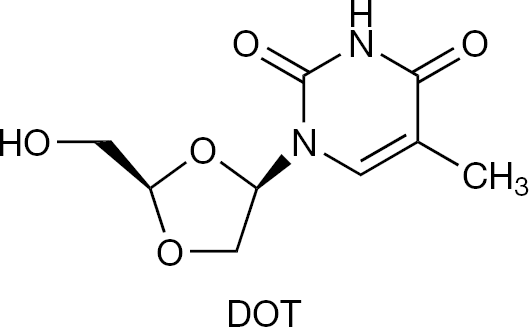
Structure of DOT
Materials and methods
Chemistry
Reactions were monitored by thin layer chromatography with Analtech TLC Plates (Analtech, Inc., Newark, DE, USA) and visualized by ultra-violet (UV) light or by charring in 5% sulfuric acid in methanol. Nuclear magnetic resonance (NMR) spectra were recorded on a Bruker Avance II 400 MHz spectrometer (Billerica, MA, USA) and on a Varian Mercuryplus 400 MHz spectrometer (Varian, Inc., Palo Alto, CA, USA). Proton NMR spectra were recorded in CDCl3 or DMSO-d6 as noted at room temperature. Chemical shifts (δ) are reported in parts per million (ppm), and signals are reported as singlet (s), doublet (d), triplet (t), quartet (q), multiplet (m) or broad singlet (br s). 31P NMR spectra were recorded in CDCl3 with tri-phenylphosphate as an external standard. UV spectra were recorded at 254 nm of PDF detector of HPLC. Column chromatography was performed using silica gel (100 A) from Shanghai Sanpont (Shanghai, China). The purities of all final compounds were determined using a HPLC gradient method and were >95%. The purity of the compounds was assessed by Shimadzu HPLC 20AB (Shimadzu Corp, Kyoto, Japan; Sepax HP-C18 4.6×50 mm [5 μm], with a flow rate of 3.0 ml/min, acquire time of 6 min, wavelength of UV 220 and oven temperature of 40°C) and on Waters (Mil-ford, MA, USA) Alliance 2695 separations module, Waters 2996 PDA detector (Waters Atlantis dC18 5 μm, 3×150 mm, with a flow rate of 0.7 ml/min, acquired time of 40 min); chiral HPLC was conducted on Shimadzu HPLC 20A. LCMS was conducted on Shimadzu LCMS 2010EV using electrospray positive equipped with a Shim-pack XR-ODS 2.2 μm column (3.0 mm×30 mm), eluting with 0.0375% trifluoroacetic acid in water (solvent A) and 0.01875% trifluoroacetic acid in acetonitrile (solvent B). The preparative HPLC was conducted on a Gilson Nebula system with Gilson 156 UV/Vis detector, a Gilson 215 injector and fraction collector, with Unipoint control software. The mobile phase included HPLC grade water (solvent A) and HPLC grade acetonitrile (solvent B) systems. Supercritical fluid chromatography was conducted on Berger MultiGram™ SFC from Mettler Toledo Co., Ltd.
General procedure for preparation of appropriate amino acid ester (2)
A solution of the amino acid in the appropriate alcohol (R4OH) and p-toluenesulfonic acid in anhydrous toluene were heated to reflux overnight until a stoi-chiometric amount of water was removed (Dean-Stark). The reaction mixture was cooled to room temperature, ether was added and the mixture was left in an ice bath for 1 h and filtered and washed with ether (twice). The solid obtained was dissolved in dichloromethane and washed with 10% aqueous K2CO3 solution followed by water. The organic layer was separated, dried and filtered. The filtrate was evaporated under vacuum. The viscous oil obtained was dissolved in acetone and the mixture was neutralized with 1N HCl. The solvent was then evaporated and the solid was titurated with ether to give the product as white solid, which was filtered, dried under vacuum at 40–50°C and was used without further purification (Figure 2).
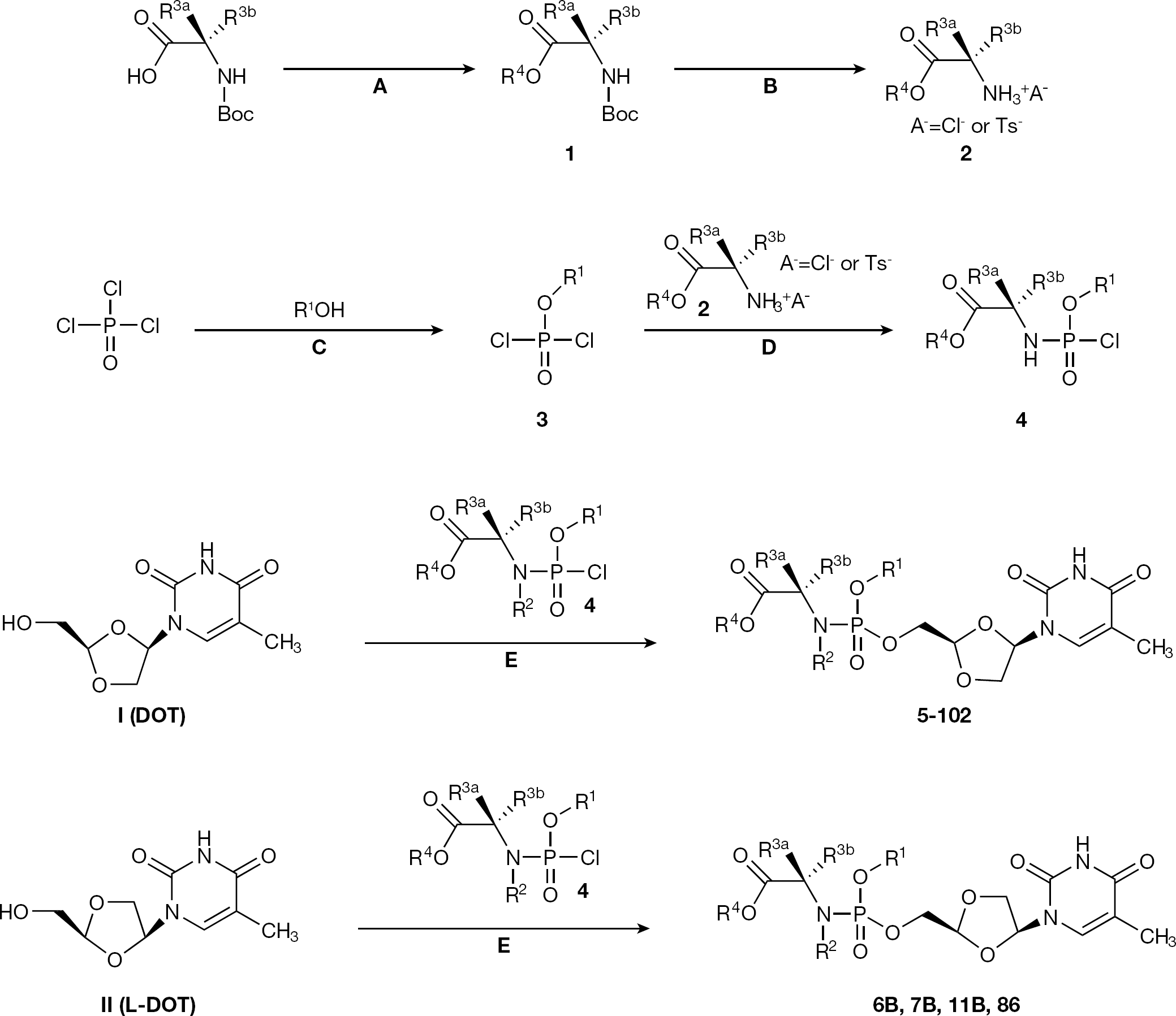
Synthesis of DOT phosphoramidates
General procedure for preparation of phosphorodichloridates (3)
A solution of the suitably substituted phenol R1-OH (1 equivalent) and triethylamine (1 equivalent) in anhydrous ether was added dropwise to a stirred solution of phosphoryl trichloride (1 equivalent) at 0°C over a period of 3 h under nitrogen. The temperature was then warmed to room temperature, and the reaction was stirred overnight. The triethylamine salt was removed with suction filtration and the filtrate concentrated in vacuo to dryness to afford 3 as an oil that was used directly without purification, or distilled under vacuum.
General procedure for preparation of phosphorochloramidate (4)
A solution of triethylamine (2 equivalents) in anhydrous dichloromethane was added dropwise to a solution of aryloxy-phosphodichloridate
General procedures for DOT phosphoramidate derivatives
Method 1
A solution of the appropriate phosphorochloramidate
Method 2
Method 2 was conducted via in situ generation of the phosphochloramidate [14]. To a solution of amino acid ester (1.6 equivalents) in anhydrous dichloromethane at −5°C to 0°C was added appropriate aryloxy phosphorodichloridate
Preparation of D-dioxolane-thymine 5′-(phenyl ethoxy-alanyl phosphate) (5)
Phenyl ethoxy-alanyl phosphorochloridate (0.52 g, 2.03 equivalents) dissolved in 10 ml of THF was added to a mixture of DOT (0.2 g, 1 equivalent) and N-methylimidazole (0.29 g, 4.05 equivalents) in 10 ml THF with vigorous stirring at room temperature, then the reaction was stirred overnight. Solvent was removed under reduced pressure, and the residue was further purified by pre-HPLC to give the product as a white solid (95 mg, 22.4%). 1H NMR (DMSO-d6) 8 1.11–1.23 (m, 6H), 1.70 (d, 3H), 3.75–3.82 (m, 1H), 4.01–4.06 (m, 2H), 4.11–4.30 (m, 6H), 5.13–5.16 (d, 1H), 6.01–6.11 (m, 1H), 6.28–6.31 (m, 1H), 7.14–7.18 (m, 3H), 7.33–7.38 (m, 2H), 7.41–7.46 (m, 1H), 11.35 (s, 1H); MS, m/e 484.1 (M+1)+.
Preparation of D-dioxolane-thymine 5′-(phenyl isopropyloxy-L-alanyl phosphate) (6)
The yield was 9.3%. 1H NMR (DMSO-d6) 8 1.12–1.21 (m, 9H), 1.70–1.71 (m, 3H), 3.67–3.81 (m, 1H), 4.11–4.15 (m, 1H), 4.20–4.29 (m, 3H), 4.81–4.85 (m, 1H), 5.13 (d, J=15.2 Hz, 1H), 6.00–6.06 (m, 1H), 6.27–6.30 (m, 1H), 7.14–7.18 (m, 3H), 7.32–7.41 (m, 2H), 7.43 (d, J=13.6 Hz, 1H), 11.31 (d, 1H); MS, m/e 498.4 (M+1)+.
Preparation of L-dioxolane-thymine 5′ (phenyl isopropyloxy-L-alanyl phosphate) (6B)
The yield was 56.2%. 1H NMR (CDCl3) 8 1.12–1.21 (m, 9H), 1.70–1.71 (m, 3H), 3.67–3.81 (m, 1H), 4.11–4.15 (m, 1H), 4.20–4.29 (m, 3H), 4.81–4.85 (m, 1H), 5.13 (d, J=15.2 Hz, 1H), 6.00–6.06 (m, 1H), 6.27–6.30 (m, 1H), 7.14–7.18 (m, 3H), 7.32–7.41 (m, 2H), 7.43 (d, J=13.6 Hz, 1H); 31P NMR 8 4.05, 4.23 (44:56) MS, m/e 498.4 (M+1)+.
Preparation of D-dioxolane-thymine 57prime;-(phenyl n-butyloxy-L-alanyl phosphate) (7)
1H NMR (DMSO-d6) 8 0.82–0.83 (m, 3H), 1.23–1.36 (m, 5H), 1.44–1.51 (m, 2H), 1.68–1.73 (m, 3H), 3.69–3.80 (m, 1H), 3.91–3.99 (m, 2H), 4.08–4.27 (m, 4H), 5.12 (d, J=14.8 Hz, 1H), 6.00–6.09 (m, 1H), 6.27 (d, J=5.2Hz, 1H), 7.09–7.14 (m, 3H), 7.32–7.35 (m, 2H), 7.41 (d, J=14 Hz, 1H), 11.31 (s, 1H); MS, m/e 512.3 (M+1)+.
Preparation of L-dioxolane-thymine 5′-(phenyl n-butyloxy-L-alanyl phosphate) (7B)
1H NMR (CDCl3) δ 0.82–0.83 (m, 3H), 1.23–1.36 (m, 5H), 1.44–1.51 (m, 2H), 1.68–1.73 (m, 3H), 3.69–3.80 (m, 1H), 3.91–3.99 (m, 2H), 4.08–4.27 (m, 4H), 5.12 (d, J=14.8 Hz, 1H), 6.00–6.09 (m, 1H), 6.27 (d, J=5.2Hz, 1H), 7.09–7.14 (m, 3H), 7.32–7.35 (m, 2H), 7.41 (d, J=14 Hz, 1H); 31P NMR: 8 4.27, 4.07 (1:1) MS, m/e 512.3 (M+1)+.
Preparation of D-dioxolane-thymine 5′-(phenyl sec-butyloxy-alanyl phosphate) (8)
The yield was 21%. 1H NMR (DMSO-d6) δ 0.93 (m, 6H), 1.13–1.19 (m, 3H), 1.64 (d, J=6.8 Hz, 3H), 1.75–1.78 (m, 1H), 3.67–3.78 (m, 3H), 4.06–4.23 (m, 4H), 5.07 (d, J=15.6 Hz, 1H), 5.98–6.04 (m, 1H), 6.22–6.24 (m, 1H), 7.09–7.12 (m, 3H), 7.26–7.35 (m, 2H), 7.37 (d, J=13.6 Hz, 1H), 11.31 (d, 1H); MS, m/e 512.4 (M+1)+.
Preparation of D-dioxolane-thymine 5′-(phenyl pentyloxy- L-alanyl phosphate) (9)
The yield was 34.5%. 1H NMR (DMSO-d6) δ 0.80 (d, J=4Hz, 3H), 1.14–1.22 (m, 7H), 1.46–1.49 (m, 2H), 1.68 (d, J= 4.4 Hz,3H), 3.70–3.86 (m, 1H), 3.93–4.22 (m, 6H), 5.10(d, J = 16Hz, 1H), 5.98–6.09 (m, 1H), 6.25 (s,1H), 7.11–7.14 (m, 3H), 7.29–7.42 (m, 2H), 7.40 (d, J = 14Hz, 1H), 11.51 (s, 1H); MS, m/e 525.9 (M+1)+; 1072.74 (2M+23)+.
Preparation of D-dioxolane-thymine 5′-(phenyl hexyloxy- L-alanyl phosphate) (10)
The yield was 28.9%. 1H NMR (DMSO-d6) δ 0.74 (m, 3H), 1.12 (m, 9H), 1.44 (m, 2H), 1.64 (d, J=4.8 Hz, 3H), 3.70 (m, 1H), 3.89 (m, 2H), 4.15 (m, 4H), 5.10 (s, 1H), 6.00 (m, 2H), 6.21 (t, J=4.4 Hz, 1H), 7.09 (m, 3H), 7.27 (m, 3H), 11.35 (s, 1H); MS, m/e 539.9 (M+1)+.
Preparation of D-dioxolane-thymine 5′-(naphthalenyl ethoxy-alanyl phosphate) (11)
The yield was 10.4%. 1H NMR (DMSO-d6) δ 1.06–1.14 (m, 3H), 1.19–1.25 (m, 3H), 1.52–1.60 (d, 3H), 3.80–4.03 (d, 3H), 4.10–4.31 (m, 4H), 5.16–5.20 (d, 1H), 6.28–6.33 (m, 2H), 7.41–7.57 (m, 5H), 7.72–7.75 (m, 1H), 7.92–7.96 (m, 1H), 8.05–8.11 (m, 1H), 11.35 (d.1H); MS, m/e 534.2 (M+1)+.
Preparation of L-dioxolane-thymine 5′-(naphthalenyl ethoxy-alanyl phosphate) (11B)
The yield was 50%. 1H NMR (CDCl3) 8 1.06–1.14 (m, 3H), 1.19–1.25 (m, 3H),1.52–1.60 (d, 3H), 3.80–4.03 (d, 3H), 4.10–4.31 (m, 4H), 5.16–5.20 (d, 1H), 6.28–6.33 (m, 2H), 7.41–7.57 (m, 5H), 7.72–7.75 (m, 1H), 7.92–7.96 (m, 1H), 8.05–8.11 (m, 1H); 31P NMR 4.28, 4.44 (33:67) MS, m/e 534.2 (M+1)+.
Preparation of D-dioxolane-thymine 5′-(2-chlorophenyl isopropyloxy-L-alanyl phosphate) (12)
The yield was 30.3% 1HNMR (400 MHz, DMSO) δ: 1.11–1.16 (m, 6H), 1.21–1.23 (m, 3H), 1.67 (s, 3H), 3.72–3.85 (m, 1H), 4.14 (t, J=12.0Hz, 1H), 4.26–4.28 (m, 3H), 4.82–4.84 (m, 1H), 5.16 (d, J=12.0Hz, 1H), 6.27–6.28 (m, 2H), 7.18 (t, J=8.0 Hz, 1H), 7.31 (m, 1H), 7.41–7.51 (m, 3H), 11.37 (s, 1H): MS, m/e 531.88 (M+1)+.
Preparation of D-dioxolane-thymine 5′-(2-chlorophenyl n-butyloxy-L-alanyl phosphate) (13)
The yield was 22.7%. 1HNMR (400MHz, DMSO)δ: 0.82–0.88 (m, 3H), 1.24–1.30 (m, 5H), 1.47–1.51 (m, 2H), 1.68–1.69 (s, 3H), 3.76–3.80 (m, 1H), 3.97–4.02 (m, 2H), 4.14 (m, 1H), 4.26–4.29 (m, 3H), 5.17 (d, J=12.0 Hz, 1H), 6.27–6.30 (m, 2H), 7.18 (t, J=8.0 Hz, 1H), 7.32–7.33 (m, 1H), 7.41 (m, 1H), 7.44–7.47 (m, 1H), 7.51 (d, J=8.0 Hz, 1H), 11.37 (s, 1H); MS, m/e 545.89 (M+1)+.
Preparation of D-dioxolane-thymine 5′-(4-chlorophenyl ethyloxy-L-alanyl phosphate) (14)
The yield was 30.0%. 1H NMR (DMSO-d6) δ 0.74 (d, J=6.8 Hz, 3H), 1.12 (m, 9H), 1.44 (m, 2H), 1.64 (d, J=4.8 Hz, 3H), 3.70(m, 1H), 3.89 (m, 2H), 4.15 (m, 4H), 5.10 (s, 1H), 6.00 (m, 2H), 6.21 (t, J=4.4 Hz, 1H), 7.09 (m, 3H), 7.27 (m, 3H), 11.35 (s, 1H); MS, m/e 517.78 (M+1)+.
Preparation of D-dioxolane-thymine 5′-(4-chlorophenyl isopropyloxy-L-alanyl phosphate) (15)
The yield was 29.9%. 1H NMR (DMSO-d6) δ 1.09–1.19 (m, 9H), 1.68 (d, J=4.8 Hz, 3H), 4.05–4.23 (m, 4H), 4.80–4.81 (m, 1H), 5.11 (d, J=9.2 Hz 1H), 6.05–6.12 (m, 1H), 6.25 (d,1H), 7.13–7.18 (m, 2H), 7.36–7.40 (m, 1H), 11.31 (d, 1H); MS, m/e 531.9 (M+1)+; 1084.71 (2M+23)+.
Preparation of D-dioxolane-thymine 5′-(4-chlorophenyl n-butyloxy- L-alanyl phosphate) (16)
The yield was 42.5%. 1H NMR (DMSO-d6) δ 0.82 (m, 3H), 1.25 (m, 6H), 1.50 (m, 2H), 1.70 (m, 3H) 3.70 (m, 1H), 3.95 (m, 2H), 4.17–4.3 (m, 4H), 5.10 (s, 1H), 6.10 (m, 1H), 6.35 (m, 1H), 7.18 (m, 2H), 7.40 (m, 3H), 11.4 (s, 1H); MS, m/e 546 (M+1)+.
Preparation of D-dioxolane-thymine 5′-(4-bromophenyl ethyloxy-L-alanyl phosphate) (17)
The yield was 21%. 1HNMR (400 MHz, DMSO) δ: 1.11–1.20 (m, 7H), 1.71 (d, J=8.0 Hz, 3H), 4.01–4.02 (m, 2H), 4.03–4.04 (m, 1H), 4.26 (m, 3H), 5.14 (d, J=8.0 Hz, 1H), 6.08–6.19 (m, 1H), 6.28–6.31 (m, 1H), 7.11–7.14 (m, 2H), 7.43 (d, J=8.0 Hz, 1H), 7.54–7.56 (m, 2H); MS, m/e 561.80 (M+1)+.
Preparation of D-dioxolane-thymine 5′-(4-bromophenyl propyloxy-L-alanyl phosphate) (18)
The yield was 46.4%. 1HNMR (400 MHz, DMSO) δ 0.80–0.87 (m, 3H), 1.20 (dd, J=14.8, 6.8 Hz, 3H), 1.51–1.54 (m, 2H), 1.69–1.71 (m, 3H), 3.72–3.86 (m, 1H), 3.92–3.95 (m, 2H), 4.13–4.27 (m, 4H), 5.14 (dd, J=16, 1.6 Hz 1H), 6.10–6.15 (m, 1H), 6.27–6.29 (m, 1H), 7.10–7.14 (m, 2H), 7.39 (dd, J=12.4, 1.2 Hz 1H), 7.51–7.55 (m, 2H), 11.32 (d, J=5.6 Hz 1H); MS, m/e 575.82 (M+1)+; 1174.54 (2M+23)+.
Preparation of D-dioxolane-thymine 5′-(4-bromophenyl isopropyloxy-L-alanyl phosphate) (19)
The yield was 7.95%. 1HNMR (400 MHz, DMSO) δ 1.12–1.22 (m, 9H), 1.70–1.72 (s, 3H), 3.69–3.71 (m, 1H), 4.11–4.15 (m, 1H), 4.21–4.29 (m, 3H), 4.81–4.84 (m, 1H), 5.15 (d, J=8.0 Hz, 1H), 6.07–6.13 (m, 1H), 6.29 (d, J=8.0Hz, 2H), 7.11–7.16 (m, 2H), 7.42 (d, J=12.0 Hz, 1H), 7.52–7.56 (m, 2H), 11.35 (s, 1H); MS, m/e 575.80 (M+1)+.
Preparation of D-dioxolane-thymine 5′-(4-bromophenyl n-butyloxy-L-alanyl phosphate) (20)
Yield: 49% 1H NMR (400MHz, CDCl3) δ: 0.75–0.94 (m, 3H), 1.07–1.39 (m, 5H), 1.55–1.63 (m, 2H), 1.75 (s, 3H), 3.68–3.81 (m, 1H), 3.93–4.05 (m, 2H), 4.08–4.25 (m, 1H, NH), 4.32–4.43 (m, 3H), 5.15 (d, J= 4.0Hz, 1H), 6.36–6.41 (m, 1H), 7.08–7.17 (d, J= 26Hz, 2H), 7.25 (s, 1H) 7.43 (d, J = 8.0Hz, 2H), 8.31(br, 1H), MS, m/e 591.88 (M+3)+; 31PNMR (CDCl3): 4.19, 3.92 (67:33).
Preparation of D-dioxolane-thymine 5′-(4-bromophenyl t-butyloxy-L-alanyl phosphate) (21)
The yield was 66.7%. 1HNMR (400 MHz, DMSO) δ 1.15–1.20 (m, 3H), 1.34–1.39 (m, 9H), 1.71 (d, J=4.4 Hz, 3H), 3.60–3.68 (m, 1H), 4.11–4.29 (m, 4H), 5.14 (d, J=14.0 Hz, 1H), 6.03 (t, J=10.4 Hz, 1H), 6.28 (t, J=10.0 Hz, 1H), 7.11–7.17 (m, 2H), 7.42 (d, J=10.0 Hz, 1H), 7.51–7.59 (m, 2H), 11.35 (s, 1H); MS, m/e 589.68 (M+1)+, 591.66 (M+3)+.
Preparation of D-dioxolane-thymine 5′-(4-bromophenyl pentyloxy-L-alanyl phosphate) (22)
The yield was 54%. 1HNMR (400 MHz, DMSO) δ 0.82–0.86 (m, 3H), 1.14–1.23 (m, 7H), 1.45–1.48 (m, 2H), 1.68 (dd, J=6, 0.8 Hz, 3H), 3.69–3.81 (m, 1H), 3.91–3.98 (m, 2H), 4.08–4.26 (m, 4H), 5.10 (dd, J=14.4, 0.8 Hz, 1H), 6.10–6.11 (m, 1H), 6.24–6.27 (m, 1H), 7.08–7.12 (m, 2H), 7.37–7.40 (m, 1H), 7.49–7.53 (m, 2H), 11.31 (d, J=5.2 Hz, 1H); 31P-NMR (400 MHz, CDCl3) δ 20.50, 20.72. LCMS, m/e 606.0 (M+1)+.
Preparation of D-dioxolane-thymine 5′-(4-bromophenyl hexyloxy-L-alanyl phosphate) (23)
The yield was 54.9%. 1HNMR (400 MHz, DMSO) δ 0.83–084 (m, 3H), 1.17–1.26 (m, 9H), 1.46–1.49 (m, 2H), 1.70 (d, J=5.6 Hz, 3H), 3.71–3.84 (m, 1H), 3.98–3.99 (m, 2H), 4.10–4.27 (m, 4H), 5.12 (d, J=14.4 Hz, 1H), 6.12–6.13 (m, 1H), 6.26–6.28 (m, 1H), 7.12 (t, J=7.6 Hz, 2H), 7.40 (dd, J=11.2, 1.2 Hz, 1H), 7.53 (t, J=4.4 Hz, 2H), 11.32 (s, 1H); LCMS, m/e 618.1 (M+1)+.
Preparation of D-dioxolane-thymine 5′-(4-bromophenyl benzyloxy-alanyl phosphate) (24)
The yield was 18.34%. 1HNMR (400 MHz, DMSO): δ 1.20–1.26 (m, 3H), 1.68–1.70 (m, 3H), 3.85–3.92 (m, 1H), 4.12–4.19 (m, 1H), 4.22–4.25 (m, 3H), 5.09 (dd, J=12.0, 8.0 Hz, 3H), 5.19–6.28 (m, 2H), 7.07–7.13 (m, 2H), 7.31–7.36 (m, 5H), 7.39–7.42 (m, 1H), 7.48–7.50 (m, 2H), 11.35 (s, 1H). 31P-NMR (400 MHz, CDCl3) δ 20.35, 20.62. MS, m/e 625.9 (M+1)+.
Preparation of D-dioxolane-thymine 5′-(4-fluorophenyl ethyloxy-L-alanyl phosphate) (25)
The yield was 21.7%. 1HNMR (400 MHz, DMSO) δ 1.12–1.35 (m, 6H), 1.70–1.72 (d, 3H), 3.70–3.85 (m, 1H), 4.00–4.30 (m, 6H), 5.12–5.16 (d, 1H), 6.04–6.11 (m, 1H), 6.28–6.30 (m, 1H), 7.18–7.20 (m, 4H), 7.41–7.44 (d, 2H), 11.35 (s, 1H); MS, m/e 502.1 (M+1)+.
Preparation of D-dioxolane-thymine 5′-(4-fluorophenyl isopropyloxy-L-alanyl phosphate) (26)
The yield was 18.7%. 1HNMR (400 MHz, DMSO) δ 1.13–1.23 (m, 9H), 1.70–1.72 (d, 3H), 3.65–3.80 (m, 1H), 4.11–4.30 (m, 5H), 4.82–4.86 (m, 1H), 5.12–5.16 (d, 1H), 6.04–6.10 (m, 1H), 6.28–6.30 (m, 1H), 7.18–7.20 (m, 4H), 7.41–7.44 (d, 2H), 11.35 (d, 1H); MS, m/e 515.90 (M+1)+.
Preparation of D-dioxolane-thymine 5′-(4-fluorophenyl butyloxy-L-alanyl phosphate) (27)
The yield was 24.5%. 1HNMR (400 MHz, DMSO) δ 0.82–0.86 (m, 3H), 1.17–1.30 (M, 5H), 1.46–1.52 (m, 2H), 1.70–1.72 (d, 3H), 3.70–3.85 (m, 1H), 4.00–4.30 (m, 6H), 5.12–5.16 (d, 1H), 6.04–6.11 (m, 1H), 6.28–6.30 (m, 1H), 7.18–7.20 (m, 4H), 7.41–7.44 (d, 2H), 11.35 (d, 1H); MS, m/e 530.1 (M+1)+.
Preparation of D-dioxolane-thymine 5′-(2,4-dichlorophenyl ethyloxy-L-alanyl phosphate) (28)
The yield was 20%. 1HNMR (400 MHz, DMSO) δ 1.10 (m, 3H), 1.20 (m, 3H), 1.70 (d, J=4.8, 3H), 3.80 (m, 1H), 4.05 (m, 2H), 4.17 (m, 1H), 4.38 (m, 3H), 5.17 (s, 1H), 6.32 (m, 2H), 7.43 (m, 3H), 7.70 (s, 1H), 11.4 (s, 1H); MS, m/e 551.78 (M+1)+/568.7 (M+18)+.
Preparation of D-dioxolane-thymine 5′-(2,4-dichlorophenyl isopropyloxy-L-alanyl phosphate) (29)
The yield was 10%. 1HNMR (400 MHz, DMSO) δ 1.10 (m, 6H), 1.19 (t, J=6.8 Hz, 3H), 1.65 (s, 3H), 3.75 (m, 1H), 4.11 (d, J=6Hz, 1H), 4.26 (m, 3H), 4.79 (d, J=6.4 Hz, 1H), 5.13 (s, 1H), 6.25 (d, J=4 Hz, 2H), 7.38 (m, 3H), 7.67 (s, 1H), 11.4 (s, 1H); MS, m/e 565.8 (M+1)+.
Preparation of D-dioxolane-thymine 5′-(2,4-dichlorophenyl butyloxy-L-alanyl phosphate) (30)
The yield was 18.6%. 1HNMR (400 MHz, DMSO) δ 0.85 (m, 3H), 1.25 (m, 5H), 1.50 (m, 2H), 1.70 (s, 3H), 3.80 (m, 1H), 3.92 (m, 2H), 4.05 (m, 1H), 4.26 (m, 3H), 5.10 (s, 1H), 6.26 (m, 2H), 7.43 (m, 3H), 7.67 (s, 1H), 11.4 (s, 1H); MS, m/e 579.78 (M+1)+/596.7 (M+18)+.
Preparation of D-dioxolane-thymine 5′-(3,4-dichlorophenyl methoxy-L-alanyl phosphate) (31)
The yield was 7.7%. 1H NMR (DMSO-d6) δ 1.17–1.23 (m, 3H), 1.68 (s, 3H), 3.56 (s, 3 H), 3.65–3.82 (m, 1H), 4.13–4.35 (m, 4H), 5.11–5.16 (m, 1H), 6.25–6.29 (m, 2H), 7.16–7.21 (m, 1H), 7.38–7.49 (m, 2H), 7.63–7.64 (m, 1H), 11.34 (d, 1H); MS, m/e 538.4 (M+1)+.
Preparation of D-dioxolane-thymine 5′-(3,4-dichlorophenyl ethoxy-L-alanyl phosphate) (32)
The yield was 9.5%. 1HNMR (400MHz, DMSO) δ 1.11–1.26 (m, 6H), 1.70–1.72 (d, 3H), 3.75–3.85 (m, 1H), 4.00–4.10 (m, 2H), 4.12–4.18 (m, 1H), 4.22–4.34 (m, 3H), 5.15–5.18 (d, 1H), 6.23–6.31 (m, 2H), 7.17–7.20 (m, 1H), 7.40–7.50 (m, 2H), 7.62–7.67 (t, 1H), 11.35 (d, 1H); MS, m/e 551.81 (M+1)+.
Preparation of D-dioxolane-thymine 5′-(3,4-dichlorophenyl isopropyloxy-L-alanyl phosphate) (33)
The yield was 26.4%. 1HNMR (400 MHz, DMSO) δ 1.10 (m, 9H), 1.66 (s, 3H), 3.67 (d, J=7.2 Hz, 1H), 4.12 (m, 1H), 4.20 (m, 3H), 4.79 (t, J=6.4 Hz, 1H), 5.13 (s, 1H), 6.24 (m, 2H), 7.13 (d, J=9.2 Hz, 1H), 7.36 (t, J=14 Hz, 2H), 7.59 (d, J=8.8 Hz, 1H), 11.35 (s, 1H); MS, m/e 565.9 (M+1)+.
Preparation of D-dioxolane-thymine 5′-(3,4-dichlorophenyl butyloxy-L-alanyl phosphate) (34)
The yield was 7.2%. 1HNMR (400 MHz, DMSO) δ 0.82–0.88 (m, 3H), 1.20–1.30 (m, 5H), 1.45–1.52 (m, 2H), 1.69–1.71 (d, 3H), 3.75–3.85 (m, 1H), 3.96–4.05 (m, 2H), 4.12–4.18 (m, 1H), 4.26–4.34 (m, 3H), 5.15–5.17 (d, 1H), 6.27–6.31 (m, 2H), 7.17–7.20 (m, 1H), 7.40–7.50 (m, 2H), 7.63–7.67 (t, 1H), 11.35 (d, 1H); MS, m/e 579.83 (M+1)+.
Preparation of D-dioxolane-thymine 5′-(4-methoxyphenyl isopropyloxy-L-alanyl phosphate) (35)
The yield was 70.6%. 1HNMR (400 MHz, DMSO) δ 1.10–1.23 (m, 9H), 1.72 (d, J=4.0 Hz, 3H), 3.67–3.75 (m, 4H), 4.09–4.29 (m, 4H), 4.83–4.87 (m, 1H), 5.12 (d, J=8.0 Hz, 1H), 5.91–6.01 (m, 1H), 6.27–6.30 (m, 1H), 6.88 (dd, J=8.0 4.0 Hz, 2H), 7.08 (dd, J=12.0, 2.0 Hz, 2H), 7.44 (d, J=16.0 Hz, 1H), 11.33 (s, 1H); MS, m/e 527.91 (M+1)+.
Preparation of D-dioxolane-thymine 5′-(4-methoxyphenyl butyloxy-L-alanyl phosphate) (36)
The yield was 17.7%. 1HNMR (400 MHz, DMSO) δ 0.80–0.91 (m, 3H), 1.13–1.28 (m, 5H), 1.47–1.53 (m, 2H), 1.72 (d, J=8.0Hz, 3H), 3.72–3.77 (m, 4H), 3.99–4.03 (m, 2H), 4.12–4.29 (m, 4H), 5.13 (d, J=16.0 Hz, 1H), 5.96–6.00 (m, 1H), 6.29 (dd, J=12.0, 8.0 Hz, 1H), 6.88 (m, 2H), 7.07–7.10 (m, 2H), 7.44 (d, J=12.0 Hz, 1H), 11.35–11.39 (s, 1H); MS, m/e 541.95 (M+1)+.
Preparation of D-dioxolane-thymine 5′-(4-methylphenyl isopropyloxy-L-alanyl phosphate) (37)
The yield was 14.2%. 1HNMR (400 MHz, DMSO) δ 1.12–1.20 (m, 9H), 1.70 (d, J=3.6 Hz, 3H), 2.25 (s, 3H), 3.60–3.79 (m, 1H), 4.13–4.25 (m, 4H), 5.143 (d, 1H), 5.96–6.05 (m, 1H), 6.27–6.29 (m, 1H), 7.01–7.14 (m, 4H), 7.42 (d, J = 16 Hz, 1H), 11.31 (d, 1H); MS, m/e 511.9 (M+1)+; 1,044.74 (2M+23)+.
Preparation of D-dioxolane-thymine 5′-(4-methylphenyl butyloxy-L-alanyl phosphate) (38)
The yield was 20%. 1HNMR (400 MHz, DMSO) δ 0.78–0.89 (m, 3H), 1.14–1.27 (m, 5H), 1.45–1.50 (m, 2H), 1.68 (d, J=4.4 Hz, 1H), 2.22 (s, 3H), 3.70–3.80 (m, 1H), 3.96–3.98 (m, 2H), 4.08–4.25 (m, 4H), 5.10 (d, J=15.6 Hz, 1H), 5.90–6.05 (m, 1H), 6.25–6.27 (m, 1H), 6.99–7.11 (m, 4H), 7.40 (d, J=15.6 Hz, 1H), 11.31 (s, 1H); MS, m/e 525.98(M+1)+; 1072.78(2M+23)+.
Preparation of D-dioxolane-thymine 5′-(4-bromolphenyl methyloxy-D-alanyl phosphate) (39)
The yield was 77.3%. 1HNMR (400 MHz, DMSO) δ 1.18–1.21 (m, 3H), 1.71 (s, 3H), 3.56–3.58 (m, 3H), 3.78–3.81 (m, 1H), 4.11–4.15 (m, 2H), 4.24–4.28 (m, 2H), 5.13 (d, J=14.4 Hz, 1H), 6.18–6.21 (m, 1H), 6.27–6.30 (m, 1H), 7.10–7.17 (m, 2H), 7.41–7.43 (m, 1H), 7.43–7.57 (m, 2H), 11.35 (s, 1H); MS, m/e 549.84 (M+2)+, 570.00 (M+23)+.
Preparation of D-dioxolane-thymine 5′-(4-bromolphenyl butyloxy-D-alanyl phosphate) (40)
The yield was 50.6%. 1HNMR (400 MHz, DMSO) δ 0.82–0.87 (m, 3H), 1.19–1.28 (m, 5H), 1.46–1.50 (m, 2H), 1.72 (s, 3H), 3.72–3.85 (m, 1H), 3.96–4.00 (m, 2H), 4.13–4.26 (m, 4H), 5.14 (d, J=13.2 Hz, 1H), 6.10–6.20 (m, 1H), 6.28 (s, 1H), 7.14 (dd, J=18.4 Hz, 8.0 Hz, 2H), 7.43 (d, J=6.0 Hz, 1H), 7.53–7.56 (m, 2H), 11.35 (s, 1H); MS, m/e 589.79 (M+1)+.
Preparation of D-dioxolane-thymine 5′-(4-chlorophenyl methyloxy-D-alanyl phosphate) (41)
The yield was 30.8%. 1HNMR (400b MHz, DMSO) δ 1.21 (m, J=6.8 Hz, 3H), 1.72 (s, 3H), 3.58 (m, 3H), 3.75–3.83 (m, 1H), 4.11–4.34 (m, 4H), 5.14 (d, J=14.8 Hz, 1H), 6.12–6.20 (m, 1H), 6.29 (s, 1H), 7.14–7.23 (m, 2H), 7.34–7.44 (m, 3H), 11.35 (s, 1H); MS, m/e 503.85 (M+1)+, 526.08 (M+23)+.
Preparation of d-dioxolane-thymine 5′-(phenyl ethoxy-glycinyl phosphate) (42)
The yield was 15.26%. 1H NMR (DMSO-d6) δ 1.13–1.18 (m, 3H), 1.71 (s, 3H), 3.56–3.65 (m, 2H), 4.03–4.15 (m, 3H), 4.26 (d, J=8.8 Hz, 3H), 5.14 (s, 1H), 5.94–6.01 (m, 1H), 6.27–6.29 (m, 1H), 7.16–7.19 (m, 3H), 7.32–7.38 (m, 2H), 7.44 (d, J=4.8 Hz, 1H), 11.34 (s, 1H); MS, m/e 470.1 (M+1)+.
Preparation of d-dioxolane-thymine 5′-(phenyl benzyloxy-glycinyl phosphate) (43)
Yield 17.3% 1H NMR (DMSO-d6) δ 1.70–1.70 (t, 3H), 3.65–3.75(m,2H), 4.08–4.12 (m,1H), 4.24–4.27 (m, 3H), 5.10–5.13 (m, 3H), 6.01–6.10 (m, 1H), 6.28–6.30 (m, 1H), 7.16–7.18 (m,3H), 7.32–7.42 (m, 7H), 7.43–7.45 (m, 1H), 11.35 (s.1H); MS, m/e 532.1 (M+1)+.
Preparation of d-dioxolane-thymine 5′-(phenyl benzyloxy-2-aminoisobutyric phosphate) (44)
The yield was 9.01%. 1HNMR (400MHz, DMSO) δ 1.28–1.33 (m, 3H), 1.35–1.39 (m, 3H), 1.67 (s, 3H), 4.09–4.26 (m, 4H), 5.06–5.09 (m, 3H), 5.99–6.02 (m, 1H), 6.27 (s, 1H), 7.13–7.17 (m, 3H), 7.28–7.35 (m, 7H), 7.37–7.41 (m, 1H), 11.32–11.34 (m, 1H); MS, m/e 559.95 (M+1)+.
Preparation of d-dioxolane-thymine 5′-(4-fluorophenyl methyloxy-d-alanyl phosphate) (45)
The yield was 56.8%. 1HNMR (400 MHz, DMSO) δ 1.20 (t, J=15.6 Hz, 3H), 1.72 (d, J=3.2 Hz, 3H), 3.58 (d, J=7.2 Hz, 3H), 3.70–3.85 (m, 1H), 4.12–4.28 (m, 4H), 5.14 (d, J=14.4 Hz, 1H), 6.10–6.13 (m, 1H), 6.27–6.29 (m, 1H), 7.17–7.22 (m, 4H), 7.42–7.44 (m, 1H), 11.35 (s, 1H); MS, m/e 487.85 (M+1)+.
Preparation of d-dioxolane-thymine 5′-(4-fluorophenyl cyclohexyloxy-(S)-2-aminobutyric phosphate) (46)
The yield was 81.6%. 1HNMR (400 MHz, DMSO) δ 0.72–0.83 (m, 3H), 1.22–1.36 (m, 5H), 1.45–1.64 (m, 5H), 1.65–1.73 (m, 5H), 3.58–3.60 (m, 1H), 4.12–4.27 (m, 4H), 4.62–4.64 (m, 1H), 5.12–5.16 (m, 1H), 5.97–6.03 (m, 1H), 6.28–6.30 (m, 1H), 7.17–720 (m, 4H), 7.41–7.45 (m, 1H), 11.34 (d, J=8.0 Hz, 1H); MS, m/e 569.92 (M+1)+.
Preparation of d-dioxolane-thymine 5′-(4-chlorophenyl cyclohexyloxy-(S)-2-aminobutyric phosphate) (47)
The yield was 69.5%. 1HNMR (400 MHz, DMSO) δ 0.70–0.83 (m, 3H), 1.20–1.32 (m, 6H), 1.44–1.76 (m, 9H), 3.57–3.60 (m, 1H), 4.12–4.30 (m, 4H), 4.62 (s, 1H), 5.14 (d, J=13.2 Hz, 1H), 6.02–6.10 (m, 1H), 6.28–6.29 (m, 1H), 7.19 (d, J=8.8 Hz, 2H), 7.39–7.43 (m, 3H), 11.35 (s, 1H); MS, m/e 585.90 (M+1)+, 608.08 (M+23)+.
Preparation of d-dioxolane-thymine 5′-(4-bromophenyl cyclohexyloxy-(S)-2-aminobutyric phosphate) (48)
The yield was 35.7%. 1HNMR (400 MHz, DMSO) δ 0.72–0.85 (m, 3H), 1.22–1.31 (m, 6H), 1.44–1.72 (m, 9H), 3.57–3.58 (m, 1H), 4.11–4.27 (m, 4H), 4.60–4.62 (m, 1H), 5.13 (d, J=13.6 Hz, 1H), 6.02–6.08 (m, 1H), 6.28–6.29 (m, 1H), 7.13 (d, J=8.4 Hz, 2H), 7.43 (d, J=12.4 Hz, 1H), 7.51–7.55 (m, 2H), 11.35 (s, 1H); MS, m/e 629.87 (M+1)+.
Preparation of d-dioxolane-thymine 5′-(phenyl cyclohexyloxy-(S)-2-aminobutyric phosphate) (49)
The yield was 69.4%. 1HNMR (400 MHz, DMSO) δ 0.72–0.82 (m, 3H), 1.27–1.34 (m, 5H), 1.53–1.72 (m, 10H), 3.51–3.67 (m, 1H), 4.13–4.27 (m, 4H), 4.57–4.68 (m, 1H), 5.13 (d, J=14.8 Hz, 1H), 5.91–6.06 (m, 1H), 6.29 (d, J=4.4 Hz, 1H), 7.14–7.17 (m, 3H), 7.30–7.36 (m, 2H), 7.43 (d, J=16.8 Hz, 1H), 11.33 (d, J=10.4 Hz, 1H); MS, m/e 551.95 (M+1)+.
Preparation of d-dioxolane-thymine 5′-(phenyl ethoxy-phenyl l-alanyl phosphate) (50)
The yield was 19%. 1H NMR (400 MHz, DMSO-d6) δ 1.04–1.11 (s, 3H), 1.72–1.74 (s, 3H), 2.85 (m, 1H), 2.87 (m, 1H), 3.95–4.02 (s, 4H), 4.15–4.19 (s, 2H), 4.28 (s, 1H), 5.10 (s, 1H), 6.30 (m, 1H), 6.34–6.35 (m, 1H), 7.06–7.07 (s, 2H), 7.18–7.20 (s, 2H), 7.23–7.41 (s, 6H), 7.46 (s, 1H), 11.40 (m, 1H). MS, m/e 559.97 (M+1)+.
Preparation of d-dioxolane-thymine 5′-(phenyl methoxy-prolinyl phosphate) (51)
The yield was 7.38%. 1HNMR (400 MHz, DMSO) δ 1.65 (s, 3H), 1.75–1.81 (m, 2H), 1.96–2.00 (m, 1H), 3.06 (m, 1H), 3.16–3.20 (m, 1H), 3.47–3.55 (m, 3H), 4.04–4.10 (m, 2H), 4.14–4.26 (m, 2H), 4.34 (m, 1H), 5.06–5.12 (m, 1H), 6.22–6.24 (s, 1H), 7.08–7.15 (m, 3H), 7.26–7.34 (s, 2H), 7.39 (s, 1H), 11.30 (s, 1H). MS, m/e 495.93 (M+1)+.
Preparation of d-dioxolane-thymine 5′-(4-bromophenyl methoxy-l-valyl phosphate) (52)
The yield was 8.4%. 1H NMR (DMSO-d6) δ 0.68–0.81 (m, 6H), 1.67 (d, J=8.0 Hz, 3H), 1.83–1.88 (m, 1H), 3.44–3.48 (m, 1H), 3.54 (d, J=2.0 Hz, 3H), 4.08–4.26 (m, 4H), 5.12 (s, 1H), 5.99 (t, J=12.0 Hz, 1H), 6.26 (d, J=2.0 Hz, 1H), 7.10 (d, J=4.0 Hz, 2H), 7.38 (d, J=4.0 Hz, 1H), 7.51 (d, J=4.6 Hz, 2H), 11.31 (s, 1H); MS, m/e 576 (M+1)+.
Preparation of d-dioxolane-thymine 5′-(phenyl methyloxy-l-leucinyl phosphate) (53)
The yield was 25.1%. 1HNMR (400 MHz, DMSO) d 0.66–0.80 (m, 6H), 1.35–1.39 (m, 3H), 1.68–1.69 (m, 3H), 3.54 (d, J=2.4 Hz, 3H), 3.62–3.74 (m, 1H), 4.11–4.26 (m, 4H), 5.14 (d, J=1.6 Hz, 1H), 5.99–6.11 (m, 1H), 6.26–6.28 (m, 1H), 7.10–7.15 (m, 3H), 7.30–7.38 (m, 2H), 7.44 (d, J=1.2 Hz, 1H), 1.31 (s, 1H); MS, m/e 511.96 (M+1)+; 1,044.73 (2M+23)+.
Preparation of d-dioxolane-thymine 5′-(4-bromophenyl methyloxy-l-leucinyl phosphate) (54)
The yield was 56.2%. 1HNMR (400 MHz, DMSO) δ 0.65–0.75 (m, 3H), 0.75–0.84 (m, 3H), 1.36–1.65 (m, 3H), 1.71 (d, J=6.0 Hz, 3H), 3.57 (d, J=6.8 Hz, 3H), 3.66–3.76 (m, 1H), 4.11–4.19 (m, 2H), 4.20–4.32 (m, 2H), 5.12–5.16 (m, 1H), 6.06–6.18 (m, 1H), 6.27–6.30 (m, 1H), 7.12 (t, J=8.2 Hz, 2H), 7.42 (d, J=21.2 Hz, 1H), 7.54 (t, J=8.6 Hz, 2H), 11.35 (s, 1H); MS, m/e 589.78 (M+1)+.
Preparation of d-dioxolane-thymine 5′-(4-bromophenyl ethyloxy-l-leucinyl phosphate) (55)
The yield was 14.9%. 1HNMR (400 MHz, DMSO) δ 0.67–0.77 (m, 3H), 0.82 (dd, J=14.0, 6.4 Hz, 3H), 1.13–1.16 (m, 3H), 1.38–1.46 (m, 2H), 1.45–1.63 (m, 1H), 1.60–1.65 (m, 3H), 3.64–3.71 (m, 1H), 4.00–4.10 (m, 2H), 4.11–4.18 (m, 2H), 4.20–4.29 (m, 2H), 5.12–5.16 (m, 1H), 6.04–6.18 (m, 1H), 6.28–6.29 (m, 1H), 7.12 (t, J=8.0 Hz, 2H), 7.43 (d, J=20.8 Hz, 1H), 7.51–7.54 (m, 2H), 11.34 (s, 1H); MS, m/e 603.91 (M+1)+.
Preparation of d-dioxolane-thymine 5′-(4-bromophenyl isopropyloxy-l-leucinyl phosphate) (56)
The yield was 44.5%. 1HNMR (400 MHz, DMSO) δ 0.67–0.83 (m, 6H), 1.11–1.14 (m, 6H), 1.36–1.44 (m, 3H), 2.49 (s, 3H), 3.58–3.63 (m, 1H), 4.11–4.27 (m, 4H), 4.81–4.86 (m, 1H), 5.13 (d, J=16.4 Hz, 1H), 5.99–6.05 (m, 1H), 6.28 (d, J=4.8 Hz, 1H), 7.09–7.13 (m, 2H), 7.42 (d, J=20 Hz, 1H), 7.50–7.55 (m, 2H), 11.32 (d, J=7.6 Hz, 1H); MS, m/e 617.85 (M+1)+.
Preparation of d-dioxolane-thymine 5′-(4-bromophenyl butyloxy-l-leucinyl phosphate) (57)
The yield was 56%. 1HNMR (400 MHz, DMSO) δ 0.68–0.86 (m, 9H), 1.24–1.51 (m, 7H), 1.71–1.72 (m, 3H), 3.61–3.72 (m, 1H), 3.96–3.99 (m, 2H), 4.14–4.27 (m, 4H), 5.15 (d, J=17.6 Hz, 1H), 6.02–6.16 (m, 1H), 6.28 (d, J=5.2 Hz, 1H), 7.09–7.13 (m, 2H), 7.41 (d, J=18.8 Hz, 1H), 7.50–7.55 (m, 2H), 11.32 (d, J=6.4 Hz, 1H); MS, m/e 631.93 (M+1)+.
Preparation of d-dioxolane-thymine 5′-(4-fluorophenyl methyloxy-l-leucinyl phosphate) (58)
The yield was 50.1%. 1HNMR (400 MHz, DMSO) δ 0.67–0.77 (m, 3H), 0.82 (dd, J=14.0, 6.4 Hz, 3H), 1.49–1.72 (m, 3H), 1.72 (d, J=3.2 Hz, 3H), 3.58 (d, J=7.6 Hz, 3H), 3.65–3.75 (m, 1H), 4.10–4.18 (m, 2H), 4.19–4.30 (m, 2H), 5.12–5.16 (m, 1H), 6.00–6.15 (m, 1H), 6.28–6.29 (m, 1H), 7.14–7.23 (m, 4H), 7.43 (d, J=23.2 Hz, 1H), 11.33 (s, 1H); MS, m/e 529.90 (M+1)+.
Preparation of d-dioxolane-thymine 5′-(4-chlorophenyl methyloxy-l-leucinyl phosphate) (59)
The yield was 66.0%. 1HNMR (400 MHz, DMSO) d 0.64–0.81 (m, 6H), 1.35–1.42 (m, 3H), 1.68–1.69 (m, 3H), 3.54–3.57 (m, 3H), 3.66–3.69 (m, 1H), 4.08–4.25 (m, 4H), 5.11 (d, J=17.6 Hz, 1H), 6.02–6.06 (m, 1H), 6.25–6.26 (m, 1H), 7.12–7.16 (m, 2H), 7.36–7.42 (m, 3H), 11.31 (d, J=7.6 Hz 1H); MS, m/e 545.91 (M+1)+.
Preparation of d-dioxolane-thymine 5′-(4-fluorophenyl cyclohexyloxy-l-leucinyl phosphate) (60)
The yield was 79.7%. 1HNMR (400 MHz, DMSO) δ 0.68 (d, J=6.0 Hz, 3H), 0.75–0.84 (m, 3H), 1.28–1.44 (m, 9H), 1.61–1.70 (m, 4H), 1.72 (s, 3H), 3.61–3.72 (m, 1H), 4.13–4.27 (m, 4H), 4.62 (s, 1H), 5.15 (d, J=14.8 Hz, 1H), 5.95–6.13 (m, 1H), 6.29 (d, J=6.0 Hz, 1H), 7.15–7.20 (m, 4H), 7.40–7.46 (m, 1H), 11.34 (d, J=10.4 Hz, 1H); MS, m/e 598.07 (M+1)+.
Preparation of d-dioxolane-thymine 5′-(4-chlorophenyl cyclohexyloxy-l-leucinyl phosphate) (61)
The yield was 68.4%. 1HNMR (400 MHz, DMSO) δ 0.60–0.78 (m, 6H), 1.21–1.37 (m, 9H), 1.55–1.66 (m, 7H), 3.55–3.59 (m, 1H), 4.08–4.21 (m, 4H), 4.52–4.56 (m, 1H), 5.05 (d, J=14.8 Hz 1H), 5.96–6.06 (m, 1H), 6.21–6.23 (m, 1H), 7.08–7.13 (m, 2H), 7.31–7.38 (m, 3H), 11.26 (d, J=9.2 Hz, 1H); MS, m/e 614.04 (M+1)+.
Preparation of d-dioxolane-thymine 5′-(4-bromophenyl cyclohexyloxy-l-leucinyl phosphate) (62)
The yield was 77.4%. 1HNMR (400 MHz, DMSO) δ 0.67–0.69 (m, 2H), 0.75–0.84 (m, 4H), 1.24–1.45 (m, 9H), 1.62–1.72 (m, 7H), 3.51–3.62 (m, 1H), 4.11–4.27 (m, 4H), 4.60 (s, 1H), 5.13 (d, J=16.0 Hz, 1H), 6.07–6.10 (m, 1H), 6.29 (d, J=5.6 Hz, 1H), 7.11 (t, J=16.0 Hz, 2H), 7.43 (d, J=18.4 Hz, 1H), 7.54 (t, J=12.0 Hz, 2H), 11.35 (s, 1H); MS, m/e 657.15 (M+1)+.
Preparation of d-dioxolane-thymine 5′-(phenyl cyclohexyloxy-l-leucinyl phosphate) (63)
The yield was 36%. 1HNMR (400 MHz, DMSO) δ 0.64–0.89 (m, 6H), 1.28–1.39 (m, 9H), 1.58–1.67 (m, 7H), 3.61 (br S, 1H), 4.09–4.20 (m, 4H), 4.58 (br S, 1H), 5.07–5.11 (m, 1H), 5.92–6.07 (m, 1H), 6.24 (s, 1H), 7.10–7.12 (m, 3H), 7.29–7.42 (m, 3H); MS, m/e 580(M+1)+.
Preparation of d-dioxolane-thymine 5′-(phenyl methyloxy-l-isoleucinyl phosphate) (64)
The yield was 14.0%. 1HNMR (400 MHz, DMSO) δ 0.67–0.77 (m, 6H), 0.99–1.33 (m, 1H), 1.28–1.41 (m, 1H), 1.57–1.71 (m, 4H), 3.51–3.55 (m, 4H), 4.10–4.24 (m, 4H), 5.13 (d, J=1.6 Hz, 1H), 5.91–6.11 (m, 1H), 6.26–6.28 (m, 1H), 7.13–7.16 (m, 3H), 7.31–7.40 (m, 2H), 7.43 (d, J=1.2 Hz 1H), 1.31 (s, 1H); MS, m/e 511.94 (M+1)+; 1,044.74 (2M+23)+.
Preparation of d-dioxolane-thymine 5′-(phenyl methyloxy-l-tryptophan phosphate) (65)
The yield was 20.7%. 1HNMR (400 MHz, DMSO) δ 1.62 (d, J=1.2 Hz, 3H), 2.91–2.93 (m, 1H), 3.04 (s, 1H), 3.45 (m, 3H), 3.93–4.04 (m, 2H), 4.05–4.10 (m, 2H), 4.19 (d, J=8.0 Hz, 1H), 4.98 (s, 1H), 6.05–6.11 (m, 1H), 6.22 (m, 1H), 6.90–6.95 (m, 3H), 6.97–7.00 (m, 3H), 7.21–7.25 (m, 2H), 7.28–7.33 (m, 1H), 7.34–7.39 (m, 2H), 10.81 (s, 1H), 11.28 (d, J=18.0Hz, 1H); MS, m/e 584.98 (M+1)+.
Preparation of d-dioxolane-thymine 5′-(phenyl methyloxy-l-methioninyl phosphate) (66)
The yield was 58.6%. 1HNMR (400 MHz, DMSO) δ 1.71 (d, J=10.8 Hz, 3H), 1.76–1.80 (m, 2H), 1.92 (d, J=14.0 Hz, 3H), 2.22–2.27 (m, 1H), 2.37–2.46 (m, 1H), 3.55 (s, 3H), 3.79–3.82 (m, 1H), 4.09–4.12 (m, 1H), 4.20–4.25 (m, 3H), 5.11 (d, J=20.0 Hz, 1H), 6.04–6.18 (m, 1H), 6.24–6.26 (m, 1H), 7.11–7.15 (m, 3H), 7.28–7.37 (m, 2H), 7.42 (s, 1H), 11.30 (s, 1H); MS, m/e 529.92 (M+1)+.
Preparation of d-dioxolane-thymine 5′-(phenyl cyclopropylmethyloxy-l-alanyl phosphate) (67)
The yield was 69.1%. 1HNMR (400 MHz, DMSO) δ 0.23–0.25 (m, 2H), 0.46–0.50 (m, 2H), 1.02–1.06 (m, 1H), 1.18–1.24 (m, 3H), 1.70–1.72 (m, 3H), 3.77–3.88 (m, 1H), 4.11–4.29 (m, 4H), 5.12–5.16 (m, 1H), 6.05–6.16 (m, 1H), 6.27–6.30 (m, 1H), 7.14–7.21 (m, 3H), 7.32–7.38 (m, 2H), 7.42–7.46 (m, 3H), 11.36 (s, 1H); MS, m/e 509.97 (M+1)+.
Preparation of d-dioxolane-thymine 5′-(4-chlorophenyl cyclopropylmethyloxy-l-alanyl phosphate) (68)
The yield was 24.7%. 1HNMR (400 MHz, DMSO) δ 0.23–0.24 (m, 2H), 0.46–0.50 (m, 2H), 1.02–1.06 (m, 1H), 1.19–1.25 (m, 3H), 1.71–1.72 (m, 3H), 3.83–3.87 (m, 3H), 4.11–4.16 (m, 1H), 4.23–4.27 (m, 3H), 5.14 (d, J=15.6 Hz, 1H), 6.11–6.18 (m, 1H), 6.27–6.30 (m, 1H), 7.17–7.22 (m, 2H), 7.40–7.44 (m, 3H), 11.37 (s, 1H); MS, m/e 543.93 (M+1)+.
Preparation of d-dioxolane-thymine 5′-(4-bromophenyl cyclopropylmethyloxy-l-alanyl phosphate) (69)
The yield was 30.6%. 1HNMR (400 MHz, DMSO) δ 0.23–0.25 (m, 2H), 0.47–0.50 (m, 2H), 0.98–1.10 (m, 1H), 1.20–1.25 (m, 3H), 1.71–1.73 (m, 3H), 3.77–3.87 (m, 3H), 4.11–4.30 (m, 4H), 5.12–5.16 (m, 1H), 6.14–6.17 (m, 1H), 6.27–6.30 (m, 1H), 7.12–7.16 (m, 2H), 7.41–7.44 (m, 1H), 7.53–7.57 (m, 2H), 11.35 (s, 1H); MS, m/e 587.93 (M+1)+.
Preparation of d-dioxolane-thymine 5′-(4-fluorophenyl cyclopropylmethyloxy-l-alanyl phosphate) (70)
The yield was 51.8%. 1HNMR (400 MHz, DMSO) δ 0.20 (s, 2H), 0.49 (s, 2H), 1.02–1.06 (m, 1H), 1.17–1.24 (m, 3H), 1.70–1.71 (t, J=2.8 Hz, 3H), 3.81–3.85 (m, 3H), 4.11–4.29 (m, 4H), 5.11–5.15 (d, J=16 Hz, 1H), 6.10–6.14 (m, 1H), 6.26–6.29 (m, 1H), 7.17–7.22 (m, 4H), 7.40–7.44 (m, 1H), 11.36 (s, 1H); MS, m/e 527.96 (M+1)+.
Preparation of d-dioxolane-thymine 5′-(4-bromophenyl cyclobutyloxy-l-alanyl phosphate) (71)
The yield was 57.9% 1HNMR (400 MHz, DMSO) δ 1.13–1.18 (m, 3H), 1.49–1.57 (m, 1H), 1.66–1.68 (m, 4H), 1.85–1.88 (m, 2H), 2.17–2.18 (m, 2H), 3.68–4.73 (m, 1H), 4.07–4.25 (m, 4H), 4.38–4.41 (m, 1H), 5.10 (d, J=14.8 Hz, 1H), 6.07–6.11 (m, 1H), 6.24–6.26 (m, 1H), 7.07–7.12 (m, 2H), 7.39 (m, 1H), 7.49–7.52 (m, 2H), 11.31 (s, 1H); MS, m/e 589.90 (M+1)+.
Preparation of d-dioxolane-thymine 5′-(4-fluorophenyl cyclobutyloxy-l-alanyl phosphate) (72)
The yield was 64.3%. 1HNMR (400 MHz, DMSO) δ 1.19 (d, J=18.8 Hz, 3H), 1.52–1.60 (m, 1H), 1.71 (s, 3H), 1.62–1.75 (m, 1H), 1.88–1.99 (m, 2H), 2.18–2.27 (m, 2H), 3.70–3.82 (m, 1H), 4.10–4.30 (m, 4H), 4.82–4.88 (m, 1H), 5.12–5.16 (m, 1H), 6.04–6.12 (m, 1H), 6.27–6.31 (m, 1H), 7.18–7.23 (m, 4H), 7.45 (s, 1H), 11.34 (s, 1H); MS, m/e 527.96 (M+1)+.
Preparation of d-dioxolane-thymine 5′-(phenyl cyclobutyloxy-l-alanyl phosphate) (73)
The yield was 58.1%. 1HNMR (400 MHz, DMSO) δ 1.15–1.21 (m, 3H), 1.50–1.60 (m, 1H), 1.63–1.70 (m, 4H), 1.89–1.93 (m, 2H), 2.19–2.22 (m, 2H), 3.75–3.80 (m, 1H), 4.11–4.29 (m, 4H), 4.81 (s, 1H), 5.07–5.12 (t, J=8.4 Hz, 1H), 6.11 (s, 1H), 6.23–6.26 (m, 1H), 7.10–7.14 (m, 3H), 7.30–7.33 (m, 2H), 7.37–7.41 (m, 1H), 11.36 (s, 1H); MS, m/e 509.9 (M+1)+.
Preparation of d-dioxolane-thymine 5′-(4-chlorophenyl cyclobutyloxy-l-alanyl phosphate) (74)
The yield was 56.7%. 1HNMR (400 MHz, DMSO) δ 1.15–1.21 (m, 3H), 1.50–1.60 (m, 1H), 1.69–1.70 (m, 4H), 1.89–1.93 (m, 2H), 2.19–2.22 (m, 2H), 3.77–3.88 (m, 1H), 4.11–4.29 (m, 4H), 4.80–4.90 (m, 1H), 5.12–5.14 (d, J=14.8 Hz, 1H), 6.11 (s, 1H), 6.27–6.28 (t, J=3 Hz, 1H), 7.15–7.19 (m, 2H), 7.38–7.42 (m, 3H), 11.36 (s, 1H); MS, m/e 543.97 (M+1)+.
Preparation of d-dioxolane-thymine 5′-(phenyl cyclopentyloxy-l-alanyl phosphate) (75)
The yield was 49.4%. 1HNMR (400 MHz, DMSO) d 1.14–1.20 (m, 3H), 1.51–1.1.59 (m, 6H), 1.70–1.77 (m, 5H), 3.66–3.78 (m, 1H), 4.09–4.28 (m, 4H), 5.00 (s, 1H), 5.13 (d, J=14.8 Hz, 1H), 5.99–6.09 (m, 1H), 5.13 (d, J=14.8 Hz, 1H), 6.28 (d, J=4.4 Hz, 1H), 7.14–7.17 (m, 3H), 7.31–7.37 (m, 2H), 7.43 (d, J=15.6 Hz, 1H), 11.35 (s, 1H); MS, m/e 523.98 (M+1)+.
Preparation of d-dioxolane-thymine 5′-(4-bromophenyl cyclopentyloxy-l-alanyl phosphate) (76)
The yield was 57.0%. 1HNMR (400 MHz, DMSO) δ 1.18 (m, 1H), 1.50–1.58 (m, 6H), 1.70–1.72 (m, 5H), 3.62–3.75 (m, 1H), 4.10–4.14 (m, 1H), 4.23–4.26 (m, 3H), 5.00 (s, 1H), 5.15 (d, J=1.6 Hz, 1H), 6.02–6.15 (m, 1H), 6.29 (d, J=4.0 Hz, 1H), 7.11–7.15 (m, 2H), 7.42 (d, J=12.8 Hz, 1H), 7.53 (t, J=8.8 Hz, 2H) 11.35 (s, 1H); MS, m/e 601.92 (M+1)+.
Preparation of d-dioxolane-thymine 5′-(4-bromophenyl cyclopentyloxy-l-leucinyl phosphate) (77)
The yield was 73.2%. 1HNMR (400 MHz, DMSO) δ 0.65–0.75 (m, 2H), 0.78–0.83 (m, 4H), 1.35–1.41 (m, 3H), 1.51–1.60 (m, 6H), 1.71–1.77 (m, 5H), 3.51–3.67 (m, 1H), 4.11–4.15 (m, 2H), 4.23–4.28 (m, 2H), 5.00 (m, 1H), 5.13 (d, J=16.4 Hz, 1H), 6.03–6.09 (m, 1H), 6.29 (d, J=5.6 Hz, 1H), 7.11 (t, J=16.8 Hz, 2H), 7.40–7.45 (m, 1H), 7.54 (t, J=12.0 Hz, 2H), 11.5 (s, 1H); MS, m/e 643.98 (M+1)+.
Preparation of d-dioxolane-thymine 5′-(4-fluorophenyl cyclopentyloxy-l-alanyl phosphate) (78)
The yield was 50.5%. 1HNMR (400 MHz, DMSO) δ 1.15–1.21 (m, 3H), 1.51–1.59 (m, 6H), 1.71–1.78 (m, 5H), 3.69–3.75 (m, 1H), 4.11–4.29 (m, 4H), 4.99–5.02 (m, 1H), 5.12–5.15 (d, J=14.4 Hz, 1H), 6.03–6.09 (m, 1H), 6.28–6.30 (t, J=3.8 Hz, 1H), 7.17–7.20 (m, 4H), 7.41–7.45 (d, J=16 Hz, 1H), 11.36 (s, 1H); MS, m/e 541.97 (M+1)+/564.11 (M+23)+.
Preparation of d-dioxolane-thymine 5′-(4-chlorophenyl cyclopentyloxy-l-alanyl phosphate) (79)
The yield was 46.7%. 1HNMR (400 MHz, DMSO) δ 1.18 (m, 3H), 1.51–1.60 (m, 6H), 1.71–1.77 (m, 5H), 3.68–3.80 (m, 1H), 4.11–4.15 (m, 1H), 4.20–4.28 (m, 3H), 5.01 (t, J=5.6 Hz, 1H), 5.14 (d, J=15.6 Hz, 1H), 6.09 (s, 1H), 6.28 (t, J=6.0 Hz, 1H), 7.17–7.20 (m, 2H), 7.39–7.43 (m, 3H), 11.35 (s, 1H); MS, m/e 557.96 (M+1)+.
Preparation of d-dioxolane-thymine 5′-(4-bromophenyl cyclopentyloxy-l-alanyl phosphate) (80)
The yield was 57.0%. 1HNMR (400 MHz, DMSO) δ 1.18 (m, 3H), 1.50–1.58 (m, 6H), 1.70–1.72 (m, 5H), 3.62–3.75 (m, 1H), 4.10–4.14 (m, 1H), 4.23–4.26 (m, 3H), 5.00 (s, 1H), 5.15 (d, J=1.6 Hz, 1H), 6.02–6.15 (m, 1H), 6.29 (d, J=4.0 Hz, 1H), 7.11–7.15 (m, 2H), 7.42 (d, J=12.8 Hz, 1H), 7.53 (t, J=8.8 Hz, 2H) 11.35 (s, 1H); MS, m/e 601.92 (M+1)+.
Preparation of d-dioxolane-thymine 5′-(4-bromophenyl cyclohexyloxy-l-alanyl phosphate) (81)
The yield was 23.8%. 1HNMR (400 MHz, DMSO) δ 1.18–1.30 (m, 9H), 1.62–1.72 (m, 7H), 3.70–3.85 (m, 1H), 4.11–4.29 (m, 4H), 4.60 (s, 1H), 5.14 (d, J=14.4 Hz, 1H), 6.11–6.15 (m, 1H), 6.27–6.30 (m, 1H), 7.11–7.15 (m, 2H), 7.40–7.43 (m, 1H), 7.52–7.56 (m, 2H), 11.35 (s, 1H); MS, m/e 615.85 (M+1)+.
Preparation of d-dioxolane-thymine 5′-(phenyl cyclohexyloxy-l-alanyl phosphate) (82)
The yield was 64.9% 1HNMR (400 MHz, DMSO) δ 1.17–1.22 (m, 4H), 1.23–1.35 (m, 4H), 1.44–1.46 (m, 1H), 1.63–1.73 (m, 7H), 3.70–3.82 (m, 1H), 4.10–4.29 (m, 4H), 4.59–4.66 (m, 1H), 5.12–5.16 (m, 1H), 6.01–6.11 (m, 1H), 6.28–6.31 (m, 1H), 7.15–7.18 (m, 3H), 7.32–7.37 (m, 2H), 7.42–7.46 (m, 1H), 11.33 (d, J=10.0 Hz, 1H); MS, m/e 538.01 (M+1)+.
Preparation of d-dioxolane-thymine 5′-(4-methoxyphenyl cyclohexyloxy-alanyl phosphate) (83)
The yield was 59%. 1HNMR (CDCl3) δ 1.18–1.26 (m, 3H), 1.69–1.71 (m, 3H), 3.71 (s, 3H) 3.80–3.91 (m, 1H), 4.08–4.28 (m, 4H), 5.05–5.13 (m, 3H), 6.01–6.15 (m, 1H), 6.28–6.30 (d, 1H), 6.83–6.88 (m, 2H), 7.04–7.08 (m, 2H), 7.34 (s, 5H), 7.40–7.45 (m, 1H), 11.35 (s, 1H); 31P NMR 4.69, 4.49 (36:64); MS, m/e 568.5 (M+1)+.
Preparation of d-dioxolane-thymine 5′-(4-fluorophenyl cyclohexyloxy-l-alanyl phosphate) (84)
The yield was 65.9%. 1HNMR (400 MHz, DMSO) δ 1.17–1.24 (m, 3H), 1.28–1.47 (m, 6H), 1.64–1.69 (m, 4H), 1.72 (s, 3H), 3.72–3.79 (m, 1H), 4.10–4.29 (m, 4H), 4.61–4.63 (m, 1H), 5.12–5.17 (m, 1H), 6.05–6.14 (m, 1H), 6.27–6.30 (m, 1H), 7.18–7.23 (m, 4H), 7.45 (s, 1H), 11.36 (s, 1H); MS, m/e 556.00 (M+1)+.
Preparation of d-dioxolane-thymine 5′-(4-chlorophenyl cyclohexyloxy-l-alanyl phosphate) (85)
The yield was 66.8%. 1HNMR (400 MHz, DMSO) δ 1.16–1.33 (m, 8H), 1.42–1.46 (m, 1H), 1.59–1.71 (m, 7H), 3.71–3.79 (m, 1H), 4.11–4.27 (m, 4H), 4.54–4.59 (m, 1H), 5.12 (d, J=14.0 Hz, 1H), 6.07–6.13 (m, 1H), 6.27–6.28 (m, 1H), 7.18 (t, J=16.0 Hz, 1H), 7.38–7.42 (m, 3H), 11.31 (s, 1H); MS, m/e 571.98 (M+1)+.
Preparation of d-dioxolane-thymine 5′-(4-fluorophenyl cyclohexyloxy-l-alanyl phosphate) (86)
The yield was 59%. 1HNMR (CDCl3) δ 1.18–1.26 (m, 3H), 1.69–1.71 (m, 3H), 3.71 (s.3H), 3.80–3.91 (m, 1H), 4.08–4.28 (m, 4H), 5.05–5.13 (m, 3H), 6.01–6.15 (m, 1H), 6.28–6.30 (d, 1H), 6.83–6.88 (m, 2H), 7.04–7.08 (m, 2H), 7.34 (s, 5H), 7.40–7.45 (m, 1H), 11.35 (s, 1H); 31P NMR 4.58, 4.36 (37:63); MS, m/e 556.4 (M+1)+.
Preparation of d-dioxolane-thymine 5′-(phenyl 2,2,2-trifluoroethyloxy-l-alanyl phosphate) (87)
The yield was 60.3%. 1HNMR (400 MHz, DMSO) δ 1.20–1.26 (m, 3H), 1.68–1.69 (d, J1=6.4 Hz, 3H), 3.92–3.94 (d, J1=10.4 Hz, 1H), 4.11–4.29 (m, 4H), 4.70–4.74 (m, 2H), 5.10–5.14 (d, J=16 Hz, 1H), 6.24–6.28 (m, 2H), 7.13–7.16 (m, 3H), 7.30–7.42 (m, 3H), 11.36 (s, 1H); MS, m/e 538.1 (M+1)+.
Preparation of d-dioxolane-thymine 5′-(4-fluorophenyl 2,2,2-trifluoroethyloxy-l-alanyl phosphate) (88)
The yield was 26.3%. 1HNMR (400 MHz, DMSO) δ 1.22 (m, 3H), 1.66 (d, J=5.6 Hz, 3H), 3.89–3.94 (m, 1H), 4.05–4.24 (m, 4H), 4.65–4.78 (m, 2H), 5.09 (d, J=14 Hz, 1H), 6.19–6.25 (m, 2H), 7.10–7.20 (m, 4H), 7.37 (d, J=15.6 Hz, 1H), 11.37 (d, J=6.8 Hz, 1H); MS, m/e 555.93 (M+1)+.
Preparation of d-dioxolane-thymine 5′-(4-bromophenyl 2,2,2-trifluoroethyloxy-l-alanyl phosphate) (89)
The yield was 72.8%. 1HNMR (400 MHz, DMSO) δ 1.22–1.32 (m, 3H), 1.69–1.75 (m, 3H), 3.90–4.10 (m, 1H), 4.12–4.29 (m, 4H), 4.72–4.79 (m, 2H), 5.11–5.15 (m, 1H), 6.28–6.35 (m, 2H), 7.15 (d, J=6.8 Hz, 2H), 7.39–7.42 (m, 1H), 7.52–7.58 (m, 2H), 11.35 (s, 1H); MS, m/e 617.87 (M+2)+.
Preparation of d-dioxolane-thymine 5′-(phenyl 4-fluorobenzyloxy- l-alanyl phosphate) (90)
The yield was 48.8%. 1HNMR (DMSO-d6) δ 1.18–1.25 (m, 3H), 1.69 (d, J=8.0 Hz, 3H), 3.82–3.89 (m, 1H), 4.09–4.28 (m, 4H), 5.04–5.12 (m, 3H), 6.07–6.18 (m, 1H), 6.28 (s, 1H), 7.11–7.20 (m, 5H), 7.30–7.43 (m, 5H), 11.35 (s, 1H). MS, m/e 563.94 (M+1)+.
Preparation of d-dioxolane-thymine 5′-(4-fluorophenyl benzyloxy-l-alanyl phosphate) (91)
The yield was 19.9%. 1HNMR (400 MHz, DMSO) δ 1.20–1.35 (m, 3H), 1.68–1.70 (d,3H), 3.83–3.89 (m, 1H), 4.10–4.30 (m, 4H), 5.08–5.12 (m, 3H), 6.11–6.20 (m, 1H), 6.27–6.29 (m, 1H), 7.14–7.20 (m, 4H), 7.34–7.44 (m, 6H), 11.35 (d, 1H); MS, m/e 563.87 (M+1)+.
Preparation of d-dioxolane-thymine 5′-(4-fluorophenyl benzyloxy-d-alanyl phosphate) (92)
The yield was 44.4%. 1HNMR (400 MHz, DMSO) δ 1.24 (m, 3H), 1.69–1.72 (m, 3H), 3.80–3.95 (m, 1H), 4.13–4.26 (m, 4H), 5.06–5.12 (m, 3H), 6.10–6.22 (m, 1H), 6.29 (d, J=4.0 Hz, 1H), 7.14–7.20 (m, 4H), 7.32–7.36 (m, 5H), 7.43 (s, 1H), 11.35 (s, 1H); MS, m/e 586.05 (M+23)+.
Preparation of d-dioxolane-thymine 5′-(4-fluorophenyl benzyloxy-l-leucinyl phosphate) (93)
The yield was 39%. 1HNMR (400 MHz, DMSO) δ 0.64–0.82 (m, 6H), 1.39–1.47 (m, 3H), 1.69–1.70 (m, 3H), 3.68–3.76 (m, 1H), 4.11–4.26 (m, 4H), 5.07–5.10 (m, 3H), 6.03–6.17 (m, 1H), 6.26–6.28 (m, 1H), 7.12–7.17 (m, 4H), 7.31–7.35 (m, 5H), 7.41 (m, 1H), 11.32 (d, J=8.4 Hz, 1H); MS, m/e 605.99 (M+1)+.
Preparation of d-dioxolane-thymine 5′-(2-chlorophenyl benzyloxy-l-alanyl phosphate) (94)
The yield was 29.6%. 1HNMR (400 MHz, DMSO) δ 1.12 (m, 3H), 1.78 (d, J=13.2 Hz, 3H), 3.70 (m, 1H), 4.11 (s, 1H), 4.26 (t, J=2.4 Hz, 3H), 5.09 (m, 3H), 6.27 (d, J=22.4 Hz, 2H), 7.10–7.50 (m, 10H), 11.4 (s, 1H); MS, m/e 579.87 (M+1)+/596.78 (M+18)+.
Preparation of d-dioxolane-thymine 5′-(4-chlorophenyl benzyloxy-l-alanyl phosphate) (95)
The yield was 49.38%. 1HNMR (400b MHz, DMSO) d 1.23 (m, 3H), 1.69 (d, J=7.6 Hz, 3H), 3.83–3.85 (m, 1H), 4.09–4.27 (m, 4H), 5.07–5.11 (m, 3H), 6.18–6.28 (m, 2H), 7.13–7.18 (m, 2H), 7.33–7.42 (m, 8H), 11.33 (d, J=8.0 Hz, 1H); MS, m/e 579.9 (M+1)+.
Preparation of d-dioxolane-thymine 5′-(4-chlorophenyl benzyloxy-l-leucinyl phosphate) (96)
The yield was 73.7%. 1HNMR (400 MHz, DMSO) δ 0.62–0.79 (m, 6H), 1.32–1.61 (m, 3H), 1.66–1.67 (m, 3H), 3.67–3.75 (m, 1H), 4.08–4.21 (m, 4H), 5.03–5.08 (m, 3H) 6.02–6.20 (m, 1H), 6.24 (d, J=5.6 Hz 1H), 7.11–7.13 (m, 2H), 7.29–7.40 (m, 8H), 11.31 (s, 1H); MS, m/e 631.93 (M+1)+.
Preparation of d-dioxolane-thymine 5′-(4-chlorophenyl benzyloxy-d-alanyl phosphate) (97)
The yield was 56.7%. 1HNMR (400 MHz, DMSO) δ 1.20–1.27 (m, 3H), 1.70 (d, J=7.6 Hz, 3H), 3.86–3.90 (m, 1H), 4.10–4.28 (m, 4H), 5.06–5.12 (m, 3H), 6.16–6.29 (m, 2H), 7.13–7.21 (m, 2H), 7.31–7.42 (m, 8H), 11.35 (s, 1H); MS, m/e 579.84 (M+1)+.
Preparation of D-dioxolane-thymine 5′-(4-bromolphenyl benzyloxy-D-alanyl phosphate) (98)
The yield was 10.1%. 1HNMR (400 MHz, DMSO) δ 1.12–1.25 (m, 3H), 1.69–1.70 (m, 3H), 3.81–3.90 (m, 1H), 4.10–4.27 (m, 4H), 5.02–5.12 (m, 3H), 6.19–6.22 (m, 1H), 6.28 (d, J=5.6 Hz, 1H), 7.11 (m, 2H), 7.15–7.41 (m, 6H), 7.51 (d, J=8.4 Hz, 2H), 11.33 (d, J=6 Hz, 1H); MS, m/e 623.87 (M+1)+.
Preparation of D-dioxolane-thymine 5′-(4-bromophenyl benzyloxy-L-leucinyl phosphate) (99)
The yield was 35.2%. 1HNMR (400 MHz, DMSO) δ 0.67–0.77 (m, 3H), 0.82 (m, 3H), 1.40–1.45 (m, 2H), 1.45–1.52 (m, 1H), 1.72 (s, 3H), 3.70–3.79 (m, 1H), 4.09–4.28 (m, 4H), 5.07–5.11 (m, 3H), 6.09–6.25 (m, 1H), 6.28 (d, J=4.2 Hz, 1H), 7.07–7.12 (m, 2H), 7.32–7.43 (m, 5H), 7.42 (d, J=18.0 Hz, 1H), 7.46–7.54 (m, 2H), 11.33 (s, 1H); MS, m/e 665.91 (M+1)+.
Preparation of D-dioxolane-thymine 5′-(2,4-dichlorophenyl benzyloxy-L-alanyl phosphate) (100)
The yield was 20.6%. 1HNMR (400 MHz, DMSO) δ 1.26 (d, J=7.2 Hz, 3H), 1.66 (s, 3H), 3.90 (m, 1H), 4.12 (s, 1H), 4.26 (m, 3H), 5.10 (m, 3H), 6.26 (m, 1H), 6.41 (m, 1H), 7.36 (m, 8H), 7.67 (d, J=3.2 Hz, 1H), 11.35 (s, 1H); MS, m/e 613.9 (M+1)+.
Preparation of D-dioxolane-thymine 5′-(3,4-dichlorophenyl benzyloxy-L-alanyl phosphate) (101)
The yield was 14.4%. 1HNMR (400 MHz, DMSO) δ 1.21 (m, 3H), 1.66 (d, J=4.8 Hz, 3H), 3.85 (t, J=8.6 Hz, 1H), 4.12 (m, 1H), 4.24 (d, J=9.6 Hz, 3H), 5.08 (m, 3H), 6.32 (m, 2H), 7.14 (t, J=3.6 Hz, 2H), 7.41 (m, 5H), 7.45 (m, 2H), 7.58 (d, J=8.8 Hz, 1H), 11.35 (s, 1H); MS, m/e 614.1/616.4 (M+1)+.
Preparation of D-dioxolane-thymine 5′-(4-methoxyphenyl benzyloxy-L-alanyl phosphate) (102)
The yield was 11.5%. 1HNMR (DMSO-d6) δ 1.18–1.26 (m, 3H), 1.69–1.71 (m, 3H), 3.71 (s, 3H) 3.80–3.91 (m, 1H), 4.08–4.28 (m, 4H), 5.05–5.13 (m, 3H), 6.01–6.15 (m, 1H), 6.28–6.30 (d, 1H), 6.83–6.88 (m, 2H), 7.04–7.08 (m, 2H), 7.34 (s, 5H), 7.40–7.45 (m, 1H), 11.35 (s, 1H); MS, m/e 576.2 (M+1)+.
Preparation of D-dioxolane-thymine 5′-(4-methylphenyl benzyloxy-L-alanyl phosphate) (103)
The yield was 16.3%. 1HNMR (400 MHz, DMSO) δ 1.18–1.25 (m, 3H), 1.68 (d, J=6Hz, 3H), 2.24 (s, 3H) 3.78–3.92 (m, 1H), 4.09–4.27 (m, 4H), 5.06–5.10 (m, 3H), 6.02–6.15 (m, 1H), 6.26–6.28 (m,1H), 6.98–7.03 (m, 2H), 7.08–7.11 (m, 2H), 7.33–7.43 (m, 6H), 11.31 (s, 1H); MS, m/e 582.2 (M+23)+; 1,140.73 (2M+23)+.
Virology
HIV activity
HIV screen
Primary screening of compounds for antiviral HIV activity was done at 50 μM. The results were obtained using P4CCR5 luc cells [15], which are human HIV indicator cells derived from Hela cells that express CD4, CXCR4, CCR5, luciferase and a β-gal gene under the control of HIV-1 long terminal repeat. P4CCR5 luc cells were cultivated in DMEM, 10% fetal bovine serum (FBS), penicillin, streptomycin and G418 at 500 μg/ml. An aliquot of 100 μ of P4 CCR5-luc cells were plated at 10,000 cells per well in 96 well opaque assay plates (BD Biosciences, San Jose, CA, USA) and incubated overnight at 37°C. The next day, the medium was aspirated from the plates and replaced by 100 μl of compound freshly diluted into media at 2×50 μM, in triplicate, for 4 h at 37°C. The cells were then infected with 100 μl NL43 virus at 5 ng of p24 per well, in the presence of 2×20 μg/ml of DEAE-dextran for 40–42 h. Non-infected, infected no-drug and zidovudine (AZT)-treated controls were always present in triplicate on each plate. After infection the β-gal was quantitated using the Galacto-Star kit (Applied Biosystems, Foster City, CA, USA) using the manufacturer's instructions and the luminescence measured using a Victor apparatus from Perkin-Elmer (Waltham, MA, USA). Results were represented as percentage inhibition compared to untreated cells. The assays were performed in two to three independent experiments.
Titration of activity to determine the 50% effective concentration on P4 CCR5-luc cells.
P4 CCR5-luc cells were plated at 10,000 cells per well (100 μl) in 96 well opaque assay plates (BD Biosciences) and incubated overnight at 37°C. The next day, the medium was aspirated from the plates and replaced by 100 μl of compound freshly diluted into medium (DMEM, 10% FBS, G418 500 μg/ml and penicillin/streptomycin) at 2× the fnal concentrations in fvefold dilutions, usually from 2×100 μM to 2×0.032 μM, in triplicate, for 4 h at 37°C. The cells were infected with 100 μl NL43 wild-type or mutant virus, at 5–20 ng of p24 per well, in the presence of 2×20 μg/ml of DEAE-Dextran, for 40–42 h. Non-infected and infected no-drug controls were present in triplicate on each plate. An AZT control was tested in parallel for each experiment. After infection, the β-gal in the cell lysate was quantifed using the Galacto-Star kit (Applied Biosystems) and the luminescence measured using a Victor apparatus (Perkin-Elmer). The 50% effective concentration (EC50) was calculated using a Microsoft® Excel® spreadsheet, and defined as the concentration necessary to inhibit 50% of the infection. Determinations of EC50 values were based on at least two independent experiments.
Cytotoxicity
Luciferase assay
P4 CCR5-luc cells were plated at 10,000 cells per well (100 μl) in 96-well opaque assay plates (BD Biosciences) and incubated overnight at 37°C. The next day, the medium was aspirated from the plates and replaced with 200 μl of compound freshly diluted into medium in fivefold dilutions from 100 μM to 0.0062 μM. After 6 days of incubation at 37°C, the luciferase activity was measured in the cell lysate using the Bright Glow kit (Promega, Madison, WI, USA) and the luminescence measured using a Victor Apparatus (Perkin-Elmer).
MTS assays
Human cells lines Huh 7 and HepG2 (liver), BxPC3 (pancreatic) and CEM (lymphoid) were used for the MTS assays in 96-well plates. Compounds were freshly diluted in media at 2×100 μM, 50 μM, 25 μM, 10 μM, 5 μM and 1 μM, and 50 μl was dispensed in triplicate in the plates. The wells at the periphery of the plate contained 100 μl of media only and served as the blank controls. Six wells with no drug in each plate served as controls. A quantity of 50 μl of cells were added to the plate, containing 2,000 cells per well for Huh 7, HepG2 and PxPC3, and 5,000 cells per well for CEM cells. No cells were added at the periphery of the plate. The medium used for Huh-7 and HepG2 cells was DMEM with 10% FBS, and penicillin/streptomycin, and RPMI with 10% FBS, and penicillin/streptomycin for PxPC3 and CEM cells. After 8 days of incubation at 37°C, 20 μl of MTS dye from the CellTiter 96 Aqueous One Solution Cell Proliferation Assay kit (Promega) was added to each well and the plate incubated for 2 h at 37°C. The absorbance was then read at 490 nm using the microplate reader Victor 3 (Perkin-Elmer). The signal was calculated by subtracting the absorbance measured in the blank controls. The 50% cytotoxic concentration (CC50) value was then determined by comparing the signal obtained with the no-drug cell control to the wells with treated cells and calculating the concentration of drug necessary to inhibit 50% of the signal in the wells treated with drugs.
Stability in simulated gastric fluid and simulated intestinal fluid
A stock solution of product (2 mg/ml) was prepared in acetonitrile and stored at −20°C. A quantity of 50 μl of the stock solution was added to 1,950 μl of simulated gastric fluid (SGF) without pepsin (RICCA Chemical Company, Arlington, TX, USA) or simulated intestinal fluid (SIF) without pancreatin (RICCA Chemical Company) to give the working solution (50 μg/ml). The working solution was immediately injected into HPLC to obtain the initial (t=0) absorbance value (peak area at 260 nm). The sample was repeatedly injected every 2 h over a 20 h time period with the autosampler set at 37°C. The product was analysed by reverse phase HPLC with a Waters Atlantis 5 μm C18 column (Waters) using a Waters Alliance system (Waters). The mobile phase consisted of solvent A (water with 0.025% trifluoroacetic acid) and solvent B (acetonitrile with 0.025% trifluoroacetic acid). Elution was performed using a linear gradient of solvent B from 5–98% for 10 min. The remaining percentage of the parent compound was calculated for each time point based on the peak area in relation to the t=0 value. The half-life of product was determined by the time of 50% remaining parent compound.
Stability in plasma and human liver S9 fractions
Plasma assay
A stock solution of the product (50 mM) was prepared in DMSO and stored at −70°C. A total of 500 μl of human plasma was mixed with 500 μl of phosphate-buffered saline containing 5 mM of MgCl2. The reaction was started by adding 2 μl of a 50 mM stock solution of PSI-7851 to give a final concentration of 100 μM and incubated at 37°C. At the desired times (0 h, 0.5 h, 1 h, 2 h, 4 h, 6 h, 8 h and 24 h), 100 μl aliquots were taken and the reaction was stopped by mixing the reaction mixture sample with 200 μl of methanol. The samples were centrifuged at 14,000 rpm for 30 min at 4°C. An aliquot of 100 μl of the supernatant was mixed with 100 μl of LC/MS solvent A (95% water, 5% acetonitrile, 10 mM ammonium acetate and 0.01% formic acid) and frozen at −20°C.
S9 assay
A stock solution of product (50 mM) was prepared in DMSO and stored at −70°C. The reaction mixture was prepared in a total volume of 1 ml containing 5 mM of MgCl2, 50 mM of K2HPO4 (pH=7.4), 100 μM of product and 4 mg/ml of S9 fraction. The reaction was started by addition of S9 and incubated at 37°C. At the desired times (0 h, 0.5 h, 1 h, 2 h, 4 h, 6 h, 8 h and 24 h), 100 μl aliquots were taken and the reaction was stopped by mixing the reaction mixture sample with 300 μl of acetonitrile. The samples were centrifuged at 14,000 rpm for 30 min at 4°C. A volume of 100 μl of the supernatant was mixed with 100 μl of LC/MS solvent A (95% water, 5% acetonitrile, 10 mM ammonium acetate and 0.01% formic acid) and frozen at −20°C.
LC/MS analysis
The standard solution was prepared from 10 mg/ml of stock solution and diluted to a final concentration of 1 μg/ml in methanol. The standard solution was injected into the LCMS to determine the daughter ion, cone voltage and collision energy in order to develop the LC-MS/MS method. Product was separated by using a Phenomenex Luna 5 μm C18 column (Phenomenex, Torrance, CA, USA) with a Waters Alliance system (Waters). The mobile phase consisted of solvent A (95% water, 5% acetonitrile, 10 mM ammonium acetate and 0.01% formic acid) and solvent B (95% acetonitrile, 5% water, 10 mM ammonium acetate and 0.01% formic acid). Elution was performed using a linear gradient of solvent B from 0% to 100% for 3 min. The MS/MS detection was performed by using Micromass Quattro Micro (Waters) with cone voltage 30 and collision energy 20 eV. The samples collected at the desired time points were thawed and 10 μl aliquots were used for LC/MS analysis. The amount of parent compound based on the peak area was determined for each time point and the percentage remaining was calculated based on the initial amount measured at 0 h. The half-life of the product, which is a measure of the stability of the compound was calculated by using GraphPad Prism software (La Jolla, CA, USA).
Results
Antiviral activity
The DOT phosphoramidates were characterized in vitro as inhibitors of HIV-1 replication using P4-CCR5 luc cells [15]. AZT was used as the positive control and data are presented in Figures 3, 4, 5 and 6 as EC50 values (representing the concentration of compounds reducing HIV replication by 50%) and CC50 values (representing the concentration of compounds reducing cell viability by 50%).
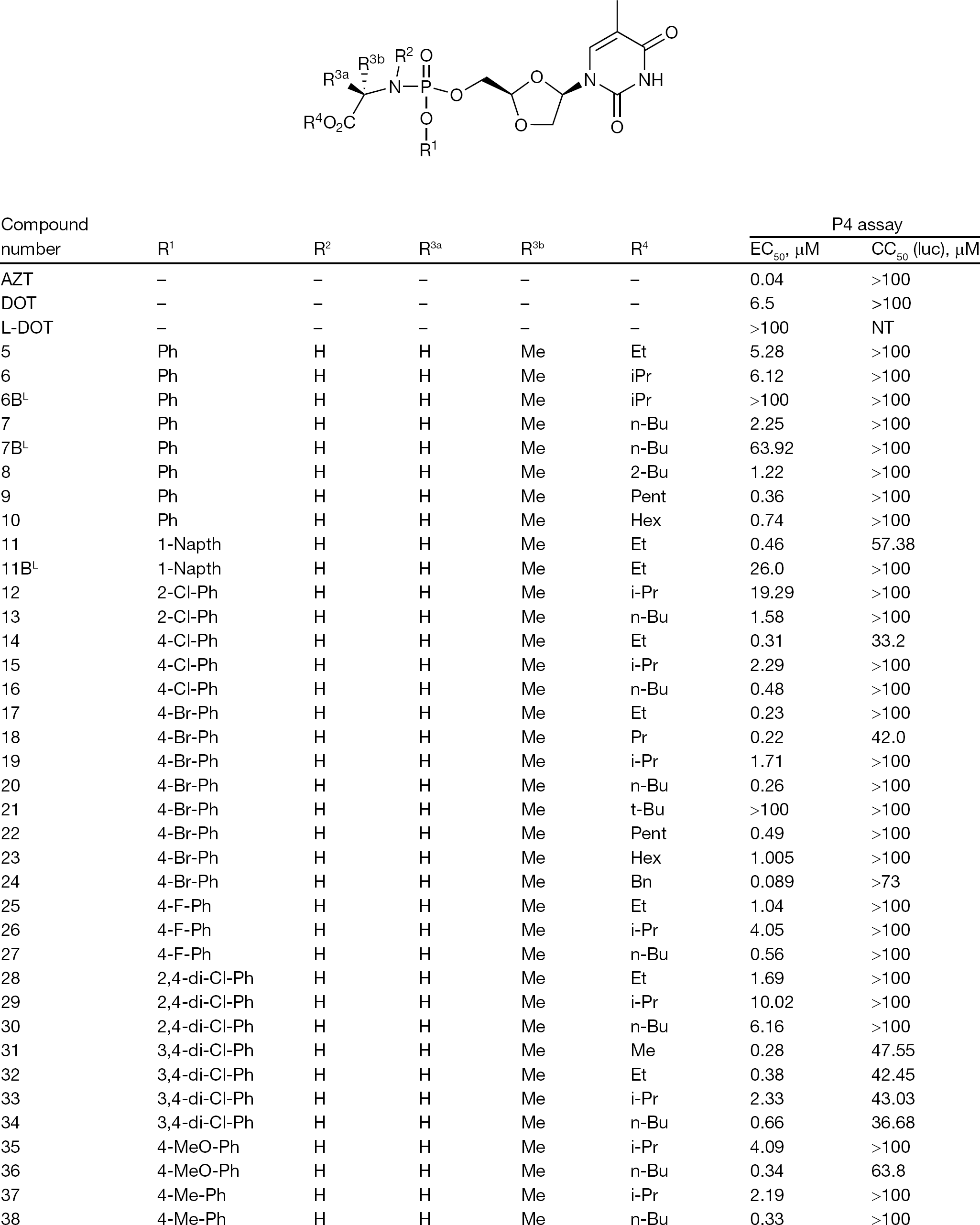
Effect of the aryloxy group on the anti-HIV activity and cytotoxicity of DOT phosphoramidates
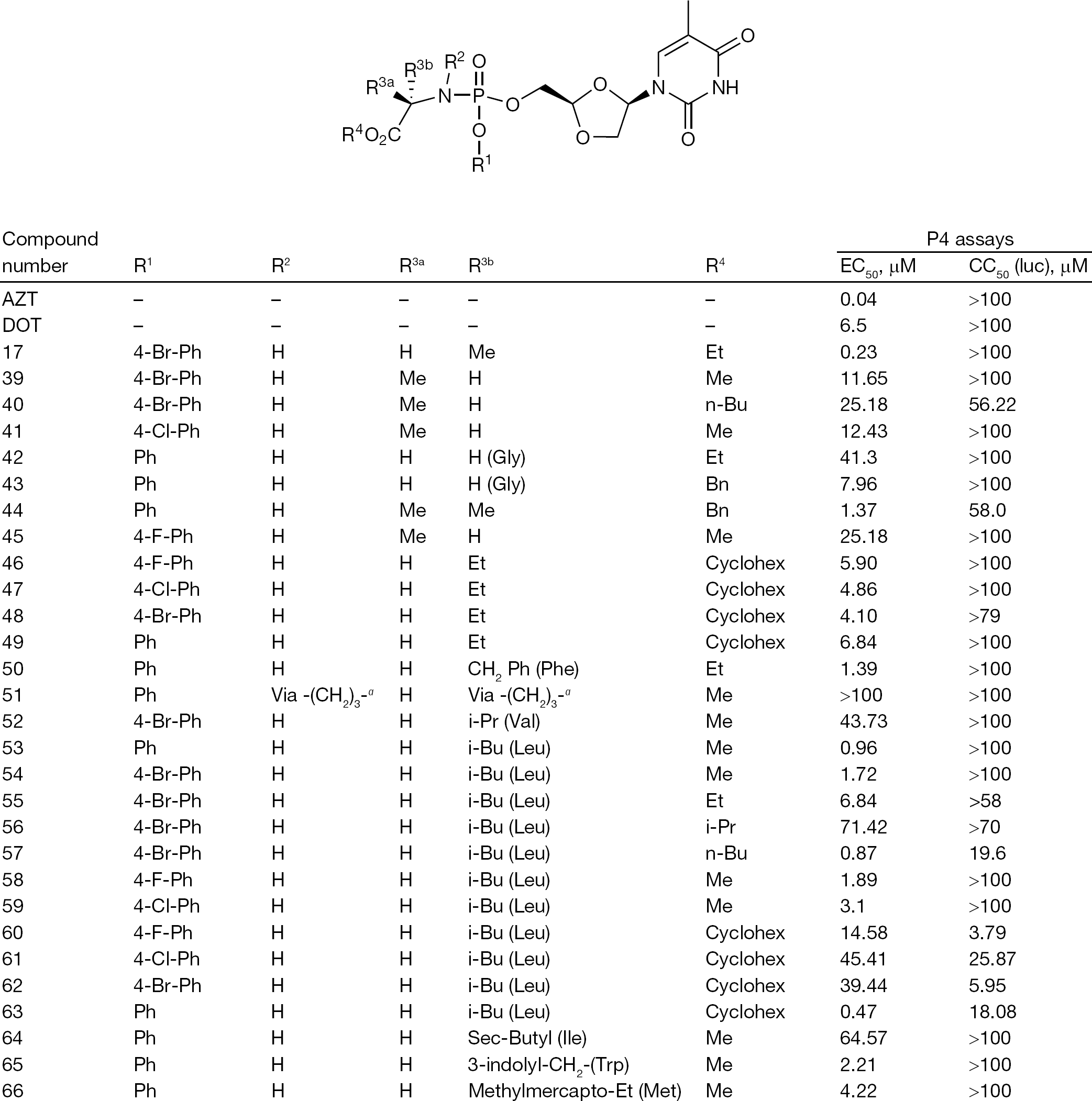
Effect of the amino acid group on anti-HIV activity and cytotoxicity of DOT phosphoramidates
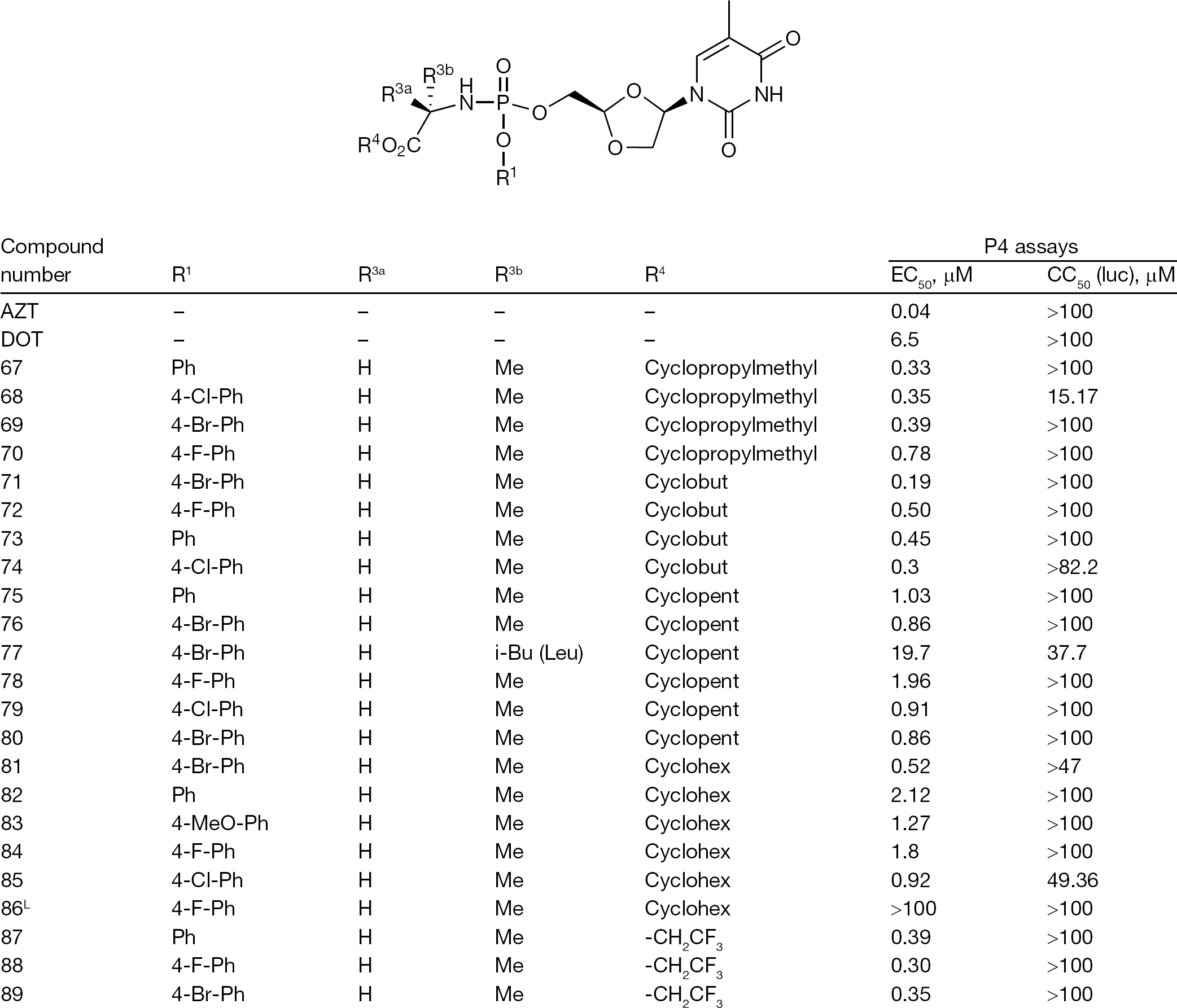
Effect of the ester group on anti-HIV activity and cytotoxicity of DOT phosphoramidates
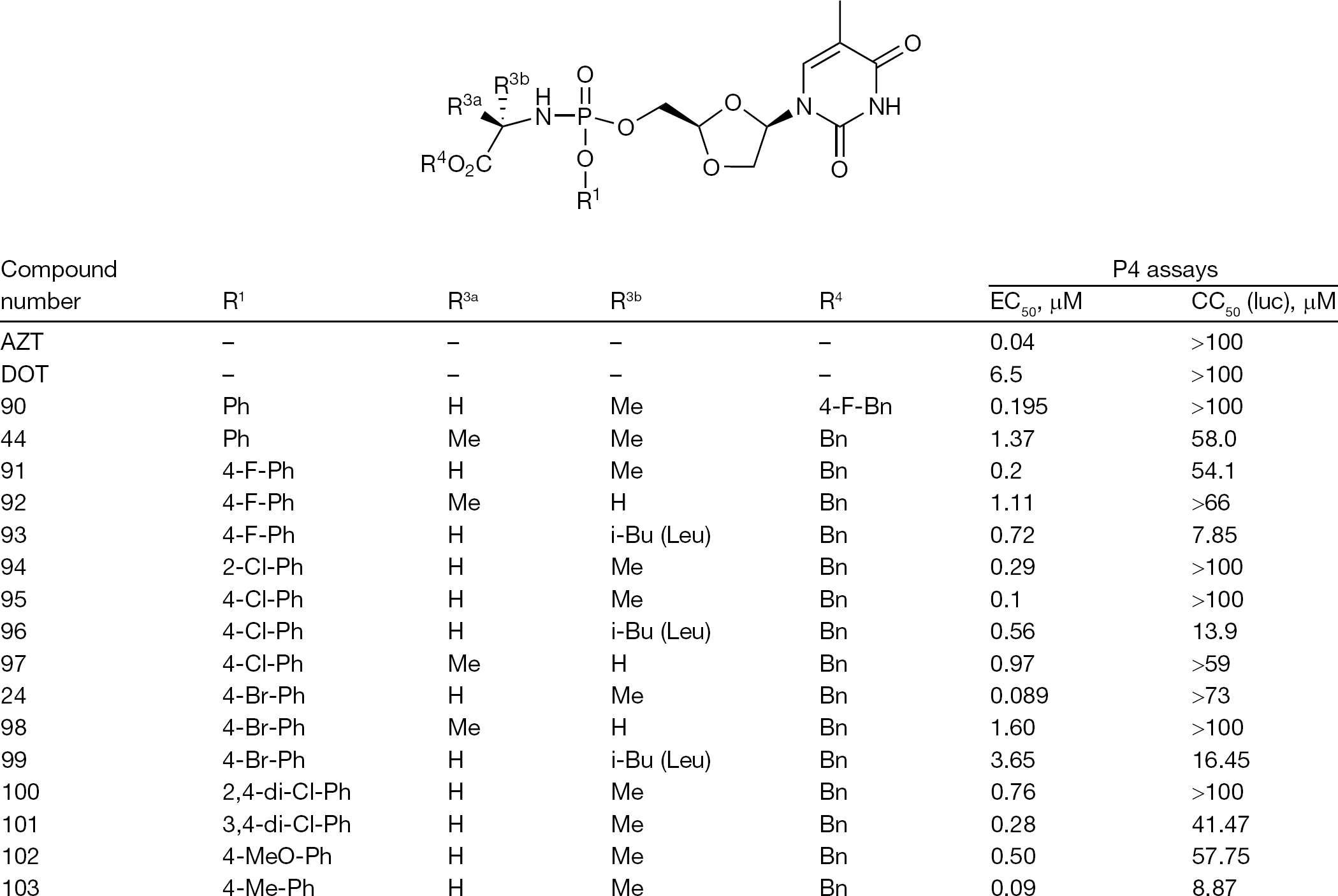
Effect of a benzyl ester group on anti-HIV activity and cytotoxicity of DOT phosphoramidates
The effect of the phosphate aryloxy substituents on anti-HIV activity and cytotoxicity of the DOT phosphoramidates is presented in Figure 3. In Figure 4, modifications to the amino acid moiety were investigated by maintaining the phosphate ester substituent as phenyl or halogenated phenyl and the amino acid ester as either methyl or ethyl. Data showing the effect of cyclic ester modifications on anti-HIV activity and cytotoxicity of DOT phosphoramidates is presented in Figure 5. DOT phosphoramidates having benzyl esters are reported in Figure 6.
Stability and cytotoxicity
As a result of our SAR study a number of DOT phosphoramidate derivatives emerged with improved potency relative to the parent nucleoside DOT. Our next objective was to further assess these potent derivatives for characteristics that would support in vivo evaluation. Therefore, metabolic stability in SGF, SIF, human plasma and liver S9 fractions was studied to obtain data on the correlation between stability and structure and to gain a preliminary understanding of the underlying stability issues in this series (Table 1).
Stability and cytotoxicity data for DOT phosphoramidates
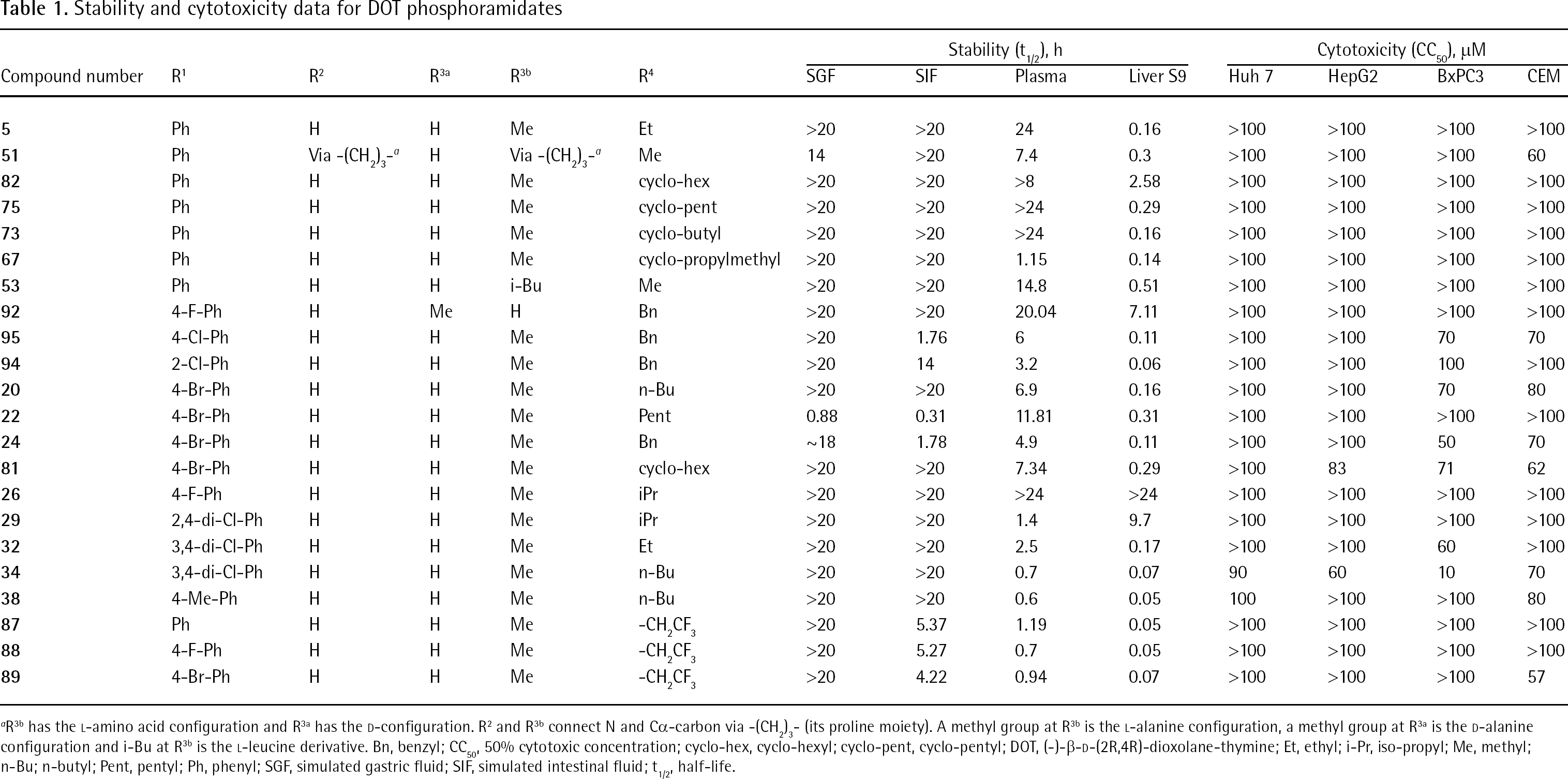
R3b has the L-amino acid configuration and R3a has the D-configuration. R2 and R3b connect N and Ca-carbon via -(CH2)3- (its proline moiety). A methyl group at R3b is the L-alanine configuration, a methyl group at R3a is the D-alanine configuration and i-Bu at R3b is the L-leucine derivative. Bn, benzyl; CC5[), 50% cytotoxic concentration; cyclo-hex, cyclo-hexyl; cyclo-pent, cyclo-pentyl; DOT, (−)-β-D-(2R,4R)-dioxolane-thymine; Et, ethyl; i-Pr, iso-propyl; Me, methyl; n-Bu; n-butyl; Pent, pentyl; Ph, phenyl; SGF, simulated gastric fluid; SIF, simulated intestinal fluid; t½, half-life.
Although most selected compounds were rather stable in SGF and SIF with half-lives of >20 or 18 h in both media, the 2,2,2-trifluoroethyl derivatives
The most unstable compounds are those having 2,2,2-trifluoroethyl and benzyl esters. Although derivatives
With regard to other ester variants, the compounds having secondary esters, such as the isopropyl derivative
An expanded cytotoxicity assessment was undertaken using a cell panel comprised of Huh7, HepG2, BxPC3 and CEM cells (Table 1). Most compounds showed no significant cytotoxicity up to 100 μM in these cell lines, although some weak cytotoxicity was observed for phosphoramidates
Discussion
Chemistry
The DOT phosphorochloridates were synthesized following previously described phosphorochloridate chemistry using NMI as the coupling agent as shown in Figure 2 [13]. Phosphoramidates were prepared by condensation of DOT
It was noted that some nucleoside phosphoramidate derivatives with halogenated aryl substitution showed improved in vitro potency and p-substituted systems specifically p-halogenated substituents were particularly effective [18]. Thus, we prepared a number of DOT phosphoramidate analogues with halogen and electron donating groups on the phenyl ring and a 1-naphthyl substituent
In order to compare the activity of the phosphoramidates of DOT (with natural D-nucleoside configuration) with their L-nucleoside congeners, several L-DOT (enantiomeric DOT) phosphoramidates (
Biology
The screening results for DOT phosphoramidates with variations in the amino acid side chains and the amino acid esters indicated that changes to these moieties translated to significant changes in anti-HIV activity. In Figure 3, the results of these aryl phosphoramidates of DOT with structural modifications on the aryl moiety indicated that changes in the aryloxy group led to insignificant changes in activity. Among the DOT phosphoramidates that had L-alanine as the amino acid and small linear substitutions in the corresponding ester region (such as methyl, ethyl and n-butyl) it was observed that the electron withdrawing substitutions on the phenyl ring (4-chloro
In order to further optimize the anti-HIV activity we chose L-alanine as the amino acid and varied the size of the ester group from methyl to ethyl maintaining the electron withdrawing substituents (4-chloro, 4-bromo, 4-fluoro and 3,4-dichloro phenyl) on the aryloxy group intact. The phosphate ester moiety having only the phenyl or para-halogenated phenyl substitution displayed the desired potency enhancement. Introduction of 3,4-dichloro substituents in the aryloxy moiety
Notably, this small change in size of the ester did not bring about a significant change in antiviral potency. While the ethyl ester was less active than the methyl ester with phenyl and 2,4-dichlorophenyl as the aryl groups, n-butyl, n-pentyl and n-hexyl ester derivatives displayed potent anti-HIV activity. On the contrary, analogues with secondary ester isopropyl derivatives
It was observed that relatively small changes in the amino acid side chain led to significant changes in activity (Figure 4). Thus, the L-alanine derivatives, such as
In Figure 5, cyclic ester modifications namely cyclohexyl
In Figure 6, the benzyl ester derivatives
In summary, an extensive series of phosphoramidate prodrugs of DOT were prepared and evaluated as inhibitors of HIV replication in vitro. The observed antiviral efficacy of the DOT phosphoramidates was far superior to that of the parent nucleoside. Fine tuning of the three substituents around the phosphoramidate phosphorus center provided compounds with as much as a 75-fold enhancement in potency relative to DOT. It can be concluded from the SAR results that L-alanine is the preferred amino acid unit, that small alkyl, cycloalkyl or benzyl esters provide maximal potency and that simple phenyl phosphate esters are desired. Metabolic stability studies indicated that the although these DOT phosphoramidate derivatives have the potential to show acceptable stability in the gastrointestinal tract, rapid metabolism in the liver may result in low systemic circulating levels of prodrug and therefore reduce their potential as anti-HIV agents.
Footnotes
Acknowledgements
We would like to thank WuXi Apptec Co., Ltd and Spectrix Analytical Services for their contributions to the work described in this manuscript.
The authors declare no competing interests.