




Abstract
Background:
Animals persistently infected (PI) with bovine viral diarrhoea virus (BVDV) are a key source of viral propagation within and among herds. Currently, no specific therapy exists to treat PI animals. The purpose of this research was to initiate evaluation of the pharmacokinetic and safety data of a novel antiviral agent in BVDV-free calves and to assess the antiviral efficacy of the same agent in PI calves.
Methods:
One BVDV-free calf was treated with 2-(2-benzimidazolyl)-5-[4-(2-imidazolino)phenyl]furan dihydrochloride (DB772) once at a dose of 1.6 mg/kg intravenously and one BVDV-free calf was treated three times a day for 6 days at 9.5 mg/kg intravenously. Subsequently, four PI calves were treated intravenously with 12 mg/kg DB772 three times a day for 6 days and two PI control calves were treated with an equivalent volume of diluent only.
Results:
Prior to antiviral treatment, the virus isolated from each calf was susceptible to DB772 in vitro. The antiviral treatment effectively inhibited virus for 14 days in one calf and at least 3 days in three calves. Subsequent virus isolated from the three calves was resistant to DB772 in vitro. No adverse effects of DB772 administration were detected.
Conclusions:
Results demonstrate that DB772 administration is safe and exhibits antiviral properties in PI calves while facilitating the rapid development of viral resistance to this novel therapeutic agent.
Introduction
Bovine viral diarrhoea virus (BVDV) is the prototypical virus of the Pestivirus genus of Flaviviridae [1]. Based on genomic and serotypic differences, BVDV is divided into two genotypes, BVDV 1 and BVDV 2[2]. Clinical disease caused by BVDV infection is a source of significant economic losses in cattle worldwide [3]. The effects of BVDV infection are manifested in the respiratory, gastrointestinal, reproductive, cardiovascular, lymphatic, immune, integumentary or central nervous system of affected cattle [4]. Of utmost importance in the propagation of BVDV infection is the persistently infected (PI) animal [5]. In utero exposure to non-cytopathic BVDV before development of fetal immunocompetence can result in a calf that is PI with the virus [6]. Such cattle consistently shed large quantities of virus throughout their life and serve as a constant reservoir of infection to their herd mates [7]. Previous studies involving the treatment of PI animals with human or bovine interferon (IFN) were largely unsuccessful and in some cases was associated with significant negative side effects [8,9]. As no specific therapies are available to cure PI animals, treatment is currently limited to supportive care or humane euthanasia.
Aromatic cationic compounds possess inhibitory action against several RNA viruses, including HIV [10], rotavirus [11] and respiratory syncytial virus [12]. Givens [13] and others used a similar novel compound, 2-(2-benzimidazolyl)-5-[4-(2-imidazolino) phenyl]furan dihydrochloride, (DB772; molecular weight =410.28) to inhibit BVDV growth in cell culture while demonstrating the compound's lack of cytotoxicity. The 99% end point for prevention of viral replication by DB772 was found to be 6 nM [14]. Furthermore, DB772 has been shown to eliminate BVDV infection in contaminated bovine fetal fibroblast cells with a single passage in culture media supplemented with 4 μM of DB772 [14]. Blastocyst development was not hindered by exposure to a closely related compound and heifers resulting from treated blastocysts displayed normal characteristics during puberty, breeding, gestation and lactation [15,16]. The mechanism of action of similar compounds has shown to be through inhibition of the RNA-dependant RNA polymerase [17,18].
The effects of DB772 in animals are not known; therefore, the purposes of this study were threefold: to establish pharmacokinetic data of DB772 after intravenous injection in BVDV-free calves; to assess the safety of DB772 administration in BVDV-free calves; and to evaluate the antiviral activity of DB772 when administered to PI calves.
Materials and methods
Pharmacokinetic and safety and toxicity study
Sample collection
A 10-day-old miniature calf (calf 601) and its dam were isolated within a 9.3 m2 pen inside a humidity-and temperature-controlled room. The calf nursed milk from its dam as desired throughout the study. The 17.7 kg calf was administered 1.6 mg/kg DB772 via an intravenous catheter in the left jugular vein at time 0. Blood samples were collected and analysed for serum concentration of DB772 at 0, 5, 10, 15, 30 and 45 min, and at 1, 1.5, 2, 3, 4, 6, 8, 10 and 12 h and then every 4 h throughout 36 h post-administration. Samples were submitted for analysis to measure serum DB772 concentration, serum biochemical profIle (SBP) and complete blood count (CBC) on days 0, 3 and 5. Clinical scores for appetite, appearance, dehydration status and faecal appearance were assigned daily.
A second 10-day old miniature calf (calf 701) and its dam were isolated within a 9.3 m2 pen inside a humidity- and temperature-controlled room. The calf nursed milk from its dam as desired throughout the study. The calf weighed 20.5 kg and was treated intravenously with 9.5 mg/kg of DB772 every 8 h for 6 consecutive days with the first administration of DB772 defined as time 0. Serum samples were collected immediately before and 1 h after each administration of DB772 for analysis of serum concentration of DB772. Serum was separated from clotted blood and frozen at −80°C until analysis. Additional samples collected 3, 5, 9, 13, 17, 25, 37 and 63 h after the final administration of DB772 were also analysed for drug concentration. Clinical scores for appetite, appearance, dehydration status and faecal appearance were assigned daily. Clinical scores were assigned on a scale from 0.0 (normal) to 1.0.
Sample analysis
Serum samples were thawed at room temperature and vortexed to homogeneity. Samples were prepared for analysis by the combination of 200 μl serum with 500 μl methanol, vigorous vortexing for 15 s, and centrifugation at 1,900 g for 30 min at room temperature; 30 μl of the supernatant were injected through the HPLC system (Waters Corporation, Milford, MA, USA).
DB772 was analysed by HPLC-based on a combination of previously described methods [19–21]. The mobile phase consisted of solvent A (15 mM ammonium formate [Sigma Aldrich, St Louis, MO, USA] and 35 mM formic acid [v/v; Sigma Aldrich] in distilled water) and solvent B (15 mM ammonium formate, 35 mM formic acid [v/v] in 80:20 acetonitrile [VWR, West Chester, PA, USA] distilled water solution [v/v]). The solvents were mixed using an initial gradient of 14% solvent B that progressed to 34% over 5 min, followed by a second gradient to 95% over 0.5 min. After 10 min at this point, a return gradient to 14% occurred over 5 min before recycling. The flow rate of the system was 0.8 ml/min. DB772 separation was achieved at room temperature using a Zorbax Bonus-RP, 5 μm, 2.1×150 mm chromatographic column (Agilent Technologies, Santa Clara, CA, USA), protected by a Zorbax Bonus RP, 5 μm, 2.1×12.2 mm pre-column (Agilent Technologies). DB772 was detected using a fluorescence detector (Waters Corporation), with excitation occurring at 366 nm and emission at 500 nm.
Unknown concentrations in animal samples were quantitated by comparing the fluorescent signal to the signal generated from standards prepared by the addition of known amounts of DB772 to plasma and serum. The calibration curve contained known concentrations ranging from 25 to 1,000 ng/ml. The linear correlation coefficient of the calibration curve was 0.9995 and the lower limit of detection was 10 ng/ml. The lower and upper limits of quantitation were 25 ng/ml and 1,000 ng/ ml, respectively. The coefficient of variation for controls was 22.87%, 8.82%, 2.41% and 0.77% for 25 ng/ml, 50 ng/ml, 500 ng/ml and 1,000 ng/ml, respectively.
Samples were submitted to the clinical pathology service at Auburn University Teaching Hospital (Auburn, AL, USA) on days 0, 3, 5, 7 and 11 for SBP and CBC analysis. Parameters assessed in the SBP included total protein, albumin, globulins, albumin/globulin ratio, sorbitol dehydrogenase (SDH), aspartate aminotransferase, γ-glutamyltransferase (GGT), total bilirubin, creatine kinase, urea nitrogen, creatinine, calcium, phosphorus, magnesium, glucose, bicarbonate, sodium, potassium, chloride, anion gap, osmolality and iron.
Pharmacokinetic analysis
Serum DB772 concentration versus time curves were subjected to non-compartment analysis using a commercial computer software programme (WinNon-lin version 5.1; Pharsight Corporation, Mountain View, CA, USA). Terminal elimination half-life (t½) was calculated and a minimum of three data points were used to calculate the elimination rate constant (kel). Area under the curve and its first moment (AUMC) were calculated to infinity (AUC0-∞ using the log-linear trapezoidal rule. From these values, other kinetic parameters were calculated: clearance (Cl) = dose/AUC, volume of distribution (Vdss) = dose xAUMC/AUC2, and mean residence time (MRT) = AUMC/AUC. The maximal serum concentration (Cmax) was also recorded. Concentration at time 0 (following intravenous administration; C0,) was estimated by back extrapolation of the first two time points via log-linear regression to time 0. For multiple dosing, weekly peak (time 1) and trough (time 2) concentrations were also used to determine elimination t based on the relationship of t½= 0.693/kel and kel = In(C1/C2)/t2-t1), where C = concentration at time (t).
In vivo antiviral evaluation of DB772 in PI calves
Animals
Six crossbred beef calves (A-F) born between September and October 2008 at the Upper Coastal Plain Agricultural Research Center (Winfield, AL, USA) were separated from their dams and moved to the research facility at 2–5 days of age. All six calves were confirmed to be PI animals as reported earlier [22]. Calves B and D were bulls, and the remaining four calves were heifers. Calves A, C and D were PI with BVDV 1, whereas calves B, E and F were PI with BVDV 2. On treatment day 0, the calves were 15–17 days of age and weighed 25.9–33.3 kg.
Housing
The calves were housed in individual 1.9 m2 pens arranged two per humidity- and temperature-controlled room. The calves were fed two quarts of a commercial milk replacer twice daily and had free choice access to water throughout the study. Clinical scores for appetite, appearance, dehydration status and faecal appearance were recorded daily. Clinical scores were assigned on a scale from 0.0 (normal) to 1.0.
Treatment
The compound used in this study was synthesized in the laboratory of David W Boykin (Georgia State University, Atlanta, GA, USA). A 25 mg/ml solution of DB772 was made by dissolving the compound in polyethylene glycol 200 (PEG 200; Mallinckrodt Baker, Phillipsburg, NJ, USA). After a 10-day adjustment period to the isolation facilities, jugular catheters were placed bilaterally in all six calves. Four treated calves (C, D, E and F) were administered DB772 intravenously three times a day via the right jugular catheter for 6 days at a dose (12 mg/ kg) calculated to achieve a 4 μM concentration (1.6 μg/ ml) in serum. Two control calves (A and B) were intravenously administered an equivalent volume of only diluent three times a day for 6 days. The day treatment was first initiated was defined as day 0. Serum samples were collected once daily from each calf immediately prior and 1 h following DB772 administration and analysed for DB772 concentration as described earlier.
Sample collection
Whole blood and serum samples were collected on days 0, 1, 3, 5, 7, 14, 21, 28 and 35 via the left jugular catheter or by jugular venipuncture if no catheter was patent. Nasal swab samples were collected at the same time points. Serum was removed from clotted blood after centrifugation and processed immediately or refrigerated until processing. Whole blood samples were processed as described earlier [23] to obtain the buffy coat with the exception that samples were resus-pended in 1 ml of minimum essential medium (MEM). Whole blood, serum and nasal swabs were refrigerated for <72 h before sample analysis. Whole blood and serum samples from each calf were submitted weekly to the clinical pathology service at Auburn University Teaching Hospital for CBCs and SBP analysis.
Virus detection and quantification
Serum samples from days 0, 1, 3, 5, 7, 14, 21, 28 and 35 were analysed for concentration of BVDV by quantitative PCR as described previously [24] with the exception that only BVDV primers were used. Virus isolation was performed on buffy coat and nasal swab samples as described previously [23] with the exception that 1 ml aliquots of buffy coat sample were used and the procedure was performed in six-well (9.6 cm2) plates. Virus titration of nasal swab samples was performed. Multiple, serial 10-fold dilutions of 10 μl sample diluted in 90 μl MEM were performed in triplicate and the statistical method of Reed and Muench [25] was used to quantify the concentration of virus.
In vitro viral susceptibility to DB772
Cell lysate from buffy coat samples that had been passaged as described in Virus detection and quantification were stored at −80°C. Virus from cell lysate samples obtained on day 0 and on the first day after treatment initiation when virus was isolated from buffy coat samples in sufficient concentrations were tested for susceptibility to DB772. Virus was isolated in sufficient quantity to perform this in vitro testing from buffy coat samples of calves C, D, E and F on days 14, 5, 7 and 3, respectively. Virus from each cell lysate sample was incubated in the presence and absence of 4 mM of DB772 for 4 days in a 24-well (2 cm2) plate. Plates were then frozen and thawed and virus titration was performed as described in Virus detection and quantification. Presence of BVDV was confirmed by an immunoperoxidase monolayer assay [26] and quantified by the method of Reed and Muench [25].
Results
Pharmacokinetic data
The Cmax achieved in serum after a single dose of DB772 (1.6 mg/kg) was 527 ng/ml (1.28 μM), obtained 5 min after intravenous administration (Figure 1). The serum t½ of DB772 was determined to be 13 h and the Cl rate was calculated to be 16.7 ml/min/kg. The last time point at which DB772 could be detected in serum was 36 h following administration at a concentration of 5.44 ng/ ml. The MRT of DB772 was observed to be 14 h and the Vdss was calculated to be 24,022 ml/kg.
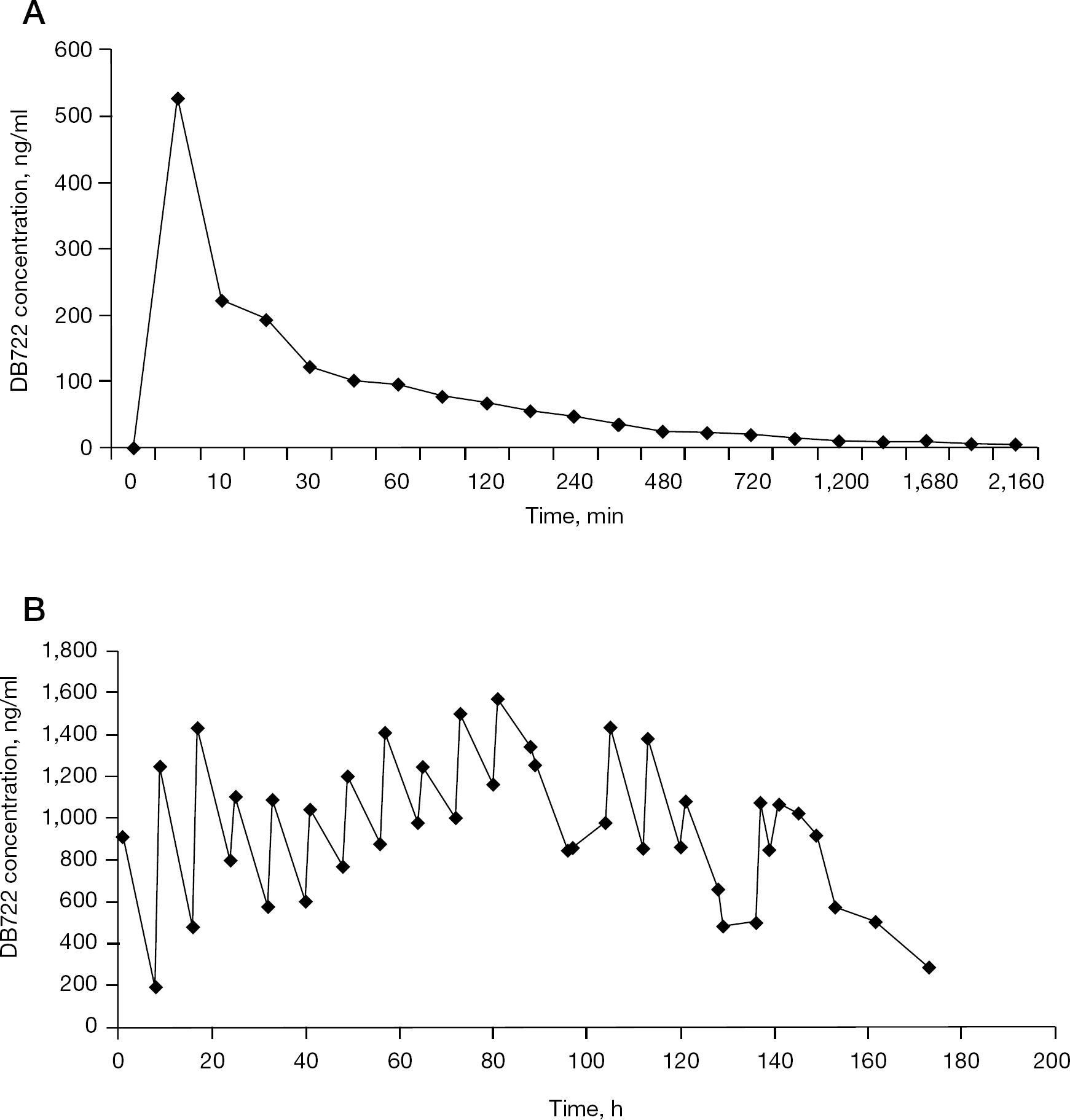
Serum DB772 concentrations after intravenous administration of a single dose of 1.6 mg/kg DB772 or after treatment with 9.5 mg/kg of DB772 every 8 h
Intravenous administration of DB772 at a dose of 9.5 mg/kg every 8 h resulted in serum concentrations >575 ng/ml (1.4 μM) after 16 h (Figure 1). This concentration was maintained throughout the remainder of the administration period. The first time point at which the measured serum concentration of DB772 fell below the in vitro therapeutic goal was at 129 h, or 9 h after the final administered dose. The Cmax of 1,073 ng/ml (2.6 μM) was obtained 137 h after the first administration of DB772. The serum t½ of DB772 was determined to be 16.2 h and the Cl rate was calculated to be 28.6 ml/min/kg. The Vdss of DB772 in the calf treated every 8 h for 6 days was similar to the Vdss in the calf treated once at 26,613 ml/kg. Meanwhile, the MRT nearly doubled to 26.6 h.
Safety and toxicity data
Clinical evaluations of the initial miniature calf treated with DB772 indicated no sign of toxicity from treatment. A mild lymphopenia (1,892 cells/μl; reference range 2,500–7,500 cells/μl) was detected before treatment and attributed to a stress leukogram. On day 3, the lymphocyte count had increased to 2,263 cells/μl, before decreasing to 1,833 cells/μl on day 5. Similarly, GGT was elevated on days 1, 3 and 5 (142, 116 and 85 U/l, respectively; reference range 3.7–31 U/l). No changes in clinical scores were seen at any point in the study period.
Similarly, no clinical signs of toxicity or adverse health effects due to DB772 administration were seen when 9.5 mg/kg of DB772 was administered intravenously to a single calf every 8 h for 6 consecutive days. A decrease in lymphocytes occurred on days 7 and 11 post-administration, decreasing from 4,649 cells/μl on day 0 to 3,165 and 1,833 cells/ml, respectively. The lymphopenia did not result in clinical evidence of infection. No other significant changes in the haematological or biochemical profiles of the calf were detected during or following DB772 administration.
In vivo antiviral evaluation of DB772 in PI calves
Physical and haematological findings
Serum concentrations of DB772 exceeded 4 μM 24 h following the initial DB772 administration in three of four treated calves (A, B and C) and in all four treated calves by 48 h following initial treatment. Daily clinical scores did not differ among treatment groups or change during the course of the study. There were no consistent, consequential changes in the CBCs of either treatment group. Two of the treated calves had lymphocytes of 1,500 cells/μl or less on day 0. However, as with the other calves in this study, lymphocyte counts did not fluctuate during the study period. One of the control calves (A) had a consistently high fibrinogen level (800–1,300 mg/dl) throughout the study (reference range 200–730 mg/dl) but no other indicators of inflammation were seen. The concentration of GGT in all six calves (range 20–185 U/l) was elevated above the reference range (18.3 U/l) at all time points during the study with the exception of one control calf who had values of 16 U/l and 17 U/l on days 14 and 21, respectively, and one treated calf who had a value of 17 U/l on day 28. Likewise, SDH was elevated in all 6 calves on days 28 and 35. Values on day 28 ranged from 16.9 to 101.4 U/l (reference range 2.6–16 U/l). Values on day 35 ranged from 30.9 to 259 U/l.
Virus detection and quantification
Virus was isolated from the buffy coat samples of all six calves on day −7 and 0. On day 1, the control calves remained positive on virus isolation while no virus was isolated from the buffy coat samples of any of the four treated calves. On day 3, the treated calves PI with type 1 BVDV (C and D) remained negative while both treated calves PI with type 2 (E and F) were positive on virus isolation from buffy coat samples and remained so throughout the remainder of the study. One calf PI with type 1 BVDV (C) remained negative on virus isolation from buffy coat samples until day 14 while virus was first isolated from the other calf PI with type 1 BVDV (D) on day 5.
On day 0 the treated calves PI with type 1 BVDV (C and D) were positive for virus isolation in nasal swab samples with a mean of 1.9×10⁴ cell culture infectious dose 50% (CCID50)/ml (Figure 2). Samples from both calves were negative on days 1 and 3. Calf C remained negative until day 21 and calf D remained negative until day 5. Viral concentration in nassal swab samples of calves C and D returned to pretreatment concentrations on days 35 and 28, respectively. On day 0, the treated calves PI with type 2 BVDV (E and F) were positive for virus isolation in nasal swab samples with a mean of 1.2×10⁵ CCID50/ml (Figure 3). The amount of virus in the nasal swab samples decreased three log scores to a mean of 4.9×10² CCID50/ml on day 5. Viral concentration in nasal swab samples of calves E and F returned to pretreatment concentrations on days 14 and 7, respectively. By contrast, the control calf PI with type 1 BVDV (A) had 2×10⁵ CCID50/ml of virus in nasal swab sample on day 0 and remained at this concentration throughout the study. On days 0 and 1, the control calf PI with type 2 BVDV (B) was only positive for virus in nasal swab samples following passage. However, 4.7×10² CCID50/ml of virus in nasal swab sample was detected on day 3 and increased to 6.2×10⁵ CCID50/ml on day 21.
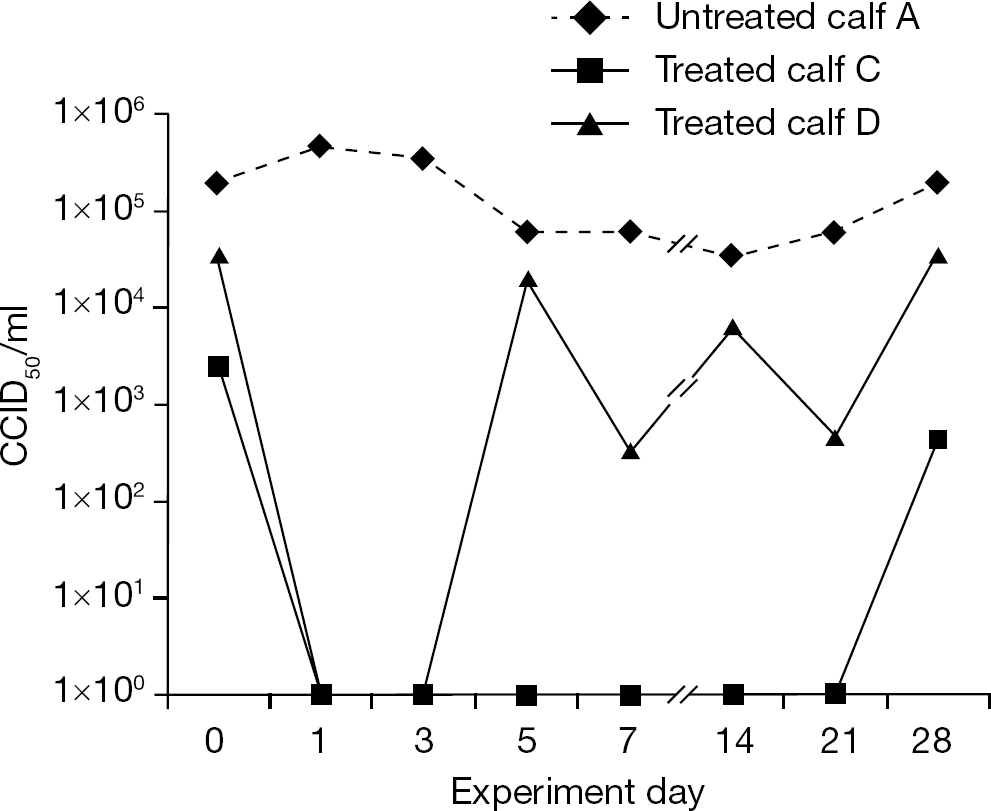
CCID50/ml of nasal swab media in calves persistently infected with BVDV 1 by experiment day
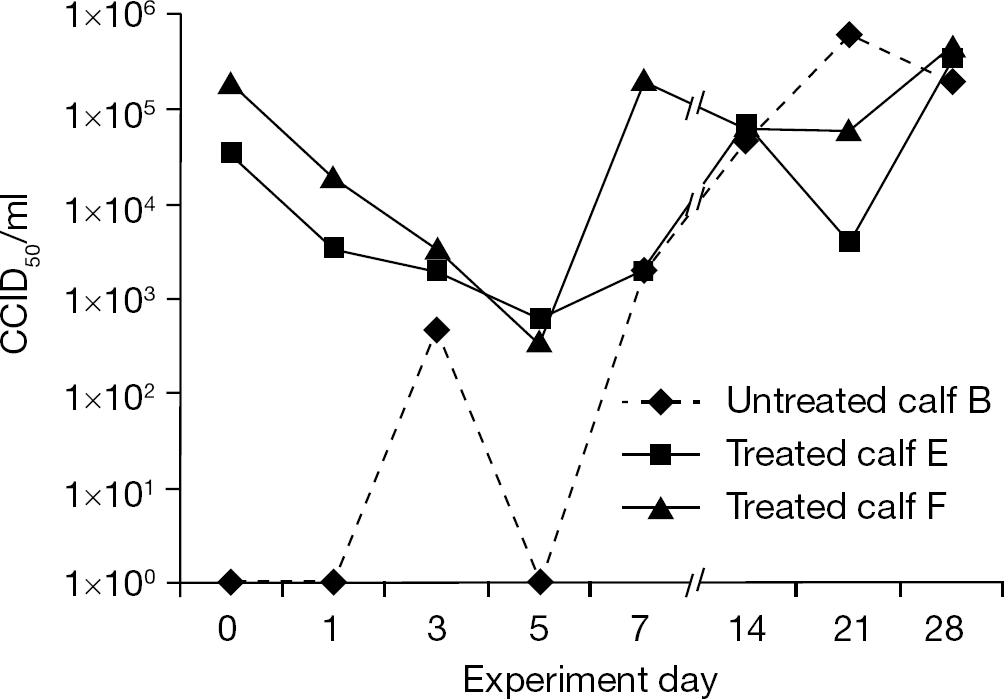
CCID50/ml of nasal swab media in calves persistently infected with BVDV 2 by experiment day
On day 0, the treated calves PI with type 1 BVDV (C and D) had an average of 65 viral copies of RNA/μl of serum (Figure 4). The amount of viral RNA decreased to a mean of 1.4 viral copies of RNA/μl of serum on day 14 before subsequently increasing to an average of 740 viral copies of RNA/μl of serum on day 28. Likewise, the treated calves PI with type 2 BVDV (E and F) decreased from a day 0 mean of 46 viral copies of RNA/μl of serum to a mean of 8 viral copies of RNA/ ml of serum on day 14 (Figure 5). A subsequent increase to an average of 396 viral copies of RNA/μl of serum occurred on day 28. By contrast, the number of viral copies of RNA/μl of serum increased steadily in the control calf PI with type 1 BVDV (A) from 356 on day 0 to 1,360 on day 14 and 3,100 on day 28. A similar increase was seen in the control calf PI with type 2 BVDV (B), from 0.6 viral copies of RNA/ml of serum on day 0, 10 on day 14 and 2,100 on day 28.
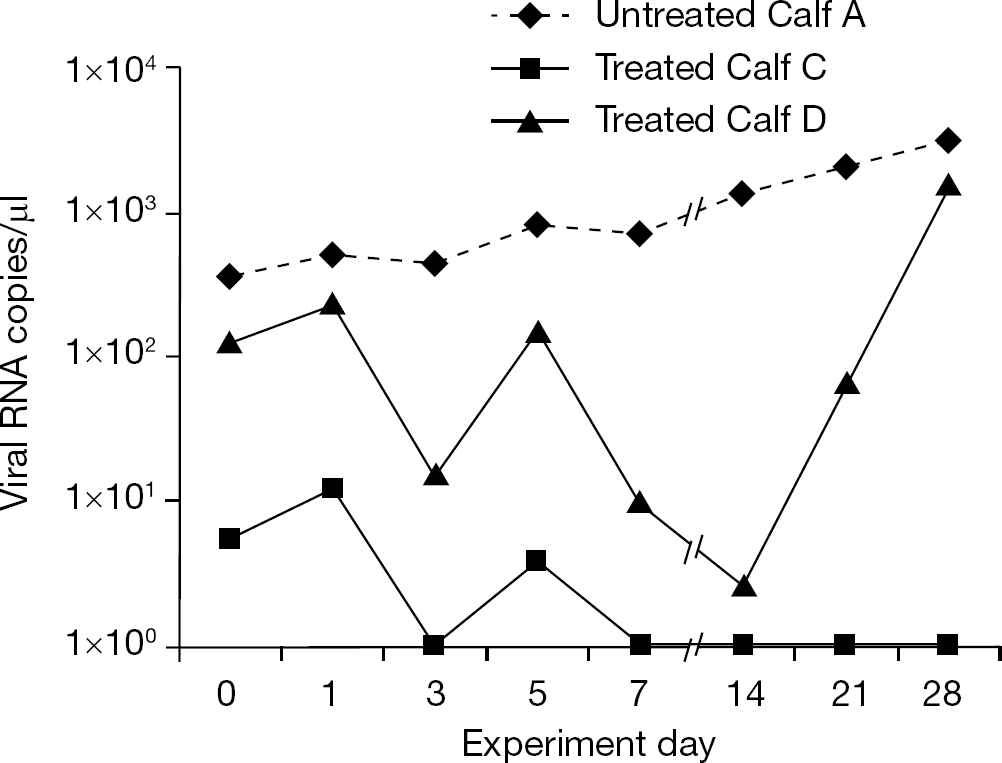
Number of viral RNA copies/μl of serum in calves persistently infected with BVDV 1 by experiment day
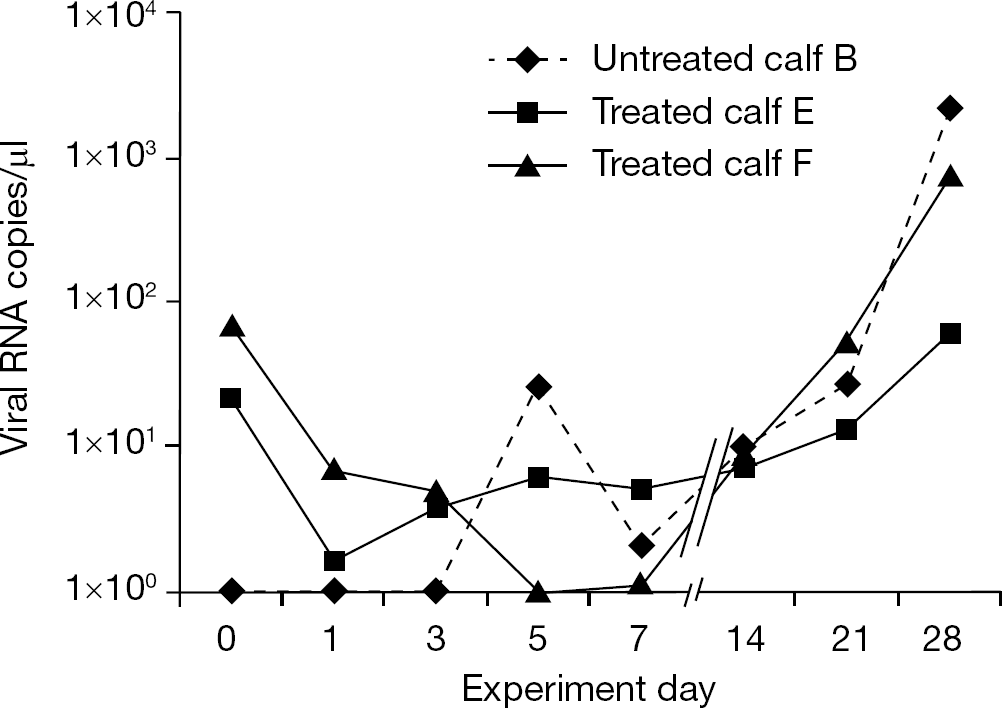
Number of viral RNA copies/μl of serum in calves persistently infected with BVDV 2 by experiment day
In vitro viral susceptibility to DB772
Virus was detected from all day 0 samples at a concentration of 6.2×10⁴–6.2×10⁶ CCID50/ml when cultured in the absence of DB772. Virus was completely inhibited in all day 0 samples when cultured in the presence of 4 μM concentration of DB772. Likewise, cell lysate samples from the day virus was first detected in buffy coat samples yielded a concentration of 3.5×10⁵–2×10⁷ CCID50/ml when cultured in the absence of DB772. However, when cultured in the presence of DB772, growth was inhibited one log score or less in calves D, E and F. By contrast, virus was completely inhibited in the sample from calf C when cultured in the presence of 4 μM concentration of DB772.
Discussion
Treatment of PI calves with 12 mg/kg of DB772 every 8 h for 6 days resulted in temporary reduction of viral load in all treated calves below the detection threshold of virus isolation after passage of buffy coat samples. In a similar experiment, six PI animals were treated with bovine IFN for two rounds of five daily treatments in a 2-week period [9]. A transient decrease was seen in mean serum BVDV titres during the treatment period. However, in a follow-up study 3 months later, no antiviral activity of human IFN was seen when given either orally or by intramuscular injection. In our study, all four calves treated with DB772 were negative by virus isolation 24 h after the initial treatment while the two control calves remained viraemic. However, the two treated calves PI with BVDV type 2 (E and F) were again positive on virus isolation on day 3 while virus was not isolated from calves C and D (PI type 1 calves) until days 14 and 5, respectively. Due to the small subject numbers in this pilot study, it is unclear if this represents a true difference of efficacy of DB772 against the different genotypes.
Although the antiviral treatment decreased the viral concentration to below the detection threshold in white blood cells, we theorize that the virus was able to replicate despite continued treatment with DB772. The exception is calf C from whom virus was not isolated until after the treatment period was over. This indicates that a longer duration of treatment most likely would not have changed the outcome for calves D, E and F. It is possible that treatment with higher dosages would reduce the viral load even further than seen with the current dose, which may allow additional treatments to be successful.
Results indicate that the treatment of PI calves with DB772 drastically reduced the viral concentration in the calves at initiation of treatment and then subsequently selected for resistant mutants of the virus, which gained a competitive edge and replicated in the face of treatment with DB772. This conclusion is supported by isolation of virus from three of the four treated calves (D, E and F) in the face of DB772 administration. When viral isolates obtained during the treatment period from these three calves were tested for DB772 susceptibility in vitro, viral replication was similar to replication in media lacking DB772. This demonstrates that strains resistant to the antiviral effects of DB772 were selected for and became the strain persisting within the animal. This research also describes the first documentation of strains of BVDV that are resistant to DB772.
To our knowledge, this is the first in vivo study involving an aromatic cationic molecule as an antiviral agent. No evidence of toxicity was seen in any of the calves at any point during the study. Data obtained from subjective clinical scoring as well as objective data from haematological and biochemical profiles revealed no significant differences among treated animals and their untreated cohorts. No significant changes in haematological or biochemical profiles of treated animals were detected from pretreatment time points through the treatment period or up to 4 weeks post-treatment. All calves in this study were unweaned and consuming a diet consisting of either milk or milk replacer. The effects of DB772 have not yet been studied in weaned or ruminating animals. Neither a meat nor a milk withdrawal time has been established for DB772 but the pharmacokinetic data from this study indicate that the drug has a relatively short t½ in serum of 13–16.2 h when administered intravenously.
Due to the rapid selection for or development of virus resistant to the antiviral effects of DB772, therapeutic potential of the compound for PI animals is likely to require combination therapy. To date, reports evaluating the efficacy of combination therapy for persistent BVDV infections are lacking from the scientific literature. In hepatitis C, a closely related flavivirus that can also cause persistent infection, combination therapy with interferons and ribavirin has been shown to be more effective than monotherapy [27]. Treatment of PI animals with bovine interferon resulted in a transient decrease in viral titres [9], but its efficacy as a component of combination therapy has yet to be studied.
Currently, there is no specific treatment for PI cattle and thus, the current recommendation is to eliminate these animals from the herd to decrease viral spread to naive herd mates. However, the authors believe the PI animal to be the most robust in vivo test of a novel antibiotic because of the consistent high level of viraemia exhibited by such animals [7]. An effective antiviral compound, such as DB772, holds potential as a prophylactic agent in the case of outbreaks in areas free of BVDV or in susceptible animals during gestation to prevent the generation of PI fetuses. Infection of fetal fibroblast cells was effectively prevented by nanomolar concentrations of DB772 [14], although in vivo tests will be necessary to confirm its efficacy in live animals. This study demonstrates that DB772 inhibits viral replication at the high viral concentrations seen in PI calves and therapeutic doses can safely be administered to live animals.
This is the first reported study of the use of antivirals in calves PI with BVDV type 2. Previous studies involved only calves PI with BVDV type 1. In hepatitis C infections, certain genotypes have proven more amenable to treatment than others [27]. Interestingly, treatment with DB772 appeared to be more successful in calves PI with BVDV 1 in this pilot study. The calves PI with BVDV 1 remained negative on buffy coat virus isolation longer than their type 2 counterparts, including one calf (C) who remained negative until day 14, 9 days after treatment had ceased. Additionally, a larger decrease was seen in the number of viral RNA copies/ml of serum in calves PI with type 1 than PI type 2 calves. The decrease in CCID50/ml found in nasal swab samples was also greater in PI BVDV 1 calves. The reason for this is currently unknown as the mechanism of DB772 has yet to be elucidated. Given the small number of animals in this study, it remains to be seen if this response difference by genotype is repeatable on a larger scale.
A single intravenous dose of DB772 at 1.6 mg/kg in this research achieved a maximum serum concentration (1.28 μM) that was 213 times the 99% end point previously determined to prevent infection of primary fetal fibroblast cells in vitro (0.006 μM); however, the serum concentration that was achieved with this single dose may not have been sufficient to consistently clear BVDV from infected cells in vitro as has been demonstrated with 4 μM concentrations of DB772 [14]. Yet, when administering DB772 at 9.5 mg/kg intravenously every 8 h for 6 days, the serum concentration of DB772 consistently exceeded 1.4 μM after 16 h, which corresponded to the second dose. When administered at 12 mg/kg intravenously every 8 h for 6 days, the serum concentration of DB772 in nursing calves consistently exceeded 1.9 μg/ml (3 μM) after 24 h and 1.4 μg/ml (3.6 μM) after 48 h.
In summary, the dosing regimen used in this study resulted in serum concentrations of DB772 sufficient to inhibit viral replication in calves PI with BVDV types 1 and 2. Furthermore, no adverse effects of DB772 were detected in any treated calf. The rapid development of viral resistance to the compound is a significant concern but does not preclude its use in combination therapy. Thus, DB772 or related compounds continue to represent a potential therapeutic agent for BVDV infections.
Footnotes
The authors declare no competing interests.