




Abstract
Parkinson's disease (PD) is a common neurodegenerative disease characterized by the selective loss of dopaminergic (DA) neurons in the midbrain. Various types of stem cells that have potential to differentiate into DA neurons are being investigated as cellular therapies for PD. Stem cells also secrete growth factors and therefore also may have therapeutic effects in promoting the health of diseased DA neurons in the PD brain. To address this possibility in an experimental model of PD, bone marrow-derived neuroprogenitor-like cells were generated from bone marrow procured from healthy human adult volunteers and their potential to elicit recovery of damaged DA axons was studied in a partial lesion rat model of PD. Following collection of bone marrow, mesenchymal stem cells (MSC) were isolated and then genetically modified to create SB623 cells by transient transfection with the intracellular domain of the Notch1 gene (NICD), a modification that upregulates expression of certain neuroprogenitor markers. Ten deposits of 0.5 μl of SB623 cell suspension adjusted from 6,000 to 21,000 cells/μl in PBS or PBS alone were stereotaxically placed in the striatum 1 week after the nigrostriatal projection had been partially lesioned in adult F344 rats by injection of 6-hydroxydopamine (6-OHDA) into the striatum. At 3 weeks, a small number of grafted SB623 cells survived in the lesioned striatum as visualized by expression of the human specific nuclear matrix protein (hNuMA). In rats that received SB623 cells, but not in control rats, dense tyrosine hydroxylase immunoreactive (TH-ir) fibers were observed around the grafts. These fibers appeared to be rejuvenated host DA axons because no TH-ir in soma of surviving SB623 cells or coexpression of TH and hNuMA-ir were observed. In addition, dense serotonin immunoreactive (5-HT-ir) fibers were observed around grafted SB623 cells and these fibers also appeared to be of the host origin. Also, in some SB623 grafted rats that were sacrificed within 2 h of dl-amphetamine injection, hot spots of c-Fos-positive nuclei that coincided with rejuvenated dense TH fibers around the grafted SB623 cells were observed, suggesting increased availability of DA in these locations. Our observations suggest that NICD-transfected MSC hold potential as a readily available autologous or allogenic cellular therapy for ameliorating the degeneration of DA and 5-HT neurons in PD patients.
Keywords
Introduction
Parkinson's disease (PD) is a prevalent neurodegenerative disorder characterized by tremor, muscle rigidity, slowness of voluntary movement, and postural instability. The pathophysiological basis for PD is the progressive degeneration of dopaminergic (DA) neurons in the substantia nigra pars compacta (SN) that innervate the striatum, leading to a severe deficiency of striatal DA. Current pharmacological and surgical therapies ameliorate clinical symptoms in the early stages of the disease, but none prevent further degeneration of DA neurons. Experimental approaches currently in development are focused on stem cell therapies for replacing DA neurons, gene therapies in which genes for neurotransmitter synthesis or neurotrophic factors designed to improve function or to inhibit further degeneration are inserted into brain cells, and novel pharmacological and surgical approaches. To date, stem cell approaches have concentrated on cells that have the potential to differentiate into DA neurons. These include embryonic stem cells, neuroprogenitor cells isolated from fetal or adult brain, or mesenchymal stromal stem cells (MSC) (26, 38, 50, 57, 58, 72). The study reported here addresses an alternative mechanism through which stem cells may act therapeutically to promote recovery of damaged neurons.
MSC derived from bone marrow, also referred to as multipotent stromal cells, are excellent candidates for cell therapies because they are readily available and lack the ethical issues associated with embryonic stem cells or neuroprogenitor cells of human fetal origin. MSC can be easily isolated by bone marrow aspiration and be expanded extensively in culture where they differentiate not only into multiple cell phenotypes of mesodermal lineage, but also into cells of endothelium, endoderm, and neuroectoderm (37, 55, 70). In addition, several in vivo studies have demonstrated multilineage differentiation of MSC, including differentiation into cells with morphological and phenotypic characteristics of glia and neurons (25, 26, 37, 39, 71). There is also growing evidence that transplantation of MSC can promote remyelination (2) and improve recovery in different animal models of stroke (21, 75), spinal cord injury (22, 33) and PD (26, 46). Three basic mechanisms have been proposed to explain how MSC repair damaged neuronal tissue: transdifferentiation of grafted cells to replace degenerating host neurons, cell fusion, or enhancment of regeneration of host neuronal cells (54, 56). Several studies have shown a limited capability of primary MSC to differentiate into neurons (37, 59, 71), but this potential can be enhanced by transient expression of the intracellular domain of the Notch1 protein (NICD) (26). MSC also secrete neurotrophic factors and other neuroregulatory proteins (24, 54), and such factors may promote recovery of damaged neurons.
This study explored the neuroprotective potential of genetically modified human MSC in a rat model of PD in which DA neurons die over a prolonged period following injection of the neurotoxin 6-hydroxydopamine (6-OHDA) into the striatum (61). Adherent bone marrow stromal cells isolated from human aspirates were transiently transfected with a plasmid encoding NICD and termed SB623 cells. Micrografts of SB623 cells were placed in 10 sites in the striatum around the lesion site 1 week after the lesion. The survival of SB623 cells and their effects on 6-OHDA-damaged DA neurons were assessed by immunocytochemistry and amphetamine-induced nuclear c-Fos expression in DA target neurons in the striatum.
Materials and Methods
Genetically Modified Human MSC-SB623 Cells
SB623 cells were provided by SanBio, Inc. (Mountain View, CA). These cells were generated from bone marrow aspirates of two healthy young adult human donors (age between 18 and 24 years) and were transfected with a SVNeo plasmid encoding NICD (amino acids 1703–2504). This modification results in upregulation of phenotypic markers characteristic of neural stem cells and neuroprogenitor cells as previously reported (26). The transfected cells were subjected to 7 days of G418 selection. Cells surviving selection (approximately 10% of those transfected) were grown to near confluency and then passaged twice. The resulting cells were then harvested and cryopreserved in liquid nitrogen until used. Cells from each donor were processed separately.
SB623 Cell Preparation for Transplantation
Frozen vials containing SB623 cells were placed into a 37°C water bath until completely thawed. Vials were promptly removed and cells were transferred into a 15-ml conical centrifuge tube containing 10 ml of cold α-minimum essential medium (α-MEM medium; Lonza, Walkersville, MD) supplemented with 10% fetal bovine serum (FBS; Invitrogen, Grand Island, NY) and 1% penicillin/streptomycin (Invitrogen). The preparations were centrifuged at 1,000 rpm (200 × g) in a swinging bucket rotor for 8 min at room temperature (RT) to form a pellet of cells. The supernatant was carefully removed and Dulbecco's phosphate-buffered saline (PBS), without calcium and magnesium (DPBS w/o Ca2+-Mg2+; HyClone, Logan, UT) was added to yield a final cell concentration of about 0.5 × 10⁶ cells/ml. Cell counting was done at this step to obtain the precise cell count and to check viability. Cells were then centrifuged at 1,000 rpm (200 × g) for 8 min at RT and the buffer was removed. The pellet volume was then estimated and the final target volume was calculated. Cell counting was done to confirm the final concentration and viability prior to implantation. After cell grafting, the remaining cells were also checked and the number of viable cells was verified by trypan blue exclusion.
Lesion and Transplantation Surgery
6-OHDA Lesion. A total of 38 adult Fisher 344 male rats (200–300 g; Harlan, Indianapolis, IN) were used in two independent experiments. Rats were housed in the Children's Memorial Research Center vivarium under a standard 12-h light/dark cycle with food and water available ad libitum. All animal-related procedures were conducted in accordance with institutional, USDA, and NIH guidelines. All rats received a partial, unilateral progressive lesion of striatal DA axons by injection of 6-OHDA into the right striatum (19, 61). Rats were anesthetized using isoflurane and heads were subsequently shaved and placed in a Stoelting stereotaxic apparatus (Stoelting Co., Wood Dale, IL) equipped with a nose cone for continuous isoflurane anesthesia and digital Quintessential Stereotaxic Injector. Breathing and corneal and toe-pinch responses were continuously monitored. An incision was made in the overlying skin at the midline of the skull, the skin was retracted and the injection needle set to zero at bregma. A burr hole was made unilaterally at +0.2 A/P and −3.0 M/L from bregma. The injection needle (10-μl Hamilton syringe, 26-gauge needle) was lowered into position −5.0 D/V at a rate of 1 mm/min. After reaching injection position, the needle was held in place for 2 min before starting the injection. The injection was then initiated at a rate of 0.5 μl/min. A progressive unilateral 6-OHDA lesion was obtained by injecting 2.8 μl saline containing 0.2 mg/ml ascorbic acid and 16 μg 6-OHDA-HBr (Sigma, St. Louis, MO). After injection, the needle was held in place for 5 min to allow for diffusion of the solution from the injection site. The needle was then slowly retracted at 1 mm/min. The skin was sutured using discontinuous stitches, and double antimicrobial ointment (Fougera, Melville, NY) and LMX4 topical anesthetic (Ferndale Laboratories Inc., Ferndale, MI) were used on the wound to prevent infection and discomfort.
Microdeposit Cell Grafting
One week after the lesion, 10 microdeposits of SB623 cell suspension in PBS were stereotaxically injected into the lesioned striatum of 19 rats. Cell micrografting was performed in two independent experiments using SB623 cells from different donors. Control rats (n = 10) received PBS in the same volume and at the same coordinates or were assigned to a lesion-only group (n = 9). Ten deposits were made around the lesion site, two deposits in every needle track (coordinates 1–2: A/P +0.5, M/L −2.5, D/V −4.4/–5.8; coordinates 3–4: A/P +0.5, M/L −3.5, D/V −4.8/–6.2; coordinates 5–6: A/P 0.0, M/L −3.0, D/V −4.8/–6.2; coordinates 7–8: A/P −0.3, M/L −2.7, D/V −4.2/–5.4; coordinates 9–10: A/P −0.3, M/L −3.8, D/V −5.0/–6.2). The same general methods were used as in the 6-OHDA surgeries, but the injection protocol was changed to accommodate cell injections. Injection was done with 10-μl Hamilton syringes with 26-gauge needles (30° angle tip). Needles were held in place for 1 min before and after injections. Injection parameters were: 0.5 μl/deposit, 1 μl/min rate. New burr holes for the extra injection sites were established at the beginning of the surgery. Grafted cell numbers were: 6,000 cells/μl (n = 3), 8,000 cells/μl (n = 3), 12,000 cells/μl (n = 4), and 20,000–21,000 cells/μl (n = 9).
All rats were maintained on daily subcutaneous injections of 10 mg/kg cyclosporine to prevent immune reaction against grafted cells by injection of Sandimmune (50 mg/ml; Novartis Pharmaceuticals, East Hanover, NJ) diluted in sterile saline 1:5 (10 mg/ml) before injection. Injections were started 24 h prior to cell grafting and were given daily through the whole experiment.
Euthanasia
Two hours before sacrifice, rats received IP injections of dl-amphetamine sulfate (5 mg/kg; Spectrum Chemicals and Laboratory Products, Gardena, CA) to induce release of DA, which stimulates nuclear c-Fos expression in striatal target neurons that receive projections from DA axons (31). Rats were then sedated with Nembutal (50 mg/kg). Corneal and toe pinch reflexes were checked to make sure anesthesia was adequate before proceeding to intracardiac perfusion with saline (200 ml) followed by 4% paraformaldehyde (400 ml; Sigma).
Tissue Processing
After intracardiac perfusion with paraformaldehyde, tissue blocks containing striatum were postfixed overnight and then transferred into 10%, 20%, and 30% sucrose solutions consecutively after the tissue had sunk in each solution. Frozen coronal sections of 40-μm thickness were collected from each brain and kept in a cryoprotective solution at −20°C until stained.
Histology
Tyrosine Hydroxylase Immunoreactivity (TH-ir)
Frozen sections obtained from the striatum were washed three times in Tris-buffered saline (TBS), incubated for 15 min in 0.3% H2O2 in TBS, blocked for 20 min at RT in 10% normal goat serum (NGS), 0.5% Triton X-100 (Sigma) in TBS, and briefly washed in TBS/0.1% Triton X-100. Sections were then incubated overnight at room temperature (RT) on an orbital shaker with 1:2000 polyclonal rabbit anti-TH antibody (Chemicon, Temecula, CA) in 1% NGS and 0.3% Triton X-100 in TBS. After incubation with the primary antibody, sections were briefly washed in TBS/0.1% Triton X-100, and incubated for 2.5 h at RT with biotinylated goat anti-rabbit antibody (Vector Laboratories, Burlingame, CA) diluted 1:500 in 1% NGS and 0.1% Triton X-100 in TBS, followed by incubation in avidin-peroxidase conjugate (Vectastain ABC Elite, Vector Laboratories) in TBS for 2 h. Visualization was done with 20 mg/ml diaminobenzidine (DAB; Sigma), 0.8% nickel sulfate, 0.005% H2O2 in 50 mM sodium acetate, 10 mM imidazole buffer (pH 7.0). Several washes with 0.1% Triton X-100 in TBS were performed between each step.
c-Fos Immunorecativity (c-Fos-ir)
Amphetamine-induced expression of c-Fos-positive nuclei in the striatum was determined by immunocytochemistry. Frozen sections were washed in PBS three times, incubated for 15 min in 0.3% H2O2 in PBS, and blocked for 1 h at RT in 3% NGS, 2% bovine serum albumin (BSA; Sigma) in 0.05% Triton X-100 in PBS. Sections were then incubated overnight at RT in polyclonal anti-c-Fos antibody (Santa Cruz, Santa Cruz, CA) diluted 1:1000 in 1% NGS, 1% BSA, and 0.05% Triton X-100 in PBS. Sections were washed several times with 0.05% Triton X-100 in PBS, and then incubated in a biotinylated goat anti-rabbit secondary antibody (Vector Laboratories) diluted 1:500 in 1% NGS and 1% BSA for 2.5 h followed by incubation in avidin-peroxidase conjugate (Vectastain ABC Elite in PBS) for 2 h. Visualization was done with DAB (20 mg/ml; Sigma), 0.8% nickel sulfate, 0.005% H2O2 in 50 mM sodium acetate, 10 mM imidazole buffer (pH 7.0). Several washes with 0.05% Triton X-100 in PBS were performed between each step.
Double Immunocytochemistry for TH and c-Fos
To examine the colocalization of TH-ir fibers and c-Fos-positive nuclei in the striatum, striatal sections were incubated for 15 min in 0.3% H2O2 in PBS and blocked for 40 min at RT in 3% NGS, 2% BSA in 0.05% Triton X-100 in PBS. Sections were first stained with antibody against c-Fos using the same protocol as described above. After completing the c-Fos staining, sections were placed in TBS overnight and on the following day incubated in the monoclonal anti-TH antibody (1:2000; Immunostar, Hudson, WI) overnight at RT in 1% NGS, 0.3% Triton X-100 in TBS. Sections were than incubated in biotinylated anti-mouse secondary antibody (Vector Laboratories; 1:250 in 1% NGS, 0.3% Triton X-100 in TBS) for 2.5 h followed by 2-h incubation in avidin-peroxidase conjugate (Vectastain ABC Elite in TBS). Visualization was done with Nova Red (Vector Laboratories). Several washes with 0.1% Triton X-100 in TBS were performed between each step. In negative control sections with omitted primary antibodies no staining for DAB and Nova Red was detected.
Human Nuclear Mitotic Apparatus Immunoreactivity (hNuMA-ir)
Surviving SB623 cells in tissue sections were detected by staining for human nuclear mitotic apparatus protein or nuclear matrix protein (hNuMA). Following antigen retrieval by incubation in sodium citrate buffer (10 mM, pH 8.5, at 80°C for 30 min) striatal sections were washed three times in PBS and blocked for 1 h at RT in 5% NGS, 5% BSA in 1% Triton X-100 in PBS. Sections were incubated for 48 h at 4°C in a mouse monoclonal anti-hNuMA antibody (CalBioChem, Gibbstown, NJ) diluted 1:50 in a blocking solution. Sections were washed several times with 0.02% Triton X-100 in PBS and the signal was detected by incubation for 90 min at RT with a secondary antibody conjugated to Cy3 (Jackson ImmunoResearch, West Grove, PA) diluted 1:250 in a blocking solution without Triton X-100. Hoechst nuclear staining was done by treating sections with Hoechst 33,342 dye (5 μg/ml in PBS; Invitrogen) for 15 min.
Double Immunofluorescence Labeling
The same protocol as for hNuMA staining alone (see above) was used. The mouse monoclonal anti-hNuMA antibody (CalBioChem) was applied simultaneously with various polyclonal rabbit antibodies. The primary antibodies used for double labeling were diluted in blocking solution as follows: anti-hNuMA antibody 1:50, anti-TH antibody (Chemicon) 1:500, anti-serotonin (5-hydroxytryptamine, 5-HT; ImmunoStar) antibody 1:1000, anti-glucose transporter type 1 (GLUT-1; Chemicon) antibody 1:200, anti-glial fibrillary acidic protein (GFAP; DAKO, Carpinteria, CA) antibody 1:500, and anti-neuron-specific class III β-tubulin (Covance, Emeryville, CA) antibody 1:50. Visualization was performed by incubating sections for 90 min at RT with secondary antibodies conjugated to Cy3 and Cy2 (Jackson ImmunoResearch) diluted 1:250 in a blocking solution without Triton X-100. Following incubation in secondary antibodies, Hoechst nuclear staining was performed as described above.
Counting of c-Fos-Positive Nuclei in the Striatum
After staining cells for c-Fos-ir using DAB immunostaining to quantify amphetamine-induced c-Fos expression in the striatum, positive nuclei were counted using Neurolucida™ software (version 7.50.4, MicroBright-Field Bioscience, Williston, VT) at the level of 0.48 mm from bregma. A grid was set with its center corresponding to the center of the injection sites under 2× objective. Note that the 10 deposits of cells usually appeared merged and could not be individually distinguished. Using the “contour” function, three contour plots were drawn; one on either side of the injection sites and one below. The areas bound by the contours on the sides and below the injection sites were 0.25 and 0.125 mm2, respectively. The objective was then changed to 20× and the NeuroLucida “meander scan” function was activated and the contours were examined in 180 × 180-μm increments for cells positive for c-Fos. A mirror point was established in the striatum contralateral to the center of the graft sites using the center of the midline of the brain section as a reference, and as on the grafted side, three contour plots were drawn under 2× objective and cells positive for c-Fos were counted under 20× objective. Data were expressed as a fraction of c-Fos-positive nuclei on the lesioned (grafted or control) side relative to the unlesioned side.
Blood Vessels Quantitation
The vascular network was quantified using Neurolucida™ software at the level of 0.48 mm from bregma, according to Bendfeldt et al. (10) with some modifications. Slides with GLUT-1 immunostained striatal coronal sections were coded and quantified by a code-blind observer. Images of GLUT-1 immunostained coronal sections were recorded using 20× objective (730× magnification). Using the “contour” function, six 25-box square grids (100 × 100 μm) were drawn. One square grid was placed in the center of the graft, two were placed on the each side of graft, and one below. The distance between individual 25-box square grids was 100 μm. As described above for c-Fos counting, 10 deposits of cells usually appeared merged and could not be individually distinguished. The total number of intersections of vessels with gridlines, excluding bottom and left hand boundaries, was counted in two sections per rat (n = 5).
Correlation Between the Number of Surviving SB623 Cells and the Density of TH Fibers around the Graft
Cells that coexpress hNuMA and Hoechst were counted at 200× in every sixth section through the striatum. To determine whether there was a correlation between the number of surviving SB623 cells and the effect on DA fibers rejuvenation, TH-ir fibers in striatum were assessed semiquantitatively by a blinded observer. The density of TH-ir fibers around the grafts was scored at 200× on a 3-point grading scale (1, low; 2, moderate; 3, high).
Statistical Analysis
All results are expressed as mean ± SEM and statistical analyses were performed using GraphPad Prism™ software. Analyses with three experimental groups were compared by analysis of variance (ANOVA), while two experimental groups were compared with Student's two-sample t-test. No post hoc testing was performed due to an absence of significance following ANOVA of c-Fos and GLUT-1 data. The correlation between the number of surviving SB623 cells and TH fibers density was calculated by Spearman rank coefficient. Significant differences were taken at p ≤ 0.05. For analysis of the number of c-Fos-positive nuclei PBS-injected and lesion-only rats were pooled, after determining that there was no significant difference between these groups in a Student's two-sample t-test. One rat from the lesion-only group was excluded because the number of the c-Fos nuclei was more than two standard deviations away from the mean of the group.
Results
Graft Survival 3 Weeks Posttransplantation
Surviving SB623 cells were visualized in 6-OHDA-lesioned rat striatum by immunoreactivity to hNuMA. At 3 weeks after transplantation, a small number of grafted SB623 cells were detected in graft sites in the majority of rats as visualized by colabeling with Hoechst and hNuMA-ir (Fig. 1A–C). According to the number of cells double labeled with hNuMA and Hoechst, the survival of SB623 cells was less than 1% in all rats. However, we cannot exclude the possibility that some surviving cells were not labeled with hNuMA and that the actual cell survival was higher. Grafted cells were observed in a dorso-ventral direction along the needle track, and migration into the host parenchyma appeared to be minimal, although a few cells were observed just outside the main core of the graft (Fig. 1A–C).

Effect of SB623 cell grafts on recovery of dopaminergic fibers in the Fisher 344 rat striatum lesioned with the neurotoxin 6-OHDA. Cells were grafted 1 week after the lesion and rats euthanized at 4 weeks. (A) Survival of SB623 cells in 6-OHDA-lesioned rat striatum as visualized by immunoreactivity to human nuclear matrix protein (hNuMA) in red showing surviving cells at 3 weeks postgrafting. (B) Hoechst-positive cell nuclei in same sections as (A). (C) Colocalization of hNuMA and Hoechst shown in pink. (D–F) Sections stained for TH-ir using a nickel-enhanced diaminobenzidine method (black). Note dense TH-ir fibers (arrows) around SB623 micrografts at low cell dose (6,000 cells/μl) in (D), and high cell dose (12,000 cells/μl) in (E), and near absence of these fibers around vehicle injection sites in control rat in (F). (G–I) Recovery of TH-ir fibers around grafted SB623 cells in a second micrografting experiment using cells from a different donor. Arrows show DA fibers stained for TH-ir (black). Note dense TH-ir fibers around the graft sites in two different rats from the second experiment that received SB623 cells in concentration of 20,000 cells/μl 1 week after lesioning with 6-OHDA in (G) and (H). In vehicle-injected control rats, only sparse TH-ir fibers were present around the injection site in (I). In (D–I), brown cells show macrophages or dead cells in the needle track. (J–O) Recovery of host dopaminergic fibers around grafted SB623 cells as visualized by hNuMA-ir and TH-ir. (J) Overlay of hNuMA (red) and Hoechst nuclear staining (blue) showing few surviving SB623 cells (marked with arrows) that coexpress hNuMA (red) and Hoechst nuclear (blue) staining at 3 weeks in the striatum of a rat that received SB623 cells in concentration of 20,000/μl 1 week after lesioning with 6-OHDA. (K) Overlay of hNuMA-ir (red) and TH-ir (green) in the same section shown in (J). Note recovery of TH-ir fibers surrounding the SB623 cell graft, but no overlap of hNuMA-ir with TH-ir, implying a host origin of the TH-ir fibers. (L) Overlay of the hNuMA-ir (red), Hoechst (blue), and TH-ir (green). (M) Overlay of hNuMA-ir (red) and Hoechst nuclear staining (blue) showing a decent number of surviving SB623 cells (marked with arrows) at 3 weeks in the striatum of another rat from the same experiment. (N) Overlay of hNuMA-ir (red) and TH-ir (green) in the same section as (M), showing a dense network of TH-ir fibers around the graft. (O) Overlay of hNuMA-ir (red), TH-ir (green), and Hoechst nuclear staining (blue) in the same section. Note that in the rat with the larger number of surviving SB623 cells (M–O), a higher number of TH-ir fibers was observed, suggesting a positive correlation with the number of surviving cells and the density of TH-ir fibers near the grafts. Scale bars: (A–C) 50 μm; (D–O) 100 μm.
Regenerative or Protective Effect on Host DA Fibers
In two independent experiments, dense TH-ir fibers were observed around the grafted SB623 cells while only sparse TH fibers were observed in the lesioned striatum of control rats (Fig. 1D–I). In the first experiment, dense TH-ir fibers were observed around the grafts both in sections from rats that received a low concentration of the cells (Fig. 1D) and in rats that received a higher concentration of the cells (Fig. 1E). However, this effect on TH fibers was most noticeable in rats that received the higher dose of cells. All three rats that received 21,000 cells/μl had more surviving cells and denser TH-ir fibers than rats that received the low dose of cells. In three rats that received the low dose of the cells (6,000 and 8,000 cells/μl) and in two rats that received 12,000 cells/μl, no surviving or only a few surviving SB623 cells were found. In those rats few TH fibers were observed around the grafts (Table 1). In the second experiment, in which SB623 cells from the other donor were used, five out of six rats that received 20,000 cells/μl had surviving cells and six out of six had increased TH-ir fibers near the graft sites (Fig. 1G–I), Table 1). Together these data suggest that there was a positive correlation between the number of surviving SB623 cells and the density of TH-ir fibers near the grafts, which was confirmed by the Spearman rank coefficient analysis (r = 0.67, p < 0.01) (Table 1).
Correlation Between the Number of Surviving SB623 Cells and Density of TH-ir Fibers
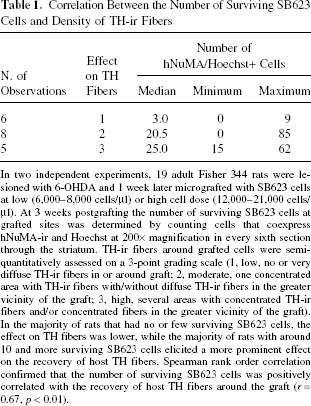
In two independent experiments, 19 adult Fisher 344 rats were lesioned with 6-OHDA and 1 week later micrografted with SB623 cells at low (6,000–8,000 cells/μl) or high cell dose (12,000–21,000 cells/μl). At 3 weeks postgrafting the number of surviving SB623 cells at grafted sites was determined by counting cells that coexpress hNuMA-ir and Hoechst at 200× magnification in every sixth section through the striatum. TH-ir fibers around grafted cells were semiquantitatively assessed on a 3-point grading scale (1, low, no or very diffuse TH-ir fibers in or around graft; 2, moderate, one concentrated area with TH-ir fibers with/without diffuse TH-ir fibers in the greater vicinity of the graft; 3, high, several areas with concentrated TH-ir fibers and/or concentrated fibers in the greater vicinity of the graft). In the majority of rats that had no or few surviving SB623 cells, the effect on TH fibers was lower, while the majority of rats with around 10 and more surviving SB623 cells elicited a more prominent effect on the recovery of host TH fibers. Spearman rank order correlation confirmed that the number of surviving SB623 cells was positively correlated with the recovery of host TH fibers around the graft (r = 0.67, p < 0.01).
No TH-ir was observed in the soma of surviving grafted cells, implying that the TH-ir fibers observed around grafts were of host brain origin. To further explore the origin of rejuvenated DA fibers around the grafts, we performed double labeling with anti-TH and hNuMA antibodies. No colocalization of TH-ir with hNuMA-ir in grafted cells was observed, again suggesting that TH-ir fibers surrounding graft sites were of host origin and that SB623 cells did not differentiate into DA neurons (Fig. 1J–O). In addition, in sections costained for TH-ir and hNuMA, it was confirmed that there was a positive correlation in the number of surviving cells and the density of TH-ir fibers near the grafts (Fig. 1J–O), Table 1). Moreover, in addition to the effect on TH-ir fibers, SB623 cells also increased the density of 5-HT-ir fibers in striatum (Fig. 2A–C). In sections double labeled with anti-5-HT and hNuMA antibodies, no colocalization of 5-HT-ir with hNuMA-ir was observed (data not shown), implying that 5-HT-ir fibers surrounding graft sites were also of host origin.

Effect of SB623 cell grafts on recovery of 5-HT fibers in the 6-OHDA-lesioned Fisher 344 rats and amphetamine-induced nuclear translocation of c-Fos in striatal target neurons. SB623 cells were grafted 1 week after the lesion and rats euthanized at 3 weeks postgrafting. (A–C) Sections from rats grafted with SB623 cells (n = 4) and controls (n = 4) were stained for 5-HT-ir (green) and Hoechst nuclear staining (blue). Note dense 5-HT-ir fibers around SB623 micrografts at the high cell dose (12,000 cells/μl) in (A) and at the low cell dose (6,000 cells/μl) in (B), and less dense 5-HT-ir fibers around vehicle injection sites in a control rat in (C). (D) Counts of nuclear localized c-Fos in striatal neurons lateral to a graft in rats sacrificed 2 h after injection of amphetamine. Data are expressed as a fraction of counts of c-Fos nuclei in a comparable sampling area of the contralateral unlesioned striatum. Note the decrease in the number or c-Fos-positive nuclei in lesioned control brains to 49% of that on the unlesioned side, confirming the DA lesion. This was increased to 65% in striatum grafted with SB623 cells. Although this increase was not statistically significant at p ≤ 0.05, it suggests that increased TH-ir fibers near the cell grafts are accompanied by increased levels of available DA. (E) Low magnification image of the lesioned striatum showing a “hot spot” of positive c-Fos nuclei (arrow) near a graft site (asterisk). (F) Higher magnification of the “hot spot” of positive c-Fos nuclei (arrow) shown in (E). (G) Low magnification image of the nonlesion (intact) side of the same section shown in (E) and (F), showing that there are no “hot spots” of positive c-Fos nuclei as on the grafted side. (H) Same graft from the consecutive set of sections stained for TH-ir and c-Fos-ir. Note two hot spots of positive c-Fos nuclei (arrows) near the graft and rejuvenated TH-ir fibers (visualized by Nova red). (I, J) Higher magnification of c-Fos hot spots from (H), showing that c-Fos hot spots colocalize with dense TH-ir fibers around grafts. Scale bars: (A, B, C, I, J) 50 μm; (F) 100 μm; (E, G, H) 200 μm.
Sections from two rats from the second experiment with surviving SB623 cells at the graft site were costained for hNuMA and the astrocyte marker GFAP or neuron-specific class III β-tubulin. In surviving SB623 cells, there was no colocalization of hNuMA with GFAP or class III β-tubulin (data not shown), suggesting that at 3 weeks postgrafting the majority of surviving SB623 cells were still at a progenitor stage.
DA Function as Assessed by Amphetamine-Induced c-Fos Translocation to Nuclei of Striatal Target Neurons
In the second experiment, amphetamine-induced c-Fos-ir nuclei in the striatum were counted in sampling areas medial and lateral to the injection sites and in matched sampling areas in the contralateral striatum as a measure of the level of DA that was available for release from functional nigrostriatal fibers. The amphetamine induction was started 2 h before sacrificing the rats. As expected, in rats with a partial 6-OHDA lesion that were not injected with cells, the mean fraction of c-Fos-positive nuclei counted in sampling areas medial and lateral to the injection sites was 0.66 ± 0.05 of that in the contralateral intact striatum, thus confirming the 6-OHDA-induced loss of DA for postsynaptic signaling. In striatum of SB623 grafted rats, there was a small increase in the fraction of c-Fos-positive nuclei to 0.76 ± 0.13 of the contralateral side, but this was not statistically significant. Counts of c-Fos nuclei in sampling areas only lateral to the injection sites showed a greater tendency toward an increase in the fraction of c-Fos-positive nuclei in SB623 grafted rats compared to the control rats (SB623, 0.65 ± 0.12; Controls, 0.49 ± 0.08, p > 0.05) (Fig. 2D). Although there was no statistically significant difference between SB623 and control groups in the fraction of c-Fos-positive nuclei, there was also considerable variability among grafted rats. Two out of six rats displayed very high levels of c-Fos-positive nuclei around the graft sites. In those two rats, we also observed areas with dense c-Fos-positive nuclei, or hot spots of c-Fos-positive nuclei, around the grafted SB623 cells (Fig. 2E–G). Double labeling of consecutive sets of striatal sections with anti-TH and c-Fos antibodies showed that these c-Fos hot spots colocalized with the dense rejuvenated TH fibers around the SB623 cell grafts (Fig. 2H–J). This observation suggests that the increase in TH-ir fibers is correlated with an increase in amphetamine-releasable DA near the SB623 cell grafts in some rats, but not throughout the striatum and not in all grafts.
Effect of Grafted SB623 Cells on the Host Blood Vessels
The effect of grafted SB623 cells on the host blood vessels was examined using immunostaining against GLUT-1, a blood–brain barrier phenotypic marker (52). In rats that received both lower and higher concentrations of SB623 cells, GLUT-1-ir blood vessels were observed in proximity to surviving SB623 cells (data not shown). Although the surviving SB623 cells were surrounded with dense GLUT-1-ir blood vessels, the overall density of blood vessels around and inside the graft in rats that received SB623 cells was not significantly different from that in control rats.
Discussion
MSC are an interesting cell source for neurological cell therapies. Not only are the cells readily available and easy to prepare from human bone marrow, but they are also not subject to the ethical concerns presented by embryonic stem cells or by neuroprogenitors isolated from fetal or adult brain tissue. Moreover, several groups have demonstrated that MSC can be differentiated toward a neuronal fate by various growth conditions (3, 20, 27, 62). The work of Dezawa and colleagues has also shown that transduction of rodent and human MSC with a plasmid containing the NICD of Notch1, the genetic modification used to generate the SB623 cells used in our study, results in downregulation of MSC markers and increased expression of the neuroprogenitor and radial glia markers, glutamate transporter (GLAST), 3-phosphoglycerate dehydrogenase (3-PDGH), and nestin (26). After exposure to a cocktail of different growth factors [basic fibroblast growth factor (bFGF), ciliary neurotrophic factor (CNTF), and forskolin], these genetically modified MSC differentiate into electrically excitable cells that can exhibit action potentials in vitro. Additional treatment of these cells with glial cell line-derived neurotrophic factor (GDNF) induces markers of the DA phenotype (26). Transplantation of these cells into the fully lesioned 6-OHDA rat model of PD resulted in improved performance in DA-dependent motor behavior that was correlated with increasing stages of differentiation (26). Other studies have shown that MSC have trophic action in vitro or in brain following intravenous injection or transplantation (14, 17, 24, 45, 54, 67). No studies, however, have previously explored a possible trophic action of MSC-derived neuroprogenitor-like cells on host DA neurons in an experimental model of PD.
We report for the first time that human MSC genetically modified with NICD and grafted into the rat striatum after partial depletion of its DA input leads to an increase in host TH-ir fibers. Stimulation of neuronal recovery of damaged DA neurons in the adult brain of mouse, rat, and nonhuman primate models of PD has previously been observed under many different experimental conditions (6), such as delivery of growth factor proteins or genes (8, 19, 23, 30, 40, 41, 43, 64), or grafting of primary fetal brain tissue (42, 47), amnion tissue (7), or adrenal medulla to the brain (11). Recently, it was reported that transplantation of human neuronal progenitor cells (hNPC) overexpressing GDNF spared or upregulated DA fibers in 6-OHDA partially lesioned rats, but this was not observed in rats receiving insulin-like growth factor 1 (IGF-1)-secreting hNPC, or in rats receiving live or dead (frozen/thawed) uninfected hNPC, suggesting that effect on TH fibers is not a nonspecific effect of cell grafting (9, 29). In addition, transplantation of human neural SC cloned by v-myc gene transfer (HB1.F3 cells) in 6-OHDA-lesioned rats exerted neuroprotective effects against DA depletion by trophic factor secretion and neuronal differentiation (73). The SB623 cells appeared to protect or stimulate regeneration in host DA neurons rather than providing stem cell-derived DA neurons because there was no evidence of TH-ir human cells in graft sites. Because this effect was observed even when cell survival was less than 1% at 3 weeks postgrafting, an early trophic action of the grafted cells is suggested. In addition, a trophic effect of SB623 on striatal 5-HT fibers was observed. It has been reported previously that 5-HT innervation is significantly decreased in 6-OHDA-lesioned striatum (28, 65) and that some rats with mesencephalic DA-rich grafts had increased levels of 5-HT (28, 36) and 5-HT innervation (66). The trophic effect of SB623 cells on 5-HT fibers observed in our study may be beneficial in PD because striatal levels of 5-HT fall in parallel with DA levels in PD and are thought to contribute to motor and affective symptoms (32, 60). Moreover, it has been reported that the indirect 5-HT agonist MDMA can transiently decrease motor symptoms in MPTP-treated monkeys and decrease dyskinesias when administrated together with L-dopa (35).
To determine if the increase in TH-ir fibers was accompanied by an increase in DA tone, we studied amphetamine-induced nuclear localization of c-Fos in striatal target neurons. Previous studies in this model have shown that rejuvenation of DA fibers by GDNF gene delivery is accompanied by an increase in amphetamine-induced c-Fos expression in striatal target neurons (23). Although this effect was variable, obvious hot spots of c-Fos induction were observed that correlated with areas of dense DA fibers around the SB623 cell grafts. This observation suggests that the effect of SB623 cells to increase TH-ir fibers around the graft was accompanied by the ability of these fibers to release DA in response to amphetamine. Further studies will be necessary to improve survival of the grafted SB623 cells in order to achieve a more global effect on rejuvenating DA fibers in the striatum and improve DA-dependent motor behavior, which was not studied here.
The mechanisms responsible for the rejuvenating effects of SB623 cells on DA neurons in the host brain are unknown. The SB623 cells may have upregulated TH expression in existing fibers or stimulated de novo fiber growth from host DA neurons. Either effect could be mediated by the secretion of neurotrophic factors from SB623 cells. There are a number of DA trophic factors such as GDNF (8, 19), neurturin (NTN) (30), persephin (PSP) (1), brain-derived neurotrophic factor (BDNF) (64), fibroblast growth factor (FGF) (69), and others. Human MSCs express neurotrophin low-affinity receptors (NGFR) and high-affinity trk receptors and they secrete various growth factors, such as GDNF, BDNF, bFGF, nerve growth factor (NGF), hepatocyte growth factor, vascular endothelial growth factor (VEGF), neurotrophin-3 and 4 (NT-3, NT-4) [(18, 24, 26, 34, 54, 63), and unpublished data]. Moreover, it has been reported that human MSC can respond to a neuronal tissue environment with both neurotrophin protein release and neurotrophin receptor expression (54).
Recently it was shown that treatment with MSC derived conditioned medium (MSC-CM) prevents the death of DA neurons in vitro after serum deprivation and exposure to the neurotoxin 6-OHDA (63). In addition, survival of embryonic mesencephalic DA neurons in in vitro cell injury models and after grafting into the striatum of a rat model of PD was significantly enhanced by treating donor cells with MSC-CM, also suggesting that MSC may synthesize and secrete diffusible factors capable of protecting DA neurons against neuronal injury (63). Human bone marrow-derived SB623 cells have also been shown to secrete VEGF in vitro (unpublished data). In our study we observed dense GLUT-1-ir blood vessels in the vicinity of the grafted cells, implying that SB623 cell can stimulate blood vessel growth, which could be mediated in part through VEGF and its receptor VEGFR2 (5, 17). Although the surviving SB623 cells were surrounded with the dense GLUT-1-ir blood vessels, the overall blood vessel density around the graft sites was not significantly different from controls. A possible explanation is that the stimulatory effect of SB623 cells on the blood vessels was very localized. The effect of SB623 cells on blood vessels may be linked to their neuroprotective effect. Several studies suggest that an angiogenic microenvironment can stimulate adult neurogenesis and that angiogenesis and neurogenesis are coupled processes (51, 68). Furthermore, it has been reported that in addition to an effect on angiogenesis, transplanted MSC can stimulate endogenous stem cells to proliferate and participate in repair after ischemic (16, 45) and traumatic (48) brain injury. Neurogenesis was not directly studied here; however, there was no evidence of newly formed TH-ir DA neurons in grafted striata. Other in vivo experiments have shown that transplantation of MSC can induce therapeutic angiogenesis in a rat model of hind limb ischemia (4) and in a rat stroke model (12, 16, 17, 67). The effects of MSC may also have been indirectly mediated by other nonneuronal cells in the host brain, such as astrocytes, by stimulating their release of BDNF, NGF, or VEGF (17, 45, 49), or secretion of an extracellular matrix (ECM) molecule that enhances DA neurite growth or function. Many studies have shown that cell–ECM interactions are crucial for nerve fiber growth and regeneration (15, 44, 74). In this regard, it has been shown that human MSC continue to express collagen type I and fibronectin 6 weeks after grafting into the ischemic rat brain (75). Similarly, in our study ECM expressed by SB623 cells might be involved in rejuvenation of both host DA fibers and blood vessels.
In summary, our observations show that microtransplants of SB623 cells distributed through the striatum in close proximity to degenerating DA axons have the capacity to induce rejuvenation and recovery of function of these axons, suggesting that this readily available source of stem cells might be developed as an autologous or allogenic stem cell therapy for PD.
Note Added in Revision
Two publications supporting our observations appeared after submission of this manuscript (13, 53).
Footnotes
Acknowledgments
The authors acknowledge Ms. Jianping Xie for her technical assistance and SanBio Inc. for providing SB623 cells. We also thank Casey Case, Ph.D., and Mari Dezawa, Ph.D., for their comments on the manuscript. This work was supported by the State of Illinois Regenerative Medicine Institute, and Harry F. Elaine M. Chaddick Foundation.